
Navigating a child support case in North Carolina can be overwhelming, especially when faced with unfamiliar legal forms. One of the most critical documents you'll encounter is the child support worksheet. For families where one parent has primary physical custody of the children, North Carolina Child Support Worksheet A is the required form.
Understanding who uses Worksheet A and why is the first step toward a fair and accurate child support calculation. This guide will break down the rules, explain the process in plain English, and address common concerns for North Carolina parents.
Who Uses NC Child Support Worksheet A?
In North Carolina, the type of child support worksheet you use is determined by your custody schedule—specifically, the number of nights the children spend with each parent per year.
Worksheet A is used for "primary custody" arrangements. But what does that mean under North Carolina law? It’s not about who makes decisions for the child; it’s a simple math problem.
According to the North Carolina Child Support Guidelines, you must use Worksheet A if:
- The children live with one parent (the custodial parent) for at least 243 nights per year.
- Consequently, the other parent (the non-custodial parent) has the children for fewer than 123 nights per year.
This overnight count is the sole factor the court uses to decide if Worksheet A is the correct form for your family.

A Real-World Example: The "Every Other Weekend" Schedule
Let's look at a common scenario to see how this works.
- Parent A is the primary custodial parent.
- Parent B has the children every other weekend (Friday and Saturday night), which equals 52 nights per year (2 nights x 26 weekends).
- Parent B also has the children for two weeks during summer vacation (14 nights).
In this case, Parent B has the children for a total of 66 nights (52 + 14). Because 66 is less than 123, this family must use Worksheet A to calculate child support. Parent A, who has the children for the remaining 299 nights, is the custodial parent for support purposes.
Which NC Child Support Worksheet Should I Use?
Choosing the right form is essential. This table provides a quick reference to see if Worksheet A fits your situation.
| Custody Situation | Use Worksheet A | Use Another Worksheet (B or C) |
|---|---|---|
| One parent has the child for 243+ nights per year | ✓ | |
| The non-custodial parent has the child for fewer than 123 nights | ✓ | |
| Parents share custody, with each having at least 123 nights | ✓ | |
| Custody is split, with each parent having primary of one child | ✓ |
If your parenting schedule fits a primary custody model, Worksheet A is the only form to use. For shared or split custody arrangements, you will use Worksheet B or C, respectively. Getting this right is the first step toward a fair and accurate child support calculation under North Carolina's "income shares" model.
The 243-Night Rule: The Key to Using Worksheet A
When it comes to North Carolina child support, one number often dictates which form you'll use: 243. This isn't about who makes the big decisions for your child; it's a simple, clear-cut threshold based on the parenting schedule.
The child support guidelines, established under N.C. Gen. Stat. § 50-13.4, draw a firm line. If your child lives with one parent for 243 nights or more out of the year, that parent has primary physical custody for support calculation purposes. This means you must use Worksheet A.
How Do We Count the Nights?
Figuring out the number of overnights might seem complicated, but it’s really just a matter of looking at your calendar for the year. An "overnight" is exactly what it sounds like: any night the child sleeps at a parent’s home.
Let's walk through a common schedule to see how this plays out in the real world.
Example Parenting Schedule:
- Alternating Weekends: The non-primary parent has the child from Friday evening to Sunday evening, every other week. That adds up to 52 nights over a year (2 nights x 26 weekends).
- Summer Vacation: That same parent gets two uninterrupted weeks during the summer, adding another 14 nights.
- Holidays: They split major holidays, with this parent taking Thanksgiving in even years and a week at Christmas in odd years. This averages out to about 4 nights per year.
Adding it all up, the non-primary parent has the child for a total of 70 nights (52 + 14 + 4). Since 70 is well below the 123-night minimum for shared custody, the primary parent has the child for the remaining 295 nights. In this situation, the family must use Worksheet A to calculate support.
Worksheet A in North Carolina child support calculations represents the most straightforward custody arrangement and is utilized when one parent maintains primary physical custody of all children for whom support is being determined. Specifically, Worksheet A applies when a child lives with one parent for at least 243 nights per year, which translates to approximately two-thirds of the year or roughly 67% of custodial time. You can discover more insights about North Carolina's child support basics on smithdebnamlaw.com.
Getting this count right is the critical first step. A mistake here could mean using the wrong worksheet, leading to an incorrect child support order from the court. You can learn more about how this impacts primary physical custody in our detailed guide.
Calculating Your Income for the Worksheet
At the heart of Worksheet A is North Carolina's "income shares" model. Think of it as a commitment to ensuring a child receives the same level of financial support they would have if their parents lived together. The court combines both parents' incomes to figure out a basic support obligation, and getting your income right is the most critical step.
Understanding Monthly Adjusted Gross Income
The key number on the worksheet is your monthly adjusted gross income. This isn't just your paycheck; it's your gross earnings from nearly every source before most taxes and deductions.
What counts as income?
- Wages and Salary: Your regular pay from your job.
- Bonuses, Commissions, and Overtime: Since this income can fluctuate, courts usually average it over a reasonable time, like the past 12 months, to find a monthly figure.
- Self-Employment Income: This is calculated by taking your gross receipts and subtracting ordinary and necessary business expenses. Navigating this can be tricky, and you can learn more in our guide to child support for self-employed parents in North Carolina.
North Carolina law demands complete financial transparency from both parents. The goal is to reflect your combined earning capacities to fairly support your child.
Allowed Deductions from Gross Income
While you can't deduct your taxes or most other expenses, the law does allow a few specific adjustments to your gross income.
The most common deduction is for responsibility for other children. If you are legally responsible for and currently supporting other biological or adopted children who live with you (and are not part of this specific support case), you can receive a credit for that obligation.
This infographic helps explain the 243-night rule, which is the first step in confirming whether Worksheet A is the right form for your custody arrangement.
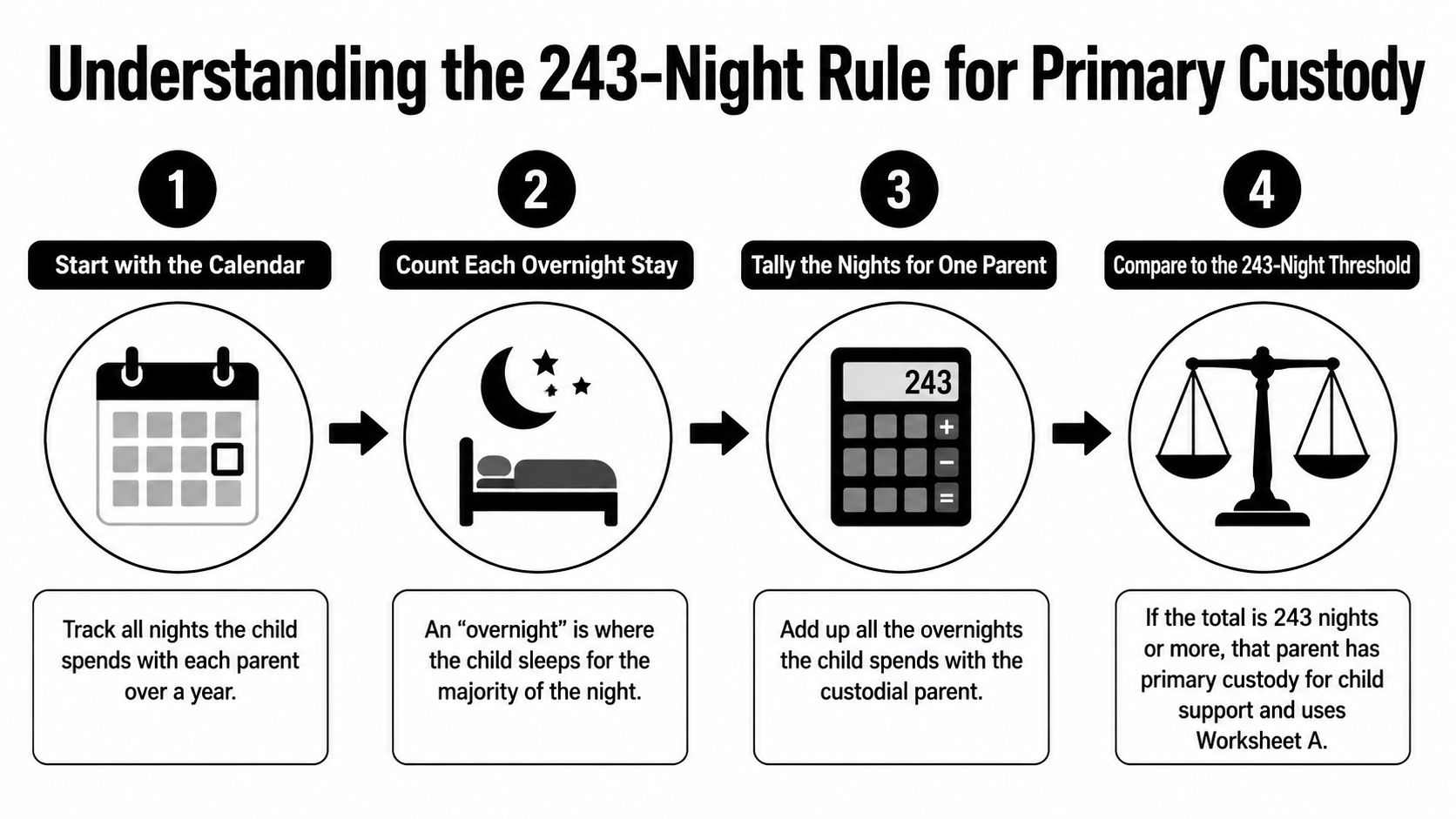
If one parent has the child for 243 nights or more, your situation fits the primary custody guidelines, and Worksheet A is the required form.
Ethical Note: Honesty in Financial Disclosure is Legally Required. You are legally required to provide complete and accurate financial information. Attempting to hide income or inflate deductions can lead to severe legal consequences, including being held in contempt of court. In family law, honesty isn't just the best policy—it's the law.
Because your income is the cornerstone of the entire child support calculation, any mistake can lead to an incorrect support order that is difficult and costly to change down the road. An experienced attorney can help you gather the right documentation and ensure your income is calculated correctly under North Carolina's specific rules, protecting you from future problems.
Adding Health Insurance and Childcare Expenses
When calculating child support in North Carolina, the basic obligation covers a child's fundamental needs. However, the guidelines also account for major, recurring costs that can significantly affect a parent's budget: health insurance and work-related childcare.
Worksheet A provides specific lines to factor in these expenses. Think of them as "add-ons" to the base support amount. The court first determines the basic obligation based on both parents' incomes, then adjusts that figure to give credit to the parent who pays for these necessary costs.
Factoring in Health Insurance Premiums
If you are the parent providing health, dental, or vision insurance for your child, you get a credit for that expense on the worksheet. The key is that this credit only applies to the portion of the premium paid specifically for the child, not the cost of an entire family plan.
Here’s a practical example: say your "employee only" health coverage costs $100 a month. To add your child, you upgrade to a "family plan" that costs $350 a month. The amount you can claim as a credit is the difference—$250 per month. That $250 is entered on Worksheet A, and it directly reduces your share of the total support obligation. You can explore more about how such costs fit into the broader framework by reviewing the official North Carolina child support guidelines.

Including Work-Related Childcare Costs
Childcare costs are handled in much the same way. If you pay for childcare so you can work or go to school to improve your earning potential, those expenses are added to the calculation. Of course, the costs must be reasonable and directly connected to your employment or education.
The total amount for both childcare and the child's health insurance premium is added to the basic support obligation. This new, larger total is then split between the parents according to their percentage of the combined income.
The parent who actually pays for these expenses out-of-pocket then gets a credit for their payments, which is subtracted from what they owe. This ensures these essential costs are shared proportionally. For instance, if you pay $300 a month for after-school care, that amount is factored into the total support need, and you receive a direct credit for what you've already spent. Getting these numbers right is a critical part of making sure Worksheet A is accurate.
Common Mistakes to Avoid on Worksheet A
Filling out legal forms like North Carolina's Child Support Worksheet A can be deceptively simple. The boxes seem straightforward, but one small error can lead to a miscalculated support amount that impacts your family for years. From our experience, knowing the common pitfalls is the best way to ensure the final calculation is fair and accurate from the very start.
One of the most frequent and costly mistakes is the confusion between gross income and net income. Worksheet A is built on your gross monthly income—that’s everything you earn before taxes, health insurance premiums, or any other deductions are taken out. Using your take-home pay (net income) will create a support figure that is artificially low and is an error a judge will immediately correct.
Miscalculating Income and Credits
A parent's income is rarely just a simple salary. Many people make honest mistakes with variable pay or improperly claim credits, leading to numbers that don't hold up in court.
- Forgetting Bonus or Commission Pay: If you receive irregular income from bonuses, commissions, or overtime, it must be included. A court will typically average this income over the past 12 to 24 months to find a consistent monthly figure to add to your gross income.
- Miscalculating the Health Insurance Credit: This is a big one. You can only claim the cost to add the child to your plan, not the entire premium. For example, if your "employee only" coverage is $100 a month and the "employee + child" plan is $300, the credit you can claim on the worksheet is $200—the difference—not the full $300.
- Incorrectly Listing Childcare Costs: The guidelines are clear: only work-related childcare expenses count. This means you can include the cost of daycare or after-school care that allows you to maintain your job. You cannot include costs for a weekend babysitter for a night out.
A Note on Documentation: A critical misstep is failing to properly document these expenses. It's not enough to just write down a number. You must be ready to provide proof, like insurance statements showing the premium breakdown or invoices from your childcare provider. Without it, your claim will likely be denied by the court.
The Danger of Incomplete Disclosure
Perhaps the most damaging mistake of all is failing to disclose all income sources, whether by accident or on purpose. Hiding assets or failing to report a side gig can lead to serious legal consequences, including being found in contempt of court, paying the other party's attorney's fees, and losing credibility with the judge.
Under North Carolina law, both parents have a duty to provide complete and honest financial information. Any attempt to hide the ball not only undermines the process but can result in a judge making unfavorable assumptions about your finances. When it comes to these worksheets, accuracy isn't just recommended—it's required.
Why an Attorney Is Essential for Worksheet A
Even though Worksheet A is often called the "simple" form, its appearance is deceiving. Many parents think they can handle this worksheet on their own, only to discover later that small mistakes have led to significant financial consequences that are difficult and expensive to correct. An incorrect order can affect your family for years to come.
The final child support number is only as fair and accurate as the information put into it. Hiring an experienced family law attorney is a critical investment in your child's financial stability and the protection of your own financial future.
Protecting Your Interests with a North Carolina Lawyer
An attorney’s role goes far beyond just plugging numbers into a form. They provide crucial support in several key areas where self-represented parents often struggle, ensuring the process is handled correctly from the start.
A knowledgeable attorney provides several key advantages:
- Verifying All Income: They work to ensure the other parent fully discloses all sources of income, including bonuses, commissions, side jobs, and self-employment earnings, which are frequently misreported.
- Uncovering Hidden Assets: Attorneys have legal tools, like formal discovery, to uncover income a parent might be trying to hide. This ensures the calculation is based on their true earning capacity, not just what they choose to show.
- Arguing for Deviations: If your family has unique circumstances—like a child with special needs requiring expensive care—an attorney can build a case and argue for a deviation from the standard guidelines to ensure your child’s specific needs are met.
- Handling Complex Scenarios: They correctly calculate credits for health insurance, navigate income from complex sources, and ensure every detail complies with North Carolina law.
A common misconception is that you only need legal help for a high-conflict custody battle. In reality, an attorney's guidance on Worksheet A is what prevents small errors from snowballing into long-term financial problems. Please note that legal representation does not guarantee a specific outcome, but it ensures your rights are protected throughout the process.
Frequently Asked Questions About Worksheet A in NC
1. Can we agree on a different child support amount than the worksheet calculates?
Yes, parents in North Carolina can agree on a child support amount that differs from the worksheet calculation. However, for this agreement to be legally binding, it must be formalized in a consent order and signed by a judge. A judge will review the agreement to ensure it is reasonable and serves the child's best interests before approving it.
2. What happens if the other parent is hiding income?
If you suspect the other parent is voluntarily unemployed, underemployed, or not disclosing all their income, an attorney can initiate the formal "discovery" process. This legal tool allows us to demand financial documents like tax returns, bank statements, and business records. If a judge finds a parent is deliberately suppressing their income, the court has the authority to impute income—calculating support based on what that parent should be earning.
3. What if my child's needs are more expensive than the basic amount?
The NC Child Support Guidelines cover a child's "reasonable needs," but courts can deviate from the guideline amount in special circumstances. If your child has extraordinary needs—such as significant medical expenses for a special needs child, private school tuition, or substantial travel costs for visitation—you can file a motion to deviate. You will need to provide strong evidence and detailed financial proof to justify why a higher amount is necessary.
4. How do I change the child support amount if my income changes?
A child support order does not change automatically. If you or the other parent experiences a "substantial change in circumstances" (e.g., a major job loss or promotion), you must file a Motion to Modify with the court. Under N.C. Gen. Stat. § 50-13.7, a modification may be warranted. Additionally, if it has been three years since the order was entered, a 15% or greater difference between the current order and a new calculation is presumed to be a substantial change, justifying a review.
Get Trusted Legal Guidance for Your North Carolina Child Support Case
The nuances of child support calculations are complex, and getting it right from the start is critical for your family's financial stability. At the Law Office of Bryan Fagan, our experienced North Carolina attorneys are here to ensure your Worksheet A is completed accurately and fairly, protecting both your rights and your child's best interests. We understand the stress you are under and are committed to providing clear, empathetic, and knowledgeable guidance. Don't leave your financial future to chance.
Schedule a consultation with our dedicated North Carolina legal team today. Visit us at https://bryanfaganlaw-nc.com to discuss your case and learn how we can help.