The call doesn't come. The exchange time passes. Your child is waiting, you're checking your phone, and the other parent has decided the court order doesn't matter today.
That puts you in a hard position. You may be angry, worried, and tempted to fix the problem yourself. Most parents I talk to are less focused on “winning” than on restoring something basic: predictability for their child.
If you're searching for what to do if other parent violates custody order in NC, the short answer is this. Stay calm, document the violation, avoid retaliation, and use the enforcement tools North Carolina courts recognize. A custody order is not a suggestion. If one parent keeps ignoring it, the court can respond.
Your North Carolina Custody Order Was Violated What Now
A common example looks like this. The order says pickup is at 6:00 p.m. Friday. You arrive on time. You send a text saying you're there. Nobody answers the door. Then you get a message later saying the child “didn't want to go,” or that the other parent “made different plans.”
Another version is less visible but just as damaging. The order allows scheduled phone or video contact, but the calls keep getting blocked, ignored, or cut short. Over time, that chips away at your relationship with your child and creates tension that the child feels.
North Carolina law gives you a path forward. The issue is usually handled in the existing custody case, not by starting from scratch. The practical first move is to create a clean record of each denied visit, missed exchange, or blocked call. From there, the court can be asked to enforce the order through contempt or another motion in the cause.
A judge can work with facts. Anger alone won't carry a custody enforcement case.
The biggest mistake at this stage is turning a legal problem into a co-parenting battle. Long arguments, threats, and self-help almost always make the case harder. The stronger approach is controlled, organized, and focused on the order itself.
When a parent treats a custody order as optional, North Carolina courts can treat that as serious misconduct. The question is not whether you're frustrated. The question is what record you're building today for the hearing that may come next.
Your First Steps After a Custody Violation
The first day matters. So does the second. What you do in those first hours can either strengthen your position or give the other side material to use against you.
Start with the order itself. Read the exact language before you do anything else. Many disputes get worse because one parent acts on memory instead of the written terms.
Here is the basic checklist I want parents to follow.
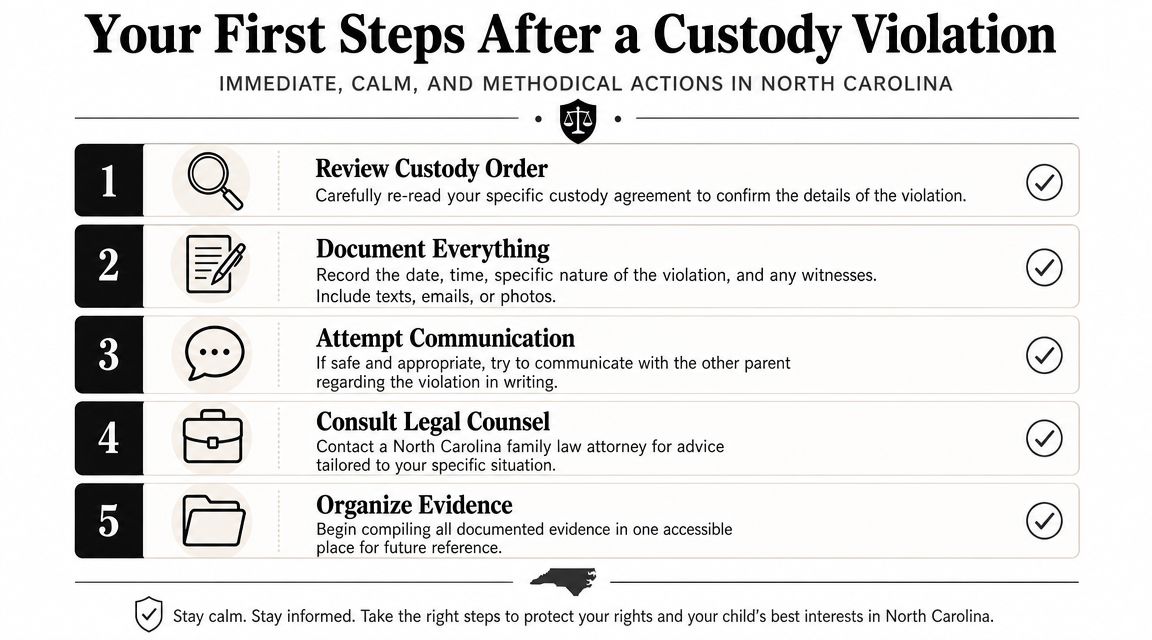
Confirm what the order actually requires
Look for the details that matter in enforcement:
- Exchange terms: Exact time, place, and who handles transportation.
- Communication terms: Whether the order sets specific phone or video call times.
- Holiday language: Whether a special holiday schedule overrides the normal one.
- Notice provisions: Whether the order requires advance notice for schedule changes.
A parent sometimes says there was a “misunderstanding.” That argument is much weaker when the order is specific and you were following it.
If your current situation involves a short-term crisis and you think the schedule itself needs immediate court attention, review this discussion of temporary custody in North Carolina. Temporary relief and enforcement are different tools, and choosing the right one matters.
Create a record while the facts are fresh
Write down what happened the same day. Don't wait until the weekend is over and don't trust yourself to reconstruct details later.
Include facts like these:
- Date and time: When the exchange or call was supposed to happen.
- Your actions: When you arrived, called, texted, or waited.
- What occurred: No-show, refusal, blocked call, late return, or denial at the door.
- Who saw it: Family member, friend, neighbor, or anyone else present.
- Supporting material: Screenshots, call logs, voicemails, photos of the exchange location if relevant.
Keep your language neutral. “Arrived at 5:55 p.m. for 6:00 p.m. pickup. Sent text at 6:01 p.m. stating I was outside. No response. Left at 6:30 p.m.” is useful. “She is always manipulative and trying to ruin everything” is not.
Communicate once, clearly, and in writing
A short written message can help you later. A long emotional argument usually won't.
Good examples include:
- Simple confirmation: “I'm here for pickup under the order.”
- Request for compliance: “Please let me know when the child will be available.”
- Follow-up record: “The scheduled call at 7:00 p.m. did not occur. I was available.”
What doesn't help is a chain of angry texts, threats to “get you back,” or comments the judge could read as harassment. If the other parent is baiting you, stop responding after you've made a reasonable written attempt.
Practical rule: Write every message as if a district court judge may read it later.
Know when calling law enforcement makes sense
Police generally do not rewrite custody arrangements at the curb. They also usually won't force a handoff just because you have a custody order. But there are times when a call is appropriate.
A call may make sense when:
- You need a welfare check: You have a genuine concern about the child's immediate safety.
- You need a report: You want neutral documentation that you were present and the exchange failed.
- There is escalating conflict: The situation at the exchange site feels unsafe.
A call usually does not help when the issue is that the other parent is being difficult and there is no immediate safety concern. In those cases, the better long-term move is often documentation followed by a court filing.
This video gives a general overview of steps parents often consider after a violation:
Avoid the mistakes that damage your case
Parents under stress often do things that feel justified in the moment but hurt them later.
Here are the big ones:
- Don't keep the child next time “to even it out.” That creates a second violation.
- Don't withhold updates out of frustration. It makes you look noncooperative.
- Don't involve the child in the dispute. Judges notice when a child is put in the middle.
- Don't wait too long. The longer you sit on repeated violations, the easier it is for the other side to call them isolated events.
What works is a calm sequence. Follow the order. Make one reasonable written effort. Preserve the evidence. Then talk with counsel about whether this is a contempt issue, a modification issue, or something more urgent.
Understanding Your Legal Options in North Carolina
A custody violation puts you at a fork in the road. One path is enforcement. Another is a request to change the order. A smaller group of cases calls for emergency action because the child may be in danger. Choosing the wrong path can cost time, money, and credibility with the judge.
In North Carolina, the right response depends on the kind of violation, how clear the order is, whether the conduct was willful, and whether the problem is isolated or becoming a pattern. That is the strategic question. Clients often come in asking, “Can I file contempt?” The better question is, “What result do I need from the court, and which motion gives me the best chance of getting it?”
North Carolina courts usually handle enforcement inside the existing custody case, not through a separate lawsuit. Contempt is often the tool when a parent knew what the order required and chose not to follow it. A North Carolina custody enforcement discussion from Pierce Law Group explains that courts may use contempt in that setting and that enforcement is typically pursued in district court within the same case file rather than by opening a new custody action.
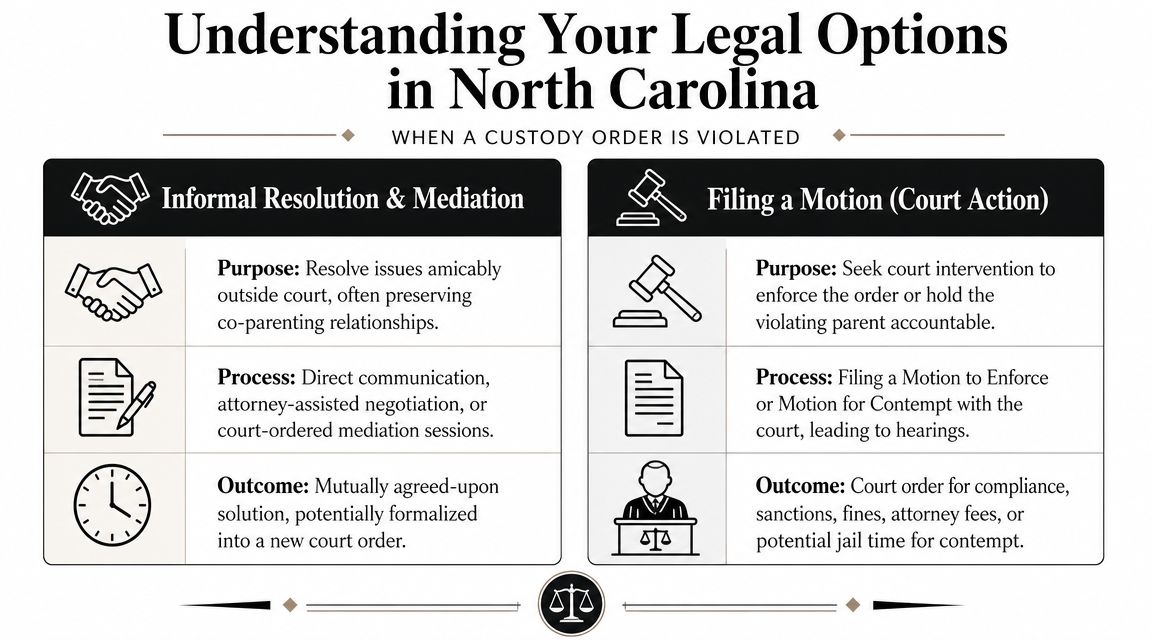
Option one is contempt and enforcement
Contempt is usually the strongest fit when the order is clear and the other parent is not complying.
The court is not deciding whether the behavior was rude or unfair. The court is deciding whether there was a valid order, whether the parent had the ability to comply, and whether the violation was willful. That distinction matters. A true emergency, a hospitalization, or some other legitimate inability to comply is different from a parent who decides the schedule no longer applies.
Contempt often comes up in cases involving:
- Denied exchanges: You show up at the correct time and place, and the child is not brought out.
- Blocked communication: The order requires calls or electronic contact, and those communications are repeatedly prevented.
- Late returns or nonreturns: The child is not returned as ordered.
- Repeated interference: The other parent keeps changing the schedule unilaterally, creating excuses, or making compliance impossible.
If a judge finds contempt, the remedies can be practical and serious. The court may order make-up parenting time, attorney's fees, or other measures aimed at forcing compliance. In more serious cases, sanctions can increase. The point is to enforce the order and stop the misconduct.
Option two is custody modification
Sometimes contempt is only part of the answer. If the violations keep happening, the bigger issue may be that the current order no longer works.
North Carolina courts do not usually change custody because of one bad exchange or one missed weekend. The court generally looks for a substantial change in circumstances affecting the child. Repeated denial of visitation, chronic interference with communication, or a consistent refusal to follow the order can become part of that showing because those facts go directly to the child's stability and the parents' ability to carry out the existing arrangement.
That is where strategy matters. If your goal is to get last weekend made up, contempt may be enough. If your goal is to stop a months-long pattern that is harming the child and making the order unworkable, modification may be the stronger long-term move. For a closer look at that standard, review this explanation of custody modification in North Carolina.
Option three is emergency custody in the right case
Emergency custody is reserved for cases involving immediate risk to the child. Courts treat these requests seriously, and they expect the facts to justify the urgency.
Abuse allegations, serious neglect, dangerous substance use, threats of abduction, or conditions that put the child at immediate risk may support emergency relief. A routine schedule dispute usually will not. Filing for emergency custody because the other parent was late, difficult, or uncooperative can damage your position if the facts do not match the filing.
The filing has to fit the facts. That is as much a credibility issue as a legal one.
Informal resolution can still be useful
Some violations are better handled first with a focused written response. If the order is vague, the problem appears to come from misunderstanding, or the violation is an isolated incident, a short lawyer letter or a direct written clarification may solve it without a hearing.
That approach has limits. Chronic violators often treat informal communication as background noise. On the other hand, filing every disagreement in court can make you look reactive and can drain resources that would be better saved for a stronger motion.
| Situation | Usually stronger first move |
|---|---|
| Single dispute with unclear order language | Clarify terms in writing |
| Missed exchange with clear order language | Document and consider contempt |
| Ongoing blocked calls or denied visits | Build the record and evaluate enforcement or modification |
| Immediate safety concern | Get emergency legal advice right away |
What tends to help, and what tends to backfire
Judges usually respond best to parents who stay disciplined and focused on the order.
What helps:
- Precise records
- Clear written communication
- Filings tied to the problem
- A realistic request for relief
What hurts:
- Using the child as a bargaining chip in the dispute
- Violating your own part of the order
- Treating child support and visitation as if one cancels the other
- Asking for emergency relief when the facts do not support an emergency
One practical step is to have a North Carolina family law firm review the order, the violation history, and the relief you want before you file. The Law Office of Bryan Fagan handles enforcement and modification matters of this kind.
A strong custody case usually turns on procedure as much as frustration. The issue is not only whether the other parent broke the order. The issue is whether you ask the court for the right remedy at the right time.
Navigating the North Carolina Court Process
Once you decide to take action, the case becomes procedural. That's where many parents get tripped up. They know the order was violated, but they don't present it in a way the court can act on.
The usual path is filing in the same North Carolina case where the custody order already exists. In many situations, that means filing a motion in the county that issued the order. The clerk's office can tell you what local forms are used, but the form itself is only part of the job. The facts you attach and the way the other parent is served matter just as much.
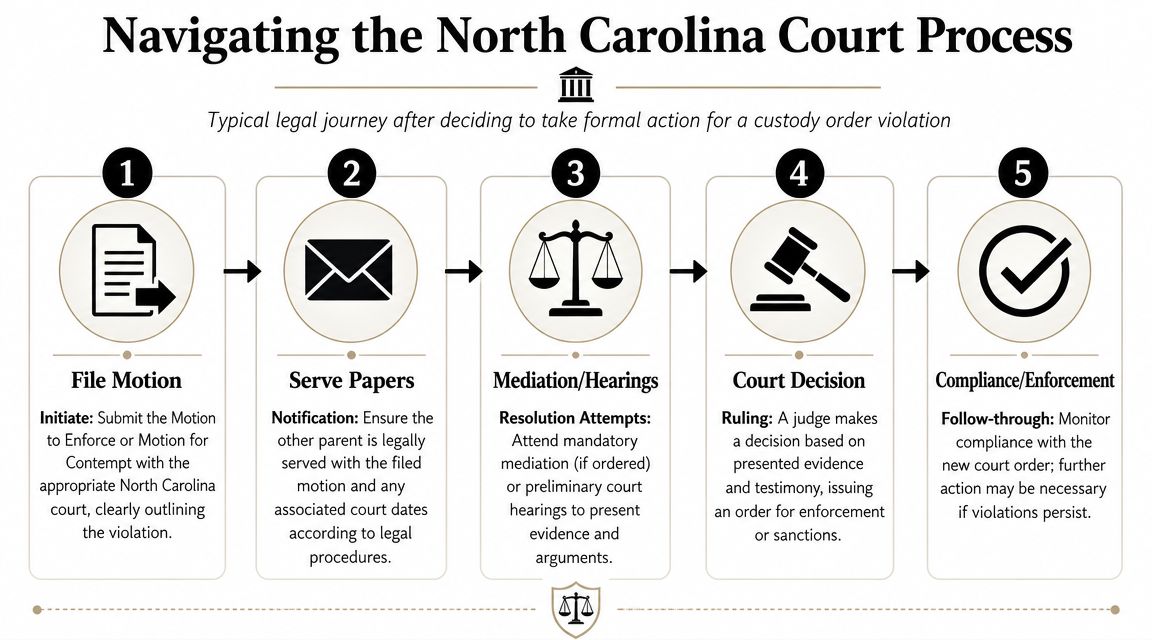
Filing the motion
The motion should identify the order, the specific provisions that were violated, and the dates and conduct at issue. General complaints are weak. Specific allegations are useful.
For example, “The defendant denied the scheduled exchange on these dates despite written notice that I was present for pickup” is much stronger than “The defendant constantly interferes.”
Many parents file either a motion for contempt, a motion to show cause, or another motion in the cause depending on local practice and the exact relief requested. The key is matching the motion to the problem.
Service is not optional
After filing, the other parent must be properly served. That is the legal notice that tells them what you filed and when they must appear.
If service is done incorrectly, your hearing can be delayed or derailed. Parents often underestimate this step because it feels administrative. It isn't. Proper service is part of due process, and judges take it seriously.
What the hearing is really about
A contempt hearing is not a free-form chance to explain every problem in the relationship. It is a focused proceeding.
The judge usually wants clear answers to questions like these:
- Was there a valid court order?
- Did the other parent know about it?
- Was the order clear enough to follow?
- Did the parent fail to comply?
- Was the failure willful?
That last point often decides the case. If the other parent claims confusion, illness, transportation failure, or some other excuse, the judge will measure that explanation against your evidence and the surrounding pattern.
Bring a clean copy of the order, your exhibits in date order, and a short timeline. Judges reward clarity.
What outcomes you may see
If the court finds a violation, the remedy depends on the seriousness of the conduct and what the judge believes will produce compliance.
Possible outcomes can include:
- Make-up parenting time
- Attorney's fees
- Fines
- Orders requiring future compliance
- More serious sanctions in severe cases
One numeric enforcement example often discussed in custody-violation proceedings is that a judge may order up to $100 per incident of denied parenting time in some jurisdictions, and may also require a bond, make-up parenting time, or a jail sentence if the violation is proven. That same guidance also notes that repeated interference with court-ordered visitation or communication can support later modification when there is a substantial change in circumstances affecting the child, as described by WomensLaw's discussion of parenting-time violations.
If you're wondering how judges evaluate parenting conduct more broadly, this overview of how North Carolina judges decide custody helps frame what the court tends to focus on.
Managing expectations about timing
Court timing varies by county and docket pressure. Some matters move quickly. Others do not. That delay is frustrating, especially when the violations are ongoing.
This is why immediate documentation matters so much. If your hearing is not tomorrow, your records become the bridge between what happened and what you can still prove later.
A practical hearing file often includes:
- The current custody order
- A violation log in date order
- Screenshots and messages
- Call logs or missed-call records
- Any police or incident documentation
- A short witness list if someone observed the failed exchange
Parents often think the hearing turns on dramatic testimony. More often, it turns on whether the judge can follow the timeline without effort.
Gathering Evidence That Strengthens Your Case
Good evidence wins custody enforcement hearings. Not louder evidence. Not more emotional evidence. Good evidence.
The strongest record usually looks boring on paper, and that is a compliment. It is organized, chronological, and focused on facts the judge can verify.
Build a custody journal the right way
Your journal should read like a business record, not a diary. That means dates, times, locations, messages sent, and what happened next.

Useful entries include:
- Exchange details: “Arrived at the school parking lot at 3:25 p.m. for 3:30 p.m. exchange.”
- Communication attempts: “Sent text at 3:31 p.m. and email at 3:40 p.m.”
- Outcome: “No appearance. Left at 4:00 p.m.”
- Child impact if directly observed: “Child later missed scheduled activity due to late return.”
Avoid guessing at motives. “He was trying to punish me” is speculation. “He texted that he was not bringing the child because he changed plans” is evidence.
Use complete conversations, not isolated screenshots
One angry screenshot rarely tells the whole story. A full text chain often does.
If you send calm, reasonable messages and the other parent responds with refusals, evasions, or shifting excuses, the conversation itself starts to show the pattern. Keep the thread intact where possible. Judges like context.
Here is the difference:
| Weak proof | Stronger proof |
|---|---|
| One screenshot with no date context | Full conversation showing your request and the refusal |
| A handwritten note with no backup | Journal entry plus text log plus call record |
| A vague claim that calls were blocked | Log of scheduled calls and whether each one occurred |
Third-party proof can matter
Neutral observations can help. If a grandparent, family friend, or exchange supervisor was present and saw what happened, that may strengthen the record.
Police reports or welfare-check documentation can also matter when properly used. They do not replace court action, but they can support your timeline with a neutral record of the event.
The court is looking for a pattern it can trust, not a story told from memory months later.
Repeated interference with custody can support a modification request, but the legal threshold is a material change in circumstances, not ordinary frustration. Courts respond better when a parent presents a chronological series of missed exchanges and attempted communications, and self-help withholding can weaken credibility, as discussed in this guidance on responding to custody-order violations.
Evidence mistakes parents make all the time
The most common evidence errors are preventable.
- Editing messages too aggressively: Don't crop out dates, names, or surrounding context.
- Relying on memory: If it isn't written down, it may be hard to prove later.
- Mixing facts with commentary: Keep your notes factual first.
- Retaliating instead of recording: Retaliation creates evidence against you.
If you want the judge to believe that the other parent is making the schedule unworkable, your proof should show exactly that. Dates. Missed exchanges. Blocked calls. Reasonable efforts on your side. That combination is far more persuasive than broad claims about bad character.
FAQ About North Carolina Custody Order Violations
Can I withhold visitation if the other parent isn't paying child support
No. That is one of the fastest ways to damage your own position.
Custody and child support are separate legal issues. If you deny court-ordered parenting time because support hasn't been paid, you may be the one violating the order. The proper response to unpaid support is to use the child support enforcement process, not to block visitation.
What if my child refuses to go with the other parent
This is one of the hardest situations parents face. A child's resistance may be temporary, may reflect stress, or may point to a bigger issue.
Your job is usually to make reasonable efforts to comply with the order unless there is a genuine safety issue. That means encouraging the exchange, staying calm, and documenting what happened. If refusal becomes a pattern, the case may need closer legal review because the problem may be deeper than a single difficult handoff.
Should I call the police every time the other parent violates the order
Usually no.
Police can be useful for a welfare check, for keeping a tense exchange from escalating, or for creating a neutral report. They usually are not the long-term enforcement mechanism for repeated custody violations. If the problem keeps happening, the court is where you typically need to be.
Can one missed visit change custody in North Carolina
Usually not by itself.
A single violation may support enforcement, especially if the order was clear and the conduct was willful. A custody change is a different question. Courts generally look for a more significant and continuing problem affecting the child, not one bad incident standing alone.
What if the other parent lives in another state
Interstate enforcement is more complicated, but it can still be done. The court that issued the original custody order often remains central to enforcement and modification questions.
These cases can become procedural quickly. If another state is involved, get legal advice early. Filing in the wrong place or asking for the wrong relief can waste time you may not have.
Take Control Schedule a Consultation to Protect Your Rights
It is 7:30 p.m. Exchange time has passed. Your calls are going unanswered, your child is not where the court order says they should be, and you are trying to decide whether to wait, call law enforcement, or get papers filed first.
That decision matters.
A custody violation in North Carolina is not one problem with one solution. Some cases are best handled with careful documentation and a contempt motion. Some justify a motion to modify custody because the violations show the current arrangement is no longer workable. A smaller group involve enough risk that immediate action is necessary. Good legal advice helps you choose the right response before a bad situation gets worse.
I have seen parents hurt their own case by reacting on instinct. They send angry messages, deny the next visit to "make it even," or show up at the other parent's home and create a new conflict. Judges pay attention to conduct on both sides. If you want the court to enforce the order, you need to look steady, prepared, and focused on the child.
Procedure matters as much as outrage. A parent may be completely justified and still lose ground by filing the wrong motion, asking for relief the facts do not support, failing to serve the other side properly, or walking into court without organized exhibits and a clear timeline.
If the other parent has started denying visits, blocking calls, returning the child late, refusing exchanges, or creating a repeated pattern of noncompliance, do not let the problem drift. Early action often gives you more options and a cleaner record.
If you need help with a North Carolina custody enforcement or modification issue, schedule a consultation with the Law Office of Bryan Fagan. A lawyer can review the order you have, identify whether the facts support contempt, modification, or emergency relief, and help you build the record you may need in court.