When your relationship is breaking down, custody questions usually become the loudest part of the problem. You may be lying awake wondering where your child will sleep on school nights, who will make medical decisions, whether the other parent's behavior will matter, and what a judge in North Carolina will consider when it's time to decide.
Most parents start with the same question. “What are my chances?” That's understandable, but it's not the first legal question the court asks. In a North Carolina custody case, the court's focus is your child, not either parent's sense of fairness.
That's why best interest of the child factors nc explained matters so much. If you understand how the court thinks, you can stop guessing and start preparing. Good custody cases aren't built on outrage, labels, or broad accusations. They're built on facts that show what arrangement best serves the child's welfare.
Facing a Custody Battle in North Carolina
A common situation looks like this. One parent has handled most school drop-offs, doctor visits, homework, and bedtime for years. The other parent insists that none of that matters because they “have equal rights.” Then the arguments start. One side says the other is unstable. The other says they're being shut out. Meanwhile, the child still has to get to school, sleep, eat, and feel safe.
That gap between what parents argue about and what the court cares about is where many custody cases go sideways.
North Carolina judges are not deciding who was the better spouse or who tells the more emotional story. They're deciding what custody arrangement will protect and support the child going forward. If you're searching for a North Carolina child custody attorney, you probably need more than reassurance. You need a clear view of how these cases are evaluated.
What parents usually worry about first
Individuals often come into a custody dispute focused on one or two issues:
- Time with the child: They're afraid of losing daily contact and routine.
- Safety concerns: They believe the other parent's substance use, anger, instability, or new relationship puts the child at risk.
- False assumptions: They've heard that mothers always win, fathers always lose, or a child can pick a parent at a certain age.
- Control over decisions: They want to know who will decide school, healthcare, counseling, and activities.
Those concerns are real. But the court won't decide them based on rumor or family pressure.
Custody cases feel personal because they are personal. The legal standard is still broader than either parent's frustration.
North Carolina custody law centers on one governing idea. The court must decide what arrangement serves the best interest of the child. Once you understand that standard, the rest of the case starts to make more sense. The judge isn't looking for a perfect parent. The judge is looking for the arrangement that best promotes the child's welfare in the everyday world.
What the Best Interest of the Child Standard Really Means
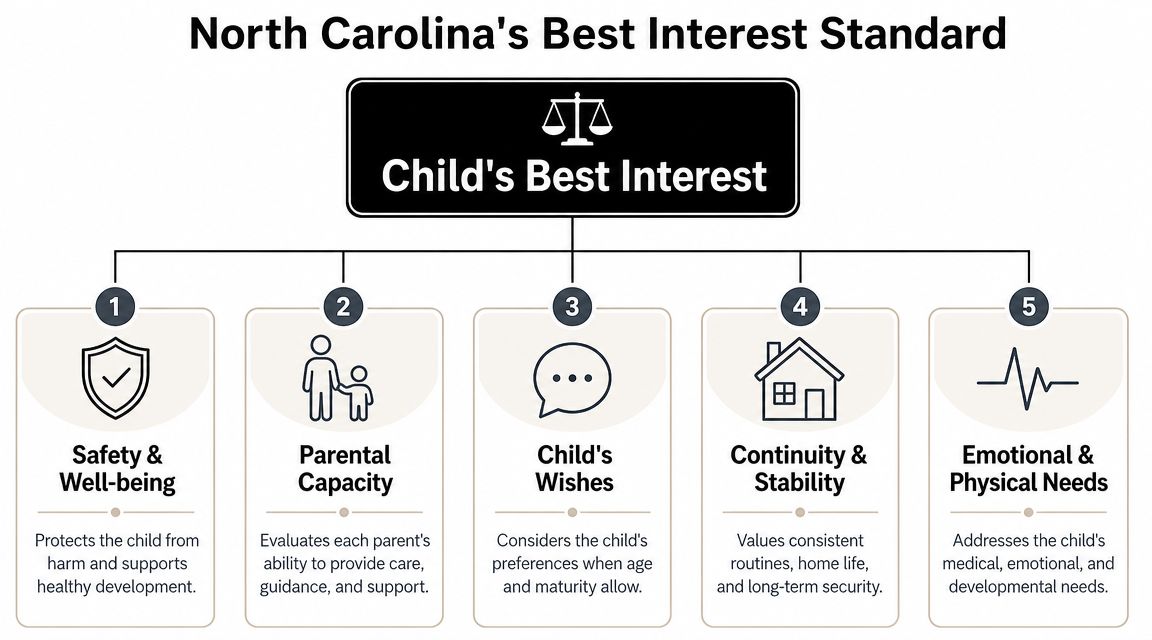
In North Carolina, the custody statute says courts must enter custody orders that will “best promote the interest and welfare of the child” under N.C. Gen. Stat. § 50-13.2, as discussed here. That same discussion notes that North Carolina courts, citing the 1982 Supreme Court decision In re the Custody of Peal, treat the standard as broad and allow judges to weigh any relevant circumstances affecting a child's physical, mental, emotional, and social well-being.
In plain English, that means there is no short checklist that automatically wins a case.
A lot of parents want a formula. They want to know whether school records count more than work schedules, or whether a cleaner house beats a closer bond. That's not how this works. Think of the judge as someone tasked with protecting the child's long-term welfare, not merely dividing parenting time in a neat pattern.
Why the standard is intentionally broad
Families don't all look the same. A preschooler with medical needs may need a very different schedule than a teenager who is firmly established in school and activities. A parent with a rotating work schedule may still be an excellent caregiver. Another parent may have more availability but less stability.
Because of that, North Carolina law gives judges room to evaluate the whole picture.
A court may look at matters such as:
- Physical safety: Whether the child is safe in each parent's care.
- Emotional health: Whether the environment is calm, supportive, and age-appropriate.
- Developmental needs: Whether the child's present needs are being met.
- Stability: Whether the child can maintain routine, schooling, and community ties.
- Parenting judgment: Whether a parent makes responsible decisions and puts the child first.
What this means for your case
The best interest standard is flexible, but it isn't random. Judges usually want to see specific facts, not slogans.
For example, saying “I'm the better parent” won't help much. Showing that you consistently handle school communication, keep medical appointments, maintain a stable home, and encourage the child's routine is much more useful. On the other hand, attacking the other parent with every grievance from the relationship often backfires unless the issue directly affects the child.
Practical rule: If a fact doesn't connect to the child's welfare, a judge may view it as noise instead of evidence.
The mistake many parents make
Parents often treat custody like a moral contest. The court doesn't. It is a welfare analysis.
That distinction matters. A parent may be difficult, selfish, or unreliable in the relationship and still receive meaningful custodial rights if the evidence shows they can safely parent the child. A parent may also feel deeply devoted and still hurt their case by refusing communication, ignoring school issues, or dragging the child into adult conflict.
The strongest custody presentation usually does three things:
| Focus area | What helps | What hurts |
|---|---|---|
| Child-centered facts | Specific examples tied to the child's needs | General complaints about the other parent |
| Stability | Consistent routines, safe housing, follow-through | Chaos, frequent disruptions, missed responsibilities |
| Credibility | Calm, documented, accurate testimony | Exaggeration, retaliation, unsupported accusations |
If you remember one point from this section, remember this. North Carolina custody decisions are built around the child's welfare, not a parent's preferred outcome.
The Key Factors NC Judges Evaluate in Custody Cases
North Carolina judges can consider many facts. There isn't a fixed statutory scorecard, but certain themes show up again and again in real custody disputes. If you want best interest of the child factors nc explained in practical terms, the legal standard becomes more concrete.
For a fuller discussion of the court's decision-making process, you can also review how judges decide custody in North Carolina.
Safety and the home environment
A judge wants to know whether each parent can provide a home that is safe, appropriate, and stable. That doesn't mean one parent needs a larger house or more expensive neighborhood. It means the child needs reliable supervision, suitable sleeping arrangements, routine, and an environment free from serious danger.
A practical example helps. If one parent lives modestly but keeps a clean, predictable home near the child's school and family support network, that can be more persuasive than a nicer home with frequent overnight guests, unpredictable schedules, or ongoing conflict.
Judges often pay attention to:
- Basic safety conditions: Is the home physically safe and suitable for the child's age?
- Reliability: Does the parent consistently show up for pickup, school obligations, and appointments?
- Calm environment: Is the child exposed to repeated chaos, adult arguments, or unsafe people?
Each parent's ability to meet daily needs
Custody isn't just about love. It's also about execution. Who gets the child to school on time? Who refills medication? Who notices when the child is struggling? Who solves problems instead of creating more of them?
A judge may look at the practical side of parenting very closely. Parents sometimes underestimate this because they think courtroom decisions turn on dramatic events. Often, ordinary caregiving matters a great deal.
Consider the difference between these two presentations:
- Parent A says, “I care more.”
- Parent B shows school communication, pediatric follow-up, attendance at activities, and a workable schedule for the child.
The second one is usually far more persuasive.
Physical and mental health concerns
North Carolina courts may consider the health of each parent when it affects the child's welfare. That does not mean a diagnosis automatically harms a parent's case. It means the court looks at whether a condition interferes with parenting, judgment, consistency, or safety.
The same is true for substance use. The issue isn't moral condemnation. The issue is whether the behavior affects supervision, reliability, decision-making, or the child's emotional security.
A health issue that is treated and managed can look very different from a pattern of denial, missed care, or impaired parenting.
Examples that may matter include repeated intoxication during parenting time, refusal to follow treatment that affects caregiving, or behavior that leaves the child anxious or unsupervised.
The child's developmental and emotional needs
A toddler, a child in elementary school, and a teenager don't need the same custody structure. Judges look at the child as an individual, not as a category.
A younger child may need more predictable transitions and closer attention to bedtime, medical routine, and attachment. An older child may be strongly tied to school, sports, counseling, work obligations, or social networks. The court can consider how each proposed arrangement supports the child's actual stage of development.
Existing relationships and caregiving history
Judges often want to understand what the child's life has looked like up to now. Who has been the steady caregiver? Who has attended parent-teacher meetings? Who helps with homework? Who has built trust with the child over time?
That doesn't mean the court automatically freezes the past in place. Parents can grow into stronger roles. But caregiving history often gives the court a useful baseline for what has been working and what has not.
A few common examples:
- One parent handled most routine care: That may support continuity, especially for younger children.
- Both parents have been consistently involved: That may support a shared arrangement if communication and logistics are workable.
- One parent was largely absent but now wants equal time immediately: The court may scrutinize whether the proposed schedule matches the child's real needs.
Willingness to support the child's relationship with the other parent
This factor matters more than many parents expect. Courts generally look favorably on a parent who can separate adult anger from the child's need for a healthy relationship with the other parent, when that relationship is safe.
That doesn't mean tolerating dangerous behavior. It means avoiding needless interference, poison, or gamesmanship.
Conduct that can hurt a custody case includes:
- Badmouthing the other parent to the child
- Blocking reasonable communication
- Using the child as a messenger
- Creating unnecessary conflict around exchanges
- Ignoring agreed schedules without good reason
A parent who says, “I want my child to have a strong relationship with the other parent, but I need the schedule to be safe and realistic,” usually presents better than a parent who appears focused on punishment.
School, community, and continuity
Children don't live in a vacuum. Their teachers, coaches, counselors, relatives, and community routines can all matter. Judges often consider whether a proposed arrangement preserves healthy continuity.
If a child is thriving in a current school, closely connected to a support system, and functioning well in a familiar routine, a major disruption may require a strong reason. Stability isn't everything, but it often carries real weight.
Here is what continuity may look like in practice:
| Issue | Why it matters to the court |
|---|---|
| School consistency | Reduces disruption to education and routine |
| Community ties | Preserves support from relatives, teachers, and activities |
| Transportation reality | Tests whether a proposed schedule is workable |
| Transition burden | Shows whether the child will face constant upheaval |
What does not work well in court
Some parents walk into a custody case thinking volume will win. It usually doesn't.
What often fails:
- Character attacks with no link to the child
- Long lists of old relationship grievances
- Text message warfare
- Social media revenge
- Unrealistic schedules that ignore school or work realities
What usually works better is a grounded, documented, child-focused presentation. If your position makes the child's daily life safer, steadier, and more manageable, that is where the court's attention belongs.
How Judges Weigh the Factors in High-Conflict and Sensitive Cases
A custody case is not a math problem. Judges do not assign points for housing, subtract points for missed visits, and produce a neat total at the end. They weigh the facts together and decide what arrangement best protects the child's welfare.
That matters most in high-conflict cases, where parents often assume one issue will automatically decide everything. Sometimes a single issue becomes very important. But North Carolina courts still look at the full picture.

No single factor is automatically controlling in every custody case. The question is how the facts affect this child in this family.
Domestic violence and safety concerns
In North Carolina, courts must consider “all relevant factors,” including acts of domestic violence and the safety of the child. North Carolina-focused commentary also notes an emerging emphasis on trauma-informed and safety-centered decision-making, with documented abuse or protective orders often influencing visitation schedules, exchange terms, and whether supervised parenting time is needed, as discussed in this North Carolina child-focused custody guide.
This is one of the most misunderstood parts of custody law. Many people hear “domestic violence is a factor” and assume it is treated like just one line on a longer list. In practice, credible evidence of abuse can change the entire structure of a case because safety issues affect every other part of the analysis.
What judges often look for when abuse is raised
The court usually wants details, context, and documentation. General statements like “he is abusive” or “she is unstable” are much weaker than evidence tied to actual events.
Useful evidence may include:
- Protective order records
- Police reports
- Medical records
- Photographs
- Threatening messages or voicemails
- Witness testimony from people with firsthand knowledge
The court may also focus on practical consequences. Does the child need supervised exchanges? Should communication occur only in writing? Is overnight visitation safe right now? Has the alleged conduct happened in the child's presence, or affected the child emotionally even when the child was not the direct target?
The child's preference and the magic-age myth
Another major source of confusion is the belief that a child can choose at a certain age. North Carolina does not use a magic age cutoff. As explained in Cornell Law School's overview of the best-interests standard), a child's preference may be considered if the child is of sufficient age and discretion, but that preference is only one factor among many, and the weight depends on maturity, reasoning, and whether the preference fits the child's best interests.
That means a teenager's thoughtful preference may matter more than a younger child's impulsive one. It also means a preference shaped by pressure, gifts, fear, or lax rules may carry less weight.
A judge may ask questions such as:
- Is the child mature enough to express a reasoned preference?
- Are the reasons tied to school, routine, comfort, and stability?
- Is the child being influenced by one parent?
- Would honoring the preference place the child in a worse situation?
A child's voice can matter. It does not replace the court's duty to protect the child's welfare.
How high-conflict cases are often won or lost
In sensitive cases, credibility becomes central. Judges watch for the parent who stays focused on concrete concerns and practical solutions.
That usually means:
| Approach | Likely effect |
|---|---|
| Specific facts tied to safety or welfare | Helps the court make targeted orders |
| Broad blame with little proof | Weakens credibility |
| Child-focused proposals | Shows judgment and restraint |
| Demands driven by revenge | Makes the case look parent-centered |
A parent who asks for structured exchanges, counseling safeguards, or supervised contact based on documented events often appears more credible than a parent who demands total exclusion without evidence. On the other side, a parent accused of serious misconduct who responds with denial alone, instead of records, witnesses, and changed behavior, may have a difficult time.
Gathering Persuasive Evidence for Your NC Custody Hearing
Custody cases turn on proof. Strong feelings may be genuine, but judges need evidence they can evaluate. If you want the court to understand your parenting and your child's needs, you need records, witnesses, and a clear timeline.
The goal is not to bury the court in paper. The goal is to present a focused, believable picture of daily life.
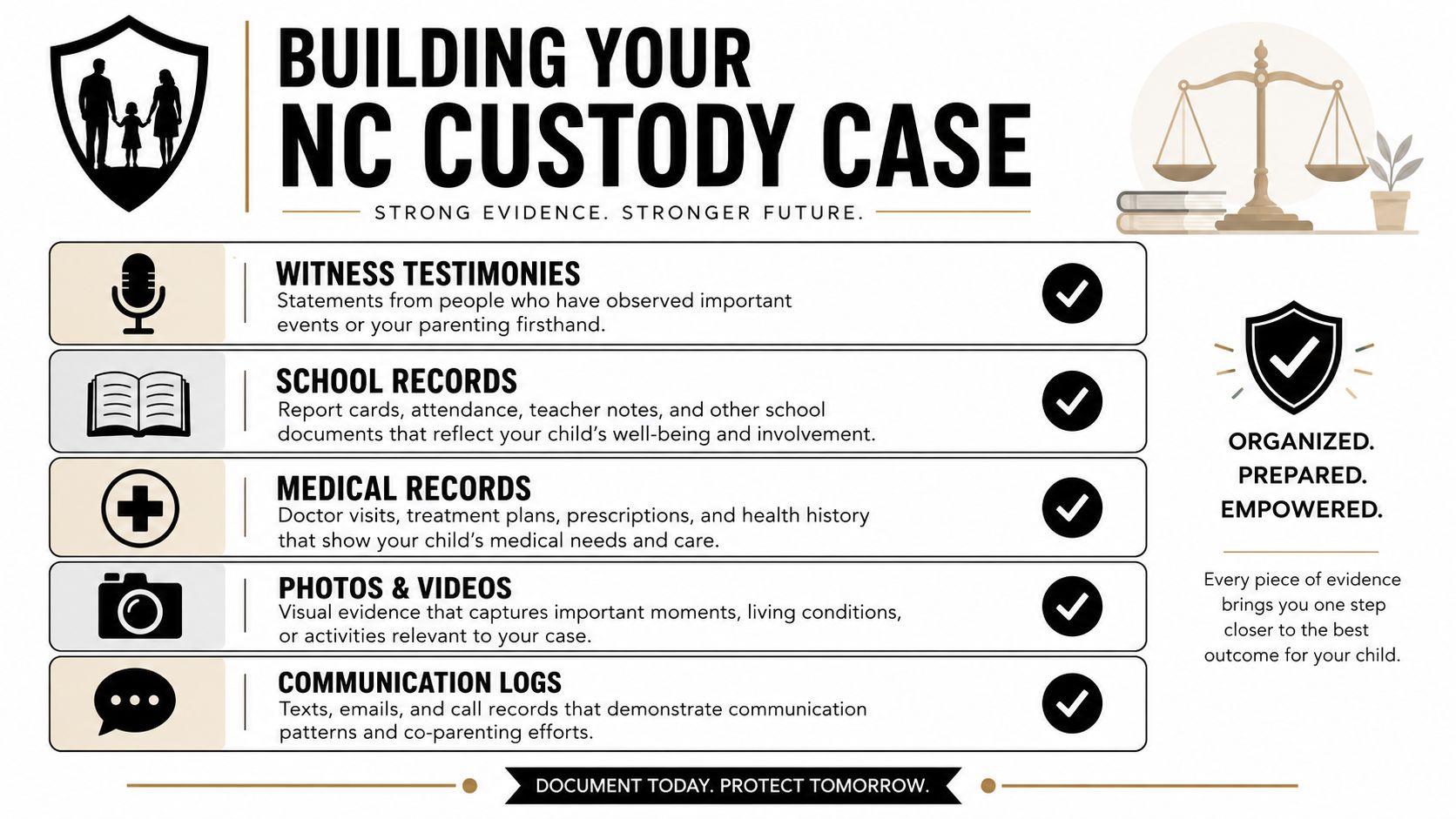
What persuasive evidence usually looks like
The most effective evidence tends to be ordinary and consistent. Judges often give more weight to records created in real time than to dramatic statements made once litigation starts.
Useful categories include:
- School records: Attendance, report cards, teacher communications, and notes showing involvement.
- Medical records: Appointment history, treatment follow-up, and who participates in care.
- Communication logs: Texts, emails, and co-parenting messages that show reliability or conflict patterns.
- Calendars and journals: A careful timeline of exchanges, missed visits, school issues, or concerning incidents.
- Neutral witnesses: Teachers, counselors, coaches, relatives, or childcare providers with firsthand observations.
What parents should start doing now
If your case is active or likely, disciplined record-keeping can make a real difference.
A practical approach is to:
- Preserve messages carefully. Save texts and emails in context, not just isolated screenshots that invite arguments about missing content.
- Track parenting responsibilities. Note pickups, homework help, doctor visits, extracurricular attendance, and missed obligations.
- Collect independent records. School and medical documents often carry more weight than self-serving summaries.
- Stay measured in writing. Assume every text may be read by a judge later.
- Organize by issue. Safety concerns, school issues, missed exchanges, and medical matters should be grouped separately.
Evidence that often hurts more than it helps
Not all “proof” is useful. Some material makes a parent appear reactive, invasive, or more focused on conflict than the child.
Examples include:
- Edited or incomplete message chains
- Secretly curated social media attacks
- Huge binders with no clear point
- Friends repeating rumors instead of firsthand knowledge
Courts usually respond better to a clean timeline and reliable records than to a stack of accusations.
When parents need help organizing a custody case, they may work with counsel, a therapist involved in the child's care, or structured co-parenting tools. The Law Office of Bryan Fagan handles North Carolina family law matters, including custody disputes and post-order issues, and can help evaluate what evidence is legally useful versus what is just emotionally satisfying.
Modifying and Enforcing Your North Carolina Custody Order
A custody order is not always the final word. Children grow up. Parents move. Work schedules change. Health, school, and safety issues can shift over time. North Carolina law allows custody orders to be revisited when circumstances materially change in a way that affects the child's welfare.

If you're dealing with a parenting plan that no longer fits reality, how to modify a custody agreement becomes an important question.
When a custody order can be modified
A parent generally cannot ask for a change just because the current schedule is frustrating. The court usually needs to see a substantial change in circumstances affecting the child.
Examples may include:
- Relocation: One parent's move now makes the schedule unworkable.
- Safety concerns: New conduct raises concerns about supervision or judgment.
- Major routine changes: School demands, medical needs, or the child's development have changed the practical needs of the case.
- Persistent noncompliance: The existing order is not being followed in a way that harms stability.
The court does not automatically rewrite the order after a life change. The parent seeking modification still needs to connect that change to the child's welfare.
Enforcement matters too
Sometimes the issue is not changing the order. The issue is enforcing it. If the other parent refuses exchanges, blocks communication, or repeatedly ignores terms of the order, you may need to return to court.
That can involve a motion for contempt or another enforcement filing, depending on the facts. The right response depends on the wording of the existing order and the type of violation.
Here is a short overview:
| Problem | Possible legal response |
|---|---|
| Missed exchanges | Enforcement or contempt action |
| Repeated refusal to follow terms | Request court intervention |
| Order no longer fits the child's needs | Motion to modify custody |
| Safety issue during visitation | Seek prompt legal review and possible emergency relief |
Parents often make a mistake here. They try to “fix” violations by self-help. They withhold the child, change the schedule unilaterally, or stop communicating. That can create new problems for their own case.
A brief overview may help if you're dealing with post-order issues:
The safer approach is usually to document the problem, protect the child, and get legal advice before taking steps that could be seen as violating the order yourself.
Frequently Asked Questions About NC Child Custody Factors
Does North Carolina favor mothers over fathers in custody cases
North Carolina custody law focuses on the child's welfare, not a parent's gender. The practical question is which arrangement best serves the child's needs, safety, and stability. A mother does not automatically win, and a father does not start at a disadvantage because he is the father.
At what age can my child decide where to live in North Carolina
There is no magic age in North Carolina. A child's preference may be considered if the child has sufficient age and discretion, but the preference is not controlling. The court looks at maturity, reasoning, and whether the child's stated preference matches the child's best interests.
Can I move out of state with my child after a custody order is entered
Maybe, but you should not assume you can do so without legal consequences. If the move affects the custody schedule, school, travel demands, or the other parent's time, it can trigger litigation. Relocation often becomes a modification issue because it may significantly affect the child's routine and the practicality of the existing order.
What is a custody evaluation or Guardian ad Litem
In some contested cases, the court may use additional tools to better understand the child's circumstances. A custody evaluation typically involves a professional assessment of family dynamics and parenting issues. A Guardian ad Litem, when appointed in an appropriate case, serves in a child-focused role and provides information to help the court assess the child's welfare. Whether either will be used depends on the facts and the court's concerns.
If the other parent violates the order, can I just keep the child with me
Usually, that is risky. Even when you are frustrated, self-help can make things worse unless there is an immediate safety issue that requires urgent action. In most situations, the better course is to document the violation and ask the court for enforcement or other relief.
Protecting Your Family's Future in North Carolina
Custody cases are difficult because they touch every part of your child's life. School. Health. Routine. Safety. Emotional stability. North Carolina courts look at those real-world details through the best-interest standard, and the parents who do well are usually the ones who present a credible, child-focused case.
If you're involved in a custody dispute, don't rely on myths, internet rumors, or pressure from the other parent. The law is broader and more fact-specific than that. A strong approach starts with understanding what a judge may weigh, gathering useful evidence, and building a position grounded in your child's welfare.
If you live in North Carolina and need guidance about custody, visitation, modification, or enforcement, it's wise to get advice based on the facts of your case, not someone else's.
If you're facing a custody dispute anywhere in North Carolina, schedule a consultation with the Law Office of Bryan Fagan. You can discuss your specific facts, your child's needs, and the legal options available for protecting your parental rights and your child's future.