When a judge, opposing counsel, or even your own lawyer first says the words custody evaluation, most parents hear something else: scrutiny, risk, and a fear that one interview could decide their child's future. That reaction is normal. In North Carolina, a custody evaluation can feel invasive because it asks a stranger to look closely at your parenting, your home, and your family dynamics.
The good news is that the process is usually more structured than people expect. It isn't a punishment, and it isn't automatically a sign that the court thinks you're a bad parent. In many cases, it's used because the court needs more reliable information than the parents' competing claims can provide.
A custody evaluation process in NC is a neutral assessment designed to help the court decide what arrangement serves the child's best interests. That usually matters most in hard cases: high-conflict disputes, allegations of substance abuse, concerns about mental health, claims of alienation, or safety issues that can't be resolved through simple testimony alone.
Parents also often confuse a custody evaluation with therapy, mediation, or a Guardian ad Litem investigation. They aren't the same. Therapy is treatment. Mediation tries to help people settle. A custody evaluation is a forensic assessment, which means the evaluator is gathering information for the court, not counseling either parent.
That distinction changes how you should approach every part of the process. You need to understand what the evaluator is trying to learn, what the judge is likely to care about, and how everyday choices, texts, missed appointments, doctor records, school records, and your own demeanor can affect the final report.
What Is a Custody Evaluation in North Carolina?
You are in court on a custody dispute, and the judge says more information is needed before a final decision can be made. For many parents, that is the moment the case starts to feel less like a disagreement and more like an investigation.
In North Carolina, a custody evaluation is usually reserved for cases with serious factual disputes or concerns that cannot be sorted out through testimony alone. The evaluator is asked to study the family in a structured way and give the court an opinion about the child's needs, each parent's functioning, and the parenting arrangement that appears most consistent with the child's best interests.
This process is narrower, and more strategic, than many parents expect. An evaluator is not there to provide therapy, repair communication, or decide who seems more pleasant in an interview. The evaluator is gathering information the judge may use in a hard case. That means parents should prepare for it with the same care they would give any other important piece of evidence.
What the evaluator is trying to learn
A North Carolina custody evaluation usually centers on practical questions that affect day-to-day parenting and the child's well-being:
- How stable and predictable is each parent's home life?
- How well does each parent understand and meet the child's medical, school, emotional, and behavioral needs?
- Are there credible concerns about substance use, domestic violence, neglect, untreated mental health issues, or poor judgment?
- Can the parents support the child's relationship with the other parent, or is one parent creating conflict that harms the child?
- Which custody arrangement appears workable under the family's actual circumstances?
Those questions sound simple on paper. In real cases, they rarely are. A parent may love the child and still struggle with follow-through, boundaries, sobriety, or communication. Another parent may look organized but create conflict in ways that do not show up until texts, school records, or third-party interviews are reviewed.
Why clients often misread this process
Parents often walk into an evaluation believing the main task is to tell their side clearly. Clear communication matters, but it is only one part of the picture. Evaluators tend to focus on patterns. They compare what each parent says against records, timelines, behavior during the case, and what neutral third parties report.
That trade-off matters. A parent who arrives polished but evasive can lose credibility fast. A parent who is anxious, imperfect, and well-documented may come across as more reliable.
A useful way to view the process is this: the evaluator is not looking for a perfect parent. The evaluator is looking for evidence of judgment, stability, credibility, and the ability to put the child's needs ahead of the conflict.
Why this section matters at the start
The definition alone is not enough. Its core value lies in understanding how a custody evaluation functions inside a North Carolina case, what mistakes parents make early, and how ordinary decisions can shape the final report before anyone realizes the record is being built.
If an evaluation has been raised in your case, treat it as a serious forensic process from day one. Preserve records. Stay consistent. Assume your parenting choices, communication, and follow-through will matter more than your outrage.
The Legal Foundation for Custody Evaluations in North Carolina
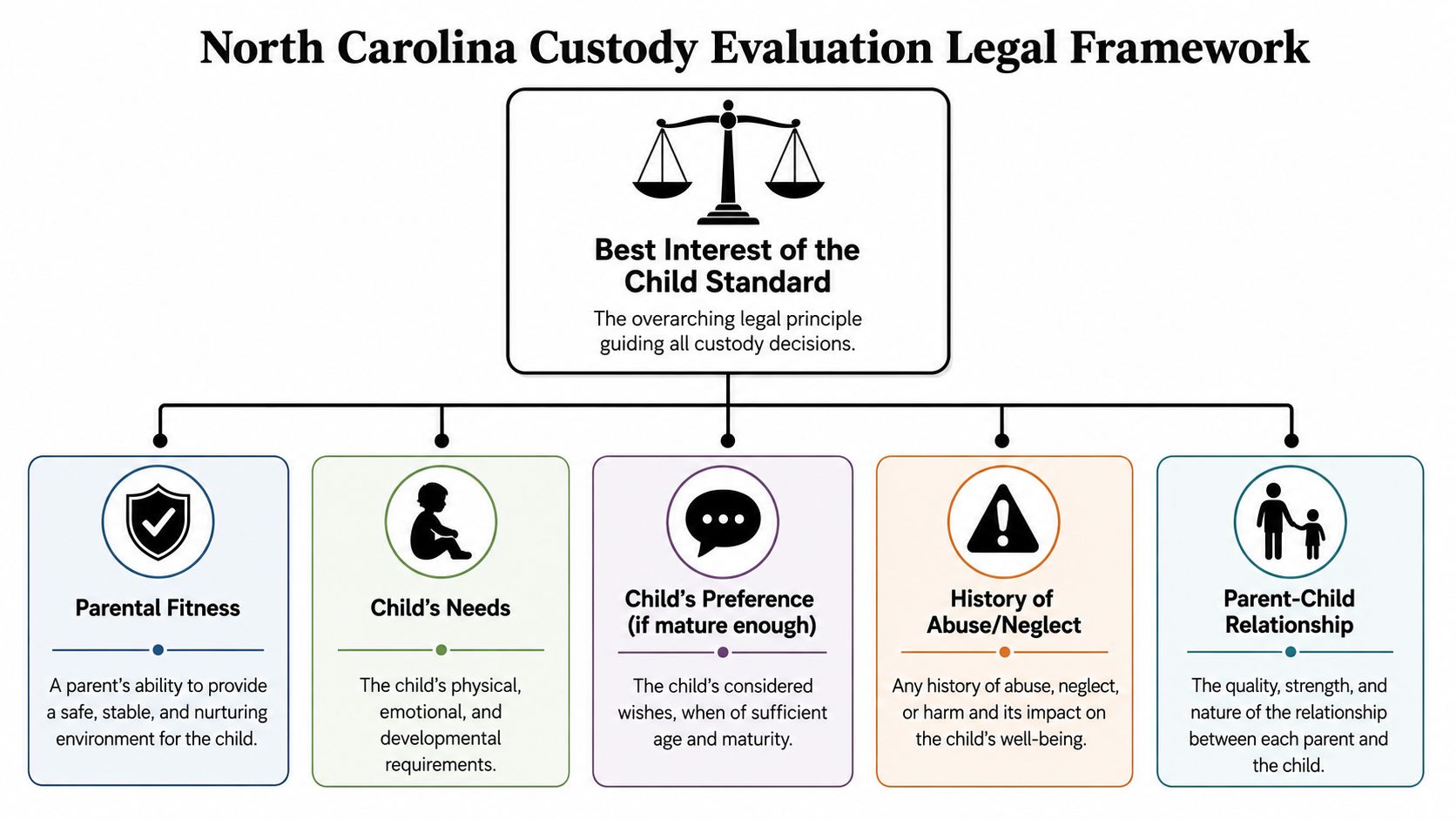
North Carolina custody decisions are guided by the best interest of the child standard under N.C.G.S. § 50-13.2. That statute gives judges broad authority to enter custody orders that promote the child's welfare. A custody evaluation fits into that framework because it gives the court a more developed factual record when testimony alone isn't enough.
What does “best interest” mean in practice? It means the judge is not focused on rewarding one parent or punishing the other. The court is trying to decide which arrangement most effectively supports the child's safety, stability, health, development, and relationship with each parent.
How the legal standard turns into an evaluation
The evaluator's work is supposed to help the court apply that legal standard to actual evidence. In North Carolina custody evaluations, the technical value comes from combining three evidence streams: parent interviews, child interviews or observation, and collateral information. The evaluator is expected to review parenting skills, physical and mental health, substance use, willingness to co-parent, the child's attachment and mental health, and third-party records such as school, medical, police, and prior court documents, as discussed in this overview of custody evaluation evidence streams.
That approach matters because it limits a common problem in custody litigation. Each parent may tell a story that sounds complete on its own. A good evaluation checks whether those stories hold up when compared against records, third-party accounts, and observed behavior.
For a broader explanation of how North Carolina courts analyze custody generally, this guide to child custody laws in North Carolina is a useful companion.
Who may serve as an evaluator
North Carolina cases often involve evaluators with mental health or forensic backgrounds, such as psychologists or clinical social workers. The specific professional matters less than many parents think. What matters most is the scope of the appointment, the evaluator's neutrality, and the quality of the methods used.
A court can appoint an evaluator by order. In some cases, the lawyers and parties may agree on a particular evaluator and ask the court to formalize that arrangement. Either way, the evaluator is not your advocate and not the other parent's advocate.
Practical rule: If you approach the evaluator as if they are “on your side,” you're already making a strategic mistake.
What the evaluator is not
It helps to clear up a few misconceptions early.
| Role | Main function |
|---|---|
| Custody evaluator | Investigates family facts and gives the court recommendations |
| Therapist | Provides treatment and support |
| Mediator | Helps parents try to reach agreement |
| Judge | Makes the final custody decision |
The evaluator may influence the outcome, but the evaluator does not decide custody. The judge does. That means the report's strength depends on how carefully the evaluator gathered and analyzed evidence, not just on the bottom-line recommendation.
The Custody Evaluation Process Step by Step
A parent usually sees the stakes of this process the first time an evaluator asks for records, names of teachers, therapist information, and a full account of daily parenting. What felt like a custody dispute between two adults starts turning into an investigation of how the child lives. That shift catches many parents off guard. It should not.
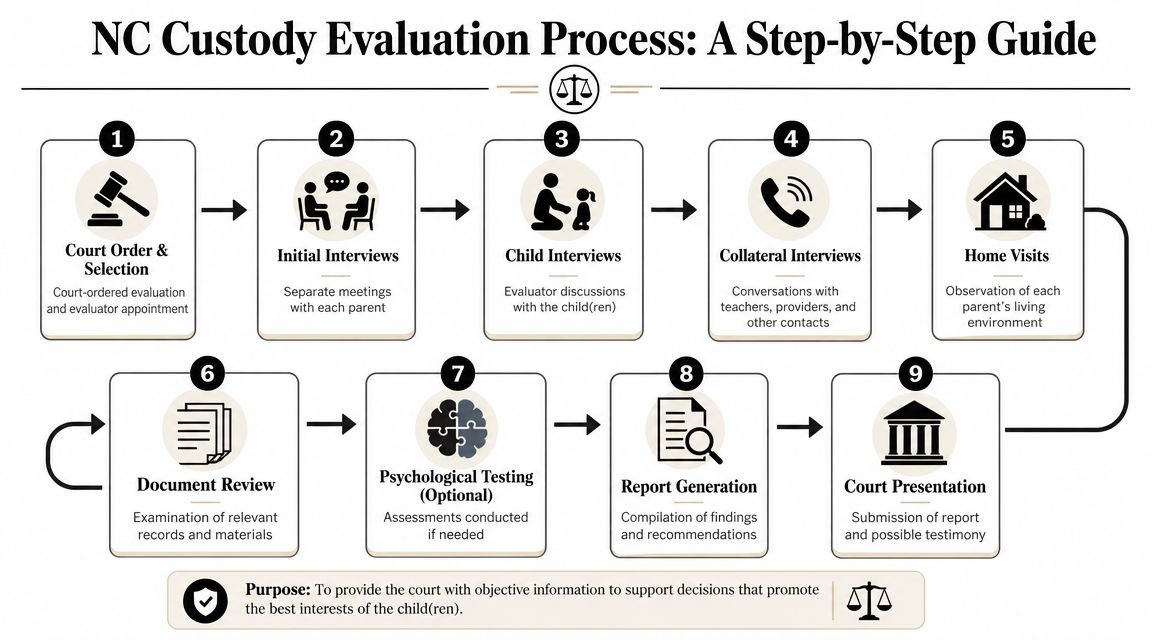
A North Carolina custody evaluation usually follows a predictable sequence, even though the details vary by county, judge, evaluator, and the issues in dispute. The evaluator starts with the scope of the appointment, gathers information from both parents and outside sources, tests each parent's claims against what can be verified, and then gives the court an opinion. Parents who understand that sequence usually prepare better and make fewer avoidable mistakes.
Step one through step three
North Carolina evaluation orders can be broad or tightly focused. Some ask for a full assessment of parenting capacity and the child's needs. Others target a narrower problem, such as substance use, mental health concerns, alienation claims, domestic violence, or decision-making problems. That distinction matters because it changes what the evaluator will spend time on, what records will matter most, and where a parent can help or hurt their case.
Court order and selection
The process starts with an order appointing an evaluator, or with the parties agreeing on an evaluator and asking the court to approve that choice. The order often addresses who the evaluator is, the issues to be assessed, what records may be reviewed, how the parties will cooperate, and who pays.
Read that order closely.
I often tell clients that the order is the map for the entire evaluation. If the scope is broad, assume almost every part of your parenting history may be examined. If the scope is narrow, stay disciplined. Parents lose credibility when they treat a targeted evaluation as an opportunity to relitigate every grievance from the relationship.
Intake and paperwork
The evaluator usually begins with releases, questionnaires, document requests, and background forms. This stage looks administrative, but it carries real strategic weight. Late forms, incomplete disclosures, and selective record production suggest either disorganization or concealment. Neither impression helps.
You may be asked for:
- Family background information, including addresses, schools, household members, and providers
- Court and agency history, such as prior custody orders, DSS involvement, criminal charges, or protective orders
- Collateral contacts, including teachers, doctors, counselors, relatives, and childcare providers
- Records, such as school reports, medical records, treatment records, communication logs, and other documents tied to the disputed issues
Accuracy matters more than volume. Sending a box of irrelevant material rarely strengthens a case. Clear, organized, relevant information does.
Individual parent interviews
The parent interview is one of the first places an evaluator starts measuring judgment. The evaluator is listening to the facts, but also to how the parent handles stress, criticism, and disagreement. Parents who spend the entire session attacking the other side often miss the point.
Useful answers are specific. Describe the child's school routine, medical needs, behavior, friendships, discipline, transitions between homes, and any support services. Explain what you do, why you do it, and how you respond when something is not working. A parent who can acknowledge ordinary shortcomings and show a plan to address them often appears more credible than a parent who claims to have no weaknesses.
Later in the process, this video may help you frame the evaluation more realistically:
Step four through step six
By this point, the evaluator usually has each parent's version of the case. The next stage is where those stories get tested.
Child interviews and parent-child observation
The child's involvement depends on age, maturity, and the issues before the court. In some cases, the evaluator interviews the child directly. In others, observation matters more than direct questioning. Either way, the evaluator is assessing the child's experience, not taking votes.
That means coached statements usually fail. A child who repeats adult language, seems anxious about pleasing one parent, or appears worried about saying the wrong thing can raise concern instead of helping the parent who prepared the script. What usually matters more is whether the child appears secure, comfortable, developmentally supported, and free to have a relationship with both parents where appropriate.
Home visits
Some evaluations include home visits. Some do not. If a home visit happens, the evaluator is assessing whether the environment works for the child in real life.
The home does not need to look perfect. It does need to look honest, safe, and functional. Suitable sleeping arrangements, safe storage of medication or firearms, age-appropriate space for the child, and a realistic plan for supervision all matter. So does candor about who lives there or regularly spends time there. Hidden partners, hidden household members, and last-minute staging are common mistakes, and evaluators usually spot them.
Collateral contacts and records
This stage often changes the direction of a case. The evaluator may speak with teachers, therapists, medical providers, relatives, coaches, or other adults involved in the child's life. The evaluator may also review school, medical, mental health, law enforcement, and court records, depending on the order and signed releases.
Outside information does not always produce a clean winner. Sometimes it confirms one parent's concerns. Sometimes it shows both parents are partly right. Sometimes it reveals that each side has exaggerated. From a strategic standpoint, consistency matters. A parent whose story lines up with records and neutral witnesses usually stands on firmer ground than a parent who relies on accusations that cannot be verified.
Step seven through step nine
The final stage is where the evaluator turns gathered information into opinions that may shape settlement talks, hearing strategy, and trial preparation.
Psychological testing if needed
Some cases involve psychological testing. Others do not. Testing is usually reserved for situations where interviews and records leave important questions unanswered, especially when there are concerns about serious mental health issues, personality features affecting parenting, substance use, or disputed allegations that require closer assessment.
Testing is only one part of the file. A score or diagnostic impression does not decide custody by itself. The evaluator still has to explain how the testing fits with observed parenting, collateral information, and the child's needs.
Drafting the report
After interviews, observations, record review, and any testing are complete, the evaluator prepares a written report. The quality of that report matters. A useful report ties recommendations to facts, explains the evaluator's reasoning, and addresses the issues identified in the appointment order.
Parents often focus only on the recommendation. That is understandable, but incomplete. The reasoning matters too. A report built on thin interviews, weak record review, or unsupported assumptions may be challenged more effectively than a report that shows careful method and clear support for each conclusion.
Presentation to the court
Some cases settle after the report is issued. Others become more contested. If the matter proceeds to hearing or trial, the evaluator may testify about the investigation, the materials reviewed, the interviews conducted, and the basis for the recommendations.
That testimony matters because the report does not speak for itself. The judge decides how much weight to give it. In practice, the strongest position involves more than obtaining a favorable report. It is preparing from the start so your records, your conduct, your witnesses, and your testimony hold up when the evaluator's work is examined in court.
Understanding Timelines Costs and Confidentiality
Parents usually ask the same three questions first. How long will this take, who's paying for it, and is what I say private?
The timeline varies with the complexity of the case, the evaluator's availability, the amount of records to collect, and whether testing or home visits are involved. A North Carolina custody evaluation is a structured forensic assessment that can take weeks or months and may include psychological testing, home visits, and collateral interviews. Some sources note that courts prefer reports to be completed in roughly 5 to 6 weeks when possible, as described in this North Carolina custody evaluation timing overview.
Timelines are driven by information flow
Delays often come from missing records, missed appointments, incomplete releases, and disputes over scope. In practice, parents can speed up the process by returning paperwork promptly and giving complete contact information from the start.
If your custody case is running alongside separation or divorce issues, the broader court schedule may also matter. This overview of the North Carolina divorce timeline gives helpful context on how family court timing can affect related matters.
Costs depend on scope and the appointment order
I'm not citing a dollar figure here because cost varies by evaluator, county, scope, and whether the court orders a limited evaluation or a more involved forensic review. In some cases, the court splits the cost between the parties. In others, the court may allocate payment differently based on the circumstances or the parties' positions.
What matters strategically is this: a more thorough evaluation usually costs more because it requires more time, more document review, more interviews, and more analysis. That can be frustrating, but it's often the same reason a report becomes more defensible.
| Issue | What to expect |
|---|---|
| Timeline | Often several weeks, sometimes longer in complex cases |
| Payment | Usually set by agreement or court order |
| Scope | Broader scope usually means more time and more expense |
| Judge's use of report | Recommendations may be persuasive, but they are not binding |
Confidentiality has real limits
Parents often make avoidable mistakes during custody evaluations. A custody evaluation is not therapy. Your statements are generally being gathered for the evaluator's assessment and report to the court. You should be honest, but you should also be thoughtful.
That doesn't mean you should sound guarded or rehearsed. It means you should understand the setting. If you make extreme allegations, minimize major facts, or contradict your own records, those problems may appear in the final report.
How to Prepare for Your North Carolina Custody Evaluation
Preparation changes outcomes because this process rewards consistency, documentation, and judgment. Parents who treat the evaluation casually often create their own problems. Parents who overprepare by trying to control every detail often create a different set of problems. The right approach sits in the middle. Be organized, be accurate, and keep the child at the center of every decision.
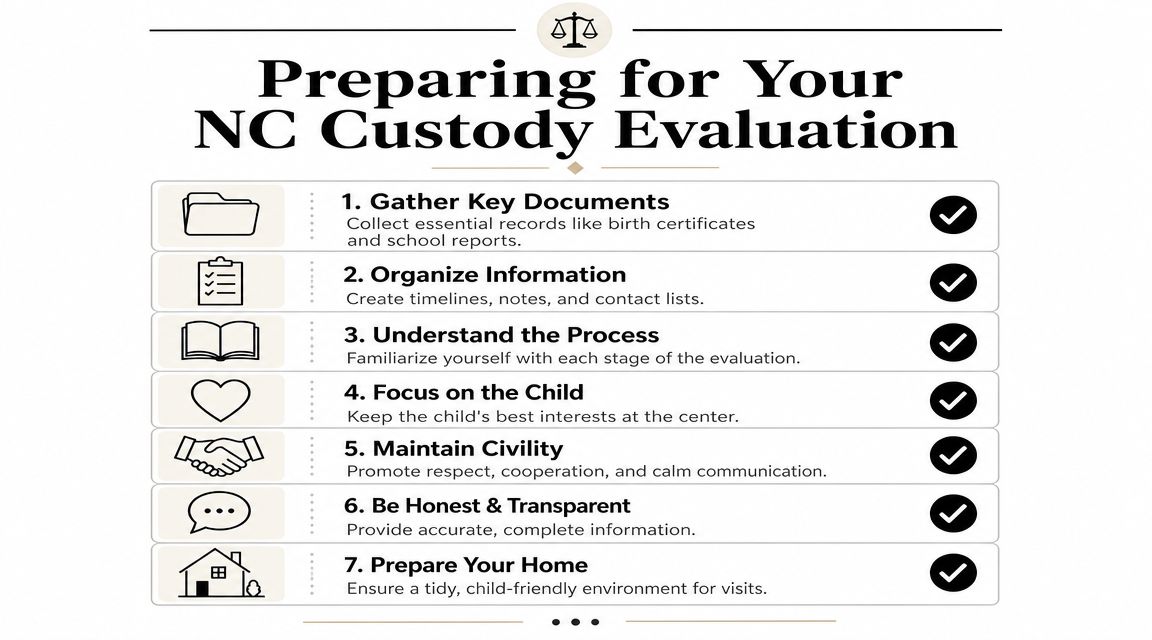
Build your file before the first interview
Don't wait for the evaluator to ask for basic information that you should already have ready. Start with a clean, usable set of records that helps someone outside the family understand your child's daily life.
A practical preparation file often includes:
- School information such as report cards, attendance issues, special education plans, teacher communications, and activity schedules
- Medical information including providers, prescriptions, appointment history, diagnoses that affect parenting or routine, and therapy contacts if applicable
- Parenting calendar details showing exchanges, overnights, missed time, and major schedule disruptions
- Communication samples that show relevant co-parenting issues without burying the evaluator in hundreds of angry texts
- Contact list for collateral sources with full names, roles, and current contact information
If you're working with counsel, use that relationship well. A family law attorney can help you decide what is relevant, what is distracting, and what may create unnecessary risk if presented badly. For parents who need legal guidance while preparing, a North Carolina child custody lawyer can help organize records, evaluate communication issues, and prepare for evaluator contact. The Law Office of Bryan Fagan is one example of a North Carolina firm that handles that kind of family law preparation.
Prepare your presentation, not a performance
Many parents think the goal is to “look good.” That usually backfires. Evaluators tend to notice when a parent sounds rehearsed, rigid, or obsessed with winning.
A better approach is to prepare around themes that matter:
- Know your child's routine. Be ready to discuss school, medical care, bedtime, emotional needs, and how transitions work.
- Acknowledge weaknesses candidly. If communication with the other parent has been poor, say so and explain what you're doing to improve it.
- Stay child-focused. Link your answers back to the child's needs, not your resentment.
- Use specifics. “I take our daughter to speech therapy every Thursday” is stronger than “I'm the involved parent.”
Client warning: The evaluator is usually measuring your judgment under stress, not just your parenting on your best day.
Prepare for domestic violence and safety issues carefully
When a case involves domestic violence, the evaluation shifts sharply toward safety. National judicial guidance says courts should determine how the child has been affected, the quality of each parent's relationship with the child, each parent's capacity to meet the child's needs, and how to protect the child's physical, psychological, and emotional well-being. That same guidance recommends early review of criminal records, court activity records, and child abuse or child-protection reports, as explained in the judicial guide for custody and visitation evaluations in domestic violence cases.
If your case includes allegations of abuse, don't rely on broad statements alone. Organize police reports, protective orders, medical records, photos, witness names, and prior agency involvement in a way your attorney can review before submission. At the same time, don't coach the child to repeat adult language. Safety concerns should be documented, not scripted.
Prepare your child and your home the right way
You should tell your child only what is developmentally appropriate. Usually that means a calm explanation that an adult will be talking with the family to help the court understand what the child needs. Don't tell the child what to say. Don't test the child afterward. Don't ask, “Did you tell them you want to live with me?”
Your home should be clean, functional, and age-appropriate. It doesn't need to look staged. It does need to reflect real parenting. Make sure medications are secure, sleeping arrangements are sensible, and the child's day-to-day life can happen there.
Common Pitfalls to Avoid During an Evaluation
Most damage in a custody evaluation doesn't come from one dramatic event. It comes from repeated judgment errors. Parents often think the evaluator will understand what they “meant.” Sometimes the evaluator won't. What gets measured is what you say, what you provide, how you act, and whether those things match the records.
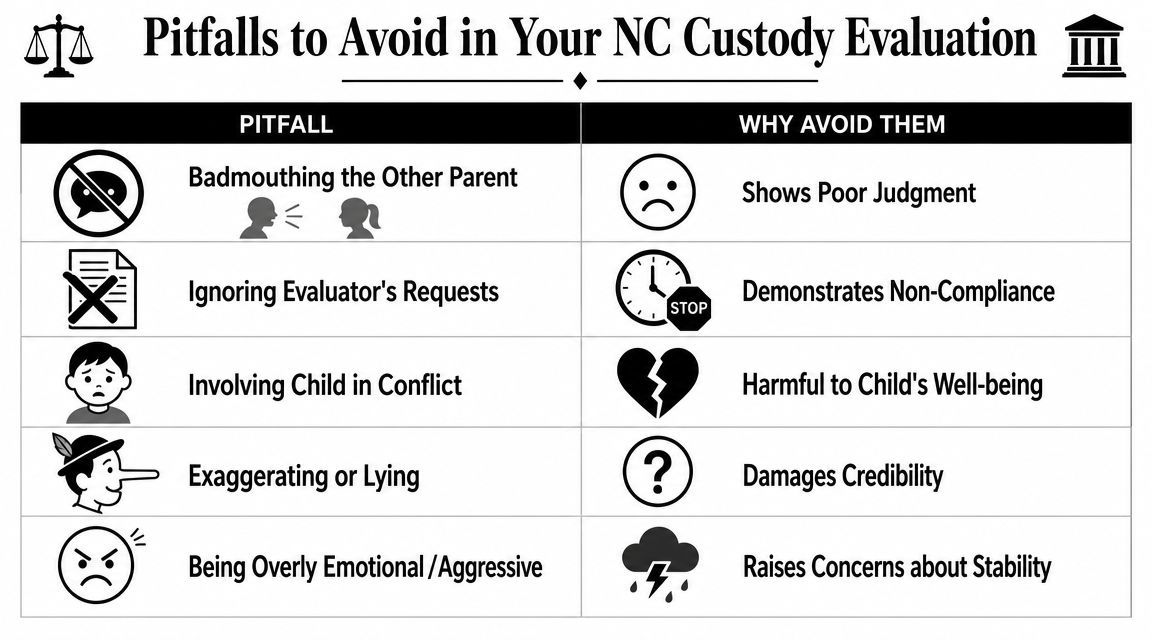
The mistakes that hurt credibility fastest
| Pitfall | Why it backfires |
|---|---|
| Badmouthing the other parent | It can make you look unable to support the child's relationship with the other parent |
| Ignoring requests | Missed deadlines and missing documents suggest poor judgment or noncompliance |
| Involving the child in litigation | It puts pressure on the child and often shows weak boundaries |
| Exaggerating facts | Once credibility slips, every later statement becomes harder to trust |
| Losing emotional control | Anger, contempt, or volatility may raise concerns about stability |
Coaching is usually obvious
Parents sometimes believe they can help a child “tell the truth” by explaining what matters before an interview. In reality, coaching often makes a child sound unnatural, repetitive, or anxious. That can damage both the child's credibility and the parent's.
A better rule is simple. Reassure the child that it's okay to be honest and that adults are handling the court part.
If a child starts using adult legal phrases that don't fit their age, the evaluator will notice.
Don't build your case around parental rights language
Parents under stress often say things like “I deserve equal time” or “I have a right to my child.” Those feelings are real, but they don't persuade evaluators nearly as much as evidence about the child's needs, routines, and developmental welfare.
If your interview keeps circling back to fairness for you, the evaluator may conclude that you're not seeing the case through the child's lens. That's especially risky in the custody evaluation process in NC, where the central question is the child's best interests, not whether the adults feel equally validated.
Perfection is not the goal
Trying to look flawless can be as harmful as looking chaotic. Real families have tension, scheduling problems, and imperfect communication. A parent who admits mistakes and shows problem-solving usually presents better than a parent who denies every weakness and blames every issue on the other side.
After the Report What Are the Next Steps
When the report is finished, many parents feel a false sense that the hard part is over. It isn't. The report is a major development, but it's still one piece of the custody case.
Your first step should be a careful review with your attorney. Don't skim for the recommendation alone. Read the factual summary, the sources relied on, the omissions, and any language that suggests assumptions rather than verified findings. Sometimes a report is favorable overall but contains smaller statements that still need to be addressed before court.
If the report helps your position
A favorable report can facilitate settlement. If the evaluator's recommendations align with a practical parenting plan, the parties may be able to negotiate an agreement rather than spend more money preparing for trial.
That doesn't mean you should become complacent. The other side may still challenge the report, attack the evaluator's methodology, or try to distinguish later facts from what the evaluator reviewed.
If the report hurts your position
An unfavorable report is serious, but it's not the end of the case. Judges in North Carolina consider evaluator recommendations, but they are not bound by them. That means strategy still matters.
Possible responses may include:
- Identifying factual inaccuracies in the report and comparing them to records
- Reviewing scope issues to see whether the evaluator addressed matters outside the appointment
- Assessing methodology such as incomplete collateral contacts or unbalanced information gathering
- Preparing cross-examination to test assumptions, omissions, or weak foundations
Some cases settle even after a difficult report because both sides now understand the likely pressure points at trial. Other cases need a direct challenge in court. The right path depends on the report's actual weaknesses, not just your emotional reaction to reading it.
Keep your conduct steady after the report
Parents sometimes unravel at this stage. They send angry messages, confront collateral witnesses, or start pressing the child for details. Don't do that. The period after the report can still generate evidence that helps or hurts you.
Frequently Asked Questions About NC Custody Evaluations
Can I refuse to participate in a court-ordered custody evaluation
Usually, refusal is a bad idea. If the court has ordered the evaluation, nonparticipation can make you look obstructive and may limit your ability to explain your side of the facts. If there is a legitimate concern about the evaluator, scope, or logistics, raise it through your lawyer rather than refusing.
What if I think the evaluator is biased against me
Bias concerns should be documented, not assumed. Keep records of missed contacts, unequal information requests, or comments that appear inappropriate. Then discuss those issues with counsel promptly. In some cases, concerns can be addressed through motion practice, objections, or cross-examination later.
Does my child get to choose where to live
Not in the way many parents think. In North Carolina, a child's preference may be considered depending on maturity and the facts, but it is not the sole deciding factor. Evaluators usually look at the child's preferences in context, including possible pressure, loyalty conflicts, and whether the preferred arrangement serves the child's needs.
Will mental health treatment hurt my case
Not necessarily. Treatment often shows that a parent recognizes a problem and takes steps to manage it. What tends to cause more concern is untreated instability, poor insight, inconsistent functioning, or denial of issues that affect parenting. In many cases, honest treatment history is better than concealment.
What if the evaluator gets something wrong in the report
That can happen. The response should be disciplined. Review the report carefully with your attorney, match disputed statements against records and witness information, and decide whether the issue is minor, correctable, or central enough to challenge in court.
If you're dealing with a custody evaluation or expect one in your North Carolina custody case, legal guidance early in the process can make a real difference. The Law Office of Bryan Fagan advises North Carolina parents on custody strategy, evidence preparation, evaluator issues, and court presentation. Schedule a consultation to discuss your situation, understand your options, and prepare for the process with a clear plan.