You may be waking up at 3 a.m. replaying the same questions. Will the judge think I work too much? Does it matter that my child has always lived mainly with me? What if the other parent is already telling people they're going to get “full custody”?
That anxiety is normal. Custody cases feel personal because they are personal. A North Carolina judge is being asked to make decisions that affect where your child lives, how school nights work, who takes your child to the doctor, and how holidays will look for years.
Most parents come into this process hoping there's a simple rule. There usually isn't. The legal standard sounds broad because it is broad. North Carolina courts decide custody based on the best interest of the child, and that phrase can feel frustratingly vague when your family's future is on the line.
A practical example helps. One parent may have a larger home and more money. The other parent may have handled school pickup, homework, therapy appointments, and bedtime for years. A judge doesn't award custody like a prize for who looks stronger on paper. The judge looks at the child's actual life and asks which arrangement better serves that child's welfare.
That's why understanding how judges decide custody in North Carolina matters. Good custody cases aren't built on outrage, slogans, or a parent saying “I'm the better parent.” They're built on specific facts, credible evidence, and a clear explanation of how the proposed schedule helps the child.
Facing a North Carolina Custody Battle
A parent will often sit in my office and describe the same fear in different words: “I don't know what the judge wants to hear.” Usually, what they really mean is, “I don't know how to show the court what my child needs without sounding defensive, angry, or overwhelmed.”
That fear gets worse when the other parent is making accusations, withholding time, or pushing for a parenting plan that doesn't match the child's routine. Many parents assume the judge will immediately see what's fair. In reality, judges only see what the evidence shows and what the witnesses can explain clearly.
Consider a common situation. Your child has one home base for school, friends, and activities. You've handled most of the day-to-day logistics, but the other parent now wants a schedule change after separation. The court isn't deciding who “deserves” more time. The court is deciding what arrangement protects stability, supports the child's development, and works in real life.
Practical rule: Custody cases usually turn on details that seem ordinary outside court. School attendance, medical follow-through, exchange problems, communication habits, and household consistency often matter more than dramatic accusations.
Another parent may come in believing North Carolina automatically favors mothers, fathers, or equal time. That misunderstanding can lead people to prepare the wrong case. Judges don't reward assumptions. They weigh facts.
The strongest approach is usually calm, organized, and child-focused. The weakest approach is often emotional score-settling dressed up as a custody argument.
The Best Interest of the Child Standard in North Carolina
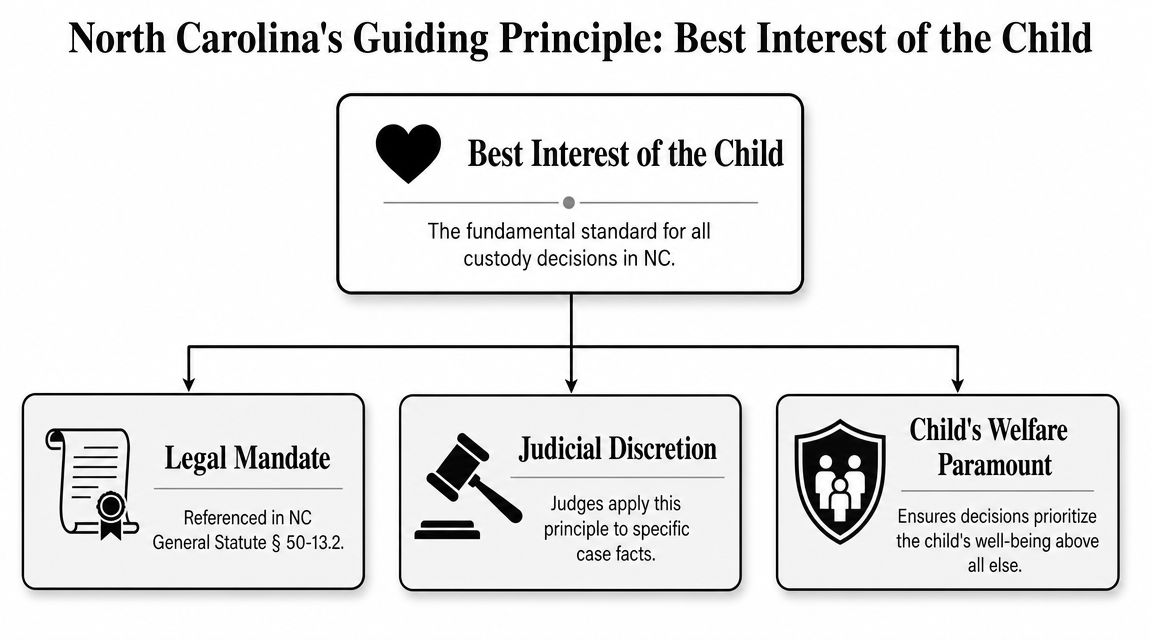
North Carolina custody law centers on one controlling principle. Under N.C. Gen. Stat. § 50-13.2, the court decides custody based on the child's best interests. That sounds simple, but in practice it gives trial judges broad discretion because the law doesn't force them into a rigid formula.
North Carolina courts have long described the child's welfare as the “polar star” guiding custody decisions, and judges may consider “all relevant factors” instead of following a strict checklist or an automatic preference for one parent, as discussed in this explanation of how North Carolina judges determine custody.
Why the standard is broad
That flexibility exists for a reason. Children don't all have the same needs. A preschooler with a heavy transition schedule may struggle in a plan that might work well for a teenager. A child with medical or educational needs may need a parent who has consistently managed specialists, school services, and daily routines.
A broad standard lets a judge look at the whole picture. It also means there is no automatic presumption that mothers should win, fathers should win, or that every case should end in a 50/50 schedule. Those assumptions make people overconfident, and overconfidence hurts custody cases.
If you want a deeper look at how courts analyze this issue, review this discussion of the best interest of the child in North Carolina.
What judges are actually trying to decide
Judges are not trying to decide which parent is more likable. They are deciding which custodial arrangement best promotes the child's interest and welfare. That often means looking at questions like these:
- Who has handled daily care: meals, homework, school forms, medical appointments, discipline, and bedtime routines.
- What arrangement is stable: not just housing, but also routines, transportation, supervision, and follow-through.
- Which parent supports the child's relationships: especially with the other parent, siblings, and important relatives.
- Whether there are safety concerns: including domestic violence, substance abuse, or conduct that destabilizes the child.
What this means for your case
The best-interest standard is flexible, but it isn't random. Judges listen for a persuasive, fact-based story. They want to know how your requested schedule would work on school mornings, during illnesses, over holidays, and when unexpected issues arise.
A parent who can connect facts to the child's daily well-being is usually far more persuasive than a parent who keeps circling back to what feels unfair.
That's the heart of how judges decide custody in North Carolina. They compare competing versions of the child's future and decide which one better serves the child.
Understanding the Types of Child Custody
Before you can evaluate a custody case, you need to know what the court is deciding. In North Carolina, custody usually has two parts: legal custody and physical custody. People often use the word “custody” as if it means only where the child sleeps, but that's only part of the picture.

Legal custody
Legal custody is decision-making authority. It covers major issues such as education, non-emergency healthcare, and sometimes religious upbringing. Parents can share legal custody even when the child primarily lives with one parent.
Think of legal custody as the parenting playbook. Who decides on school changes? Counseling? Significant medical treatment? Extracurricular commitments that affect both households? Those questions fall under legal custody.
Physical custody
Physical custody is the actual living arrangement and parenting schedule. It addresses where the child stays on school nights, weekends, holidays, summer breaks, and regular exchanges.
Physical custody can take several forms:
- Primary physical custody: one parent has the child most of the time, while the other has scheduled parenting time.
- Joint or shared physical custody: the child spends substantial time with both parents, though not always in an exactly equal split.
- Sole physical custody: one parent has nearly all physical custodial time. This is typically tied to serious practical or safety concerns.
For a fuller explanation of shared arrangements, see this page on joint custody in North Carolina.
Why the distinction matters
Parents sometimes say, “I'm fine with joint custody,” without realizing they may mean joint legal custody, joint physical custody, or both. Those are not the same thing. A custody order can mix and match them.
For example, one parent may have primary physical custody because the child's school and weekday routine are centered in that home, while both parents share joint legal custody for major decisions. Another family may have a more balanced physical schedule but still need tie-breaking language because the parents don't communicate well.
The label matters less than the practical terms. A good custody order spells out exchanges, holidays, transportation, school responsibility, and decision-making procedures clearly enough that parents don't end up back in court over avoidable disputes.
Key Factors Judges Evaluate in Custody Cases
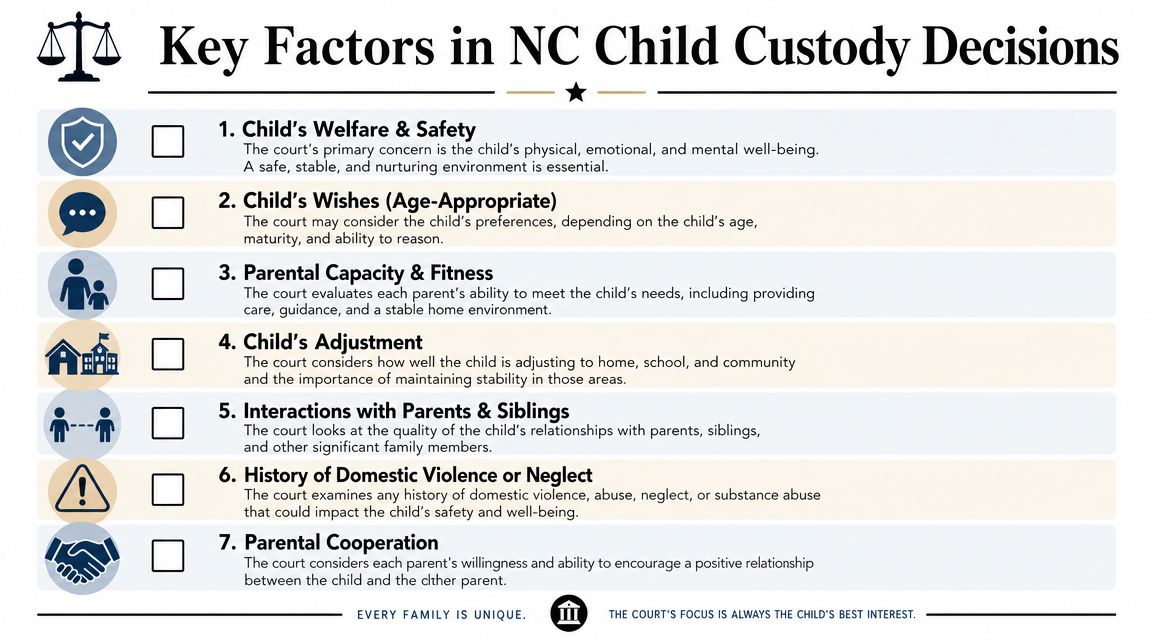
Judges in North Carolina don't use a rigid scorecard, but certain factors come up again and again because they speak directly to a child's welfare. The most effective custody arguments don't just mention these factors. They prove them with details.
Early in the case, it helps to think in two layers. First, what facts help your position? Second, what evidence can prove those facts?
Caregiving history
One of the most important questions is who has been doing the parenting work. Not who says they care more. Not who posts more on social media. The court looks for evidence of real involvement.
That can include school communication, medical appointments, therapy coordination, meal planning, homework supervision, and attendance at activities. If one parent consistently handled the child's daily needs, that history usually matters.
A typical example is a parent who can show they've managed dentist appointments, teacher conferences, medication refills, and day-to-day routines over time. That tells the judge more than a general statement like “I've always been there.”
Stability of each home
Stability isn't only about having a house or apartment. Judges look at whether the household is predictable, safe, supervised, and workable for the child's age and needs.
A parent with a neat home but chaotic routines may look less stable than a parent in a smaller residence with reliable structure. The court may care about school transportation, sleeping arrangements, adult supervision, and whether the child can maintain consistent routines.
Here is where practical trade-offs matter. A demanding work schedule doesn't automatically hurt a parent. But if that schedule means the child is regularly shuffled among caregivers with no consistent plan, the judge may view that as a stability issue.
Parent-child relationships
The court cares about the quality of the child's relationship with each parent and with other important people in the child's life. That includes siblings and close relatives when those relationships shape the child's emotional world.
A parent who knows the child's routines, fears, strengths, and challenges usually presents better than a parent who speaks in broad slogans. Judges notice when testimony sounds rehearsed and detached from the child's actual life.
To make these factors easier to scan, here's a practical summary.
| Factor | What the Judge Looks For |
|---|---|
| Caregiving history | Who has handled day-to-day parenting responsibilities consistently |
| Home stability | Safe housing, predictable routines, reliable supervision, workable logistics |
| Parent-child bond | Meaningful involvement, emotional connection, familiarity with the child's needs |
| Child's adjustment | How the child is doing at home, in school, and in the community |
| Cooperation | Whether a parent supports the child's relationship with the other parent |
| Health and fitness | Physical, mental, and practical ability to meet the child's needs |
| Safety concerns | Domestic violence, substance abuse, neglect, or other risk factors |
Child's adjustment to home, school, and community
North Carolina courts commonly consider how the child is doing in their current environment. A proposed schedule that preserves school continuity and community ties may be more persuasive than one that creates avoidable disruption.
This doesn't mean the current arrangement always wins. If the status quo is unsafe or unstable, the judge can change it. But if a child is doing well in a familiar routine, the parent asking for major change should be ready to explain why that change improves the child's life.
Each parent's judgment and willingness to cooperate
Judges often look closely at whether a parent supports the child's relationship with the other parent. This does not mean the court expects perfect harmony. It means the court watches for sabotage.
Examples that hurt a parent include withholding information, making exchanges harder than necessary, putting the child in the middle, or trying to win by cutting the other parent out. Examples that help include sharing school information, communicating about medical issues, and following temporary agreements responsibly.
A short video can help frame how these issues often play out in practice.
Health, safety, and parental fitness
A judge may weigh work schedules, health concerns, mental health issues, and any domestic violence or substance-abuse history. The key question is not whether a parent is perfect. The question is whether the parent can safely and reliably meet the child's needs.
Many cases are decided by these factors. A parent may love their child and still lose ground if they minimize drinking, fail to follow treatment, ignore the child's medical needs, or expose the child to unsafe partners or conflict.
Strong custody evidence usually answers one question directly: how does this parent's conduct affect the child on ordinary days, not just in court?
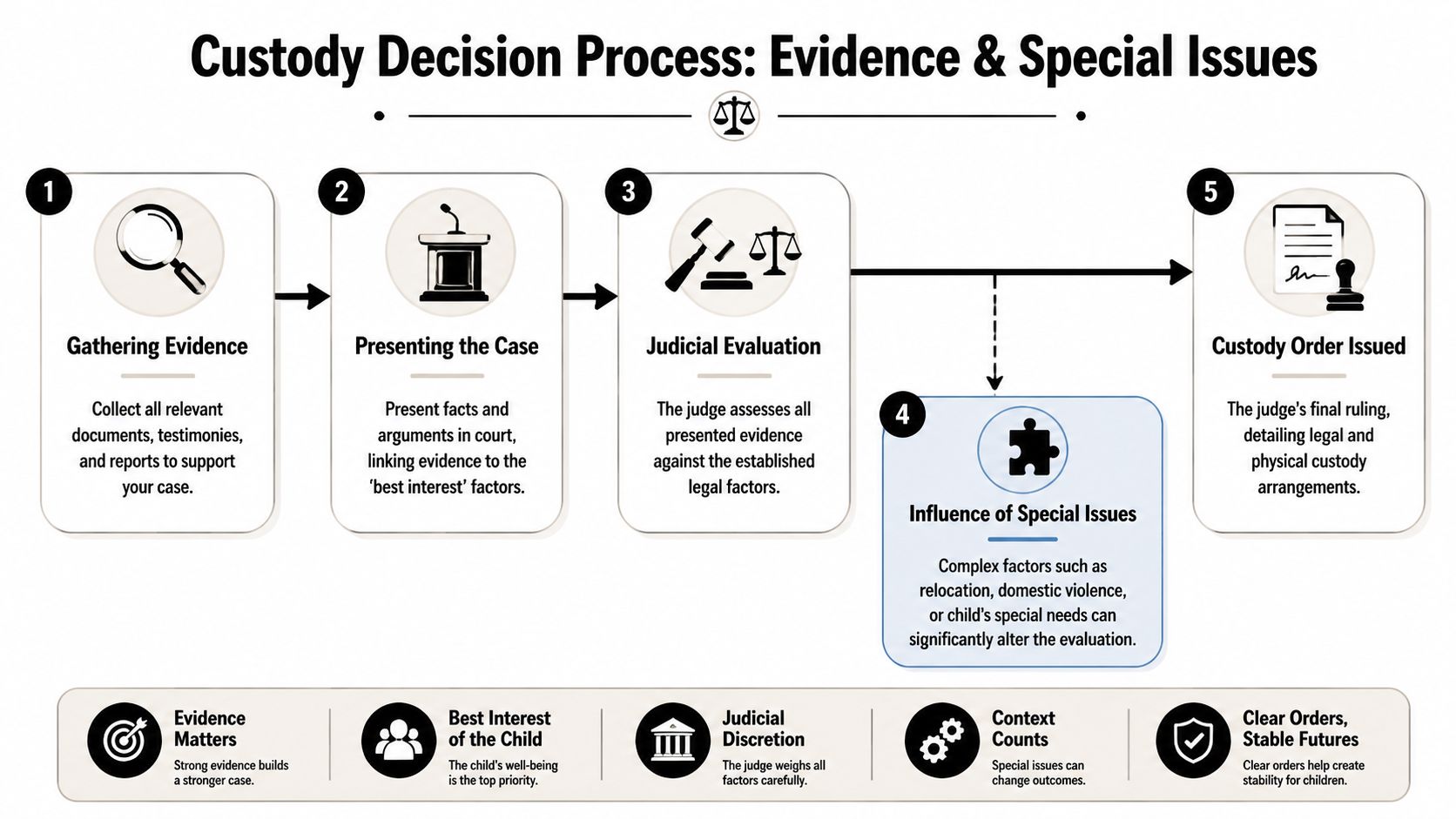
How Evidence and Special Issues Shape the Decision
Knowing the factors is only half the job. Custody hearings are won or lost on proof. Judges hear competing stories all the time. The parent who brings organized, credible, child-focused evidence usually has the advantage.
That evidence often includes documents, testimony, calendars, messages, school records, medical records, and witness accounts from people who have observed parenting. The point is not to dump paper on the court. The point is to show a clear relationship between the facts and the child's welfare.
What good evidence looks like
Useful evidence is specific. “I'm the better parent” is argument, not evidence. “I took the child to these appointments, communicated with the school, handled this diagnosis, and kept this routine” is the beginning of evidence.
Good preparation often includes:
- A parenting calendar: showing overnights, pickups, missed visits, and schedule changes.
- School records: attendance issues, teacher communication, and who responds to school needs.
- Medical documentation: appointment history, medication follow-through, and provider instructions.
- Communication records: especially messages that show cooperation or the lack of it.
- Neutral witnesses: teachers, counselors, coaches, family friends, or caregivers with firsthand knowledge.
Domestic violence and other safety concerns
Safety concerns can alter the entire analysis. If there has been domestic violence, coercive control, serious instability, or dangerous substance use, the court's focus sharpens quickly.
A parent who tries to gloss over violent conduct or repeated unsafe behavior often damages their credibility. Judges pay attention not only to the underlying conduct but also to whether the parent accepts responsibility, seeks treatment, and shows insight into how the child has been affected.
In practical terms, safety claims need support. Police reports, protective order records, medical records, photos, witness testimony, and documented communications can matter. So can evidence showing the child was exposed to conflict even if the child was not the direct target.
A child's preference
This issue causes constant confusion. In North Carolina, there is no fixed age at which a child can choose where to live. A judge may consider the preference of a child with sufficient age and maturity, but it is never the only factor and never controls by itself, as explained in this discussion of when a child can decide which parent to live with in North Carolina.
What matters is not just what the child says, but why. Is the preference based on maturity, comfort, school stability, and emotional needs? Or is it based on looser rules, fewer chores, or pressure from a parent? Judges look at context.
Older children's views may matter. They still don't get to make the legal decision on their own.
Relocation and major proposed changes
Relocation disputes are often really evidence disputes in disguise. One parent says the move creates better opportunities or is necessary for work or family support. The other says it will disrupt school, relationships, and stability.
The judge usually looks for a concrete explanation of how the move affects the child's daily life. Where will the child go to school? How will travel work? What happens to extracurriculars and medical care? How will the child maintain meaningful contact with the other parent?
A parent who presents a realistic transportation and parenting plan usually does better than a parent who offers broad promises.
Grandparents and other nonparents
Third-party custody cases follow a different path than disputes between two parents. A nonparent, such as a grandparent, doesn't start on equal footing with a natural parent.
A judge may award custody to a non-parent if the court finds the natural parent is unfit or has acted inconsistently with their constitutionally protected status as a parent, and the court must also find that third-party custody serves the child's best interest, as summarized in this explanation of how child custody is decided in North Carolina when nonparents are involved.
That's a higher hurdle than many people expect. A grandparent cannot expect to succeed by arguing, “I can offer more.” The legal issue is whether the parent's protected status has been overcome and whether the requested arrangement serves the child's welfare.
Navigating the North Carolina Custody Process
A parent often walks into my office after a difficult exchange, a missed pickup, or a sudden decision by the other parent to keep the child longer than agreed. At that point, the legal standard matters, but so does procedure. Good facts can get buried fast if you miss a deadline, ignore a mediation notice, or show up to court with scattered records.
Most custody cases begin in district court. One parent files a complaint or a motion, depending on whether the court is being asked to enter an initial order or change an existing one. The other parent gets the chance to respond, and from that point on, the court starts looking not just at the dispute itself, but at how each parent handles it.
Filing and the early stage of the case
Early decisions shape the rest of the case. Judges often see the first months after separation as a test of judgment. Who kept the child's routine steady? Who documented problems clearly? Who tried to solve scheduling issues without creating more conflict?
That matters even before a full hearing.
For unmarried parents, one rule catches many fathers off guard. Until a court enters a custody order, the mother usually has physical custody by default. The father may need to establish paternity and file for custody or visitation before the court can set enforceable terms. Once the case is properly before the judge, the court weighs both parents based on the evidence, as explained in this overview of how child custody is determined in North Carolina.
If you need an order in place before the final hearing, it helps to understand the process for getting temporary custody in North Carolina.
Mediation and negotiated parenting plans
Many custody cases in North Carolina go to mediation before trial. Mediation gives parents a chance to resolve parenting time, exchanges, holidays, and decision-making without asking a judge to sort out every disagreement.
A useful mediation session does more than produce an agreement or an impasse. It shows where the underlying dispute is. Sometimes the fight is about school choice. Sometimes it is about transportation, a new partner, or one parent refusing to share information. Pinpointing that issue matters because judges are rarely persuaded by a parent who claims the other side is bad in every way. They respond better to focused concerns supported by specific facts.
Settlement is not always the right answer. If there are credible safety concerns, substance abuse issues, or a pattern of manipulation, agreeing too early can create a bad status quo that is hard to change later.
Preparing for court
Court preparation should be disciplined and practical. Judges hear custody cases all the time. They are used to anger, accusations, and competing stories. What stands out is a parent who can explain the child's day-to-day life clearly and back it up with records.
Useful preparation often includes:
- A clear timeline: major caregiving responsibilities, schedule changes, school concerns, medical issues, and significant communication problems.
- Organized exhibits: texts, emails, calendars, report cards, medical records, and photographs tied to a real issue in the case.
- Witness preparation: teachers, counselors, relatives, or other witnesses who have firsthand knowledge and can stay focused on facts.
- Testimony practice: direct answers, no exaggeration, and no detours into adult grievances that do not affect the child.
Parents often underestimate this part. A stack of screenshots is not a strategy. The stronger approach is to choose the records that prove a point the judge has to decide.
A parent can also work with counsel who handles North Carolina custody litigation. That may mean full representation, limited-scope help in some situations, or guidance from a firm such as Law Office of Bryan Fagan for custody strategy, filings, negotiation, and courtroom advocacy in North Carolina matters.
What helps and what hurts
The parents who present well in custody court usually do the same ordinary things well over time. They get the child to school. They keep medical appointments. They communicate in a way that is calm enough to be shown to a judge later. They make it easy for the court to trust their judgment.
The parents who struggle are often the ones who chase side fights. They argue about every insult, recruit the child into the conflict, or assume the judge will punish the other parent for being difficult. Custody court does not work that way. The judge is deciding where the child is most likely to have stability, sound parenting, and a workable future.
Frequently Asked Questions About NC Custody
Does North Carolina favor mothers in custody cases
No automatic rule gives mothers custody because of gender. Judges decide based on the child's best interests and the evidence in the case. A parent who assumes the law is already on their side often underprepares.
Can a child choose which parent to live with
Not outright. A judge may consider a mature child's preference, but there is no fixed age where the child gets to decide. The court weighs that preference along with the rest of the evidence about the child's welfare.
Can grandparents get custody in North Carolina
Sometimes, but not just because they may offer a better home or more resources. A judge may award custody to a non-parent such as a grandparent if the natural parent is unfit or has acted inconsistently with protected parental status, and the court must also find that the arrangement is in the child's best interest.
Does one parent have to get sole custody
No. Many cases involve shared decision-making, shared parenting time, or a mix of primary physical custody with joint legal custody. The right arrangement depends on the child's needs, logistics, and any safety concerns.
What should I bring to a custody consultation
Bring anything that helps tell the child's day-to-day story clearly. That may include existing court orders, school records, medical records, calendars, important messages, and a short timeline of major events. The more concrete you are, the easier it is to evaluate the strengths and risks in your case.
Protect Your Family with Strategic Legal Guidance
A custody case can turn on ordinary facts. Who gets the child to school on time. Who follows through with counseling. Who can show the judge a parenting plan that fits the child's routine instead of a position built around anger at the other parent.
Judges in North Carolina do not decide these cases by checking boxes. They weigh competing facts, credibility, and practical consequences. A parent may love the child very much and still hurt the case by showing poor judgment, weak follow-through, or an unrealistic proposal. Another parent may have flaws but present stronger evidence of stability and better decision-making for the child.
That is why general advice only goes so far. A sound custody strategy has to fit your facts, the history between the parents, the local court's expectations, and the issues that tend to carry weight in real hearings, including school performance, communication patterns, safety concerns, and whether a child's stated preference appears mature and independent or influenced by pressure.
Good legal guidance helps you do more than gather paperwork. It helps you decide what evidence matters, what problems need to be addressed directly, and what custody arrangement a judge is likely to approve. It also helps you avoid avoidable mistakes, especially when text messages, social media posts, new relationships, or family involvement could distract from the issues the court cares about most.
If you are dealing with a custody dispute, separation, or parenting-time conflict in North Carolina, Law Office of Bryan Fagan can help you assess your options, prepare your case, and protect your child's future with a strategy grounded in North Carolina family law. Schedule a consultation to discuss your situation and the next practical steps.