When you're facing a separation, the first and most urgent question is often, "Where will the children live right now?" Getting temporary custody in North Carolina provides that immediate answer. It’s a court-ordered arrangement designed to bring stability to your child's life while the larger, permanent custody case unfolds.
What Is Temporary Custody and Why It Matters in NC
Think of a temporary custody order as a critical first step, not the final word. When parents separate, disagreements over daily schedules, school routines, or overnight stays can quickly create chaos and anxiety for a child. A temporary order establishes clear, legally enforceable ground rules that prevent ongoing conflict.
Most importantly, it gives your child much-needed predictability during a very difficult transition.
For example, imagine you and the other parent just moved into separate homes and can't agree on a consistent schedule. One week, the child is with you; the next, the other parent changes the plan without notice. This is exactly the kind of instability a temporary custody order is designed to stop.
The Legal Foundation in North Carolina
In North Carolina, temporary custody is governed by North Carolina General Statutes Chapter 50. The court’s primary focus—for any custody order, temporary or permanent—is always the “best interest of the child.” This means a judge will look at all relevant factors to decide on an arrangement that will best promote the child's welfare, safety, and happiness.
A temporary order can dictate several key aspects of your child's life, including:
- Physical Custody: This determines where the child will physically live and establishes a residential schedule (e.g., alternating weeks, or one parent having the child during school nights).
- Legal Custody: This outlines who has the authority to make important decisions about the child's education, healthcare, and religious upbringing.
- Visitation Schedules: It sets specific days and times for the non-custodial parent to see the child.
A Common Misconception Addressed
Many parents worry that a temporary custody arrangement will automatically become the permanent one. While it's true that judges prefer not to disrupt a stable environment that is working well, a temporary order is not set in stone.
Key Insight: A temporary order creates a "status quo." If a child is thriving under that arrangement for several months, a judge will be hesitant to make a big change later without a compelling reason. This makes getting the temporary order right from the start incredibly important.
However, the court will still conduct a full hearing for permanent custody, where new evidence and changed circumstances can be presented. The temporary order is simply a placeholder, designed to work until a permanent solution is reached through mediation, agreement, or a final trial.
Because of its potential influence, understanding the nuances of North Carolina child custody law is essential. Taking swift, informed action to establish a favorable temporary order can set a positive precedent for your family's future.
Standard Motion vs. Emergency Order: Which Custody Path Is Right for You?
When you’re facing a separation in North Carolina, one of the first and most critical questions is how to handle child custody right away. The path you choose depends entirely on the urgency of your family’s situation. Knowing the difference between a standard motion and a request for an emergency order is crucial—it can dramatically shape the initial outcome of your case.
The most common approach is filing a standard motion for temporary custody. This is the proper legal tool for typical disagreements that pop up when parents separate. For instance, if you can't agree on a weekly schedule, who gets the kids for an upcoming holiday, or which school they should attend, a standard motion is your path forward.
This process involves filing the right paperwork with the court and getting a formal hearing date on the calendar. At the hearing, both parents get their day in court to present evidence and argue their side. A judge will then make a decision and issue a temporary order based on what they believe is in the child's best interests.
When Is a Situation a True Emergency?
A much more immediate, and serious, route is seeking an emergency ex parte custody order. "Ex parte" is a legal term meaning the judge can hear from just one side—you—without the other parent even being there. Because it’s such an extreme measure that strips the other parent of their rights without a chance to respond, North Carolina courts only grant these orders in truly dire circumstances.
Under North Carolina General Statute § 50-13.5(d)(3), a judge can only issue an emergency order if you provide clear evidence that the child faces a substantial risk of immediate bodily injury, sexual abuse, or abduction. Vague worries or disagreements over parenting styles simply won't meet this high legal bar.
Think about it this way: You get a text from a reliable source with photos showing the other parent using illegal drugs in the home while your child is present. That's a direct and immediate danger, and it’s the kind of situation that would likely justify filing for an emergency order.
On the other hand, a heated argument over who gets to take the child on a weekend trip, while stressful, isn't an emergency in the eyes of the court. For that, you’d use the standard motion process.
This flowchart can help you visualize how these decisions are made when a temporary order is needed.
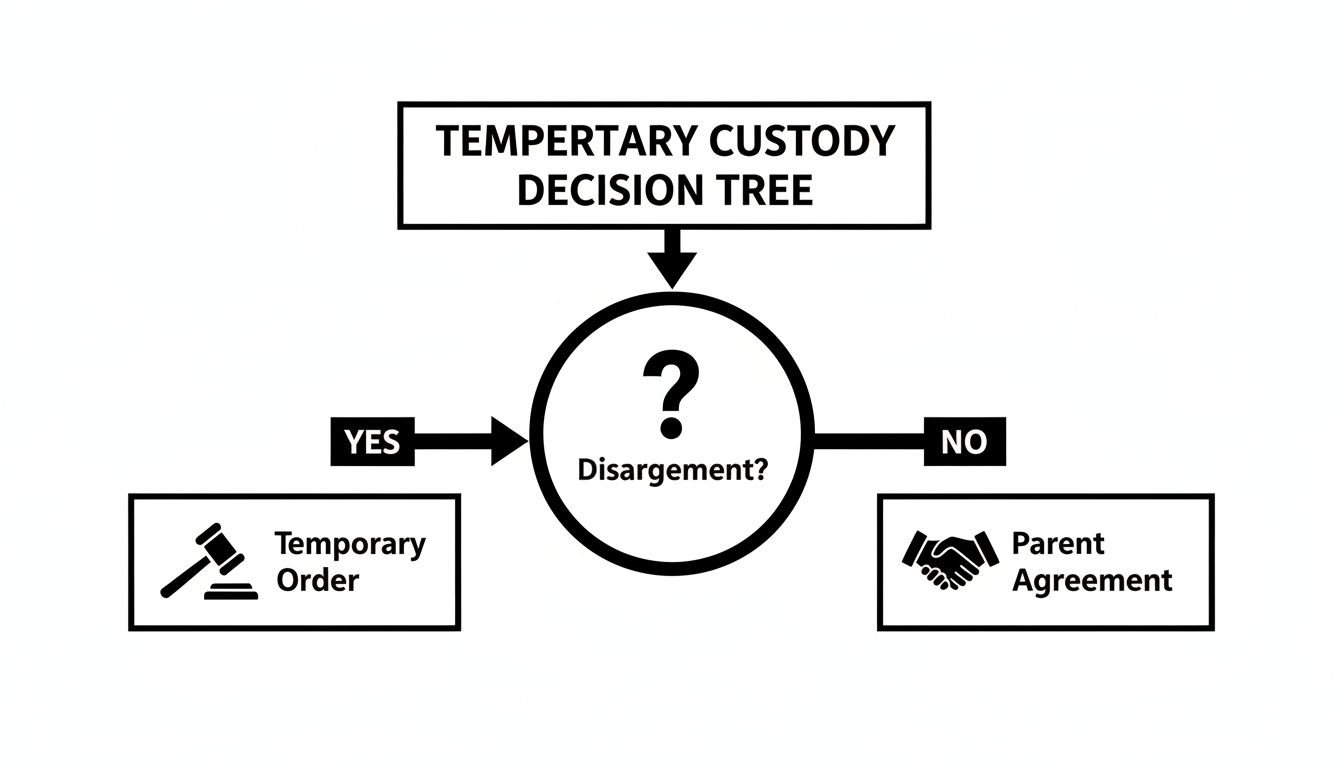
As you can see, when parents can’t find common ground, a temporary order from the court provides a necessary path to resolution. If they can agree, they can bypass this formal step.
When deciding which path to take, it’s helpful to see the differences side-by-side.
Standard vs Emergency Temporary Custody in North Carolina
| Feature | Standard Temporary Custody | Emergency (Ex Parte) Custody |
|---|---|---|
| Justification | General disagreements (schedules, holidays, school) | Substantial, immediate risk of harm or abduction |
| Initial Hearing | Both parents must be notified and can attend | Only the filing parent is present (ex parte) |
| Timing | Hearing is scheduled weeks or months out | An immediate order is issued, often same-day |
| Follow-Up | The temporary order stands until the next hearing | A mandatory hearing with both parents must occur within 10 days |
| Evidence | Standard rules of evidence apply | Must present clear proof of imminent danger |
This table makes it clear that while an emergency order is faster, it's reserved for situations where a child's safety is on the line. Filing a standard motion is the appropriate process for nearly all other custody disagreements.
What Happens After an Emergency Order Is Granted?
If a judge grants your ex parte motion, you get a temporary custody order on the spot. But the fight isn’t over. The law is designed to protect the other parent’s due process rights, so a follow-up hearing with both parents present is required by law to happen within 10 days.
At that second hearing, the judge will hear from both of you and review all the evidence. Based on what’s presented, the judge will then decide whether to keep the emergency order in place, change it, or get rid of it altogether.
Crucial Takeaway: Be very careful before filing an emergency motion. If you don’t have solid proof of immediate harm, a judge might see your filing as an attempt to game the system. This can seriously damage your credibility and hurt your entire custody case down the road.
The risk of abduction is a major factor courts consider, not just in North Carolina but worldwide. The Hague Convention on the Civil Aspects of International Child Abduction, signed by over 90 countries, shows just how seriously the global community takes preventing a parent from wrongfully removing a child. Establishing a clear, court-ordered temporary custody arrangement is your best defense against something like this and provides critical stability for your child when they need it most. You can discover more insights about the complexities of international child custody to understand why these orders are so essential.
Filing Your Motion for Temporary Custody

Starting the legal process for temporary custody isn't just about filling out paperwork; it's about strategically building the foundation of your case. Every document you file with the court tells a part of your story, and getting it right from the beginning is critical.
Let’s walk through the essential paperwork and the steps you’ll need to take to file correctly in North Carolina.
The Key Legal Documents You Will Need
To officially open a custody case, you’ll need a specific set of documents. Each one has a distinct legal purpose, and they all work together to state your request to the court and properly notify the other parent.
- Complaint for Custody (AOC-CV-600): This is the official document that starts your custody case. It identifies you, the other parent, and your child, and it formally asks the court to grant you custody.
- Civil Summons (AOC-CV-100): This form serves as the official notice to the other parent that a lawsuit has been filed. It legally commands them to file a response within 30 days.
- Motion for Temporary Custody: This is the document that makes your immediate request. Filed alongside the Complaint, it asks the judge to schedule a prompt hearing to establish a temporary custody order, giving you a clear schedule while the rest of the case proceeds.
These documents are the mandatory starting point. A mistake on any of them can cause significant and costly delays, preventing your case from moving forward.
Writing a Compelling and Factual Affidavit
Your Motion for Temporary Custody must be supported by a sworn affidavit. This is your written testimony, signed under oath, explaining to the judge why you need a temporary order and why your proposed schedule is in your child's best interest.
This is often the first opportunity you get to tell your side of the story directly to the judge. A well-written affidavit is factual, specific, and laser-focused on the child's needs. Emotional language and vague complaints won't persuade a judge—clear facts will.
An effective affidavit provides a clear, chronological narrative. Describe specific events with dates, times, and locations. Instead of saying, "The other parent is unreliable," state, "On Tuesday, October 15th, the other parent was 45 minutes late for school pickup without notice, causing our child to miss her scheduled tutoring session."
Think about a real-world situation. Imagine a parent named Alex needs to establish a consistent school-week schedule. The other parent's unpredictable work hours are causing their child to be frequently tardy or absent from school.
In this scenario, Alex’s affidavit wouldn't just claim the current situation is "chaotic." It would list the exact dates the child was marked tardy, attach a copy of the school's attendance record as an exhibit, and clearly explain how a stable five-day schedule with Alex would resolve this specific problem. That’s the kind of fact-based evidence that judges find persuasive.
The Logistics of Filing and Service of Process
Once your documents are prepared and signed, you must file them with the Clerk of Court in the county where the child lives. You'll pay a filing fee, and the Clerk will give you a case file number and assign a judge.
After filing, the other parent must be formally notified of the lawsuit. This is called "service of process," and you cannot just hand them the papers yourself.
Proper service options in North Carolina include:
- Sheriff's Office: You can pay the sheriff in the county where the other parent lives or works to personally deliver the lawsuit documents. This is often the most reliable method.
- Certified Mail: Sending the documents via certified mail with a return receipt requested is another option. You must receive the green signature card back to prove delivery.
- Acceptance of Service: The other parent can agree to sign an "Acceptance of Service" form, voluntarily acknowledging they received the documents without formal service.
Failing to properly serve the other parent is one of the most common and frustrating mistakes we see. If service isn't done correctly, the court has no authority to hear your case, and your hearing will be postponed until it's fixed. Understanding these procedural rules is essential, as they apply across many family law matters, including the overall process of navigating a North Carolina divorce.
How to Prepare for Your Temporary Custody Hearing

Your temporary custody hearing is the first—and often most critical—opportunity to present your case to a judge. The outcome will be decided based on a single guiding principle: the “best interest of the child.”
Keep in mind, these hearings move quickly, sometimes lasting less than an hour. You need to walk in organized, focused, and ready to demonstrate why your proposed custody arrangement provides the stability and well-being your child needs.
Gather Your Evidence Strategically
A judge needs facts, not just your opinion of the other parent. Strong, organized evidence will always be more persuasive than emotional arguments alone. Your goal is to gather proof that either reinforces your fitness as a parent or raises valid concerns about the other parent's ability to provide a safe environment.
For example, simply telling the judge, "They're unreliable," won't get you very far. But presenting a calendar that tracks every late or missed pickup over the past three months? That turns a general complaint into concrete data the judge can use.
Consider this checklist of powerful evidence to bring:
- Communication Records: Printouts of text messages or emails that show instability, harassment, or admissions of poor judgment by the other parent.
- Child's Records: Report cards, school attendance records, or notes from teachers that reflect how the child is doing.
- Photographs and Videos: Visual proof of a safe, clean home environment you provide or, conversely, evidence of unsafe conditions at the other parent's home.
- Financial Documents: Pay stubs and bank statements can prove your ability to financially support the child.
- Witnesses: Testimony from a neutral third party, like a teacher or daycare provider, can offer credible insight into your child's needs and your involvement.
Pro Tip: Never walk into court with a disorganized stack of papers. We advise our clients to organize all evidence in a binder with clearly labeled tabs for each exhibit (e.g., “Exhibit A: Text Messages,” “Exhibit B: School Attendance”). This small step shows the judge you are prepared and respect the court’s time.
Understand Courtroom Etiquette and Presentation
How you conduct yourself in the courtroom matters immensely. A judge is evaluating more than just the facts; they are observing your demeanor, your respect for the process, and your ability to stay composed. These observations heavily influence their perception of your credibility as a parent.
It might feel overwhelming, but North Carolina family courts are designed to handle these exact situations. Courts across the country manage around 3.8 million family law cases each year, with a significant number involving custody and support. This experience means judges can quickly assess family dynamics. You can learn more about how courts manage the sheer volume of cases in the system.
Here are the key points we drill with our clients on how to present themselves effectively:
- Dress Professionally: Business casual attire demonstrates respect for the court. Avoid jeans, t-shirts, and anything flashy.
- Address the Judge Correctly: Always use "Your Honor." Stand when you speak to the judge and when they enter or leave the courtroom.
- Speak Calmly and Clearly: Stick to the facts. Do not interrupt the other parent or their attorney, no matter how much you disagree. Your attorney will have a chance to respond.
- Be Child-Focused: Frame every request around your child’s needs. Instead of saying, "I want more time," explain why the time is beneficial: "A consistent weeknight schedule is crucial for my child to finish homework and get enough sleep for school."
Your objective is to be seen as the stable, reasonable parent who is focused on a positive outcome for your child. A calm, well-prepared presentation is always more effective than an emotional one.
Understanding the Outcome of Your Hearing
The moment the judge announces their decision is when your family's immediate future takes shape. Whether your request for temporary custody is granted, denied, or modified, the hearing ends with a formal, legally binding Temporary Custody Order. This document is now the rulebook for your co-parenting relationship, and it's critical to understand exactly what it means and what comes next.
This order is not a suggestion. It is a direct command from the court that both parents must follow to the letter. Any violation can bring serious legal consequences, potentially harming your position in the final custody case.
What Is in a Temporary Custody Order?
A well-drafted Temporary Custody Order is designed to leave no room for guesswork. It provides a clear, practical roadmap for your child's life until a permanent custody agreement is reached.
Typically, the order will clearly define:
- Physical Custody Schedule: This details exactly where the child will be on which days, including specific times for exchanges. For instance, it might state, "The Plaintiff shall have the minor child from Sunday at 6:00 p.m. until Friday at 3:00 p.m. during the school year."
- Legal Custody Provisions: This outlines who has the authority to make major decisions for your child. It may grant one parent sole legal custody (decision-making power) or require parents to decide jointly on major issues like schooling, non-emergency medical care, and religious upbringing.
- Holiday and Vacation Schedules: The order almost always includes a plan for major holidays and school breaks to prevent future arguments before they start.
- Communication Guidelines: It may also set rules for how and when parents can communicate with each other and with the child, which can be invaluable in high-conflict situations.
What if the Outcome Was Not What You Hoped For?
It is deeply disappointing when a judge’s ruling doesn’t line up with what you know is best for your child. But it is vital to remember that a temporary order is not the final chapter of your custody case.
Key Takeaway: A temporary order is designed to create stability now, but it remains in effect only until a permanent custody determination is made. This can happen through a negotiated settlement, mediation, or a full custody trial where much more evidence can be presented.
Even if you strongly disagree with the outcome, you must comply with the order while you plan your next moves. Failing to follow the court’s command can severely damage your credibility and hurt your chances of achieving a better result down the road.
Think of this temporary phase as a bridge to the next stage of your legal process.
The Next Step Is Often Mediation
In many North Carolina counties, once a temporary order is in place, the court will require both parents to attend mandatory custody mediation. This is a structured, confidential process where a neutral third-party mediator helps you and the other parent try to reach a permanent agreement on your own terms.
Mediation gives you a powerful opportunity to resolve your case without more costly and stressful court battles. It puts you in control of the final outcome, rather than leaving those deeply personal decisions in the hands of a judge. A successful mediation results in a "Parenting Agreement," which can then be signed by a judge and converted into a permanent, final custody order.
Understanding the temporary order and preparing for what comes next—whether it's mediation or building a case for trial—is essential. This is where strategic legal guidance can make all the difference in shaping your family’s long-term future.
When You Need a North Carolina Family Law Attorney
While this guide gives you a solid foundation, no article can ever replace personalized legal advice. The truth is, the stakes in any custody case are incredibly high. Trying to navigate the North Carolina family court system on your own is a huge risk, especially when your child’s well-being is on the line.
Some custody disputes go far beyond simple disagreements and absolutely demand professional legal guidance. An experienced family law attorney does so much more than file paperwork—they build a legal strategy tailored to your family's unique situation, fight to protect your parental rights, and serve as your advocate in the courtroom.
Situations That Almost Always Require an Attorney
If your case involves any of the following complexities, handling it yourself puts you at a severe disadvantage. These are red flags that you need a professional in your corner.
- Allegations of Abuse or Neglect: As soon as claims of domestic violence, substance abuse, or child endangerment enter the picture, the case becomes extremely serious. An attorney is critical for gathering the right evidence and presenting these sensitive facts effectively to a judge.
- Interstate Custody Issues: If the other parent lives in another state or is threatening to move, the case gets complicated fast. It falls under specific laws like the Uniform Child Custody Jurisdiction and Enforcement Act (UCCJEA), which are tough to navigate alone.
- Significant Financial Disparity: Facing a co-parent who has far more money to spend on legal fees can feel like an impossible uphill battle. A good attorney knows how to level the playing field and ensure you get a fair shot in court.
- High-Conflict Co-Parenting: When communication with the other parent is hostile, manipulative, or has broken down completely, a lawyer can act as a necessary buffer. They handle all communication and negotiations, shielding you from the conflict.
An attorney’s job is to focus on the legal strategy so you can focus on your child. They anticipate the other side's moves, make sure every deadline is met, and present your case in the most compelling way possible.
Understanding the full scope of your options is a critical first step. For a deeper look at the services we offer, you can learn more about our North Carolina family law practice.
Frequently Asked Questions About NC Temporary Custody
Navigating a custody dispute raises countless questions, and the uncertainty can be overwhelming. Here are straightforward answers to some of the most common concerns we hear from clients in North Carolina.
How long does it take to get a temporary custody hearing in NC?
The timeline depends on your local court's calendar. For a standard motion, you can typically expect a hearing date within 30 to 60 days of filing. However, if you have evidence that your child is at immediate risk of harm, you can file for an emergency order. A judge can hear your request within a few days, and if granted, a follow-up hearing with both parents present is legally required within 10 days.
Can a grandparent get temporary custody in North Carolina?
Yes, but it is a difficult legal path. Under North Carolina law (N.C.G.S. § 50-13.1), there is a strong legal presumption that fit parents have the right to raise their own children. To overcome this, a grandparent must first prove that the parents are unfit or have acted inconsistently with their parental rights (for example, by voluntarily leaving the child in the grandparent's care for a long period). Only after meeting this high standard will the court consider if awarding custody to the grandparent is in the child’s best interest.
What if the other parent violates the temporary custody order?
A temporary custody order is a legally binding court command. If the other parent fails to follow it, you can take immediate legal action by filing a Motion for Contempt and Order to Show Cause. This requires the other parent to appear before the judge and explain why they violated the order. If the judge finds the violation was willful, they can order the parent to pay your attorney’s fees, impose fines, or, in severe cases, order jail time.
How much does a temporary order influence the final custody decision?
While not technically final, a temporary order has a significant practical impact. Judges prioritize stability for children. If a child has been safe, happy, and doing well under a temporary schedule for several months, a judge will be very reluctant to make a major change without a compelling reason. This "status quo" effect makes the temporary custody hearing a crucial moment in your case.
Take Control of Your North Carolina Custody Case
Navigating the complexities of a temporary custody filing in North Carolina can feel overwhelming, but you don't have to face it alone. The initial decisions made in your case can set the stage for your family's future. An experienced family law attorney can help you protect your rights and build a strong strategy focused on your child's well-being.
At the Law Office of Bryan Fagan, our team is dedicated to guiding North Carolina residents through these challenging times with empathy and legal expertise. Schedule a consultation with us today to discuss the specific details of your case and take the first step toward securing a stable future for your family.