You may be reading messages from an ex-partner who keeps showing up at your home, a co-parent who has become threatening, or someone you once trusted who now makes you afraid to answer the door. You want protection quickly, but you also need to know what a restraining order in North Carolina can accomplish. A court order can create enforceable boundaries, but it can't replace a safety plan, guarantee that another person will obey, or automatically resolve custody and criminal issues.
North Carolina uses several protective-order procedures. The right one depends on your relationship with the other person, the conduct involved, the urgency of the situation, and the relief you need. The following overview focuses on the gap between expectations and courtroom reality, so you can make decisions based on North Carolina law rather than assumptions.
What a Restraining Order Means Under North Carolina Law
Consider a common situation. A former dating partner begins sending repeated messages, waits near your workplace, and threatens to harm you. If you were married, lived together, dated, share a child, or otherwise have a qualifying personal relationship, a 50B domestic violence protective order may be the appropriate civil remedy. If you don't have that qualifying relationship, a 50C civil no-contact order may be more suitable when the conduct involves stalking or other qualifying unlawful conduct.
In everyday conversation, people call both documents “restraining orders.” North Carolina law treats them as distinct legal tools governed by different statutes. A 50B order addresses domestic violence involving people with a qualifying relationship under Chapter 50B. Chapter 50C provides a separate civil no-contact process for stalking or nonconsensual sexual conduct situations when the parties don't have the relationship required for a 50B order. The North Carolina Chapter 50C statute identifies the order as one issued under that chapter with remedies authorized by the statute.
The basic function is practical. A protective order can prohibit contact, require a person to stay away from specified locations, and provide other remedies authorized by the applicable statute. It creates a court-enforced boundary. It doesn't physically stand between you and the other person, monitor every interaction, or eliminate the possibility of escalation.
Civil protection is not the same as guaranteed safety
A protective order is generally a civil proceeding, although violating certain orders can produce criminal consequences or contempt proceedings. The judge decides whether the statutory requirements are met and what relief the order should contain. The order's wording matters, including provisions concerning communication, residence, children, firearms, and other protected interests.
If the situation is urgent, you may ask for emergency relief before the other party has an opportunity to appear. That request still requires specific sworn facts. General statements such as “I'm scared” may communicate the seriousness of your situation, but the complaint should explain what happened, when it happened, how the conduct affected you, and why immediate protection is needed.
Practical rule: Treat the order as one part of a larger safety plan. Save a copy, understand every restriction, tell appropriate people, and decide in advance what you'll do if the other person appears or contacts you.
The order also has a legal life cycle. A final 50B order can last up to one year, and North Carolina law allows renewal for fixed periods of up to two years at a time when the renewal request is filed before expiration. The order expires at 11:59 p.m. on the listed expiration date unless it provides otherwise, so waiting until after expiration can create a serious procedural problem. The duration rules make renewal planning part of compliance and safety planning, not an administrative detail. North Carolina General Statutes Chapter 50B contains the controlling statutory language.
Types of Protective Orders Available in North Carolina
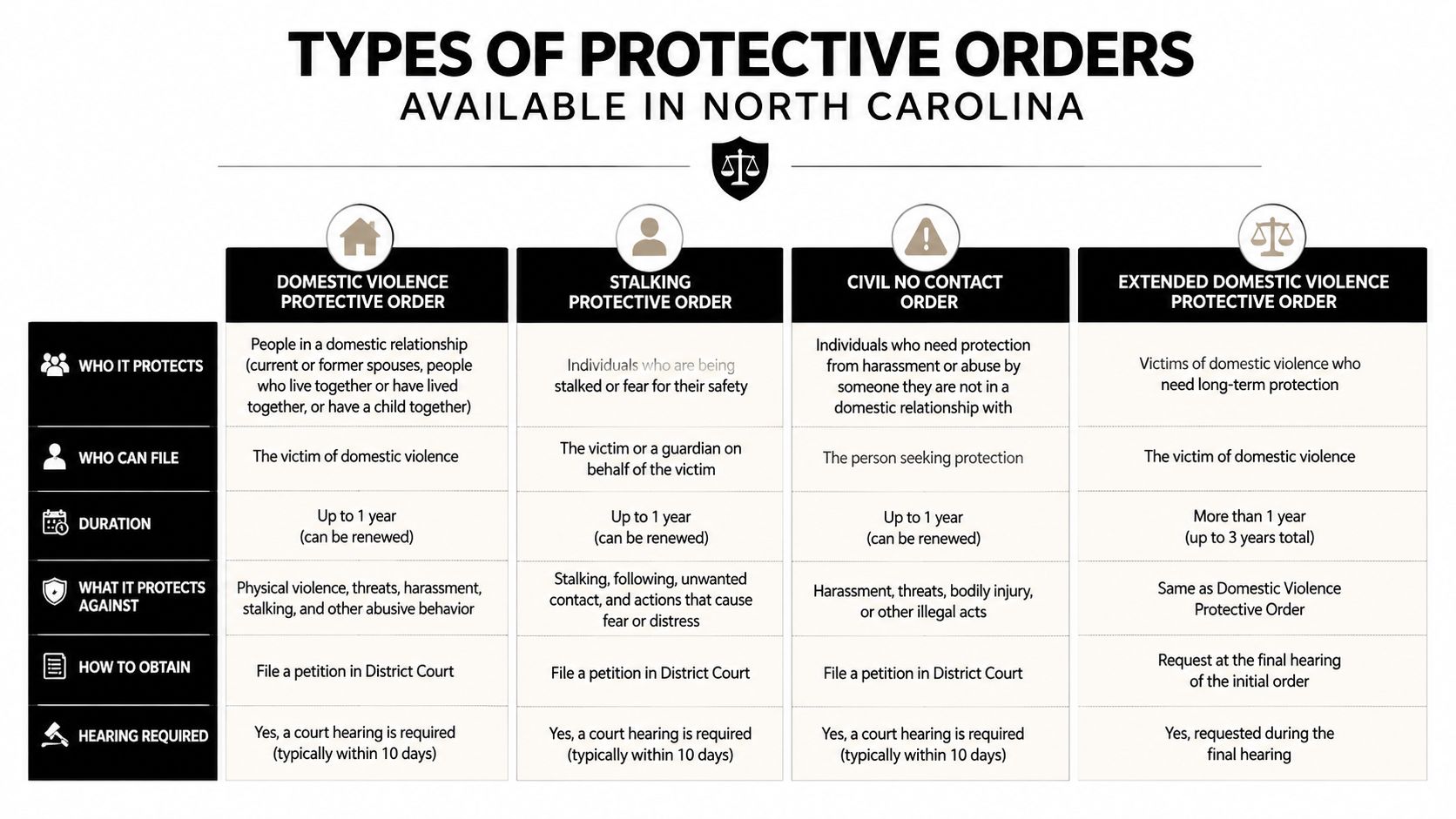
The first decision is identifying the legal category. A person seeking protection from a spouse or former dating partner usually starts by evaluating Chapter 50B. A person being stalked by an acquaintance, neighbor, or stranger may need Chapter 50C instead. A juvenile-related situation can involve a separate Chapter 50D process.
The main distinctions
A 50B domestic violence protective order, often called a DVPO, requires both a qualifying personal relationship and conduct that meets North Carolina's domestic-violence definitions. Potential qualifying relationships can include spouses, former spouses, people who live or lived together, people who have a child in common, and people in certain dating or household relationships. The alleged conduct may include bodily injury, fear of imminent serious bodily injury, or qualifying harassment that causes substantial emotional distress.
A 50C civil no-contact order doesn't depend on the 50B relationship category. It addresses qualifying unlawful conduct, including stalking or certain nonconsensual sexual conduct, when the parties don't meet the relationship requirement for a DVPO. A public disagreement or upsetting speech isn't automatically enough. The alleged conduct must satisfy the statutory requirements, and constitutional protections may matter when the requested order would restrict public expression.
A 50D order concerns juvenile victims of dating violence or sexual violence and operates within its own statutory framework. The facts, parties, and requested relief should be reviewed carefully because the correct filing path can depend on the ages and relationships involved.
| Order Type | Who Can File | Qualifying Relationship | Key Remedies |
|---|---|---|---|
| 50B domestic violence protective order | A person alleging domestic violence | A relationship recognized by Chapter 50B | No-contact and stay-away provisions, along with other statutory relief that may include temporary custody |
| 50C civil no-contact order | A victim of qualifying unlawful conduct | No qualifying 50B relationship is required | Civil no-contact remedies authorized by Chapter 50C |
| 50D juvenile protective order | Eligible juvenile victims or appropriate representatives under the statute | Relationship and conduct requirements under Chapter 50D | Relief available under the juvenile protective-order statute |
A person may read about Domestic Violence Protective Orders in North Carolina to understand how to obtain or respond to a 50B protective order in North Carolina. For a more focused discussion of the DVPO process, see this North Carolina domestic violence protective order resource.
Why the category matters
Suppose a former spouse sends threats and appears at the shared home. The relationship may support a 50B filing, and the complaint may need to address both the relationship and the specific domestic-violence conduct. By contrast, if a former coworker repeatedly follows you and sends unwanted communications, a 50C analysis may be more appropriate.
The label also affects available remedies, hearing procedures, and enforcement. Filing the wrong type of case can distract from the urgent facts and delay the relief you're seeking. A North Carolina attorney can help separate conduct that is frightening from conduct that meets the statutory elements, then identify the court process that fits.
The video below provides additional general context about protective orders and the legal process:
How to File for a Protective Order in North Carolina
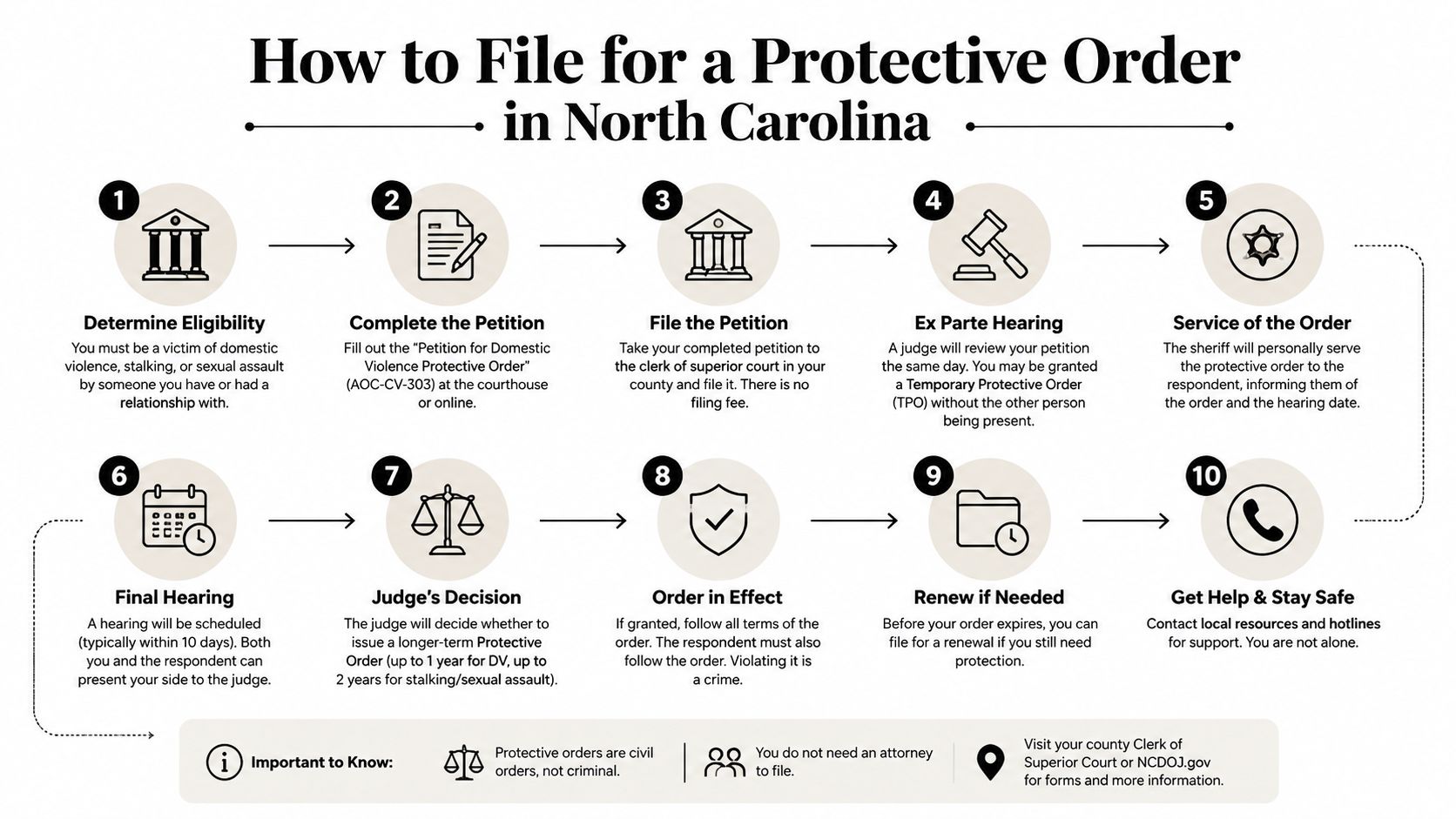
A strong filing tells the judge what happened in a clear, chronological way. Start by identifying the relationship, the conduct, the dates or approximate time periods, any threats or injuries, and why you believe contact or proximity creates a present concern. Avoid exaggeration. Specific facts are more useful than conclusions.
Preparing the complaint
Gather material that helps establish the conduct and its effect. Useful evidence may include:
- Messages and call records: Preserve texts, emails, voicemails, direct messages, and relevant call logs. Keep the surrounding conversation rather than only isolated screenshots.
- Police and medical records: Bring incident information, photographs, discharge paperwork, or other records that support an account of threats or injury.
- Witness information: List people who saw an incident, heard threats, observed injuries, or can describe a change in your safety circumstances.
- A chronological summary: Write a concise timeline before filing. It can help you answer questions accurately under pressure and identify missing evidence.
You generally file through the appropriate North Carolina court in the county connected to the parties or events. Court staff can explain where forms are submitted, but they can't provide legal advice or decide which allegations satisfy the statute. If you're seeking a 50B order, the 50B order process in North Carolina may help you understand the basic filing and hearing framework.
Emergency relief and the full hearing
An ex parte order is temporary relief considered before the respondent has been heard. For a 50C temporary order, the statute requires a verified complaint or affidavit showing specific facts that immediate injury, loss, or damage will occur before the respondent can be heard. The complainant must also address notice efforts or explain why notice shouldn't be required. The North Carolina statute governing temporary 50C orders illustrates why sworn details matter.
The court may then schedule a hearing where both sides can present evidence. Bring organized documents and follow the existing order precisely if temporary relief is granted. Don't contact the respondent to negotiate around the order, even if the other person says they want to resolve matters informally. If communication is necessary for children or property, use only the method and limits authorized by the order.
The process can feel fast, but preparation still matters. A judge must apply the statutory standard to the evidence presented, and vague or incomplete allegations can create problems at both the emergency stage and the later hearing.
Understanding the Limits of Protective Orders
A protective order can tell another person what the court prohibits. It can't ensure that the person will comply. That distinction is central to realistic safety planning.
North Carolina protective-order cases occur at significant statewide volume. A publicly reported court statistic showed that more than 32,600 people sought protective orders in 2018, while the state court system later reported roughly 20,000 protective-order filings statewide in fiscal year 2025. These figures appear in the North Carolina protective-order profile. The demand shows that protective orders are a major family-law and safety issue, not an unusual courtroom event.
The safety limits are serious. A 2025 state homicide-review report stated that 7 of 162 homicide victims had previously obtained protective orders, and 5 of those orders were still active when the homicide occurred, as reported in the North Carolina domestic violence homicide review material. Those facts don't mean protective orders are useless. They show that a civil order is not a complete response to escalating violence, repeated abuse, firearms, stalking, or a person willing to violate court instructions.
Duration and renewal require planning
A final 50B order can last up to one year. If the request is filed before expiration, a court may renew it for fixed periods of up to two years at a time. The order expires at 11:59 p.m. on the listed expiration date unless the order says otherwise, so a protected person should review the expiration date well before the deadline.
The order's duration also affects practical decisions. Housing changes, school arrangements, workplace security, communication systems, and custody planning may need attention before the order ends. Renewal is not a substitute for updated evidence or a current explanation of why protection remains necessary.
A protective order creates legal consequences. It doesn't create physical security by itself.
What enforcement can and cannot do
If the respondent violates the order, preserve evidence and contact law enforcement when appropriate. Give officers the current order and describe the specific provision that was violated. Enforcement may lead to arrest, criminal charges, or another court proceeding depending on the order and alleged conduct, but no lawyer can promise how officers, prosecutors, or a judge will respond to a particular incident.
Build a response plan that doesn't depend on the order alone. Identify a safe place, alert trusted people, review device and account security, vary routines when necessary, and ask law enforcement or a domestic-violence service about safety resources. The court order is important, but the safest strategy usually combines legal enforcement with practical steps outside the courthouse.
If separation or divorce is also part of the situation, the North Carolina absolute divorce process addresses the steps, residency rule, and filing requirements for an NC divorce. A divorce filing doesn't replace protective relief, and a protective order doesn't complete the divorce process.
How Protective Orders Interact with Custody and Criminal Law
A 50B order can affect children without deciding the entire custody case. North Carolina guidance allows a DVPO to include temporary custody and visitation provisions, but those custody provisions last only up to one year and don't renew automatically when the protective order itself is renewed. A parent who assumes renewed protection automatically carries renewed custody terms may discover that the order no longer says what they expected.
That creates a practical need to compare documents. Read the protective order alongside any existing custody order, emergency custody order, or parenting agreement. Look for conflicts involving exchanges, phone contact, school access, supervised visitation, and who may communicate with the child. Don't rely on verbal permission to disregard written terms.
Custody needs its own legal strategy
A protective order may provide immediate temporary structure, but longer-term custody relief often requires a separate family-court strategy. The judge must address the child's best interests under the facts presented, and the custody case may continue after the protective order expires.
For example, a parent may receive temporary visitation restrictions after an incident involving threats. That provision may protect the child during the emergency period, but the parties may still need a custody hearing to address schedules, exchanges, supervision, and future conditions. A resource on how to get temporary custody in North Carolina can help frame the difference between temporary relief and an ongoing custody order.
Legal-aid reporting states that 452 victims received protected custody rights through civil legal aid in 2024–25, according to the North Carolina State Bureau of Investigation domestic-violence reporting. That figure underscores how often custody protection is part of a broader legal response, rather than an automatic consequence of filing a DVPO.
Civil orders and criminal cases can overlap
The same conduct may lead to a protective-order case and criminal investigation. A 50B case is civil, but violating a 50B order can result in criminal consequences. Criminal charges, bond conditions, and court-ordered contact restrictions may also impose separate rules.
The respondent should avoid discussing the allegations with the protected person, witnesses, or investigators without legal advice. The protected person should preserve evidence and report violations through appropriate channels rather than trying to punish or confront the respondent personally. A criminal case and a protective-order case have different standards, procedures, and goals, so one result doesn't automatically determine the other.
Changes to an existing custody or support order require attention to the applicable North Carolina standards. Modifying Custody and Support Orders in NC describes when North Carolina allows changes to existing custody and support orders. A lawyer can help coordinate those issues without assuming that one filing resolves every related dispute.
Common Misconceptions About Restraining Orders in North Carolina
Many clients arrive with a reasonable but inaccurate expectation that obtaining a restraining order ends the danger. It doesn't. The order can define prohibited conduct and support enforcement, but the protected person still needs a plan for contact attempts, unexpected appearances, digital harassment, and escalation.
Misconception one, a 50B automatically changes custody
It doesn't. A DVPO may include temporary custody and visitation terms, but those terms have their own duration and don't automatically renew with the protective order. Existing custody orders also matter. Read every order together and obtain legal advice before changing exchanges or withholding visitation.
Misconception two, any upsetting conduct qualifies
Fear matters, but the complaint must connect the facts to the statutory requirements. A former partner's rude message may be upsetting without meeting the 50B standard. A 50C complaint also requires qualifying unlawful conduct, and an urgent ex parte request requires specific sworn facts showing why immediate harm may occur before the other party can be heard.
For speech-based allegations, the distinction between targeted contact and public commentary can be important. A public post isn't automatically conduct directed at a person merely because that person sees it. Threats, targeted harassment, and unlawful contact require careful factual and legal analysis.
Misconception three, the judge can issue mutual orders automatically
If both people seek protection, each claim must be evaluated separately. North Carolina law places procedural limits on mutual 50B orders, including requirements involving separate claims, findings about aggressor status and self-defense, and due process. A person shouldn't assume that making allegations in response automatically creates a valid order against the other party.
Misconception four, the expiration date is flexible
It isn't safe to treat expiration as approximate. The statute provides that a 50B order expires at 11:59 p.m. on the listed expiration date unless the order says otherwise, and renewal must be requested before expiration for the statutory renewal process to apply. Put the date on your calendar and seek advice early.
Misconception five, filing alone proves the allegations
A complaint starts a case. It doesn't establish every allegation as fact, and a respondent has the right to notice and an opportunity to be heard at the appropriate stage. Both sides should take the paperwork seriously, preserve evidence, comply with temporary restrictions, and prepare for the hearing rather than relying on assumptions about what the judge will do.
Legal advice is especially useful when children, firearms, housing, employment, criminal allegations, or an existing custody order are involved. The right strategy may include seeking protection, responding to a complaint, requesting specific relief, negotiating limited terms, or challenging an order that doesn't comply with North Carolina law.
Frequently Asked Questions About North Carolina Protective Orders
Does a North Carolina protective order appear on a background check?
It may create records or collateral consequences, but the answer depends on the type of order, the database searched, and the purpose of the check. A civil order isn't the same as a criminal conviction. Discuss employment, housing, licensing, or firearm concerns with an attorney.
Can I modify or dismiss a protective order?
Possibly. The proper procedure depends on the order, the requested change, and whether you are the protected person or respondent. Don't rely on a private agreement because the written court order remains controlling until a court changes it.
What should I do if the other person violates the order?
Preserve messages, recordings, screenshots, photographs, and witness information. Contact law enforcement when appropriate, provide the current order, and identify the specific prohibited conduct. Don't confront the other person or create a new violation yourself.
Do I need a lawyer to file?
You can ask the clerk's office about filing procedures, but court staff can't advise you on strategy or evidence. A consultation can be especially valuable when custody, criminal charges, contested facts, or an imminent hearing is involved.
The Law Office of Bryan Fagan helps North Carolina residents evaluate, obtain, or respond to protective orders while coordinating related custody, divorce, and criminal-law concerns. Visit Law Office of Bryan Fagan to schedule a consultation and discuss the facts, deadlines, and legal options affecting your situation.