You've decided your marriage is over, but the paperwork can't start tomorrow. Maybe one spouse moved into a separate apartment, while the other believes sleeping in different bedrooms should count. Maybe you've already agreed on the house, support, and parenting, and you're ready to file immediately. In North Carolina, those assumptions can create expensive delays or cause you to lose rights you didn't realize needed protection.
The NC divorce procedure is built around a strict separation requirement, residency rules, filing formalities, service of process, and claims that must be handled before the absolute divorce is entered. The safest approach is to treat the separation date, filing strategy, and property and support claims as connected decisions, not isolated paperwork.
Understanding North Carolina Divorce Eligibility and Residency Rules
A spouse may move into an apartment, tell the other spouse the marriage is over, and still discover that the divorce clock never started. The date matters only when the facts satisfy North Carolina's separation rule. A trial separation, different bedrooms, or an informal agreement to end the marriage does not automatically establish eligibility.
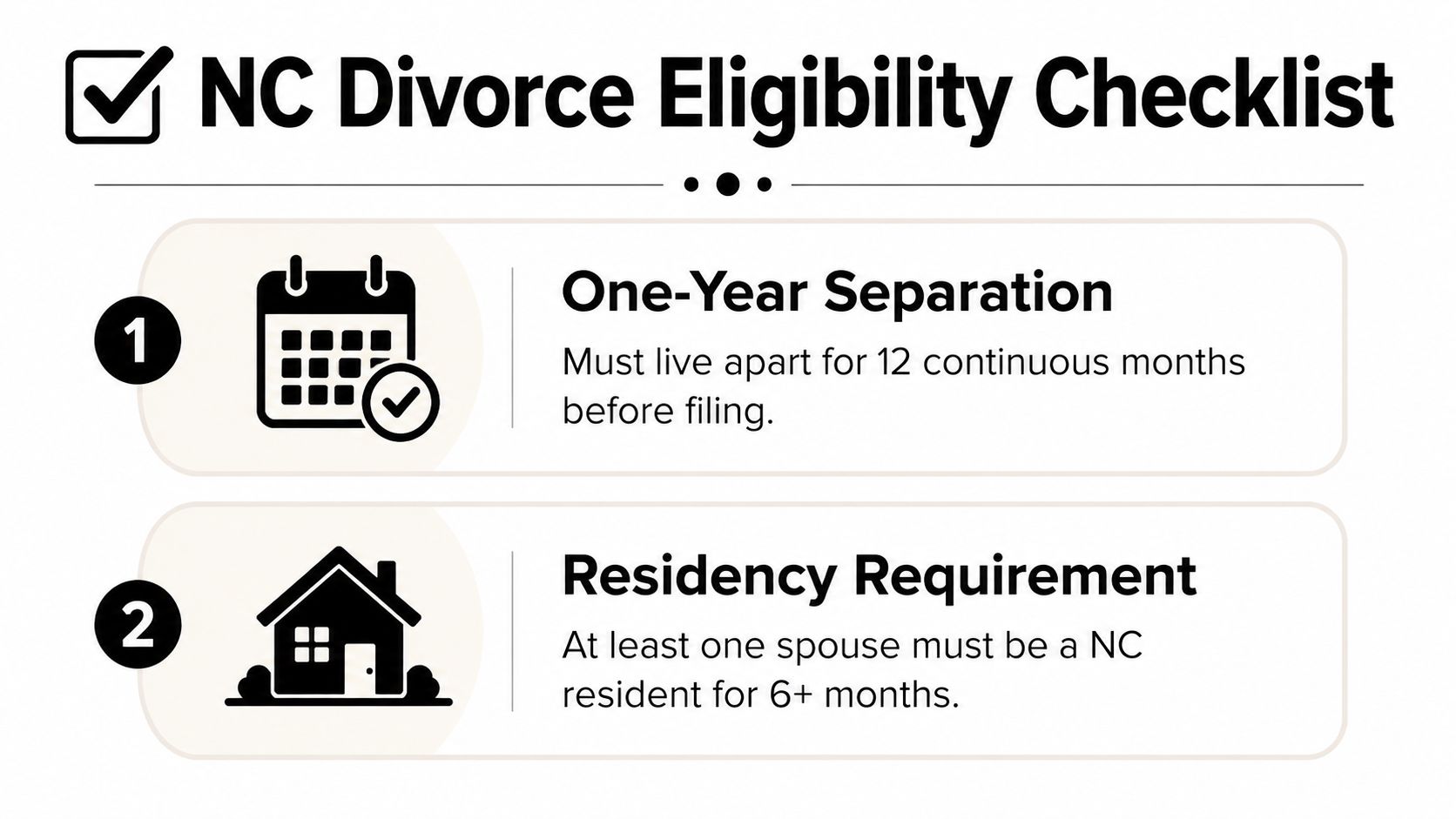
North Carolina requires spouses to live separate and apart for one year before either may obtain an absolute divorce. At least one spouse must also have lived in North Carolina for six months immediately before filing. These requirements appear in the North Carolina Judicial Branch's separation and divorce guidance and North Carolina General Statutes § 50-6.
What counts as living separate and apart
The spouses generally must occupy different homes, and at least one must intend the separation to be permanent. Separate bedrooms under one roof usually do not qualify because the statute focuses on separate residences, not separate schedules or household routines.
Spouses may prepare meals independently, manage their own finances, and avoid one another while remaining in the same residence. Those facts do not necessarily establish a valid separation. A move into a different apartment, combined with conduct showing a permanent intent to end the marriage, provides a stronger basis for identifying the separation date.
Practitioners often refer to the waiting period as one year and one day. Filing on the anniversary itself can create an avoidable dispute over whether the full period has passed. The date is fact-sensitive, so record the move-out date and preserve proof of separate residences before filing. A detailed explanation of date planning appears in this guide to the one-year separation rule in North Carolina.
Practical rule: Use the same separation date on leases, utility records, written communications, and court filings. Conflicting dates can invite an objection or delay.
Reconciliation can change the analysis. Isolated sexual intercourse does not restart the one-year period under North Carolina General Statutes § 50-6, while resuming the marital relationship may raise a different question. If the spouses resumed living as a married couple, obtain legal advice before relying on the original date.
For a focused explanation of the waiting period, review The One-Year Separation Requirement in North Carolina. The safest filing strategy confirms both the residency requirement and the separation evidence before the complaint is prepared.
Filing Your Divorce Complaint and Required Forms
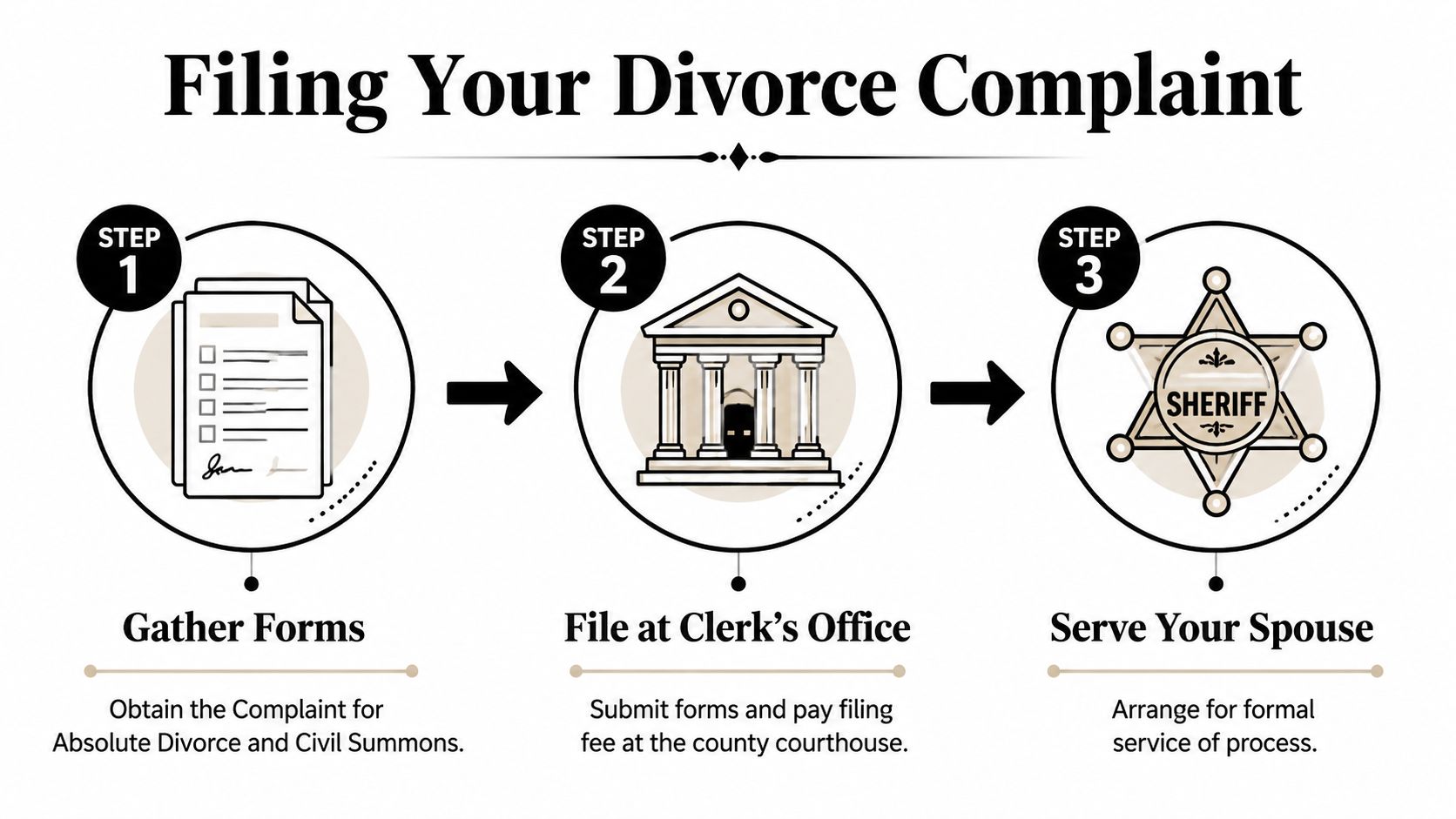
Once the separation period and residency requirement are satisfied, the case begins with a Complaint for Absolute Divorce. “Absolute divorce” means the court is being asked to dissolve the marriage permanently, not to issue a temporary separation arrangement.
You'll generally need the complaint, a civil summons, and supporting documents required by the local clerk or applicable court packet. A self-represented filer should use the forms and instructions supplied by the North Carolina Judicial Branch rather than relying on a generic online form designed for another state.
Choosing the filing location
County selection matters. The complaint must allege the required North Carolina residency. If the plaintiff is a nonresident, North Carolina law provides that the case must be brought in the county where the defendant resides, with personal service or personal acceptance under Rule 4, as addressed in North Carolina General Statutes § 50-8.
The statewide district court cost assessed for an absolute divorce action is $75, under North Carolina General Statutes § 7A-305. The North Carolina Judicial Branch's pro se divorce packet also directs the filer to take original documents, two copies, and a $225 filing fee to the clerk's office. Because court costs and packet instructions can involve separate charges or updated procedures, confirm the amount and accepted payment method with the clerk before going to court.
Filing and service
The clerk stamps the complaint and issues the summons. Filing alone doesn't give the court personal jurisdiction over your spouse. The other spouse must receive formal service, commonly through the sheriff or another legally permitted method, unless the spouse accepts service in a valid manner.
If the spouse cannot be located, do not just mail the complaint and assume the case is protected. Alternative service may require specific steps and court approval. A defective service attempt can prevent the court from entering a valid judgment, even when the separation period and paperwork are otherwise correct.
The filing process is also demonstrated in this short video:
Protecting Your Rights Before the Divorce Is Final
The most dangerous filing mistake isn't always filing too early. Sometimes the divorce is filed at the correct time, but the filer asks the court to dissolve the marriage before protecting financial claims.
Equitable distribution is North Carolina's process for dividing marital and divisible property. It requires identifying what belongs to the marital estate, determining values and classifications, and deciding how property and debt should be divided. The process can involve a home, retirement interests, bank accounts, businesses, vehicles, and liabilities. The legal label on an account or deed doesn't always answer whether an asset is marital, separate, or partly both.
Property and support claims require planning
A spouse who wants equitable distribution should address that claim before the absolute divorce is entered. The same warning applies to a claim for alimony. If a spouse obtains an absolute divorce without properly preserving an equitable distribution or alimony claim, the ability to pursue that claim may be lost.
Consider a spouse who files a simple divorce after agreeing informally that the other spouse will keep the house while the filer receives retirement funds later. The divorce decree may end the marriage before the property terms become enforceable. If the parties haven't signed an enforceable agreement or filed the necessary claim, the spouse who relied on a promise may face a serious procedural problem.
Post-separation support is a temporary form of financial assistance during the separation period. Alimony is a separate claim that may address support after divorce. The two claims can overlap in subject matter, but they aren't interchangeable, and a temporary payment arrangement doesn't automatically resolve a permanent support claim.
Before signing a divorce agreement, identify every asset, debt, property claim, and support claim that matters to your future.
If you've been served, don't wait until the hearing date to understand what was filed or what claims may be missing. The guidance on what to do after being served divorce papers in North Carolina can help you organize the immediate response, but personalized legal review is important when property or support is involved.

Navigating Discovery, Mediation, and Temporary Orders
A divorce case rarely moves from complaint to decree in one clean step. A common example involves spouses who agree that the marriage should end but disagree about the value of a business and who will remain in the marital home.
The first stage may involve discovery, the formal exchange of information. Attorneys can use interrogatories, requests for production, requests for admissions, and depositions to obtain financial records and sworn answers. Discovery can reveal account balances, debt obligations, income information, ownership documents, and other material needed to evaluate property and support issues.
A spouse who handled all household finances may feel exposed when asked for records. That discomfort doesn't make disclosure optional. Incomplete or selective answers can prolong negotiations and undermine credibility. A practical guide to North Carolina divorce discovery and financial affidavits can help explain why organized financial information matters.
Mediation and temporary arrangements
Mediation gives both spouses an opportunity to negotiate with the assistance of a neutral mediator. The mediator doesn't represent either party and doesn't decide the case. Each spouse should understand the proposal independently before signing, especially when the agreement addresses property, support, custody, or debt.
A mediated agreement can reduce uncertainty, but it isn't automatically wise just because both spouses are tired of fighting. A quick agreement that omits a retirement account, tax responsibility, or enforcement language may create a new dispute.
Temporary orders address immediate needs while the case continues. Depending on the dispute, the court may address custody, child support, spousal support, possession of the home, or responsibility for recurring expenses. For example, a temporary order may establish a parenting schedule while discovery continues, allowing the children to follow a predictable routine without deciding every permanent issue.
The strongest temporary arrangement is specific enough to follow. It should identify exchange details, payment responsibilities, deadlines, and what happens when a parent cannot comply. Vague promises often fail when communication deteriorates.
Finalizing Your Divorce at the Hearing
The final hearing is the point at which the judge reviews whether the legal requirements for an absolute divorce have been satisfied. In an uncontested matter, the spouses may have resolved the issues through agreement, or one spouse may proceed without opposition. A contested case can require more preparation because disputed claims may remain active even when one party wants the marriage dissolved.
Before the hearing, confirm the separation date, residency allegation, service documents, and proposed judgment. Bring the original documents and any copies required by the clerk or local procedure. A missing certificate, incorrect case caption, or unresolved service issue can force a continuance.
What the decree does
The judge may ask questions under oath to establish the statutory basis for the divorce. The court then enters a divorce decree, also called a judgment of absolute divorce, if the requirements are met.
The decree legally dissolves the marriage. It doesn't automatically decide every financial, property, custody, or support issue unless those matters are included in an enforceable agreement or addressed through a court order. That distinction is central to protecting rights before the hearing.
If the other spouse refuses to cooperate, that refusal doesn't necessarily prevent the divorce. Proper service and compliance with court procedure remain essential. A spouse who doesn't answer or appear may lose opportunities to contest the divorce, but the court still must have authority to act and must receive sufficient evidence.
A final divorce hearing should be the end of a planned process, not the first time you review what the judgment will resolve.
Read the proposed decree before it is entered. Check names, dates, case numbers, incorporated agreements, and references to pending claims. Once entered, the judgment changes your legal status, and correcting an omission can be far more difficult than preventing it.
Common Mistakes that Derail North Carolina Divorces
A divorce can go off course before the first hearing. In North Carolina, the filing date, living arrangements, service method, and timing of financial claims can determine whether the case proceeds as planned.
Filing before the separation period ends
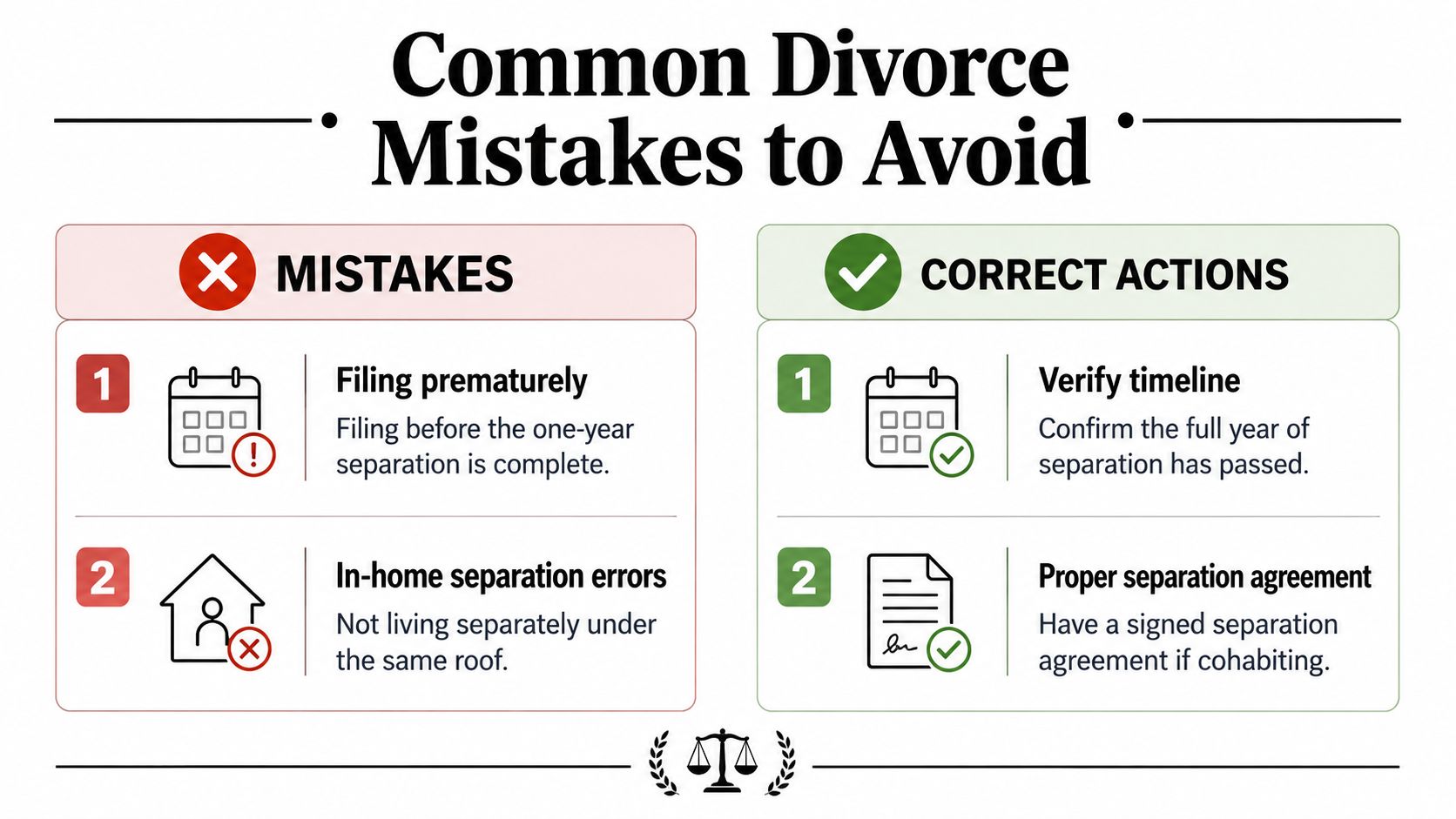
Counting twelve months from the move-out date and filing on the anniversary can be risky. Use one year and one day as the safer planning point. The separation must satisfy the required period, and filing too early can lead to dismissal, forcing the filer to begin again.
Treating an in-home separation as enough
Separate bedrooms do not create separate residences. Separate bank accounts, household chores, and social lives do not change that requirement. If moving out is impractical, obtain advice about whether a written agreement can address financial and family matters, but do not assume the agreement itself establishes the residence requirement.
Losing property or support rights
Filing for divorce does not automatically preserve every financial claim. Equitable distribution and alimony require deliberate attention before the divorce is granted. A promise to “work it out later” may leave property or support rights unresolved. Use a properly drafted agreement or assert the claim within the required timeframe.
Mishandling service
Leaving papers with a friend, sending them by ordinary mail, or relying on a text message may not satisfy service requirements. The spouse's location and willingness to accept service affect the proper method. Address service problems early. Waiting until the hearing can result in a continuance or prevent the court from proceeding.
Ignoring financial records and deadlines
Incomplete financial records make valuation and negotiation harder. Missed response deadlines can limit the ability to present defenses or claims. Review forms carefully when the case involves a business, retirement interests, complicated debts, or disputed support.
A disciplined file review helps prevent these problems. Verify the separation date, confirm residency, choose the proper county, complete the forms, arrange valid service, preserve financial claims, and calendar every deadline. A short planning error can have consequences long after the complaint is filed.
Frequently Asked Questions About NC Divorce Procedure
Do I need a lawyer to file for divorce in North Carolina?
You may represent yourself, but you remain responsible for every filing, deadline, and service requirement. An uncontested divorce with no disputed property or support may be manageable. Legal advice matters more when the case involves real estate, retirement accounts, business assets, support, custody, service problems, or uncertainty about preserved claims.
How long does divorce take in North Carolina?
The one-year separation requirement is only the starting point. After filing, timing can depend on whether service is completed promptly, how crowded the county's court calendar is, and whether the other spouse files a response. A contested case involving property, custody, or support usually takes longer because the parties may need document exchange, negotiation, mediation, or hearings. An incomplete address or failed service attempt can delay the case before the court reaches the merits.
What happens if my spouse refuses to cooperate?
A spouse's refusal does not automatically prevent an absolute divorce. The filing spouse must still establish jurisdiction, meet the separation and residency rules, and complete valid service. Noncooperation can make property, custody, and support disputes harder, particularly if the spouse ignores requests or contests the claims.
Can I date during the separation period?
Dating does not end the marriage, but it can create legal and practical complications. A new relationship may affect support issues or raise questions about conduct that began before separation. Discuss the facts confidentially with a North Carolina family law attorney before assuming dating carries no risk.
Can custody or support orders change after divorce?
A custody or support order may be modifiable when the legal requirements are met. The answer depends on the order's type, the language of any agreement, and the facts supporting the requested change. A divorce decree does not cancel existing custody or support obligations. Enforcement or modification must proceed through the proper court process.
The Law Office of Bryan Fagan helps North Carolina residents evaluate separation dates, divorce filings, equitable distribution, custody, child support, and spousal support claims. Visit Law Office of Bryan Fagan to schedule a consultation about the procedural steps that may protect your rights before filing or responding.