A lot of people start looking for a North Carolina protective order late at night, after a fight, after a threat, or after realizing the behavior isn't stopping. You may be trying to decide whether what happened is “serious enough,” whether the court will believe you, or whether asking for help will make things worse before it gets better.
That uncertainty is normal. So is fear.
North Carolina law gives some victims a civil court remedy called a Domestic Violence Protective Order, often called a DVPO or 50B order. It can order no contact, remove someone from a shared home, address temporary custody, and create enforceable rules while you try to stabilize your life. It is an important legal tool, but it works best when you understand what happens next at each stage and prepare for the places where cases commonly go off track.
The stakes are real. Between 2010 and 2016, North Carolina experienced 745 domestic violence-related homicides. In 2024 alone, there were 155 victims, with six of those victims having previously obtained protective orders that did not prevent the fatal outcome, according to the North Carolina domestic violence update. A court order matters. So do enforcement, planning, and support outside the courtroom.
If you're dealing with abuse, threats, stalking, or harassment tied to a close relationship, legal guidance can help you act with a plan instead of panic. Many people also have connected issues involving separation, children, or housing, which is why broader North Carolina family law representation often becomes part of the conversation.
Taking the First Step Toward Safety in North Carolina
A common real-world pattern looks like this. Someone has put up with escalating behavior for months. It started with controlling texts and accusations. Then came threats, showing up uninvited, blocking a doorway, grabbing a phone, or making the other person afraid to leave. By the time that person searches for a domestic violence protective order in NC, they're often exhausted and trying to think clearly in a crisis.
The first legal step is often not the hardest part emotionally. The hardest part is accepting that the situation has become dangerous enough that structure is necessary.
When the situation changes from stressful to unsafe
Clients often worry that going to court means they are “overreacting.” Many aren't. They are reacting late.
North Carolina's DVPO process exists for situations where a personal relationship and domestic violence, as the law defines it, can be shown. That legal definition can include more than visible injuries. It can also involve conduct that puts someone in fear, subjects them to repeated harassment, or creates ongoing danger in the home or after separation.
Practical rule: If your daily decisions are being controlled by fear of what the other person might do next, it's time to get legal advice quickly.
What happens next depends on timing. Some people need emergency relief right away. Others have already separated and need a final hearing strategy because the temporary order is about to expire. Some have an order already and need help enforcing it after violations start.
What this process is really about
A DVPO isn't a relationship counseling tool. It isn't a warning letter. It is a court order backed by the power of enforcement.
That matters because legal protection works best when the person seeking it understands both the legal standard and the practical follow-through. A judge can sign an order. The sheriff still has to serve it. The final hearing still has to be proved. If the order is violated, someone still has to decide whether to call law enforcement, file contempt, or both.
People in crisis don't need vague encouragement. They need a roadmap for the next decision, then the one after that. That's how you move from feeling trapped to taking controlled, deliberate steps.
Understanding a NC DVPO and Who Is Eligible
Eligibility is where many cases succeed or fail before the hearing even starts. In North Carolina, a DVPO is available only if two things are true. The other person has a qualifying personal relationship with you, and the conduct fits the legal definition of domestic violence.

The two questions the judge will focus on
At a practical level, the court is sorting your case into the right legal box. If the relationship fits and the facts fit, a 50B case may move forward. If one piece is missing, the judge may decide this is the wrong type of claim, even if your fear is real.
| Required element | Plain English meaning |
|---|---|
| Personal relationship | The other person must fall into a relationship category covered by North Carolina domestic violence law, such as a current or former spouse, someone you live with or lived with, a dating partner, or certain family relationships. |
| Act of domestic violence | The facts must show conduct the law treats as domestic violence, not just a bad relationship, repeated arguments, or mutual resentment. |
That first question surprises people. A coworker, casual acquaintance, neighbor, or stranger may be dangerous, but a DVPO is not always the remedy for that situation. The legal tool has to match the facts.
Who usually qualifies under the relationship requirement
Courts commonly see 50B claims involving spouses, ex-spouses, people who share a home or used to share one, dating partners, and certain parents and children. The relationship piece may sound simple, but it can become contested fast.
For example, a defendant may argue there was never a dating relationship, or that the parties did not live together. When that happens, details matter. Text messages, lease records, shared bills, photos, and testimony about the relationship often become more important than people expect.
Domestic violence can include more than physical injury
A client may tell me, “He never punched me, so I do not know if this counts.” Sometimes it does.
North Carolina courts can consider threats, stalking, and conduct that places someone in fear of serious harm, not only visible injuries. This North Carolina restraining order overview gives a helpful summary of the broader categories people often overlook.
Examples that may support a DVPO include:
- Threats tied to real fear: A former partner sends repeated messages saying you will regret leaving, waits outside your workplace, and knows your schedule well enough that you start changing how you get home.
- Stalking after separation: An ex appears at your apartment, your church, and your child's activities after being told to stop, causing you to avoid normal routines.
- Harassing control: A spouse monitors your location, floods your phone with unwanted contact, and uses that surveillance to intimidate you or corner you in person.
Judges look for specific conduct and its effect on your safety. They do not need a perfect victim story. They do need clear facts.
What usually falls short
Statements like “she is toxic,” “he is controlling,” or “we fight all the time” are usually not enough on their own. Those descriptions may be true, but they do not tell the court what happened, when it happened, or why the law applies.
Better facts sound like this: “On Tuesday night he texted that he would be waiting outside my job.” “She followed me to my sister's house after I told her not to contact me.” “He grabbed my arm in the kitchen, blocked the doorway, and told me I was not leaving.”
That level of detail does two things. It helps the judge decide whether you qualify, and it helps you see what evidence you need next if the case is filed.
The practical takeaway
Before filing, ask two direct questions. Do we have the kind of relationship this law covers? Can I describe specific acts that amount to domestic violence under North Carolina law?
If the answer to both is yes, you may be in the right court process. If one answer is unclear, get legal advice early. That can save time, avoid filing the wrong case, and help you decide what happens next if the other side denies everything.
How to File for a Domestic Violence Protective Order
The filing process feels intimidating the first time, but it becomes more manageable when you think of it as a series of controlled steps. You are asking the court for immediate help first, then preparing for the later hearing where the judge decides whether to enter a final order.
Start with the process flow below.
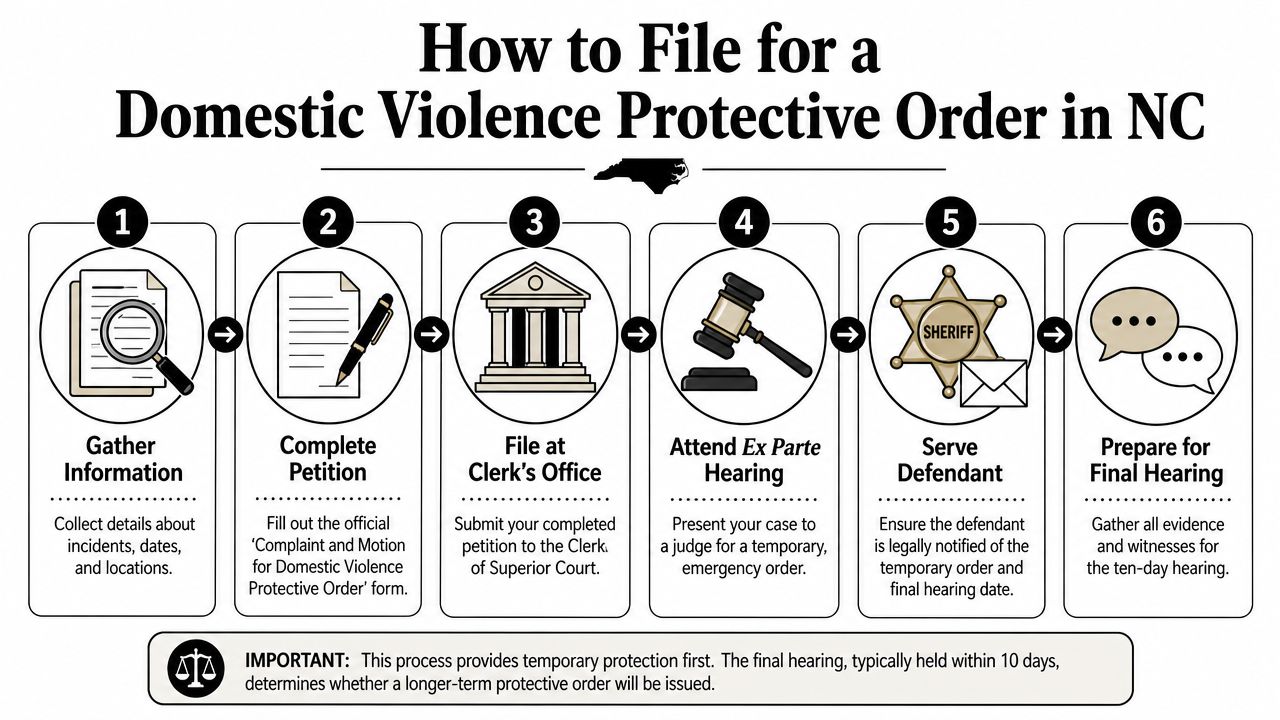
Where you go and what you ask for
In most cases, you go to the Clerk of Superior Court in the county where filing is proper and ask for the paperwork for a domestic violence protective order. The core pleading is commonly called the Complaint and Motion for Domestic Violence Protective Order. Court staff may provide forms, but they cannot give you legal advice about what facts matter most or how to present your case.
If the danger is immediate, you may ask for ex parte relief. In plain English, that means you are asking a judge for a temporary emergency order before the other side is present in court.
That temporary stage matters because waiting for the final hearing can leave a dangerous gap if there has already been threatening or violent conduct.
What to put in the complaint
Good complaints are specific. Weak complaints are emotional but vague.
Use short, factual statements. Include dates if you know them. If you don't know an exact date, tie the event to something concrete, like “the weekend before school started” or “two days after I moved out.” Describe what the person did, what they said, whether children were present, whether police responded, and why you were afraid.
A stronger statement sounds like this: “On March 3, he waited outside my apartment after I told him not to come. He pounded on the door, sent repeated texts threatening to take the children, and followed me when I left for work the next morning.”
A weaker statement sounds like this: “He's abusive and unstable.”
For people trying to understand the overall process in practical terms, Domestic Violence Protective Orders in North Carolina is one resource that discusses how to obtain or respond to a 50B protective order in NC.
What happens after filing
If the judge grants temporary relief, a hearing is set for the final DVPO. The paperwork then must be served on the defendant. Service is not a technical side issue. It is a critical part of whether the order becomes enforceable against the other party.
Later in the process, many people also find it helpful to watch a plain-language overview before the final hearing:
A few tactical points matter right away:
- Keep copies of everything: Complaint, temporary order, hearing notice, and any sheriff's paperwork.
- Read the temporary order carefully: Don't assume it says what you requested. Check the actual restrictions.
- Plan for service issues: If the defendant avoids service, your immediate protection may be weaker in practice until service occurs.
- Use the time before court well: Don't spend those days re-reading messages in panic. Start organizing your evidence for the final hearing.
The ex parte order is the beginning, not the finish line. The final hearing is where many cases are won or lost.
Preparing Evidence for Your Final DVPO Hearing
A lot of clients walk into the final hearing thinking the truth will speak for itself. Sometimes it does. Often, the better-organized side has the easier time being believed.
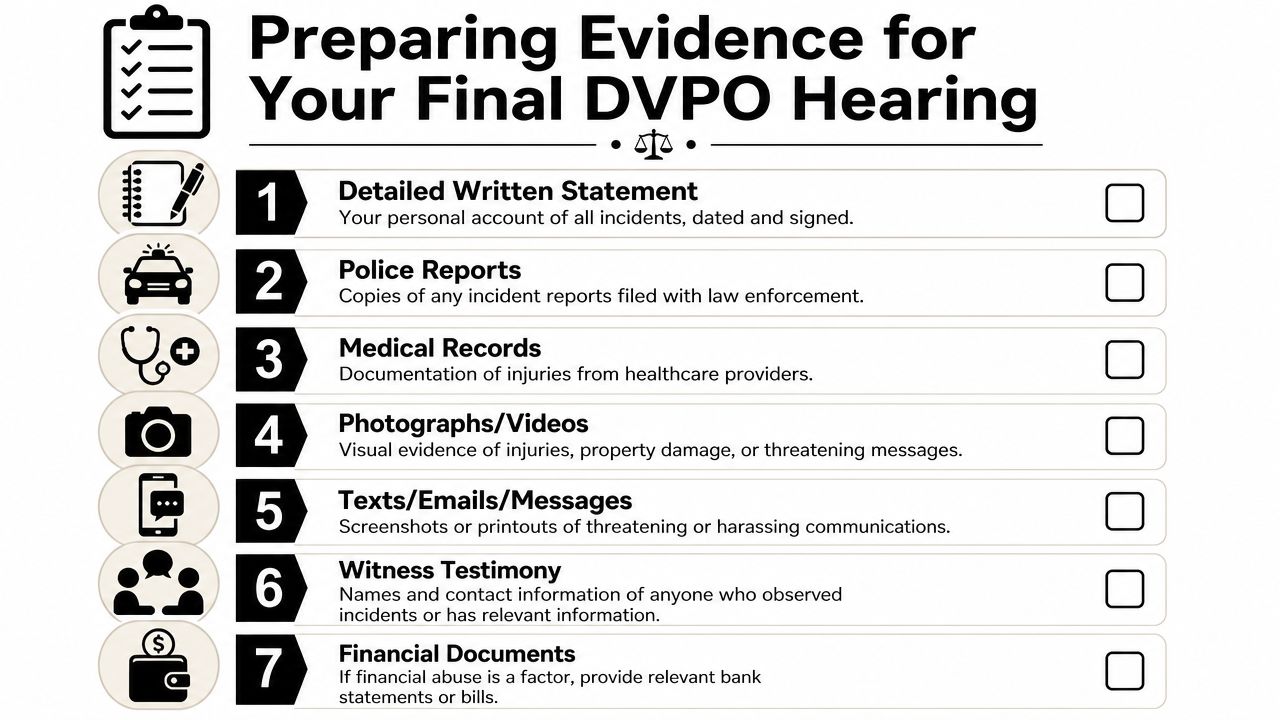
The judge usually has limited time, a crowded docket, and two people telling very different stories. Your job is to make the facts clear, specific, and easy to follow. At this stage, the practical question is simple: what can you put in front of the court that shows the relationship qualifies under North Carolina law and that the abuse, threats, stalking, or harassment did happen?
What the judge needs from you
The legal standard is lower than in a criminal case. The judge is deciding whether your account is more likely true than not. That helps, but it does not mean preparation is optional.
Judges look for detail. Dates matter. Exact words matter. Context matters. If you say, “He threatened me,” be ready to explain when, where, how he said it, whether anyone heard it, and what happened right after.
A national law school report on protective order outcomes found that many petitions fail because the evidence is too thin, the relationship is not clearly established, or the testimony is disorganized, according to the USC report on protective orders. That tracks what happens in court. Good cases can still go sideways if the proof is scattered.
Evidence that usually helps
Start with the basic story and build outward. The strongest hearing packets usually answer two questions quickly: who is this person to you, and what did this person do?
Helpful proof often includes:
- A short timeline: List the most important incidents in date order. Keep it clean and readable.
- Texts, emails, voicemails, and social media messages: Print them and highlight the parts you may need to reference.
- Photographs: Write the date, location, and what each photo shows.
- Medical records or police reports: Bring copies if they exist, but do not panic if they do not.
- Witnesses with firsthand knowledge: A witness who saw an injury, heard a threat, or observed stalking can matter.
- Documents showing the relationship: Lease papers, shared bills, school records, photos together, or messages showing you were dating or living together.
Do not bring a stack of papers you have never reviewed. Bring documents you can explain.
If a case involves a technical issue outside the usual DVPO proof, such as medical causation or another specialized subject, it helps to understand how courts treat expert witness testimony in North Carolina cases. Most 50B hearings still come down to party testimony, fact witnesses, and basic records.
What often hurts a strong case
I see the same mistakes over and over. They are fixable if you catch them before court.
One person arrives with screenshots in order, copies for the clerk or opposing side if needed, and three key incidents marked with sticky notes. Another arrives with a nearly dead phone, 200 unlabeled photos, and no clear sequence. The second person may have lived through serious abuse too. The court still has a harder time following that case.
Here are some common problems:
| Problem | Why it hurts the case |
|---|---|
| Vague descriptions | Words like “toxic,” “unstable,” or “abusive” are too general without facts behind them. |
| Too much focus on weaker incidents | Minor arguments can distract from the strongest threats, assaults, stalking, or harassment. |
| No proof of the relationship | If the judge cannot confirm the qualifying relationship, the case may not fit a Chapter 50B claim. |
| Assuming the judge will review your phone | Many judges expect printed, organized exhibits, not a live search through your device. |
| Talking past the question | Long answers create openings for confusion and cross-examination. |
A calm presentation helps. Calm is not the same as emotionless. It means the court can follow you.
How to prepare during the week before court
Use the days before the hearing with a plan.
- Write out the top incidents in chronological order.
- Put the best supporting proof behind each incident.
- Mark the two or three events that most clearly show why protection is still needed.
- Practice describing those events in plain language.
- Put your papers in one folder and charge your phone anyway, even if you plan to use printouts.
- Bring extra copies if you can.
If something goes wrong, adjust fast. A witness may not appear. A screenshot may not print clearly. The defendant may deny everything. That does not automatically sink your case. Fall back on a clean timeline, specific testimony, and the exhibits you can authenticate yourself.
If children are part of the situation, stay focused on the relief the court can grant in this hearing. Some clients understandably want to tell the judge every problem in the relationship. That instinct is human, but it can dilute the point. Keep bringing the court back to the acts of domestic violence, the risk to you or the children, and the specific protections you need the judge to include in the order.
Enforcing Your Order and Creating a Safety Plan
A signed order helps. It does not remove all risk.
People are often shocked by how quickly a violation can happen. The defendant sends a “harmless” text. Drives by the house. Has a relative reach out. Shows up at a school event. The first practical question becomes simple: what do I do right now?
The two enforcement paths
Under North Carolina law, willfully violating a 50B order is a Class A1 misdemeanor, punishable by up to 150 days in jail, and victims may also pursue civil contempt proceedings independently, as explained by Enough NC's 50B enforcement discussion.
That gives you two broad enforcement routes:
- Criminal enforcement through law enforcement: If the order is violated, calling police may lead to an arrest or criminal charge.
- Civil contempt through the court: You may ask the court to address the violation through a motion for order to show cause or similar contempt procedure.
The second option matters more than many people realize. Some victims don't want criminal charges because they fear retaliation, rely on the other person financially, or worry about immigration, housing, or family fallout. Civil enforcement can still be an important legal tool.
What works after a violation
The best response is usually immediate documentation and quick action.
If the defendant texts you, save the message and take screenshots. If they appear in person, write down the time, place, and what happened as soon as you safely can. If a third party relays contact on their behalf, preserve that too. Small details become important later.
A useful real-world approach looks like this:
- Keep a violation log: Date, time, conduct, witnesses, police report number if any.
- Carry a copy of the order: Digital and paper if possible.
- Tell key people: Employer, school, daycare, apartment office, or trusted relatives may need to know the restrictions.
- Avoid direct engagement: Don't argue, negotiate, or “clear things up” after a violation.
If an order says no contact, repeated replies from the protected party can muddy the practical picture even when the violation started with the defendant.
Your safety plan matters just as much
A DVPO is one part of a broader safety strategy. Depending on your circumstances, that may mean changing routines, improving home security, arranging escorts to your car, reviewing pickup procedures for children, or deciding where you'll go if the defendant appears unexpectedly.
Think in layers. The court order is one layer. Documentation is another. Supportive people and predictable routines are another. If something doesn't go as planned, you want backup options already in place rather than trying to invent them in a crisis.
What to Do If You Are Served with a DVPO Complaint
If you are the defendant, treat service of a DVPO complaint as urgent. A lot of people make their situation worse in the first few hours by reacting emotionally, sending messages, or trying to “explain” things directly to the plaintiff. That can be a serious mistake.
The safest first move is simple. Read the papers. Follow the temporary order exactly. Stop all prohibited contact immediately.
The short-term mistake that causes long-term damage
Even if you believe the allegations are false or exaggerated, you can't decide for yourself that the order is unfair and ignore it. If the ex parte order says no contact, stay away. If it says don't return to the residence, don't return unless the order specifically allows a law-enforcement-assisted retrieval of property or another lawful process.
People familiar with divorce or separation conflict sometimes assume this is just another family court dispute. It is not. A DVPO case can affect living arrangements, child-related issues, public records, and other litigation running at the same time. For readers already dealing with broader separation problems, this overview of what to do after being served with legal papers in North Carolina helps explain why prompt, organized action matters.
How to prepare your defense
You need your own evidence, not just your own opinion.
That may include messages showing context, witnesses who were present, records showing where you were, or evidence disputing the alleged relationship category if Chapter 50B does not apply. Stay focused on facts that matter legally. General attacks on the plaintiff's character usually don't help unless tied to a specific disputed allegation.
A practical checklist for defendants:
- Preserve evidence now: Screenshots, call logs, video, receipts, location records, and witness names.
- Do not coach witnesses: Ask them what they observed. Don't tell them what to say.
- Show up prepared: Missing court can have severe consequences.
- Get legal advice quickly: The hearing can move fast, and procedural mistakes are hard to fix later.
If the DVPO is tied to a pending separation or divorce, a North Carolina Divorce Lawyer may also handle related claims under North Carolina law, but the protective order hearing itself still requires focused preparation.
A defendant who stays silent until the hearing date and brings no organized evidence is taking a major risk, even if the allegations are weak.
Frequently Asked Questions About NC Protective Orders
How long does a final DVPO last in North Carolina
A final Domestic Violence Protective Order in North Carolina lasts for up to one year, and the petitioner can ask for an extension of up to two additional years by filing a motion before the order expires, according to Women's Law guidance on North Carolina restraining orders.
Can a DVPO be changed after it is entered
Yes. Courts may modify a protective order if a party shows good cause. That can matter when work schedules, exchange logistics, residence issues, or safety concerns change after entry of the order.
When a DVPO includes issues that overlap with parenting or support arrangements, readers sometimes also look at Modifying Custody and Support Orders in NC to understand when North Carolina allows changes to existing custody and support orders. That is a separate legal question, but the overlap is common.
What if I miss my court date
If you are the plaintiff and miss the final hearing, you may lose your chance to obtain the final order that day. If you are the defendant and fail to appear, the court may proceed without your side of the story. Either way, missing court creates serious problems quickly.
If an emergency prevents attendance, contact counsel immediately and act fast. Waiting until after the hearing usually limits your options.
Can a DVPO be renewed before it ends
Yes, but timing matters. The request for renewal must be filed before the current order expires. People wait too long on this issue more often than they should. If safety concerns remain, don't assume you can fix it after the expiration date passes.
Are DVPO cases public
Protective order proceedings are court matters, and people are often surprised by how visible that can feel. A final order can affect background checks, related family court disputes, and employment concerns depending on the context. If public-record impact is a major concern, that is a reason to get case-specific legal advice early rather than relying on assumptions.
Get Strategic Guidance for Your North Carolina Case
Protective order cases move quickly, and the practical choices matter as much as the legal rules. The filing has to be detailed enough. The hearing has to be prepared. Service has to happen. Violations have to be documented. If you're defending against a complaint, one bad text message or one missed hearing can change the entire case.
No article can tell you exactly how your facts will land with a judge. That's why case strategy matters. The right next step depends on the relationship, the evidence, any children involved, whether law enforcement has responded before, and whether other family law claims are already pending.
For North Carolina residents dealing with a domestic violence protective order, careful legal advice can help you make decisions that protect your safety, your rights, and your long-term position in court.
If you need guidance on a DVPO, enforcement issue, or related family law matter, schedule a confidential consultation with the Law Office of Bryan Fagan. The firm works with North Carolina clients on protective orders and related legal issues, including how to seek relief, respond to allegations, and prepare for the court process with a clear strategy.