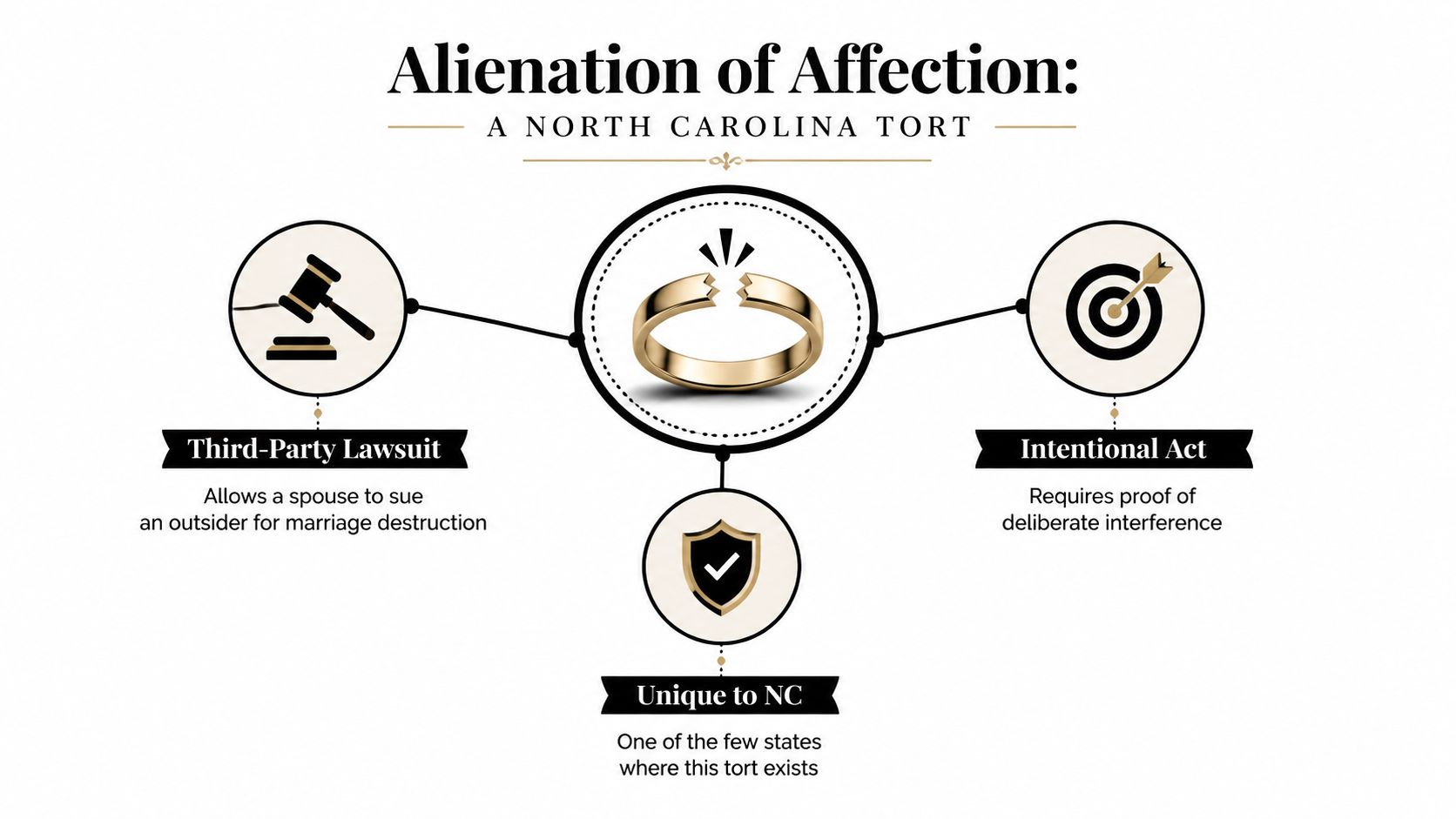
North Carolina's alienation of affection tort was abolished effective July 1, 2026, so new claims are limited, while existing cases may continue under transition rules that require careful review. Before that change, North Carolina was one of only six U.S. states recognizing this type of lawsuit.
You may be reading this after discovering messages, a relationship, or a pattern of interference that changed your marriage. You may want accountability, but you may also be unsure whether the law targets your spouse, the third party, or both. The answer depends heavily on when the conduct occurred, when the spouses separated, whether a genuine marital relationship still existed, and whether a defendant's conduct caused its destruction.
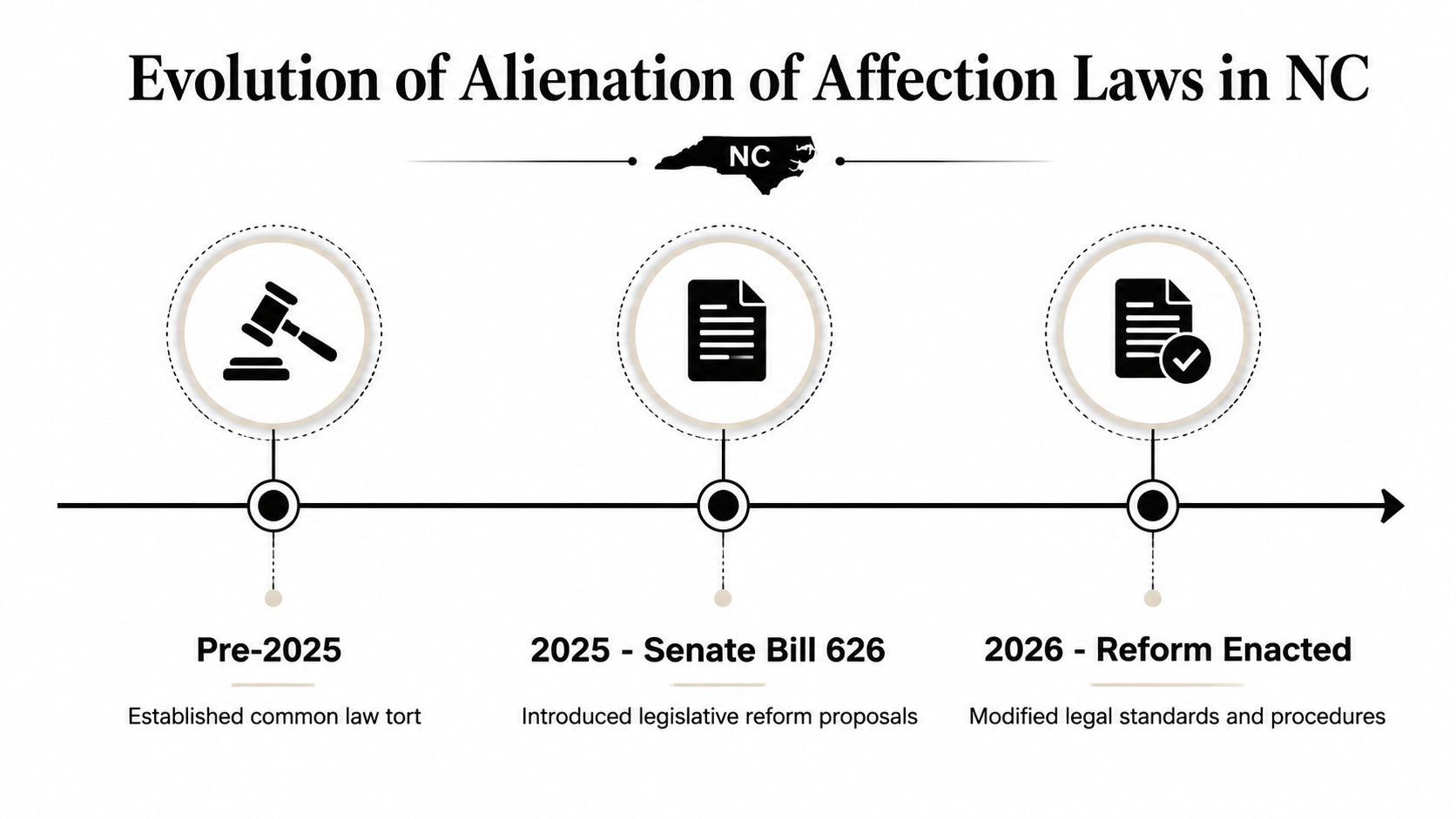
The law has also shifted quickly. North Carolina Senate Bill 626 proposed abolishing alienation of affection and criminal conversation, and a later 2026 bill summary states that the reform became effective July 1, 2026. The North Carolina General Assembly's bill materials should be read alongside advice about your specific case, particularly if conduct occurred before the effective date or a lawsuit was already pending.
What Is Alienation of Affection in North Carolina
A married couple may share a home, care for each other through illness, make financial decisions together, and remain affectionate despite ordinary disagreements. Then a third party begins pursuing one spouse, knows about the marriage, and becomes involved in the relationship. If the marriage later breaks down, the abandoned spouse may ask whether the law provides a claim against that outside person.
Historically, North Carolina allowed an injured spouse to sue the third party, rather than treating the affair itself as a lawsuit against the unfaithful spouse. The claim is known as a heart-balm tort, meaning a civil action involving interference with an intimate relationship. It protects marital interests such as love, companionship, society, and assistance.
North Carolina stood apart from many states that had abolished similar claims. Its courts continued to recognize alienation of affection unless the General Assembly changed the law. The North Carolina Supreme Court also applied a three-year limitations period in 2006, reasoning that the claim was not specifically identified in the limitations statute. Historical materials from the bar explain that lawmakers considered abolition bills repeatedly from about 1999 through 2008, but the claim remained available during that period. The North Carolina Bar's discussion of heart-balm torts provides that background.
Why the 2026 date matters
The July 1, 2026 effective date makes timing central to any evaluation. A relationship or alleged interference occurring after that date may not support a new claim under the former law. At the same time, the change does not necessarily dispose of every lawsuit or claim based on earlier conduct.
Dates function like the labels on a case file. Record the relationship, communications, separation, filing, and alleged interference before deciding whether litigation remains possible.
Practical rule: Do not assess eligibility from the affair alone. The timeline, the marriage's condition, and the status of any lawsuit must be reviewed together.
Key Elements Required to Prove the Claim
An affair alone doesn't automatically establish alienation of affection. North Carolina's civil pattern jury instruction identifies three central requirements, and each one addresses a different question about the marriage and the defendant's conduct. The North Carolina pattern jury instruction on alienation of affection lays out the framework.
A valid marriage with genuine affection
First, the plaintiff must show a valid marriage that contained some genuine love and affection. The marriage doesn't have to be perfect, peaceful, or free from disagreement. North Carolina's instruction recognizes that affection may appear through society, assistance, companionship, comfort, a sexual relationship, or a favorable mental attitude.
That means evidence might include ordinary acts of partnership, such as caring for one another, making plans together, providing support, or maintaining companionship. Frequent arguments don't necessarily defeat the claim if the relationship still included a real marital bond.
A serious loss of that affection
Second, the plaintiff must prove that the love and affection was seriously diminished or destroyed. The question isn't whether the marriage became less pleasant. The question is whether the marital relationship lost the interests the law recognizes as protectable.
For example, a spouse's decision to move out may be relevant, but it doesn't answer every legal question by itself. A court may need to examine the relationship before the alleged interference, the changes that followed, and whether the marital bond was lost.
Wrongful conduct that caused the loss
Third, the defendant's conduct must have been wrongful or malicious and the controlling or effective proximate cause of the loss. In plain English, the plaintiff must connect the defendant's actions to the destruction of the relationship, rather than just prove that the defendant was present when the marriage failed.
Texts, emails, admissions, witness testimony, and relationship timelines may help establish knowledge, intent, and causation. The defendant may respond that the marriage had already ended emotionally or that other problems, rather than the defendant's conduct, caused the separation.
Understanding Potential Damages and Settlements
North Carolina doesn't treat damages as a simple invoice for an affair. The pattern jury instructions say damages may be recovered without proof of actual damages, but the jury must still determine the present value in money of the plaintiff's actual losses. North Carolina's damages instruction makes the distinction important. A claim isn't a guaranteed payment, and a jury still evaluates the harm tied to the defendant's conduct.
Potential categories can include lost marital interests, mental anguish, shame, humiliation, injury to reputation, loss of sexual relations, loss of support, and other effects on the quality of the marriage. The North Carolina instruction on damages categories shows why both economic and emotional evidence may matter.
Reported outcomes show substantial risk
Reported North Carolina outcomes span from five-figure awards to tens of millions of dollars. The following figures come from a reported case summary at reported North Carolina alienation-of-affection decisions:
| Case Type | Compensatory Damages | Punitive Damages |
|---|---|---|
| Reported Court of Appeals matter | $52,000 | $43,000 |
| Reported 1999 case | $500,000 | $500,000 |
| Another reported decision | $910,000 | $500,000 |
| Reported 2010 Guilford County jury award | $9,000,000 | Not specified |
| Reported 2011 Wake County bench verdict | $30,000,000 | Not specified |
| Reported 2025 Court of Appeals decision | $932,042.00 | $606,502.31 |
These outcomes don't predict what a later jury will do. They do show why a defendant may face serious financial exposure and why a plaintiff needs evidence that explains the relationship's value and the losses attributed to the interference. Punitive damages can also become relevant when conduct is found willful, malicious, or aggravated.
A person considering divorce and related claims may also review information about a North Carolina Divorce Lawyer for representation involving absolute divorce and related claims under North Carolina law. For a focused discussion of valuation issues, see how North Carolina alienation-of-affection damages may be calculated.
Comparing Alienation of Affection to Other Claims
Several claims can sound alike because they arise from the same painful events. They don't require the same proof, involve the same legal theory, or serve the same purpose.
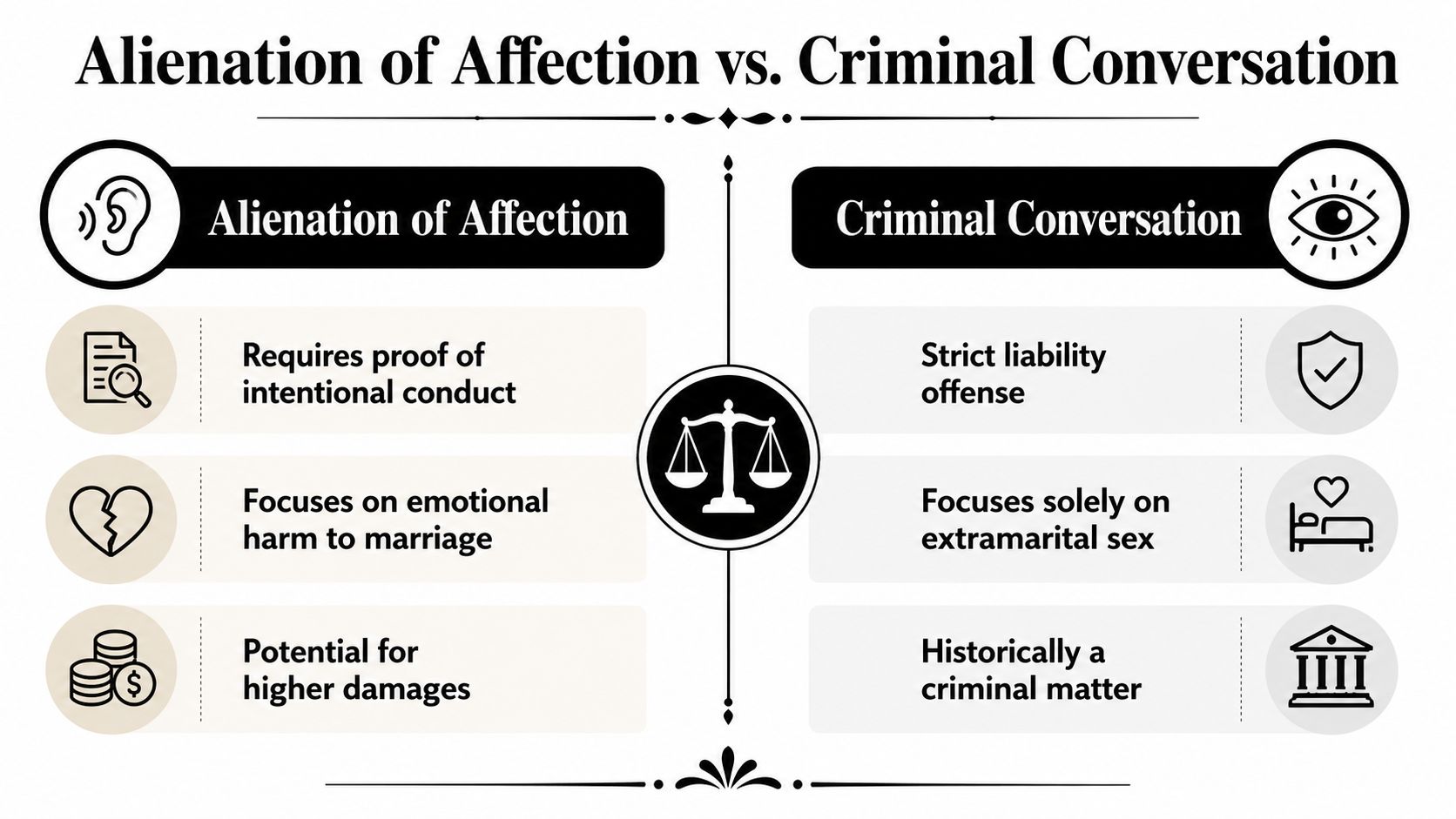
Alienation of affection focuses on the destruction of marital love and affection. The plaintiff must prove a genuine marital bond, its loss, and wrongful conduct by the third party that caused the loss. The claim historically could involve conduct beyond sexual intercourse, which made the evidence and causation analysis broader than many people expect.
Criminal conversation historically focused on adultery, specifically sexual intercourse with a married person. It was treated as a distinct claim from alienation of affection. A person considering that theory should review criminal conversation claims in North Carolina with counsel because the abolition reform affects both torts and because the proof required for one claim doesn't automatically establish the other.
These claims aren't the same as divorce
A divorce ends the legal marriage between spouses. Alienation of affection was a separate civil action against an outside person, not a request for the divorce court to add damages to the divorce decree. The spouse's conduct may still matter in other family-law disputes, but the tort itself was directed at the alleged third-party interference.
Divorce timing and filing requirements are separate questions. Readers reviewing how to file for absolute divorce in North Carolina should distinguish the steps, residency rule, and filing requirements for an NC divorce from any third-party civil claim.
Common Misconceptions About Heart Balm Lawsuits
A spouse discovers messages between their partner and someone else, then asks, “Can I sue that person?” The painful answer depends on more than proof of an affair. Before its abolition, an alienation of affection claim required evidence of a genuine marital relationship, a loss of affection, wrongful conduct, and a connection between that conduct and the marital harm.
Misconception one, any affair creates a claim
A third party's involvement did not automatically create liability. The conduct had to be wrongful or malicious and had to serve as the effective cause of the loss of affection. If the marriage had already deteriorated before the relationship began, that earlier condition could defeat causation.
Knowledge also mattered. A defendant who did not know the person was married presented a different factual situation from someone who deliberately pursued a married person. Messages, timing, statements, and other evidence could help establish knowledge and intent, but one suspicious message or isolated encounter did not prove every required element.
Misconception two, post-separation conduct always counts
North Carolina's 2009 legislative change created a firm timing issue. The alienation had to occur before the spouses separated with the intent of at least one spouse to remain permanently apart. Separation was therefore part of the legal timeline, not merely background.
Later conduct may help explain earlier events, but it cannot automatically satisfy the statutory timing requirement.
A spouse who continued communicating with a third party after separation should preserve the complete record, including earlier messages and evidence about the relationship's condition. The question is whether the legally relevant loss of affection occurred before the statutory separation date.
The abolition effective July 1, 2026, adds another timing concern for pending or potential cases. Anyone assessing infidelity's separate family-law consequences can review how adultery affects divorce in North Carolina, while counsel examines which rules apply to the civil claim.
Evaluating Your Case After Recent Legal Changes
A spouse who found messages suggesting an affair before July 1, 2026, may face a different legal question from someone discovering similar conduct afterward. Senate Bill 626 changed the starting point by abolishing North Carolina's alienation of affection claim effective July 1, 2026. The legislative proposal and bill history should be read alongside the later effective-date summary when reviewing a possible case.
Pending cases require transition analysis
The effective date does not resolve every transition issue. A pending lawsuit may depend on when it was filed, whether the claim had already accrued, and whether the legislation includes savings or transition language. A claim based on conduct before July 1, 2026, but filed later may raise a separate question. These details can affect whether a case continues, can be filed, or must be evaluated under another legal theory.
The limitations period also matters. North Carolina's modern rule used a three-year limitations period, and that filing deadline may intersect with the separation cutoff and the abolition date. Waiting for a divorce, settlement discussion, or additional evidence does not automatically preserve a claim.
Build the analysis around dates and proof
Create a chronology showing the marriage, affection between the spouses, alleged interference, separation with intent to remain apart, discovery of the conduct, and any filing activity. Preserve original communications, and do not alter or access accounts without legal authorization. The record must connect the former marital relationship's decline to the defendant's alleged conduct, rather than merely show that an affair occurred.
Public attention can make these disputes seem routine, but they often involve difficult proof and substantial emotional strain. The Monty Law discussion of North Carolina alienation claims reflects that practical concern. Many cases resolve before a jury weighs the evidence, so timing, documentation, and the law governing the case deserve careful review before anyone chooses a litigation strategy.
Next Steps and Consulting a North Carolina Attorney
Start with preservation, not confrontation. Keep a private chronology of dates, names, communications, witnesses, travel, household changes, and financial effects. Save messages in their original form when possible, and don't threaten the spouse or alleged third party because an emotional exchange can complicate both the evidence and the broader family-law case.
A lawyer can assess whether the facts fit the former North Carolina elements, whether the separation cutoff is satisfied, whether the limitations period creates urgency, and how the July 1, 2026 abolition affects filing or continuation. That review should also consider whether divorce, support, property division, or another civil claim better addresses your actual goals.
The consultation should be candid. A responsible attorney won't promise a verdict, treat an affair as automatic liability, or ignore weaknesses in the timeline. Instead, counsel should explain the available options, likely proof problems, potential exposure, and the emotional and financial cost of pursuing or defending litigation.
The Law Office of Bryan Fagan provides North Carolina-focused representation and can evaluate divorce-related and civil litigation issues involving alleged marital interference. Visit the Law Office of Bryan Fagan to schedule a consultation and discuss your timeline, evidence, and legal options.