North Carolina does not currently authorize transfer on death deeds for real property. It does recognize transfer-on-death registration for securities under Chapter 41, but that rule doesn't make a house, lot, or other land pass automatically at death.
That distinction matters because a search for “transfer on death deed NC” often produces national articles, out-of-state forms, and advice that sounds simple: sign a deed, name a child, and avoid probate. That advice doesn't describe the current North Carolina rule for real estate. The state has considered a real-property TOD deed system repeatedly, but the proposed legislation hasn't become an operative statute.
If your goal is to keep a North Carolina home out of probate, you still have lawful planning options. The right choice may involve survivorship ownership, a life estate, a revocable trust, or a carefully coordinated will and probate plan. The important first step is knowing which tools North Carolina recognizes.
The Assumption Most NC Homeowners Get Wrong About TOD Deeds
Many homeowners assume North Carolina has the same transfer-on-death deed system described in national estate-planning articles. That assumption is understandable. Other states use a recorded deed that names a beneficiary and takes effect when the owner dies, so online explanations can make the instrument sound universally available.
North Carolina is different for land. No enacted North Carolina statute currently authorizes a transfer-on-death deed for real property, even though proposed bills have addressed that exact subject. A form downloaded from another state may use familiar language, but recording it in a North Carolina county doesn't create authority that state law hasn't provided.
Why online advice causes confusion
The phrase “TOD” covers more than one legal mechanism. Under North Carolina Chapter 41, Article 4, an owner can register certain securities in beneficiary form. The surviving beneficiary can receive those securities automatically at the owner's death, outside the ordinary probate transfer process. The North Carolina statute governing TOD security registration addresses that financial-asset system, not deeds for houses or land.
A homeowner may therefore see a brokerage account pass by TOD designation and reasonably ask why the same approach can't be used for a home. The answer is that a securities registration and a real-property deed are separate legal systems. One doesn't expand the other.
Practical rule: Don't record an out-of-state beneficiary deed for North Carolina land without first confirming that North Carolina law recognizes the instrument.
What homeowners usually want instead
Many asking about a TOD deed aren't focused on the label. They want a child, spouse, or other beneficiary to receive the home with less delay, fewer court filings, and less uncertainty. They may also want to keep control during life and change the beneficiary later.
Those are legitimate planning goals. North Carolina law can address them, but not through a currently operative real-property TOD deed. A consultation should begin with the current deed, the owner's family circumstances, existing debts, and the intended recipient, rather than with a form found online.
What a Transfer on Death Deed Does in Concept
A transfer-on-death deed, where state law authorizes one, is a recorded instrument naming a beneficiary to receive real property when the owner dies. It separates ownership during the owner's life from the planned transfer at death. North Carolina homeowners should understand the concept without assuming that recording such a deed makes it effective here.
The usual structure works in three stages:
- During life, the owner retains possession, use, and control of the property.
- Before death, the named beneficiary generally receives no present ownership because the deed was recorded.
- At death, the property passes under the applicable statute, often without the same probate transfer required for property titled solely in the decedent's name.
A statute may also let the owner revoke the deed, change beneficiaries, and use an approved form. Those mechanics appeared in proposed North Carolina legislation, but a proposal does not create an operative rule. For a North Carolina house, the deed's label cannot substitute for legal authority.
The securities comparison
North Carolina does have a TOD system for certain financial assets. Chapter 41's Uniform Transfer on Death Security Registration Act allows securities to be registered in beneficiary form, with the securities passing to beneficiaries who survive all owners. A brokerage account may therefore include a beneficiary designation even though a North Carolina house cannot use a currently operative real-property TOD deed.
The shared phrase, “transfer on death,” causes understandable confusion. The assets and governing statutes differ. A financial account's beneficiary registration does not transfer a parcel of land, and a securities designation does not enter the chain of title maintained by the county register of deeds.
Why the distinction affects planning
Consider an unmarried North Carolina homeowner who names a child as beneficiary on a brokerage account. That account may pass under Chapter 41's securities rules. The house remains governed by the ownership and estate-transfer rules for North Carolina real property.
Other planning tools may address the homeowner's goals. A trust can hold the property, a survivorship arrangement may suit some co-ownership situations, and a will can direct distribution through estate administration. Each choice affects control, creditors, family relationships, and later conveyances differently. The right comparison is not just “TOD deed or no TOD deed.” It is which lawful ownership and transfer arrangement fits the property and the family.
Where North Carolina Law Stands on Real Property TOD Deeds
North Carolina's legislative record shows repeated efforts to authorize a real-property transfer-on-death system. Senate Bill 312 was introduced in the 2019–2020 session, and Senate Bill 368 was introduced in the 2021–2022 session. Each proposal described an Article 11 in Chapter 31 based on the Uniform Real Property Transfer on Death Act. The legislative record for Senate Bill 312 illustrates the proposed framework.
The proposal appeared again in Senate Bill 160 during the 2023 session. That bill stated that the Article could be cited as the Uniform Real Property Transfer on Death Act and described a transfer-on-death deed as a deed authorized under that Article. The 2023 Senate Bill 160 text shows that lawmakers again considered a statutory system for transferring real property at death.
What the proposed act would have addressed
The proposed framework mattered because it would have supplied more than a label. Legislative materials described mechanics involving:
- Revocability, so an owner could change or undo the beneficiary arrangement.
- Lifetime and death-time effects, clarifying what the deed would and wouldn't do while the owner remained alive.
- Creditor claims, addressing how debts could affect the property or transfer.
- Statutory allowances, including protections and claims that may arise after death.
- Optional statutory forms, including forms for the deed and its revocation.
A legislative summary describes these features in practical terms, including the ability to revoke and the treatment of creditor claims and allowances. That detail shows why a generic deed isn't an adequate substitute for a statute. A workable system needs rules for title, revocation, claims, and administration, not merely a sentence naming a beneficiary. See the summary of the proposed North Carolina real-property TOD framework for those proposed mechanics.
The current legal consequence
Those bills demonstrate active legislative consideration, not enactment. North Carolina still lacks an operative real-property TOD deed regime in the available statutory materials and authoritative summaries. Consequently, an instrument that purports to transfer North Carolina land at death under an out-of-state TOD system may fail to accomplish the intended transfer and can create title uncertainty.
That uncertainty can affect the beneficiary's ability to sell, refinance, insure, or insure title to the property. A deed strategy should therefore be based on North Carolina authority and reviewed before recording, not repaired after a death.
Practical NC Alternatives for Passing a House Without Probate
North Carolina homeowners can pursue several planning structures, but no single tool fits every family. The deed's current ownership, marital status, children from prior relationships, creditor concerns, and need for lifetime control all matter.
Survivorship ownership
Joint ownership with a right of survivorship can allow the surviving owner to receive the deceased owner's interest by operation of the ownership arrangement. North Carolina recognizes survivorship concepts under N.C.G.S. § 41-2, while married couples may hold property as tenants by the entirety under N.C.G.S. § 39-13.6.
This approach can be direct, but adding another owner changes the ownership relationship during life. The co-owner may have creditor exposure, divorce-related complications, or influence over later decisions involving the property. The original owner may also need that co-owner's cooperation for a future conveyance.
Life estate planning
A retained life estate can reserve the current owner's right to possess and use the home while giving another person a future remainder interest. N.C.G.S. § 41-10 is relevant to life-estate conveyancing in North Carolina.
This can reflect a simple family plan, such as a parent retaining the right to live in the home while naming children to receive the remainder. It also creates an immediate property interest that can complicate later sales, refinancing, repairs, and changes in family circumstances. The life tenant and remainder owners may need to act together.
Revocable living trusts
A revocable trust can hold title to the house during the owner's lifetime. The owner may serve as trustee, retain control under the trust terms, and name a successor trustee to administer the property after death.
The trust must be properly funded. That usually means executing and recording a deed that transfers the North Carolina property to the trust, then maintaining the trust documents as circumstances change. The trust adds paperwork and administration, but it can provide more flexibility than a simple beneficiary arrangement, especially for blended families or beneficiaries who need managed distributions.
For a broader discussion of planning approaches, see how to avoid probate in North Carolina. Separate from estate planning, homeowners dealing with marital property should also understand the North Carolina Divorce Residency Requirements, including the six-month residency rule for filing divorce in North Carolina.
| Tool | NC Statute | Passes at Death By | Key Downside |
|---|---|---|---|
| Joint ownership with survivorship | N.C.G.S. § 41-2 | Survivorship under the recorded ownership | Co-owner's creditors, debts, or divorce claims may affect the arrangement |
| Tenancy by the entirety | N.C.G.S. § 39-13.6 | Surviving spouse's ownership rights | Limited to qualifying married ownership and may not fit every family |
| Retained life estate | N.C.G.S. § 41-10 | Remainder interest after the life tenant dies | Later changes and sales may require cooperation from remainder owners |
| Revocable trust | Trust instrument and recorded deed | Successor trustee's administration | Requires funding, maintenance, and trust administration |
| Will or intestate succession | Chapter 28A and related law | Probate administration | Court involvement, creditor procedures, and transfer delays may apply |
A practical decision framework is straightforward. If a married couple wants the survivor to own the home, survivorship ownership may deserve review. If the owner wants lifetime occupancy and a fixed remainder, a life estate may be considered. If the owner needs flexible instructions, incapacity planning, or managed distributions, a revocable trust may be more suitable. A will remains important, but it usually directs a probate transfer rather than avoiding probate by itself.
How a North Carolina Home Usually Ends Up at Death in Real Life
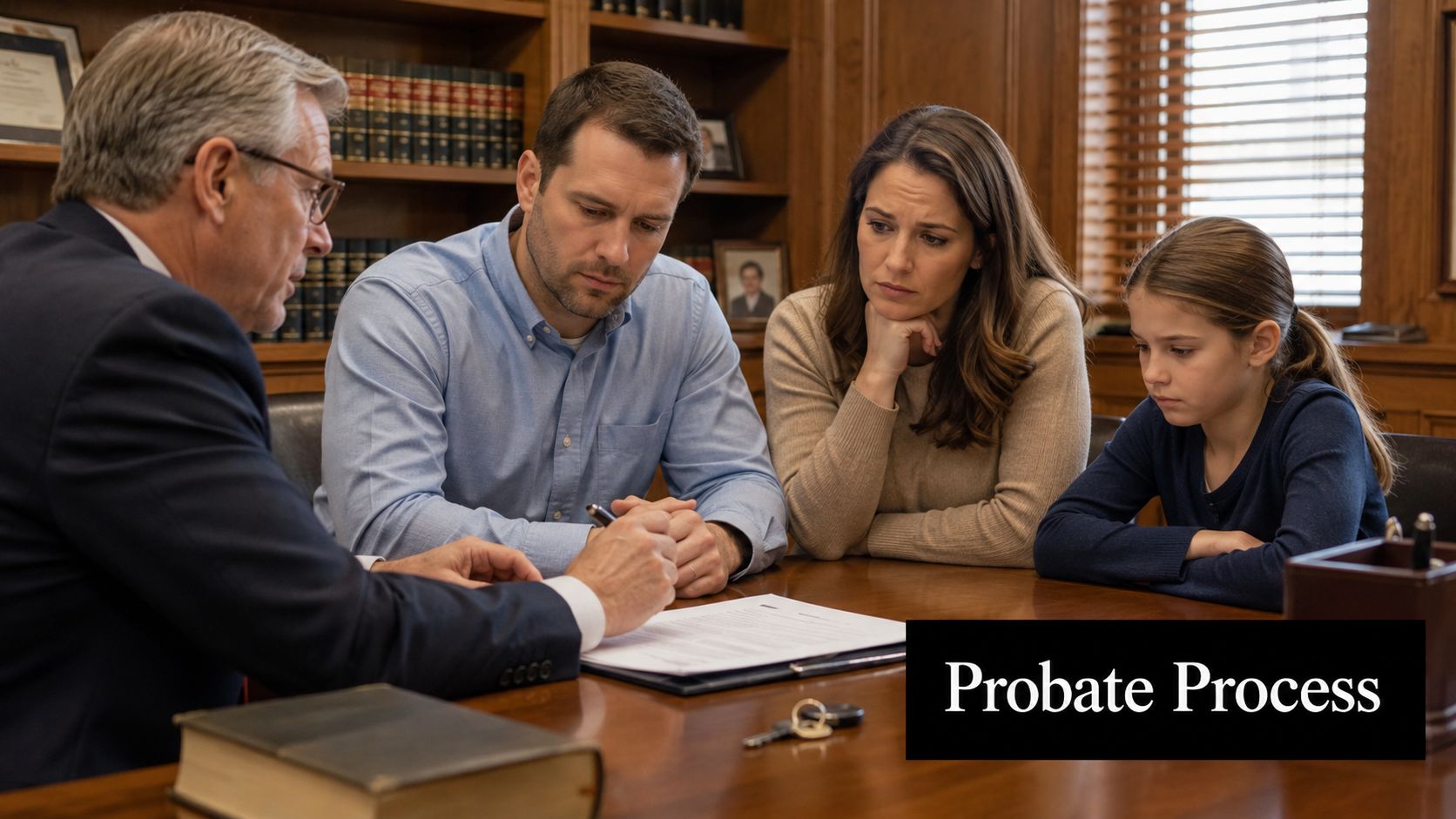
Consider an unmarried homeowner in Wake County who owns a house in the owner's name alone. The homeowner has a valid will leaving the property to two children, but the property isn't titled in a trust and there is no North Carolina real-property TOD deed to activate.
After death, the personal representative generally uses the estate process under N.C.G.S. Chapter 28A to identify assets, address creditor requirements, and carry out the will. The family may need court filings and recorded instruments before the children can obtain clear authority to sell, refinance, or divide the property. A will provides instructions, but it doesn't automatically turn sole ownership into a beneficiary transfer outside estate administration.
A different result may occur when a married couple holds title as tenants by the entirety under N.C.G.S. § 39-13.6. When one spouse dies, the survivor may document the death through an affidavit under N.C.G.S. § 28A-2-5, allowing the register of deeds to update the title without treating the property as a separately probated asset.
Two paths, different burdens
The Wake County homeowner's family may face more time, legal work, and recording activity because the property must be handled through estate administration. The surviving spouse in the tenancy-by-the-entirety example may have a more direct title update, although the affidavit and supporting records still need to be accurate.
Neither example promises a particular cost or timeline. Attorney fees, recording fees, property condition, creditor issues, and family disagreement can change the practical burden. The point is that the deed form selected during life often determines how much work remains after death.
For a related discussion of what can happen when property passes under default rules, review North Carolina intestate succession for spouses and children.
The following video offers another visual explanation of the probate process and the paperwork families may encounter:
Revocation, Creditors, and Forms That a NC Deed Strategy Must Handle
A transfer plan isn't complete merely because it names the intended recipient. The owner also needs to know how the arrangement can be changed, what claims may reach the property, and which documents must be recorded.
The proposed North Carolina real-property TOD framework recognized that need. Its described mechanics included revocation, creditor-claim treatment, statutory allowances, and optional forms for both the deed and its revocation. Those provisions would have answered practical questions, such as what happens when an owner names an adult child and later wants to name someone else.
North Carolina's existing securities TOD system has its own statutory rules. A registered security can use beneficiary-form registration under Chapter 41, Article 4, and the owner can generally alter the designation without a court proceeding. Real-property planning is different. If an owner uses a life estate, survivorship deed, trust, or another conveyancing structure, undoing it may require a corrected deed, a deed of rescission, a new conveyance, or a trust amendment.
Claims and family protections
Creditors remain an important part of estate planning. N.C.G.S. § 28A-19-2 addresses creditor claims in estate administration, while N.C.G.S. § 30-15 concerns the year's allowance available to qualifying surviving spouses and children. The presence of a deed or trust doesn't mean every debt, allowance, or statutory family protection disappears.
That is why a homeowner should review the whole plan rather than asking only whether a property avoids probate. The plan should account for mortgages, liens, taxes, estate claims, and the family's potential need for protected allowances. If a smaller estate may qualify for an abbreviated process, an attorney can also assess whether a North Carolina small estate administration affidavit is appropriate.
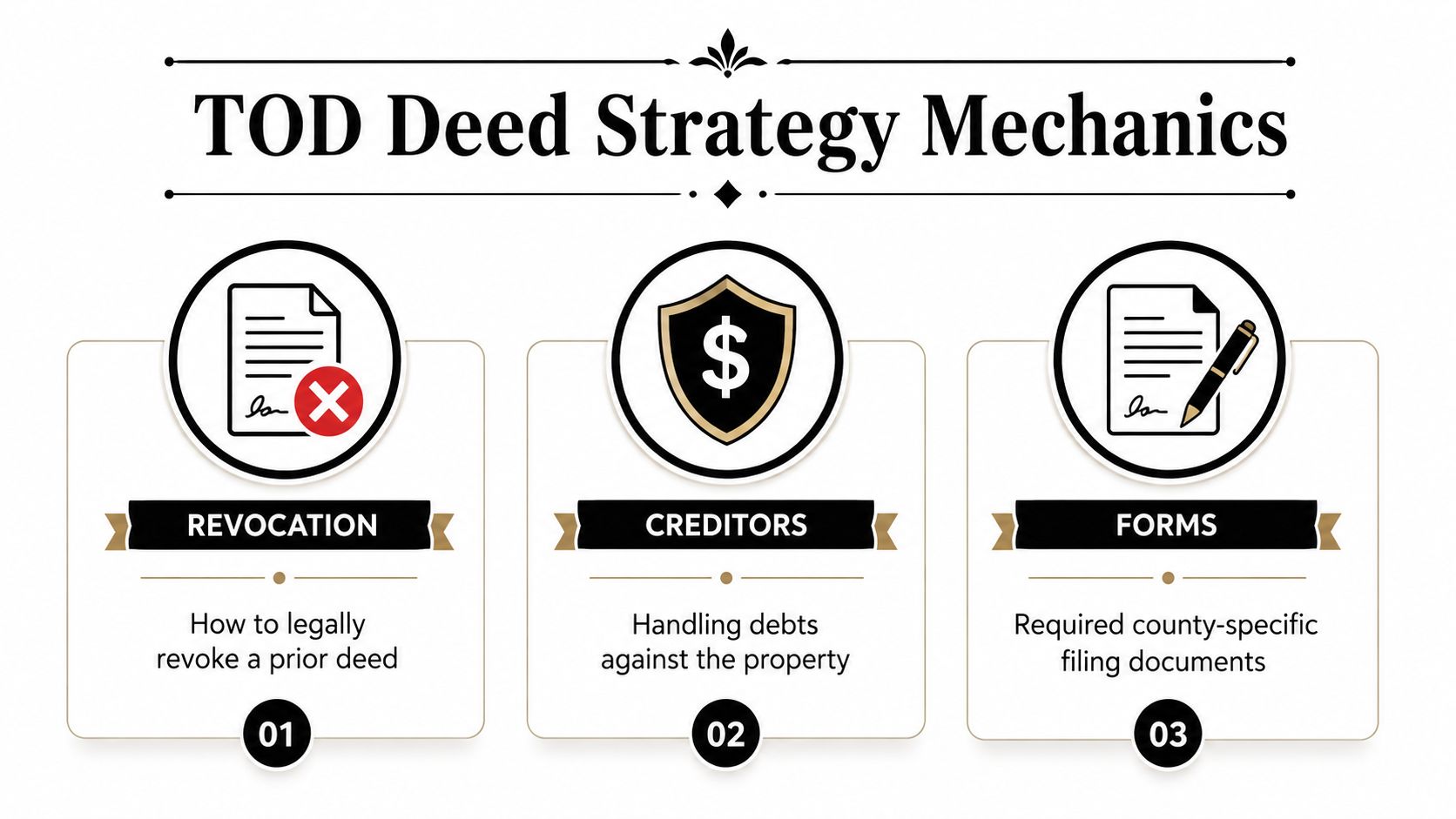
A homestead or year's-allowance issue should be considered during the owner's lifetime, not after the family discovers a problem. Recording a document without understanding these interactions can leave the intended beneficiary with a title problem or an estate that can't satisfy competing obligations.
Common Misconceptions NC Families Have About TOD Deeds
The first misconception is that one TOD designation covers every asset. It doesn't. North Carolina's operative TOD framework under Chapter 41, Article 4 applies to securities held in beneficiary form, not houses, land, or other real-property interests.
A brokerage account and a home may sit in the same family budget, but they don't pass under the same rule. The account may transfer through its beneficiary registration, while the house requires a separate ownership or estate-planning structure.
Probate isn't the only issue
A second misconception is that a real-property TOD deed, even in a state that authorizes one, would eliminate every form of administration. Probate avoidance for title transfer doesn't necessarily resolve debts, taxes, creditor claims, family allowances, or title questions. A beneficiary may still need legal assistance after death.
The third misconception is that a beneficiary deed automatically protects the home from creditors or family claims. The proposed North Carolina framework specifically contemplated rules for creditor claims and statutory allowances, which shows why those issues can't be assumed away. A planning document transfers or organizes property. It doesn't create a universal shield against every lawful claim.
Out-of-state forms aren't North Carolina authority
An online template may use the phrase “transfer on death deed” and appear professionally prepared. That doesn't make it valid for North Carolina land. A deed recorded in another jurisdiction, or a form drafted for another state's statute, generally can't supply the legal effect that North Carolina hasn't enacted.
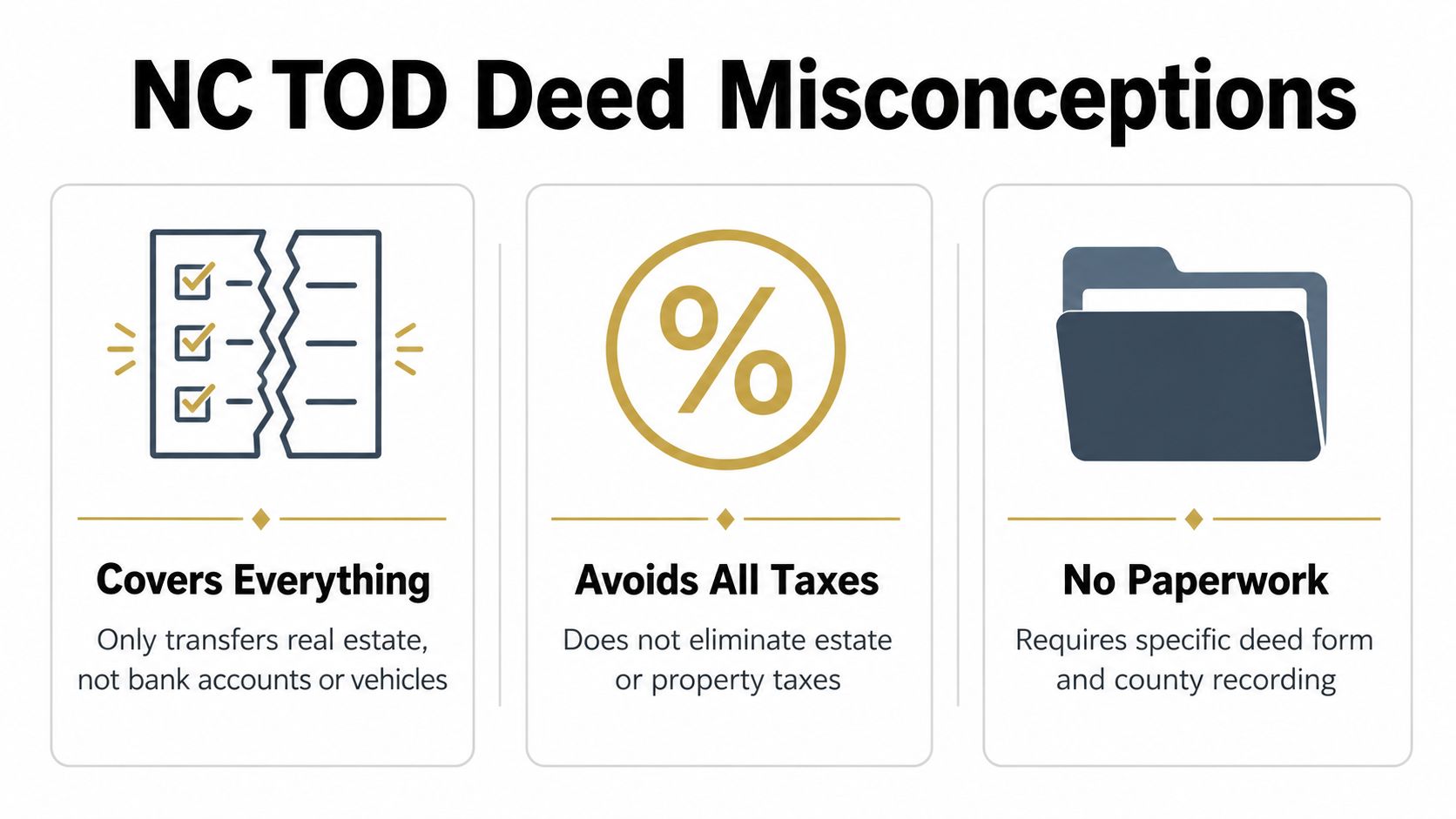
Before signing anything, compare the proposed document with the current North Carolina deed, the county recording requirements, the owner's marital status, and the intended beneficiary's circumstances. A quick form can create a long correction process when it doesn't match North Carolina law.
Next Steps and How a North Carolina Estate Planning Attorney Helps
The central answer is simple: North Carolina doesn't currently offer an operative transfer-on-death deed for real property, although it does recognize TOD registration for securities under Chapter 41. A homeowner who wants a house to pass smoothly should focus on a valid North Carolina ownership and estate-planning structure.
Before a consultation, gather:
- Current deed: Obtain the recorded deed and any later conveyances.
- Property information: Bring mortgage, lien, and tax documents that affect the home.
- Family details: Identify intended beneficiaries, co-owners, a spouse, and any blended-family concerns.
- Existing documents: Include wills, trusts, powers of attorney, and beneficiary designations.
An attorney can evaluate whether survivorship ownership, a life estate, a revocable trust, or a will-based plan fits your goals. The review should also address incapacity planning, creditor exposure, and whether the title matches the documents.
If you own North Carolina real estate and have been relying on a TOD deed form, schedule a review before recording it or assuming it will control the property's transfer.
The Law Office of Bryan Fagan helps North Carolina residents review wills, trusts, probate concerns, deed titling, and beneficiary designations as part of a coordinated estate plan. Visit the Law Office of Bryan Fagan to discuss your property, family circumstances, and planning options with North Carolina estate planning counsel.