A parent dies, and the family discovers that the house, bank accounts, and investment accounts aren't immediately available. The will may clearly state who should inherit, but North Carolina's probate process still requires court administration, filings, creditor procedures, and coordination with the clerk. For a family already dealing with grief, those steps can create delay, expense, and conflict.
A revocable living trust in North Carolina can solve part of that problem, but only when it has been properly prepared and funded. The document itself isn't magic. The important questions are which assets belong in the trust, who will manage them if you become unable to do so, and whether the plan reflects North Carolina law.
Why North Carolina Families Consider a Revocable Living Trust
Consider a Wake County family whose late parent owned a residence and maintained several financial accounts in the parent's individual name. The family may need to work through North Carolina probate court before the successor can deal with those assets. The clerk's office must process filings, creditors may submit claims, and the family may face uncertainty before the house can be sold or distributed.
A properly funded trust changes the legal ownership structure before death. The trustee, rather than the individual, holds title to trust assets. After death, the successor trustee generally follows the trust instructions without asking the clerk of superior court to administer each trust asset through probate. Families exploring broader probate planning can also review this North Carolina probate guidance.

The practical reasons families choose a trust
A trust is often considered for three related reasons:
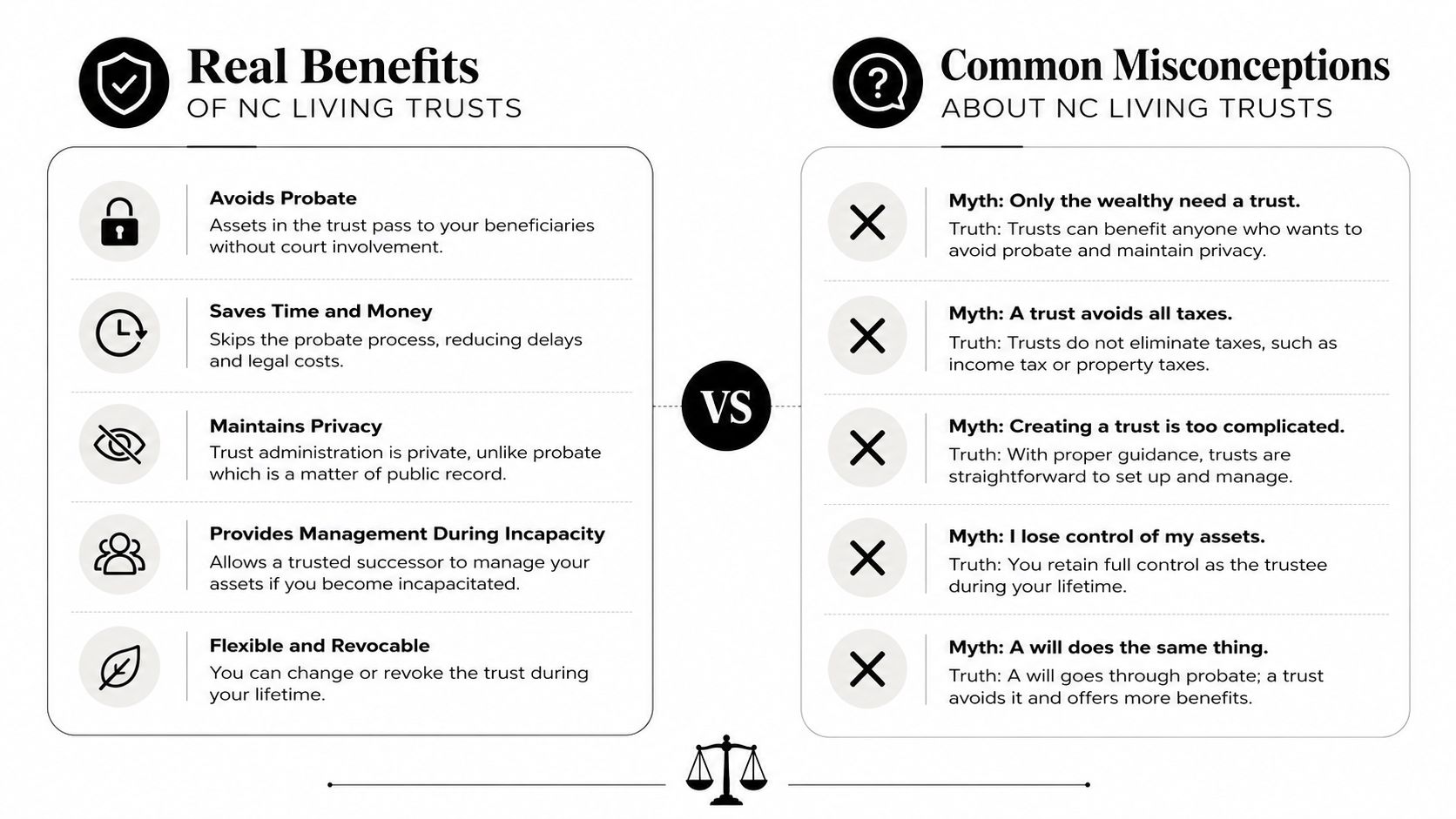
- Probate administration: Assets titled in the trust can pass under the trustee's authority instead of passing through the individual's probate estate.
- Privacy: A will filed for probate becomes part of the public court record. A trust generally keeps its terms and asset instructions outside that public filing process.
- Continuity during incapacity: If the settlor becomes unable to manage finances, a named successor trustee can step in under the trust terms, subject to the document's requirements.
These benefits can matter especially when a family owns North Carolina real estate, property in another state, or assets that require ongoing management. A blended family may also need detailed instructions for a surviving spouse, children from an earlier relationship, and later beneficiaries. A trust can provide a private administrative framework for those instructions.
Practical rule: A trust avoids probate only for property that was actually transferred into the trust.
The choice isn't automatically right for every resident. A modest estate with simple ownership and cooperative beneficiaries may be handled effectively with a will and other documents. A revocable trust also won't protect the settlor from lifetime creditors or create a separate state estate-tax shelter. Its value lies in administration, privacy, control, and incapacity planning, not in promising protections it doesn't provide.
How a Revocable Living Trust Works Under North Carolina Law
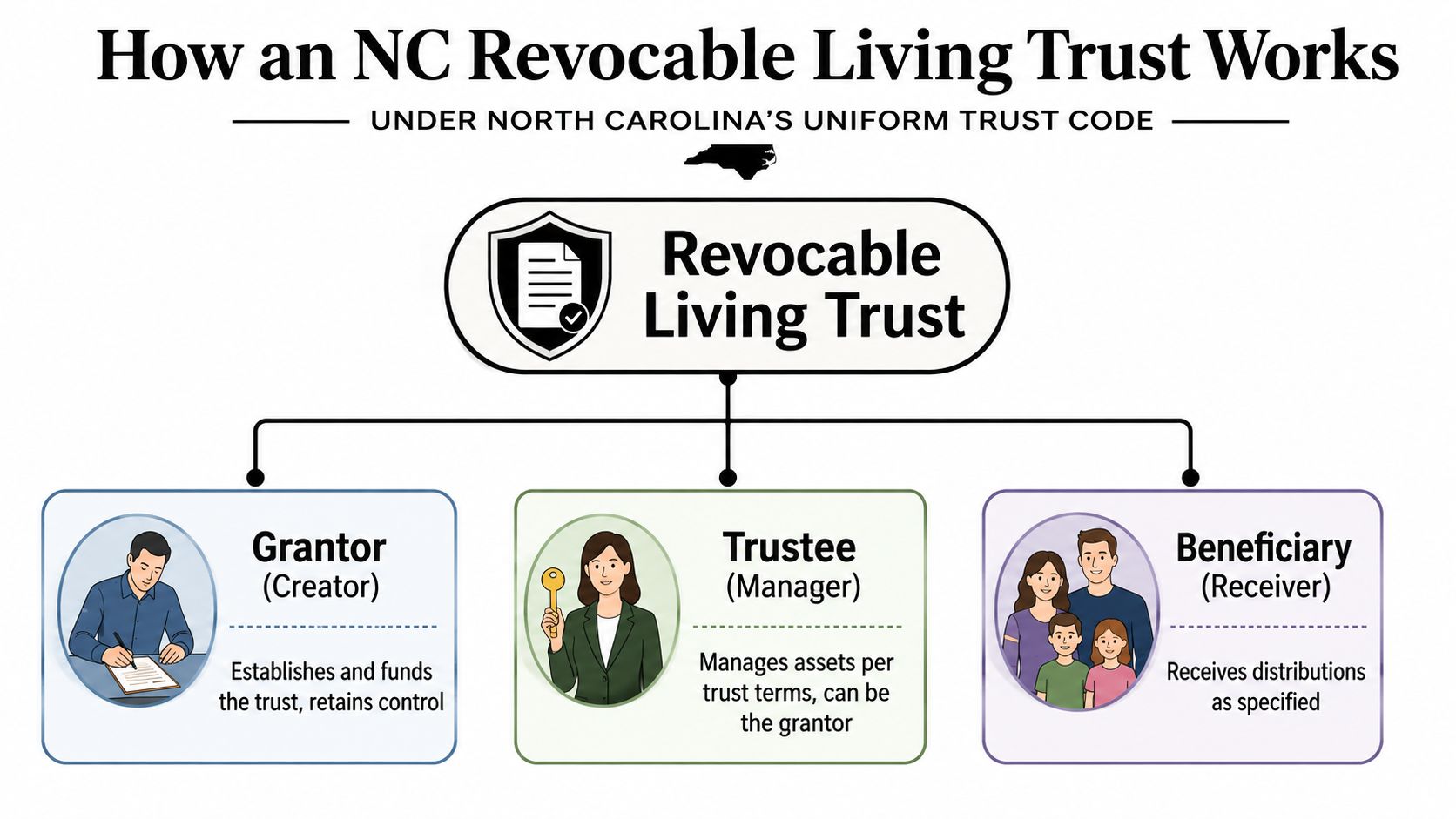
North Carolina's Uniform Trust Code, found in Chapter 36C, assigns three practical roles:
- The grantor, also called the settlor, creates the trust and transfers property into it.
- The trustee manages that property under the written trust terms.
- The beneficiary receives property or other benefits according to those terms.
One person often serves as grantor, trustee, and current beneficiary during life. The settlor can continue managing trust assets, while the agreement sets out who may serve as successor trustee and who receives property later.
The trust document supplies the governing instructions. Ownership records make those instructions operative. A deed, account retitling, or another transfer places an asset under the trustee's authority. Without that funding step, the trustee may lack authority over the property after the settlor's death. This funding gap is one of the most common practical weaknesses in an otherwise carefully prepared plan.
For a broader explanation of trust mechanics, see how a trust works in North Carolina.
What revocable means
A revocable trust remains changeable while the settlor has the legally required capacity. North Carolina law generally permits the settlor to revoke or amend the trust without the trustee's consent or the consent of an adverse-interest holder, unless the document states otherwise. The settlor may change beneficiaries, replace a trustee, add property, or end the arrangement.
North Carolina has specific rules for powers of attorney. An agent may revoke or amend the trust, add property, or direct trust property only when the trust or power of attorney expressly grants that authority. Exercising those powers also does not alter death beneficiaries under the existing estate plan.
During the settlor's life, a revocable trust generally remains connected to the settlor for federal income-tax purposes. The settlor usually reports trust income through the settlor's own tax reporting rather than treating the trust as a separate income-taxpayer structure. This treatment does not create an estate-tax shelter.
North Carolina provides a less familiar planning option under N.C. Gen. Stat. § 36C-4C-2. A resident settlor may petition the Superior Court during life for a judicial declaration that a revocable trust is valid. The petitioner must present evidence that the trust and its amendments are valid and enforceable. A favorable proceeding can address validity concerns while the settlor can still participate, rather than leaving the family to litigate after death.
A family may also use Prenuptial Agreements in North Carolina to address premarital asset protections when trust planning overlaps with marriage and property ownership.
Revocable Trust vs Will and Other Trust Options in NC
A last will and testament gives instructions for property that remains in the individual's name at death. In North Carolina, the will normally must be submitted to the clerk of superior court for probate before the personal representative can administer probate assets. The filing makes the will and related probate materials accessible through the public court system.
A funded revocable trust works differently. The trustee already holds title to trust property, so the successor trustee can administer those assets under the trust agreement rather than placing each asset into the decedent's probate estate. That doesn't mean every estate task disappears. Debts, taxes, non-trust property, and disputes may still require legal attention.
A revocable trust also differs sharply from an irrevocable trust. The revocable arrangement preserves control and flexibility, but the settlor's retained control means the trust generally doesn't shield trust assets from the settlor's own creditors during life. An irrevocable trust may support different asset-protection or Medicaid-planning objectives, but surrendering control can make changes difficult or impossible. Those structures require careful advice because the legal and personal consequences are substantial.
North Carolina comparison
| Feature | Revocable Living Trust | Last Will & Testament | Irrevocable Trust |
|---|---|---|---|
| Probate requirement | Properly funded trust assets generally avoid probate administration | Probate is generally required for assets controlled by the will | Trust assets generally follow the trust terms, subject to the structure and funding |
| Privacy | Trust administration is generally private | Probate filings are public | Trust administration is generally private |
| Tax treatment | Trust assets remain associated with the settlor for estate-tax purposes | Estate assets remain part of the taxable estate when applicable | Treatment depends on the specific structure and retained powers |
| Creditor exposure | Doesn't generally protect the settlor's assets from lifetime creditors | Doesn't provide lifetime creditor protection | May support protection planning, but only if properly structured and administered |
| Medicaid eligibility impact | Doesn't by itself protect assets from Medicaid spend-down rules | Doesn't provide that protection | May affect eligibility planning, depending on the trust and applicable rules |
| Amendment flexibility | Usually can be amended or revoked by the settlor | Can be changed while the testator has the required capacity | Usually limited after creation |
| Incapacity planning | Successor trustee may manage trust property under the document | Requires separate powers of attorney and other planning | Depends on the trust terms |
A trust doesn't replace a will. North Carolina planning commonly includes a pour-over will, which directs assets left outside the trust into it at death. The pour-over will can catch an overlooked bank account or personal item, but it doesn't make that asset avoid probate. The will is a safety net, not a substitute for funding.
Before using any online form, compare its limitations with a properly customized plan. A generic North Carolina will resource may help explain basic terminology, but estate documents should reflect the person's assets, family relationships, and North Carolina legal requirements.
Real Benefits and Common Misconceptions About NC Living Trusts
A revocable trust's practical value depends on what it owns and how its terms fit the rest of the estate plan. A successor trustee can administer property under the trust agreement, but only after the owner has transferred that property to the trust. An unfunded trust may provide detailed instructions without changing how an account or parcel is handled at death.
That funding gap is the point many summaries miss. A pour-over will can address assets left outside the trust, but those assets may still pass through probate before reaching the trust. The document's existence does not, by itself, accomplish the intended transfer.
What the trust does not do
North Carolina eliminated its state estate tax effective January 1, 2013, and the state has no inheritance tax, as explained in this North Carolina revocable trust tax discussion. A revocable trust therefore does not create a separate state estate-tax shelter. Trust property generally remains part of the settlor's taxable estate for estate-tax purposes.
Federal estate tax can still matter for estates above applicable federal exemption levels. One North Carolina legal source summarizes those levels at about $11.7 million for single filers and $23.4 million for married couples. Those thresholds can change, so substantial estates require current tax advice rather than reliance on an older figure.
A revocable trust also does not solve Medicaid eligibility or long-term-care planning. The settlor's retained control generally leaves the property available to creditors and relevant to Medicaid analysis. Transferring property to the trust alone does not avoid spend-down rules. Medicaid planning may require a different trust structure, transfers made under applicable rules, and careful attention to timing and eligibility consequences.
The same distinction applies to incapacity planning. Trust terms can authorize a successor trustee to manage property held in the trust, but accounts and property outside it may require a durable power of attorney or other documents.
A revocable trust can improve administration without changing the underlying economic ownership for every legal purpose.
North Carolina's pre-death validation procedure offers a separate planning tool. While alive, a settlor may ask the Superior Court to confirm the trust's validity, including amendments, by presenting supporting evidence. This can address validity questions before death, when witnesses and records may be easier to evaluate, but it does not prevent every dispute.
A separate contest provision gives challengers up to three years after the settlor's death to contest a trust that was revocable at death under North Carolina's statutory framework. Counsel should evaluate the validation procedure, contest provision, execution evidence, and funding together. None guarantees that a disappointed heir cannot bring a challenge.
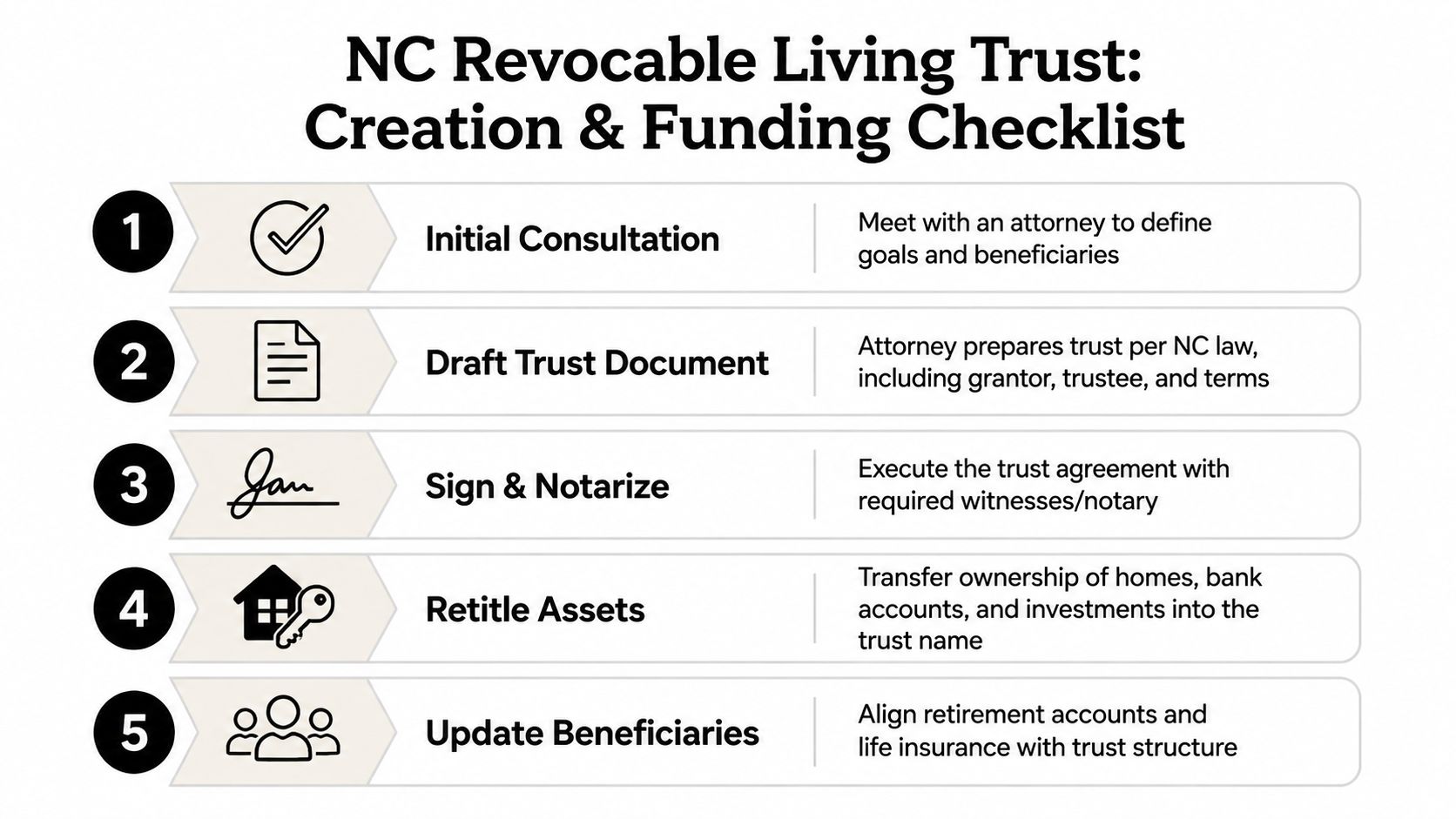
Steps to Create and Fund Your Revocable Living Trust in North Carolina
Signing the document is only the first step. Proper funding determines whether the trust can administer property when your family needs it, so begin with a clear inventory and a written implementation plan.
Start with an asset and family inventory
List real estate, bank accounts, brokerage accounts, business interests, personal property, life insurance, retirement accounts, timeshares, and mineral rights. Record the current owner, how each asset is titled, whether a beneficiary designation applies, and whether another person has a contractual or ownership interest.
Family circumstances should guide the drafting. Identify a blended family, a beneficiary with special needs, a possible divorce, or a child who should receive property in stages. Trustee instructions work best when they reflect the actual relationships, assets, and concerns the family must address.
Draft the trust terms
The trust should identify the grantor, trustee, successor trustee, and beneficiaries. It should explain distributions after death, property management during incapacity, trustee powers, removal and replacement procedures, and the result if a beneficiary dies before receiving property.
The drafting attorney should coordinate the trust with the pour-over will, durable power of attorney, health-care documents, and beneficiary designations. Review these documents as one plan. Conflicting instructions can create uncertainty and administrative work for the successor trustee.
Execute the documents correctly
Use an execution process appropriate to the trust and North Carolina practice. Notarization is commonly used, while related estate documents may require witnesses or other formalities. The signing meeting should confirm that the settlor understands the plan and has the capacity required under North Carolina law.
A resident settlor may also consider North Carolina's statutory pre-death validation procedure. Under N.C. Gen. Stat. § 36C-4C-2, the petition is filed in Superior Court and supported by evidence that the trust and amendments are valid and enforceable. This procedure can address validity questions while records and witnesses may be easier to evaluate, although it does not prevent every later dispute.
Fund the trust asset by asset
Funding is the step families most often overlook. Real property typically requires a new deed to the trustee and recording with the county Register of Deeds. Bank and investment accounts may require retitling. Business interests call for review of governing documents and transfer restrictions before any assignment occurs.
Life insurance and retirement accounts require separate beneficiary coordination. A beneficiary designation may control the transfer regardless of the trust terms, so review each designation rather than assuming the trust governs automatically.
Timeshares, mineral rights, and other specialized interests need individual review. The appropriate transfer method may depend on the governing instrument, recording requirements, and the property's location.
Maintain the plan
Keep a current asset schedule and verify that new acquisitions are titled consistently. Review the plan after marriage, divorce, births, deaths, major purchases, business changes, or a move involving property in another state. North Carolina law includes a divorce-related default rule that revokes certain provisions favoring a former spouse after an absolute divorce or annulment. A complete post-divorce review remains prudent because titles, beneficiary forms, and trustee appointments may also require changes.
The following video provides a visual introduction to the trust-planning process:
Common Pitfalls That Undermine a North Carolina Living Trust
The most damaging mistake is treating the signed trust as the finished product. If the house remains titled in the individual's name, the trust may not control it at death. The same problem can affect bank and investment accounts.
Corrective action: Request written confirmation of each funding step, including recorded deeds, account retitling, and a final asset schedule. North Carolina materials emphasize that property transferred into the trust is the property the trustee can administer.
Beneficiary designations can override the plan
Retirement accounts and life insurance often pass under beneficiary forms. If those forms name an individual who wasn't intended to receive the asset, the trust instructions may not control that transfer.
Corrective action: Review beneficiary designations beside the trust, will, and tax objectives. Don't change a designation without understanding the effect on the recipient and the overall plan.
The wrong successor trustee creates friction
A successor trustee may need to communicate with beneficiaries, preserve property, obtain valuations, pay expenses, and follow detailed instructions. Choosing someone only because they're a relative can create problems if that person lacks time, judgment, or neutrality.
Corrective action: Discuss the role with the proposed trustee and identify a backup. Consider whether a professional fiduciary is appropriate for a complicated or conflicted family.
Marital rights require careful review
Trust planning doesn't automatically eliminate a surviving spouse's legal rights. A plan that ignores North Carolina's elective share rules can leave the estate exposed to a spousal claim.
Corrective action: Review the trust with the spouses' broader marital-property plan and obtain advice specific to the family's circumstances.
Generic forms may miss North Carolina details
An online form may not address North Carolina's Uniform Trust Code, multi-settlor rules, local real-estate transfers, or the interaction between trust provisions and powers of attorney. A form also won't verify that assets were properly transferred.
Corrective action: Use a North Carolina estate-planning attorney to review both the language and the funding implementation. The document and the ownership records must work together.
Frequently Asked Questions and Next Steps for NC Residents
Does a revocable trust eliminate estate taxes in North Carolina?
No. North Carolina has no state estate tax or inheritance tax, but a revocable trust doesn't remove trust assets from the settlor's taxable estate. Federal estate-tax rules may apply to estates above the applicable exemption.
Do I still need a will?
Yes. A pour-over will can direct unfunded assets into the trust, although those assets may still require probate. The will also covers matters the trust doesn't address.
How long does trust creation take?
The planning process commonly takes four to eight weeks from consultation to full funding, depending on the family's circumstances, the number and type of assets, deed preparation, account procedures, and the client's decisions.
Can an out-of-state property go into a North Carolina trust?
Yes. Property in another state can often be transferred to the trust, subject to that state's deed and recording rules. Proper transfer can help avoid ancillary probate in the property's state.
Can I validate the trust before death?
North Carolina permits a resident settlor to petition the Superior Court for a declaration that a revocable trust is valid under N.C. Gen. Stat. § 36C-4C-2. The petitioner must provide evidence supporting validity and enforceability.
If you're considering a revocable living trust, the next step is an asset-by-asset review, not a form purchase. An attorney can determine whether the trust fits your family, explain which property should be transferred, and coordinate the trust with your will, powers of attorney, and beneficiary designations.
The Law Office of Bryan Fagan helps North Carolina individuals and families evaluate wills, trusts, probate concerns, and related estate-planning documents based on their assets and goals. Visit Law Office of Bryan Fagan to schedule a consultation about whether a properly funded revocable living trust fits your situation.