When a loved one passes away, their estate often goes through a court-supervised process called probate. Here in North Carolina, the Clerk of Superior Court oversees this procedure to validate a will, settle any outstanding debts, and formally distribute the remaining assets to the rightful heirs. Many people mistakenly believe that having a will allows their family to bypass this process. The reality is quite the opposite—a will is essentially a set of instructions for the probate court, not a way around it.
At the Law Office of Bryan Fagan, we have seen countless North Carolina families discover this fact during an already difficult time. Probate can become a significant financial and emotional burden. Understanding why it's so problematic is the first step toward creating an estate plan that truly protects your family. The primary reasons our clients seek to avoid probate are its high costs, long delays, and complete lack of privacy.
What Is Probate and Why Should You Avoid It in North Carolina?

Simply put, probate is the legal process of validating a will and administering an estate. It’s a public, court-driven procedure that can be surprisingly expensive and time-consuming. While a will is a critical document for stating your wishes, relying on it alone means your estate is almost certain to end up in probate court.
This court oversight is designed to be thorough, but it comes at a steep price. For most North Carolina families, the probate process can drain the estate of valuable assets and create unnecessary stress. That’s why proactive planning is so important.
The High Cost of Probate
Probate is far from free. The process involves numerous fees that are paid directly from the estate, which means less inheritance for your loved ones. These expenses typically include court filing fees, executor compensation, and often, significant attorney's fees.
Practical Example: Consider a common scenario for a North Carolina family: an estate with a home valued at $400,000 and other probate assets totaling $250,000. The entire $650,000 estate is subject to court fees under North Carolina law. The Clerk of Court charges $4 for every $1,000 in value, up to a maximum of $6,000. This alone amounts to a $2,600 court bill.
When you also account for legal fees, which can range from 3-5% of the estate's value depending on its complexity, you could be looking at another $19,500 to $32,500 disappearing before your heirs see a dime. We regularly explain these potential expenses to clients; for a deeper dive, you can learn more about why avoiding probate should be a key part of every North Carolina estate plan.
These aren't just abstract numbers. They represent a real loss to your family's inheritance—money you intended for your children’s education or your spouse’s security that is instead spent on administrative expenses.
Long Delays and Frozen Assets
Beyond the direct costs, probate is notoriously slow. In North Carolina, a straightforward probate case can easily take eight months to over a year to finalize. If the estate is complex or if disputes arise, it can be tied up in court for much longer.
Throughout this entire period, the estate’s assets are effectively frozen. This creates real-world problems for your family.
- Your surviving spouse might struggle to access funds needed for daily living expenses.
- The family home cannot be sold to provide financial relief or facilitate a move.
- Investment and bank accounts are locked, preventing your family from managing them or using them to pay bills.
This delay creates immense hardship. The mortgage is still due, bills keep arriving, and life doesn't pause just because an estate is in probate. Forcing your loved ones to wait months for access to the resources you left for them is a burden that proper planning can completely prevent.
A Complete Loss of Privacy
One of the most significant and often overlooked drawbacks of probate is that it is a public process. When a will is filed with the Clerk of Court in any North Carolina county, it becomes a public record, along with a detailed inventory of your assets.
This means anyone can walk into the courthouse and learn about:
- The value of your home in Raleigh or your vacation property in the Outer Banks.
- The exact balances of your bank accounts and investment portfolios.
- Who you named as beneficiaries and the specific assets they are set to inherit.
This level of public disclosure can attract unwanted attention from opportunistic creditors, distant relatives, or even scammers. It also lays your family’s financial situation bare, which can create tension or disputes among heirs who now know exactly who received what. By structuring your estate to avoid probate, you ensure these personal matters remain private and that your final wishes are carried out discreetly.
Probate vs. Non-Probate Asset Transfers in North Carolina
| Characteristic | Probate Process | Non-Probate Methods (e.g., Trusts) |
|---|---|---|
| Privacy | Public record; anyone can view the will and asset inventory. | Private; asset and beneficiary details are not made public. |
| Timeline | Typically 8-12+ months; assets are frozen during this time. | Immediate or very quick transfer, often within weeks. |
| Cost | Court fees (up to $6,000), executor fees, and attorney fees. | Typically lower administrative costs; no court or executor fees. |
| Control | Court-supervised; the executor must follow strict legal procedures. | Controlled by your designated successor trustee according to your rules. |
| Disputes | Higher risk of public will contests and creditor claims. | Lower risk of disputes; handled privately if they arise. |
As you can see, the advantages of using non-probate methods are significant. They offer a faster, more private, and less expensive way to pass your legacy to the next generation. At the Law Office of Bryan Fagan, we help North Carolina residents build plans that achieve exactly that.
Using a Revocable Living Trust to Keep Your Estate Private

For North Carolina residents who want the most powerful and complete way to avoid probate, a Revocable Living Trust is the gold standard. It’s best to think of it as a private legal container you create to hold your assets. During your life, you simply transfer ownership of your property into the trust and continue to manage everything as the trustee, just as you always have.
The real power of a trust becomes clear after you pass away. Instead of your assets being tied up in court proceedings, your chosen successor trustee steps in immediately. They can then distribute your property directly to your beneficiaries based on your private instructions—all without public filings or the frustrating delays of the probate system.
How a Living Trust Maintains Your Privacy
One of the biggest, and often overlooked, downsides of probate in North Carolina is the total loss of family privacy. When an estate goes through probate, your financial affairs become a public record, available for anyone to see.
Real-World Scenario: The estate inventory filed with the Clerk of Court lists every single asset. That $350,000 family home in Wilmington, your $150,000 retirement portfolio, and even personal heirlooms are all detailed in a public document. This isn't just an invasion of privacy; it can also create real problems. Publicly disclosing who gets what can fuel jealousy and trigger lawsuits, turning a time of grief into a bitter family feud.
A revocable living trust is your best defense against this. Because the trust owns the assets, they are not part of the public probate record. Everything remains confidential, known only to your successor trustee and beneficiaries.
Why Trusts Are Essential for North Carolina Real Estate
Here’s a critical point for anyone who owns a home in North Carolina: our state does not permit Transfer-on-Death (TOD) deeds for real estate. Many other states allow you to use a simple deed to name a beneficiary who automatically inherits your property, but that tool is not available here.
This legal reality makes a revocable living trust the single most effective way to pass your home to your loved ones privately and efficiently. By transferring the title of your home into your trust, you remove it from your probate estate. Your successor trustee can then transfer the deed to your beneficiary without needing a judge’s permission, saving your family a tremendous amount of time, money, and stress.
Key Takeaway: For North Carolina property owners, a living trust is not just a convenience—it's the primary legal tool for ensuring your home, often your most valuable asset, bypasses the public and costly probate process.
Maintaining Control During Your Lifetime
We often hear from clients who worry they will lose control over their property by putting it into a trust. With a revocable living trust, that’s simply not true. The key word here is "revocable," which means you keep full control.
During your lifetime, you have the complete authority to:
- Sell or refinance any property held in the trust.
- Add or remove assets whenever you wish.
- Change your beneficiaries or the instructions for distribution.
- End the trust entirely if your situation changes.
You are always in the driver's seat. The trust works for you, under your direction as its creator and initial trustee. It only becomes irrevocable upon your passing, at which point it locks in your final wishes and protects your legacy. This blend of probate avoidance, privacy, and lifetime control makes it an incredibly powerful estate planning tool. If you are considering this option, you can learn more about wills and trusts on our dedicated practice area page.
Smart Ways to Use Beneficiary Designations and Joint Ownership
While a revocable living trust is a fantastic tool for avoiding probate, it’s not the only way to protect your assets. North Carolina law offers several other effective methods that are often simpler and less expensive, making them a smart addition to any estate plan.
Two of the most direct strategies are Payable-on-Death (POD) designations for bank accounts and Transfer-on-Death (TOD) registrations for investment accounts. Think of them as pre-written instructions for your financial accounts. When you pass away, the money transfers directly to the person you named, completely sidestepping the probate court.
Using POD and TOD to Your Advantage
Setting up these designations is typically straightforward—often just a matter of filling out a form with your bank or brokerage firm. You can name a primary beneficiary and should also name a contingent (or backup) beneficiary. This ensures that if your first choice can't inherit, the asset still avoids probate and goes to your next choice.
Practical Example: You could name your daughter as the POD beneficiary on your $50,000 savings account in Raleigh. Upon your passing, she would simply need to provide a death certificate to the bank to claim the funds. The account isn’t frozen, and the money isn’t tied up in a public probate filing.
Understanding Joint Ownership with Right of Survivorship
For assets like real estate and bank accounts, North Carolina law provides another powerful probate-avoidance tool: Joint Tenancy with Right of Survivorship (JTWROS). When you own property this way with someone else, the surviving owner automatically inherits the entire asset when one owner dies.
That "right of survivorship" is what makes it work. Probate in North Carolina is rarely quick; it's a process that can easily drag on for 8-12 months or longer. Joint tenancy is a great solution for spouses because the deceased's share automatically passes to the survivor, keeping the asset out of probate, as long as the deed or account title is correctly worded to create this right. You can discover more insights about how JTWROS helps avoid probate's long delays in North Carolina.
Real-World Scenario: John and Mary own their Charlotte home as joint tenants with right of survivorship. When John passes away, Mary instantly becomes the sole owner. She doesn't have to wait for a court's permission to keep living there, sell the house, or refinance it.
These tools are effective, but they also carry significant risks that you absolutely must consider.
The Potential Pitfalls of Joint Ownership
Adding someone to your property as a joint owner is a major legal decision and should not be taken lightly. The moment you make someone a joint tenant, you’ve given them a current ownership stake in your asset. This creates immediate risks.
- Exposure to Creditors: The asset is now vulnerable to the other owner’s financial problems. If your co-owner gets sued, files for bankruptcy, or goes through a divorce, your property could be on the line.
- Loss of Control: You give up your sole authority. You can no longer sell, mortgage, or refinance the property without the other owner's full consent.
- Unintended Consequences: You might add a child as a joint owner, trusting they will "share" the asset with their siblings after you're gone. But legally, they have no obligation to do so. The asset is entirely theirs, and family disputes often follow.
Using these strategies requires careful thought. Adding a child's name to your deed to avoid probate might seem like a simple fix, but it can easily backfire, creating far more legal and family conflict than the probate process you were trying to skip. Consulting with an attorney is critical to make sure you understand every potential outcome.
Qualifying for North Carolina's Small Estate Procedures
Not every estate needs to go through the full, formal probate process. North Carolina law provides simpler, faster options for modest estates, recognizing that a long and costly court proceeding isn't always necessary.
If your estate is relatively small, your loved ones may be able to use a streamlined procedure to settle your affairs. These options are specifically designed to save families time, money, and stress during an already difficult period. The two main paths are "Collection by Affidavit" and "Summary Administration."
Using Collection by Affidavit for Smaller Estates
The most common simplified route is known as Collection by Affidavit. This process is available when the total value of an estate's personal property—everything except real estate—falls below a specific limit after any liens are paid.
Under North Carolina General Statutes § 28A-25-1, you can use this process if the estate's personal property is valued at:
- $20,000 or less if the surviving spouse is NOT the sole heir.
- $30,000 or less if the surviving spouse is the sole heir.
It’s crucial to remember that real estate is not part of this calculation. This affidavit process is only for personal property like bank accounts, cars, and other movable assets. After a 30-day waiting period following the date of death, the heir can file a straightforward form with the Clerk of Court to gather and distribute the property.
Real-World Scenario: Imagine a widow in Asheville whose husband passed away, leaving a $15,000 savings account and a car worth $8,000. As the sole heir, the total personal property value of $23,000 is well under her $30,000 limit. She can use the Collection by Affidavit process to gain access to the funds and transfer the car title, all without the expense and delays of a formal probate case.
Understanding Summary Administration for Spouses
North Carolina offers an even more direct path called Summary Administration. This option is available when a surviving spouse is the only person set to inherit the entire estate, whether that’s laid out in a will or determined by state law if there was no will.
This process, governed by N.C. Gen. Stat. § 28A-28-1, is initiated when the surviving spouse files a petition with the Clerk of Court.
If the Clerk confirms the spouse is the sole heir, they can issue an order releasing all of the estate's property directly to them. At that point, the spouse takes ownership and also becomes responsible for paying any of the decedent’s outstanding debts.
Summary Administration essentially consolidates the entire settlement process into one step. It bypasses the need to formally appoint an executor and avoids the detailed inventory and accounting required in full probate. It’s a dignified and swift way for a surviving spouse to take control of the assets they are meant to inherit. While helpful, these procedures have strict rules, and it’s important to ensure your family qualifies.
Building Your Probate Avoidance Plan Step by Step
Creating a plan to avoid probate in North Carolina is about more than just signing a document; it requires a thoughtful, strategic approach. We can help you turn your goals into an actionable plan that protects your assets and your family.
It all starts with a detailed inventory of everything you own. This includes real estate, bank accounts, investment portfolios, vehicles, business interests, and valuable personal property. For each asset, you need to know exactly how it is titled—is it in your name alone, in joint tenancy, or already held in a trust? This initial review is the foundation of your entire plan.
Next, you have to be realistic about your family dynamics. Do you have minor children who would need a guardian? Is yours a blended family where clear inheritance lines are critical to preventing conflict? Are any of your beneficiaries living with special needs? Answering these questions honestly is essential for choosing the right legal tools.
Matching the Right Tools to Your Assets
With a clear picture of your assets and your family’s needs, you can begin matching each asset to the best probate-avoidance strategy. A trust isn’t always the answer; sometimes, a simpler method is far more effective.
- For your North Carolina home: A Revocable Living Trust is often the best solution, especially since our state does not permit Transfer-on-Death deeds for real estate.
- For bank accounts: You can use a Payable-on-Death (POD) designation for a simple transfer, or you could title the account in the name of your trust for more comprehensive control.
- For retirement accounts (like 401ks and IRAs): These accounts pass outside of probate through beneficiary designations. It is absolutely critical to review these regularly and always name contingent beneficiaries.
- For business interests: A trust can be an excellent vehicle for planning business succession and ensuring a smooth transition without court interference.
This infographic breaks down how North Carolina's small estate procedures can serve as a simplified path for more modest estates, avoiding the full probate process.
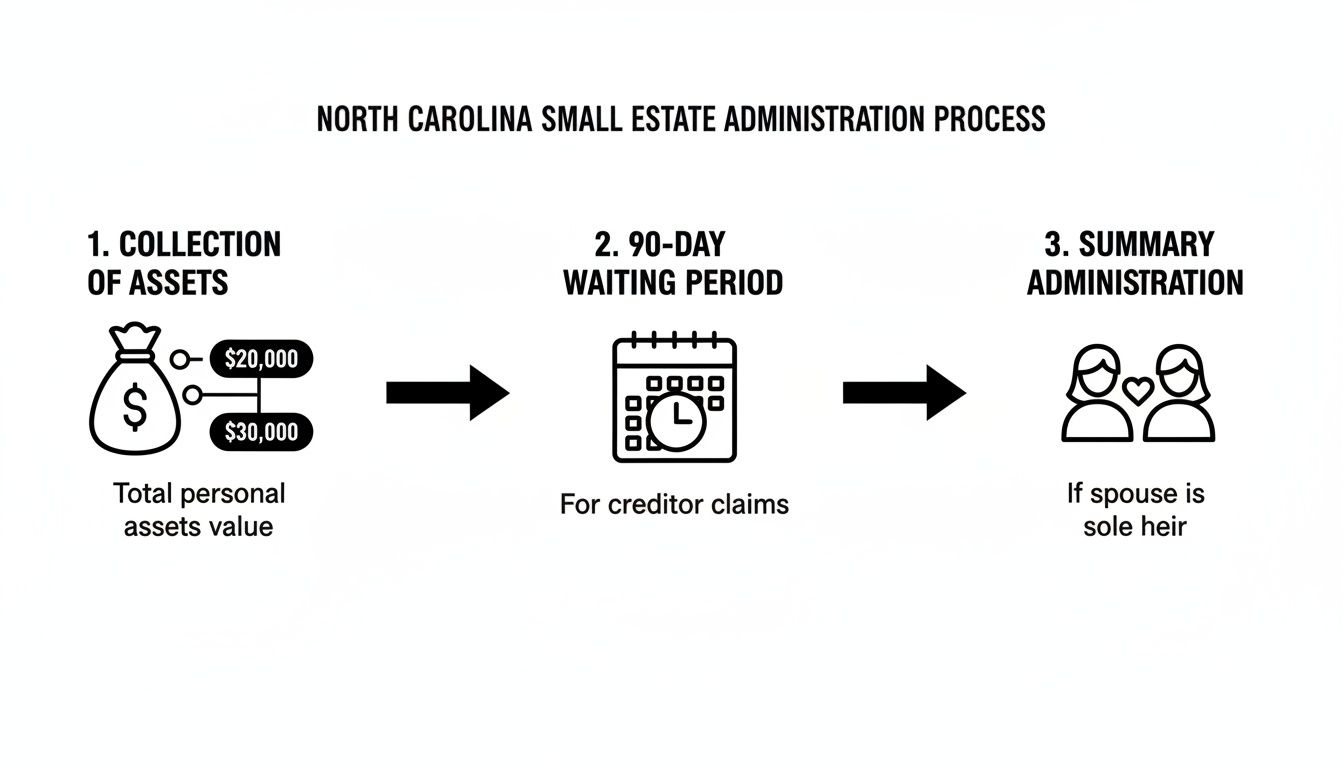
As you can see, the streamlined affidavit process for estates under the $20,000/$30,000 threshold and the summary administration option for surviving spouses can bypass lengthy and expensive court proceedings.
Deciding which tool to use can be complicated. This table compares the primary probate avoidance methods to help you see which might be the best fit for your situation.
Comparing Your Probate Avoidance Options
| Method | Best For | Cost & Complexity | Privacy Level | Control During Life |
|---|---|---|---|---|
| Revocable Living Trust | Comprehensive control over many assets; complex family situations; real estate. | Higher upfront cost and complexity to set up and fund. | High – assets are not part of the public probate record. | Full control – you can change or revoke the trust at any time. |
| Payable/Transfer-on-Death | Bank accounts, investment accounts, and (in some states) vehicles. | Low cost and very simple to set up with your financial institution. | High – avoids probate and transfers privately. | Full control – you can change the beneficiary anytime. |
| Joint Tenancy | Real estate or bank accounts co-owned with a spouse or trusted individual. | Low cost to set up, but has potential risks (e.g., creditor claims). | Moderate – avoids probate, but ownership is public record. | Shared control – the other owner has rights to the property. |
| Beneficiary Designations | Retirement accounts (401k, IRA) and life insurance policies. | No cost – a standard part of setting up the account. | High – passes privately to named beneficiaries. | Full control – you can update beneficiaries as needed. |
Each option has its place, and a well-designed plan often uses a combination of these methods to achieve your goals efficiently.
The Critical Step Everyone Misses: Funding Your Trust
Creating a trust document is only half the battle. A trust is essentially an empty box until you put assets into it—a process we call "funding the trust." This is, without a doubt, the single most common and critical mistake we see people make.
If you create a powerful trust but fail to retitle your assets in the trust's name, those assets will still have to go through probate.
Properly funding your trust means changing deeds, bank account titles, and investment account ownership from your individual name to your name as trustee. For example, a property deed would need to be changed from "Jane Smith" to "Jane Smith, Trustee of the Jane Smith Revocable Trust."
This step is what gives your trust control over the assets so it can distribute them according to your wishes. Our team helps clients navigate this often tedious but absolutely essential process. You can explore more about our comprehensive estate planning services on our practice area page.
Your Plan Is Not a "Set It and Forget It" Document
Finally, remember that your life isn’t static, and neither is your estate plan. It’s a living document that must be reviewed and updated after major life events to remain effective.
You should revisit your plan if you experience:
- Marriage, divorce, or remarriage
- The birth or adoption of a child or grandchild
- A significant change in your financial situation
- The death of a beneficiary or named trustee
- A move to or from North Carolina
A periodic review every three to five years ensures your plan continues to reflect your current wishes and provides the best possible protection for your family.
Securing Your Legacy and Protecting Your Family
You’ve worked your entire life to build something meaningful. Now it's time to make sure that legacy is protected for the people you love. As we've seen, probate in North Carolina can be a costly, public, and time-consuming process that places a heavy burden on a grieving family.
But there’s good news: probate is almost always avoidable. With the right legal tools and a proactive plan, you can shield your loved ones from the stress and expense of court proceedings altogether.
Taking Control of Your Estate
By using instruments like Revocable Living Trusts, strategic beneficiary designations, and the right kind of joint ownership, you can ensure your assets pass directly, privately, and efficiently to your heirs. A well-crafted plan removes the court from the equation and puts your family’s future firmly where it belongs—in your hands.
Taking these steps today provides an invaluable sense of peace for tomorrow. It is one of the most powerful actions you can take to care for those you love. Don’t leave your family’s financial security to chance or the discretion of the North Carolina court system.
A personalized estate plan is the ultimate act of protection. It ensures your final wishes are honored precisely as you intended, without unnecessary delays, public disclosures, or financial loss for your beneficiaries.
Frequently Asked Questions About Avoiding Probate in North Carolina
When it comes to estate planning, we find that North Carolina families often have similar questions. Here are clear, straightforward answers to the issues we address most frequently.
If I have a will, do I avoid probate in NC?
No, and this is a common misconception. A will does not avoid probate; it is a set of instructions for the probate court. Any asset titled only in your name still must pass through the public probate process. While a will is essential for declaring your wishes, tools like trusts and beneficiary designations are what actually keep assets out of court.
Can I use a Transfer-on-Death (TOD) deed for my house in North Carolina?
No. North Carolina law does not currently recognize Transfer-on-Death (TOD) deeds for real estate. This is a crucial point for property owners in our state. If you want to pass your home to heirs without probate, the most reliable methods are transferring it into a Revocable Living Trust or, in specific situations, titling it as Joint Tenants with Right of Survivorship.
How much does an estate have to be worth to go to probate in North Carolina?
There is no minimum value for an estate to enter probate in North Carolina. If an asset is titled in the deceased person's name alone and has no beneficiary designation, it will likely require probate to be transferred, regardless of its value. However, as discussed, North Carolina does offer simplified procedures like Collection by Affidavit for small estates (under $20,000 or $30,000 in personal property, depending on the heir) that avoid full, formal probate.
How much does it cost to set up a living trust in North Carolina?
The cost of creating a living trust is tailored to your financial complexity and family needs. While it requires an upfront investment, that cost is almost always far less than what your family would pay for probate. In North Carolina, probate expenses—including court fees, executor pay, and legal fees—can easily take 3-5% or more of your total estate's value. A trust is a one-time cost designed to prevent those future expenses while shielding your family from months of public proceedings.
Schedule a Consultation with Our North Carolina Estate Planning Team
Navigating North Carolina's probate and estate laws can feel overwhelming, but you don’t have to do it alone. The team at the Law Office of Bryan Fagan is committed to helping North Carolina families create clear, effective plans that protect their legacies and provide peace of mind. Taking proactive steps today is the greatest kindness you can show your loved ones.
Are you ready to secure your legacy and protect your family from the burdens of probate? schedule a consultation to discuss your specific needs and create a plan that provides the security you and your family deserve.