North Carolina allows certain heirs to collect personal property without full probate by filing an affidavit under N.C. Gen. Stat. Chapter 28A, Article 25, after 30 days have passed since death, if the decedent's personal property does not exceed $20,000 after liens and encumbrances, or $30,000 if a surviving spouse is the sole heir. That shortcut can be the difference between getting a bank account, car title, or final paycheck moving now, and opening a much heavier probate file.
A lot of families reach this point in the same way. An adult child finds out there's no will, a checking account is still in the deceased parent's name, and the DMV won't touch the title without paperwork. The small estate administration affidavit in NC exists for exactly that kind of modest, well-documented estate, but it only works when the facts fit the statute and the clerk's office is satisfied with the packet.
When a Small Estate Affidavit in NC Makes Sense
A common North Carolina scenario starts with grief and a stack of loose ends. A parent dies, an adult child needs to collect a small bank balance, maybe a vehicle, and a last paycheck, but nobody wants the expense and delay of a full estate case. When the estate is modest and the paperwork is clean, the small estate administration affidavit nc process can move those assets without opening a full administration.
What the affidavit actually does
Under N.C. Gen. Stat. Chapter 28A, Article 25, the affidavit is a court-facing shortcut for collecting personal property, not a free pass around probate. It is designed for estates that fit within the statutory cap, after liens and encumbrances, and only after the 30-day waiting period has run. North Carolina court guidance also makes clear that the filer is not just signing a form, the filer is acting as the collector, the person authorized to gather and distribute the decedent's qualifying personal property.
That matters because the collector is not the same thing as a formal personal representative. The affidavit works best when the family already knows what assets exist, knows the likely heirs, and doesn't need the court to supervise a long creditor process.
Practical rule: If the estate is small, the heirs are clear, and the assets are ordinary personal property, the affidavit is often the cleanest starting point.
For readers who are also sorting out family-property questions in another context, Equitable Distribution of Property in North Carolina is a useful reminder that North Carolina divides marital property under equitable distribution, not community property. That divorce framework is separate from probate, but families often run into both at the same time.
The affidavit process is educationally simple to describe and legally easy to misuse. This guide is informational, not a substitute for advice on a specific estate.
Who Qualifies and What the $20,000 Limit Really Means
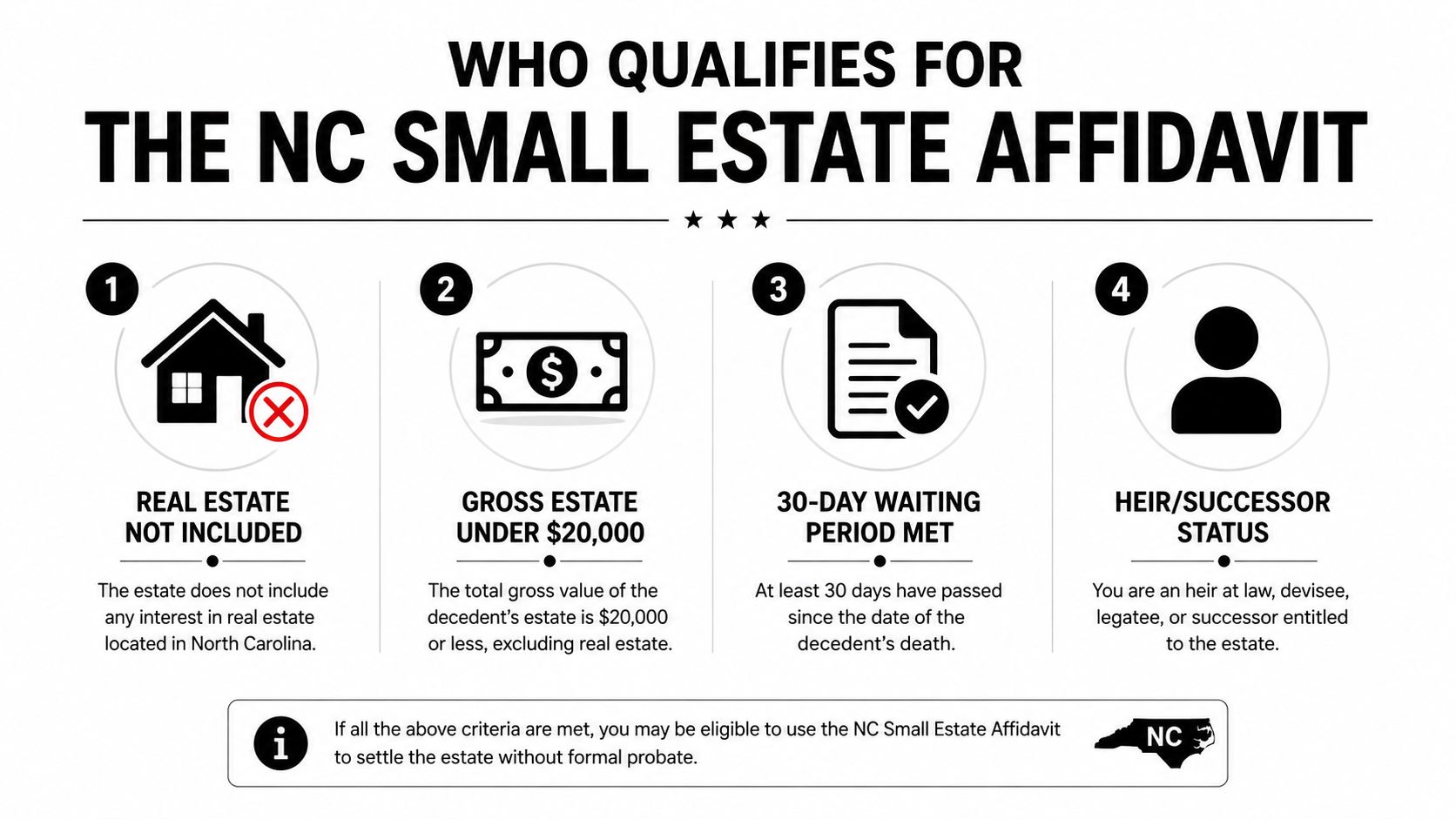
The key question is not whether the family wants a shortcut. It's whether the estate fits the statute. North Carolina limits the affidavit to personal property valued at $20,000 or less, after liens and encumbrances, and a surviving spouse who is the sole heir may qualify under the higher $30,000 ceiling in qualifying cases, as noted in secondary legal references and court-adjacent materials tied to the statute. The affidavit also cannot be used if a personal representative has already been appointed, or if a petition for appointment is pending.
What counts and what usually does not
Think in practical terms. Bank accounts, vehicles titled in the decedent's name, and other probate personal property usually belong in the analysis. Real estate is generally not what this affidavit is for, and that is one reason families run into trouble when they try to use one form for every asset in the estate.
The value test is the part people misunderstand most often. You do not just tally up sticker prices and stop there. The statute measures the decedent's personal property after deductions for liens and encumbrances, which means a financed vehicle is not valued the same way as an owned vehicle. A car worth $19,500 with a $6,000 loan does not create a $19,500 asset for affidavit purposes, and a bank account with $4,000 may still fit comfortably within the cap when the rest of the estate is modest.
A quick self-check before you file
- Wait at least 30 days: Filing too early is one of the easiest ways to waste time.
- Confirm no administrator is already in motion: If a petition is pending, this shortcut is off the table.
- List only the probate personal property: Don't lump every family asset together.
- Test the total against the cap: Use the statutory threshold, not a rough guess.
The North Carolina intestacy rules also matter when there's no will, especially if you're figuring out who inherits first. North Carolina intestate succession for spouse and children shares explained is relevant background if the heir list is unclear.
If your estate looks close to the threshold, or if the asset mix includes items that are hard to value, the affidavit may still be the wrong tool.
Choosing Between the Affidavit and Other NC Probate Shortcuts

North Carolina does not give families just one probate route. Court materials recognize several simplified procedures, including the affidavit procedure, a spouse-focused route, and a funeral-and-burial-expenses path, along with separate statutory mechanisms for certain direct payments and nonprofit delivery. That means the question is often not “Can I avoid probate?” but “Which shortcut fits this estate?”
How the choices differ in practice
The small estate affidavit is strongest when the decedent owned modest personal property, there's no pending probate, and the family wants a direct way to collect assets. The spouse-only route can be cleaner when the surviving spouse is the sole heir and the estate facts line up with that procedure. The funeral-and-burial-expenses option is narrower still, usually aimed at paying or recovering those specific costs.
A separate direct-payment pathway can matter when money is already held by the clerk, and a nonprofit-delivery option can be relevant for certain property. These are not interchangeable. They solve different problems, and each one has its own timing, filing structure, and county practice issues.
If the spouse is the only heir, compare the spouse-specific shortcut first. If the estate is just a pile of modest personal property, the affidavit may be the better fit. If the goal is only to handle funeral costs or a clerk-held payment, the narrower route may be faster.
You can also read How to Avoid Probate in North Carolina for a broader view of where the affidavit sits among other options.
The practical decision rule is simple. If the estate is small, personal property only, and the heirs are ready to document everything, the affidavit is worth considering. If there is a surviving spouse, a clerk-held payment, or an estate that's already becoming procedural, another shortcut may be cleaner.
How to File the Small Estate Affidavit in North Carolina
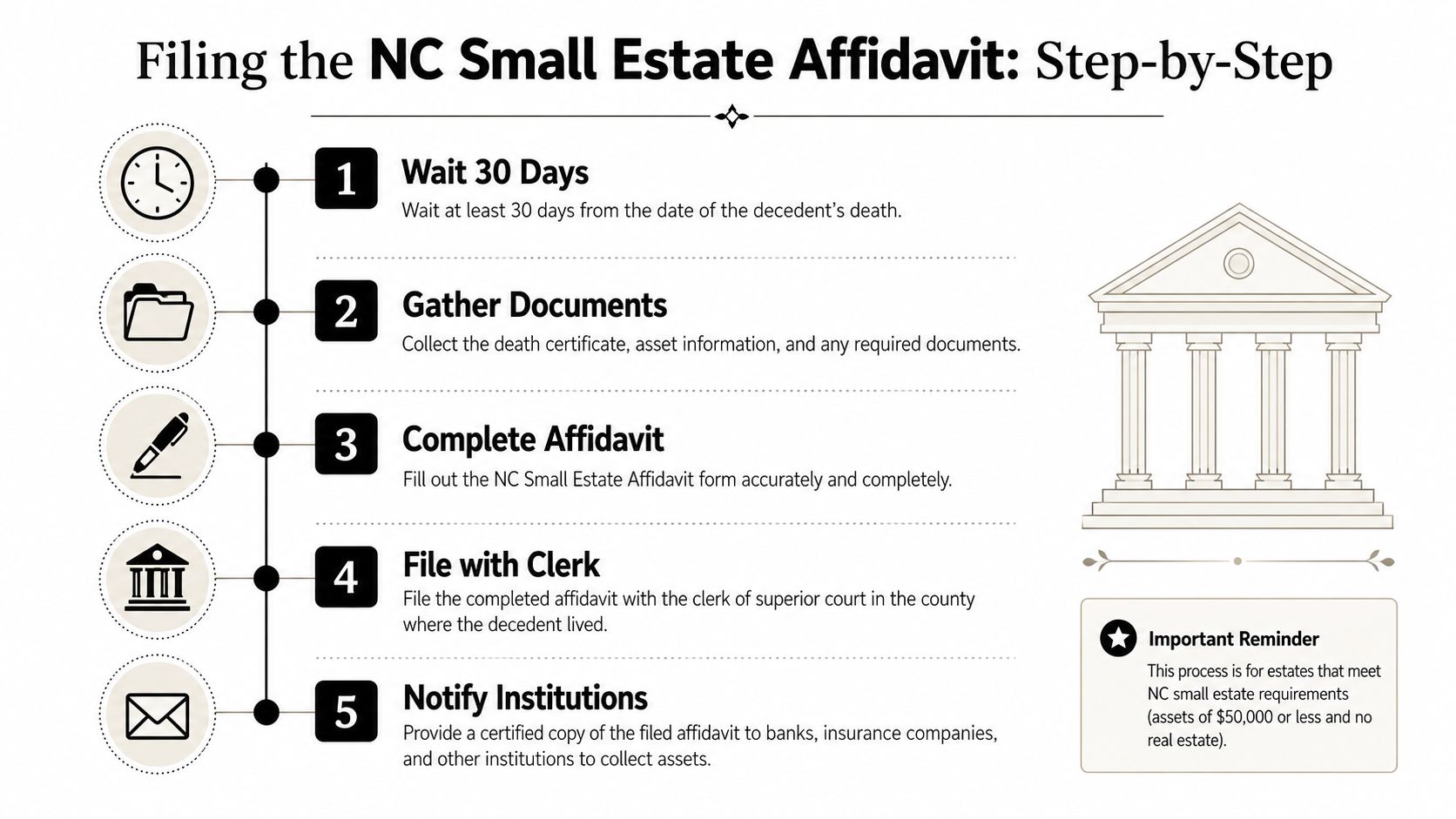
A clerk will not accept a loose form with missing pieces and a vague explanation. The filing path is straightforward, but it still has stages, waiting period first, then the paperwork, then the filing, then the release of assets. North Carolina court materials and the statute point to Form AOC-E-203B as the starting point, and the clerk's office fee is $120.
The filing order that usually works
Start with timing. Confirm that 30 days have passed since death and that no application or petition for appointment of a personal representative is pending or has been granted. Then gather the decedent's identifying information, the death certificate, the original will if one exists, and a list of the heirs or beneficiaries. The packet should also include the Family History Affidavit, because the clerk needs enough information to see who inherits, not just a signature on a form.
File in the Superior Court in the county where the decedent was domiciled or lived at death. That county-of-domicile rule matters in practice, because a filing in the wrong county often gets bounced and the family loses time starting over. If you are filing in person, bring enough copies for the clerk to stamp, keep, and return. If you want a fuller look at the sequence from opening the estate through the clerk's office, the North Carolina probate process page is a useful reference point.
The video below is a useful visual companion if you want to see the workflow before you go to the courthouse.
A divorce residency rule does not control this filing, but it shows how North Carolina court procedures often turn on exact county and timing requirements. North Carolina Divorce Residency Requirements reflects the same kind of statutory detail that probate filings demand.
Once the clerk accepts the packet, the work is still not over. The collector has follow-up duties, and the estate does not really close until those are handled.
Sample Affidavit Language and a Worked Example
A finished affidavit should read like a clean chain of facts, not like a family memo. The clerk is looking for the decedent's identity, the date and place of death, a statement that no personal representative has been appointed or petitioned for, the heir list, and a property schedule with values.
Example language that fits the statute
A workable version often sounds like this:
“I am the collector of the estate of [Decedent's Full Name], who died on [date] in [city], North Carolina. More than 30 days have passed since death. No application or petition for appointment of a personal representative is pending or has been granted. The heirs and/or devisees are [names]. The decedent's personal property subject to this affidavit is described as follows: [property description and value].”
That is not the only way to phrase it, but the core statements have to be there. Clerks care about the substance more than the style, and the missing phrase that causes problems most often is the one about no application or petition being pending.
A simple worked example
Suppose a decedent left a checking account, an older vehicle, and a final paycheck. The adult child bringing the affidavit lists the child and one sibling as heirs, attaches the death certificate, includes the original will if there is one, and itemizes each asset with a realistic value. If the vehicle is still subject to a loan, the debt is part of the value analysis, which is why the affidavit schedule should never be copied from an insurance estimate without checking the payoff.
A clerk can fix a typo. A clerk usually can't fix a missing heir, missing document, or a value that pushes the estate outside the statutory cap.
The safest drafts read plainly. They identify the decedent, prove eligibility, and give the court enough detail to see why the collector is entitled to proceed.
Common Pitfalls That Get the Affidavit Rejected
The biggest mistakes are rarely dramatic. They're procedural, which is why they're so frustrating. A family can do nearly everything right and still lose a week, or a filing fee, because one page is missing or the filing went to the wrong county.
The problems I see most often
Filing too early is a classic error. The statute requires the 30-day wait, and some families try to move faster because a bank or dealership is pressing them. The clerk won't overlook that, and neither will an institution that wants to rely on a proper certified affidavit before releasing assets.
The wrong county creates another avoidable delay. The filing belongs in the county where the decedent was domiciled or lived at death, and that rule is easy to miss when the family lives somewhere else and assumes the nearest courthouse will do. Missing the heir list or the Family History Affidavit is also a frequent problem, especially when the family tree is blended or one heir lives out of state.
I also see filings fail when people attach only a photocopy of the will or forget the death certificate. North Carolina court materials expect the original will if one exists, and the packet needs enough documentary support to let the clerk verify entitlement. The affidavit is a legal gateway, not a substitute for proof.
When the affidavit is the wrong tool
The affidavit doesn't solve disputes well. If creditors are already arguing about debts, or heirs disagree about who should receive the property, a summary shortcut can become the wrong shape for the problem. The same is true when the property value exceeds the cap, because the affidavit can't turn a larger estate into a small one.
Another point families miss is that the collector still has work after the filing. Court-oriented guidance says the collector later files an Affidavit of Collection, Disbursement and Distribution, and practical summaries describe a 90-day window for that follow-up filing unless the clerk gives more time. That means even a simple matter can stretch across several months if the banks are slow, the heir list needs correction, or the collector needs to account for money received and property turned over.
Bottom line: The affidavit is fast compared with ordinary administration, but it is not instant, and it is not a cure-all.
That is also why county practice matters. Individual clerks can be more or less strict about packet completeness, and the local office is often the final filter.
Frequently Asked Questions About NC Small Estate Affidavits
Can the affidavit transfer real estate in North Carolina?
Usually, no. The affidavit procedure is aimed at personal property, not real estate, and that's one of the most important limits to understand before you file. If a home or land is part of the problem, you may need a different procedure or full administration.
Can creditors still make claims against the estate?
Yes. The affidavit does not bar creditors the way some fuller probate procedures can. If the family knows there are debts, the collector should think carefully before using the shortcut, because the process does not give the same creditor-cutoff power as formal administration.
What if the decedent owned property in another state?
The North Carolina affidavit only controls property and process within the North Carolina estate framework. Out-of-state assets can trigger another state's rules, and that can mean a separate proceeding. Families with property in more than one state usually need a closer review before they rely on a single affidavit.
Can I use the affidavit if there is a will?
Yes, if the estate otherwise qualifies. The will should be attached if one exists, and the affidavit still has to state that no personal representative has been appointed or petitioned for. A will doesn't remove the need to satisfy the threshold, the waiting period, or the filing requirements.
How long does the process really take?
The timeline starts with the 30-day waiting period, then the filing, then the later 90-day follow-up in the usual collection path described in court guidance and practical summaries. Even a small estate can take longer if the bank, DMV, or clerk asks for corrections. The process is quicker than ordinary administration, but it still has a legal rhythm.
If you're handling a North Carolina estate and you're not sure whether the affidavit, a spouse-specific shortcut, or full probate is the right move, the Law Office of Bryan Fagan can review the documents, check the eligibility thresholds, and help you avoid a rejected filing. Visit Law Office of Bryan Fagan to schedule a consultation and get clear guidance before you submit the packet.