A Charlotte landlord discovers that rent hasn't arrived, the tenant has stopped responding, and the property appears empty. The landlord changes the locks, expecting the problem to be over. That decision can create a second legal problem, because North Carolina landlord-tenant law does not permit self-help eviction. A landlord generally must use the statutory court process rather than remove a residential tenant by force, lockout, utility shutoff, or property seizure.
The same procedural precision affects tenants. A missed notice deadline, an undocumented repair request, or an unexplained security-deposit deduction can change the strength of a case. North Carolina's rules can favor landlords in some practical respects, but they also demand careful compliance from both sides.
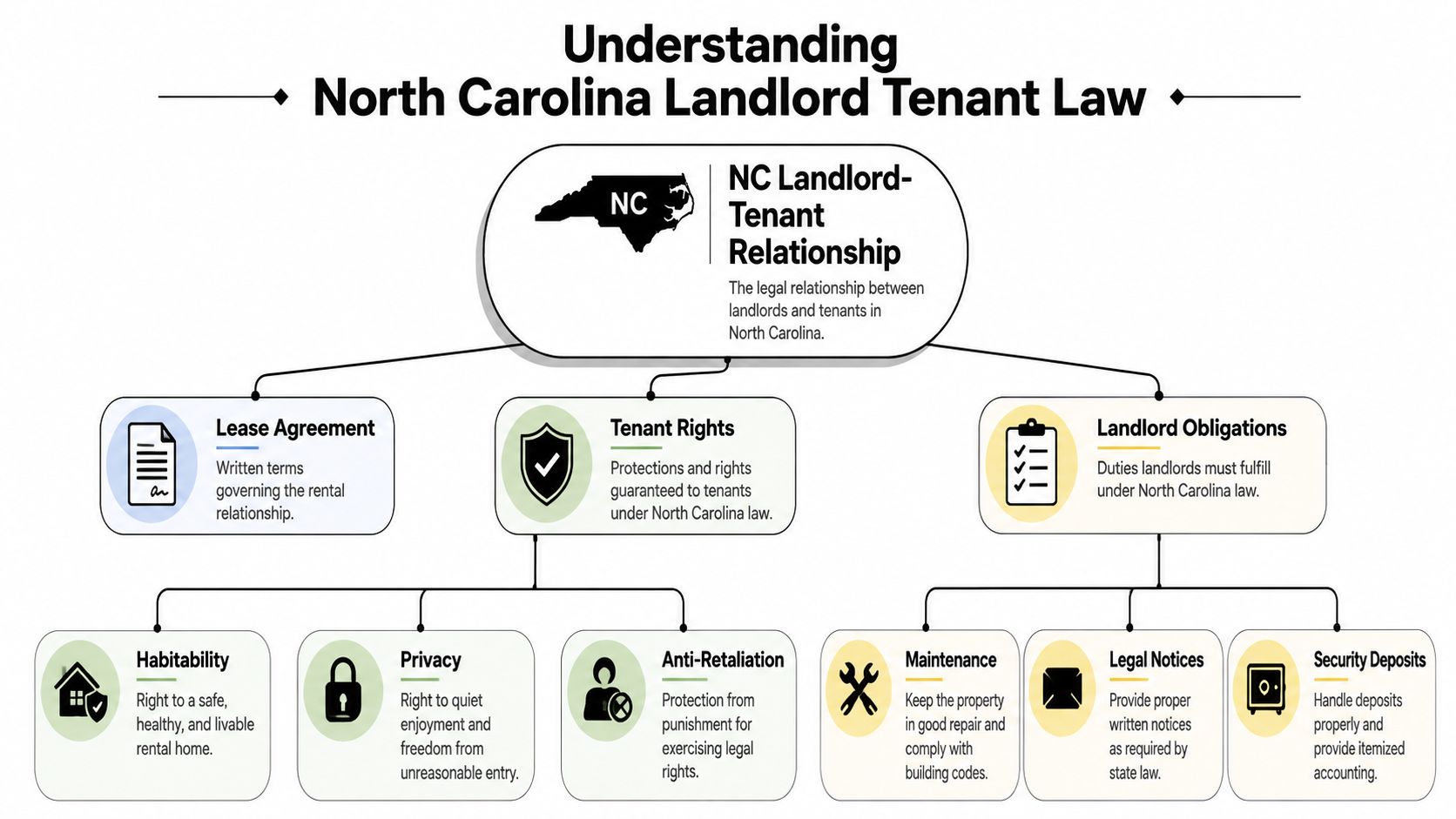
Understanding North Carolina Landlord Tenant Law
A landlord may have a valid lease-violation claim and still lose at the first procedural step. North Carolina's rules require attention to the governing statute, the written agreement, and the exact notice and court process used to enforce either one.
The primary framework is Chapter 42 of the North Carolina General Statutes. It addresses tenancy creation and termination, residential rental agreements, security deposits, and summary ejectment. The official North Carolina General Statutes Chapter 42 reflects updates through Session Law 2026-30 as of August 23, 2026. Article 5, including § 42-38, originated in 1977 and expanded statutory rules for residential rental agreements beyond older common-law lease principles.
North Carolina limits the way a residential tenant may be evicted, dispossessed, or removed. The applicable procedures appear in Article 3 or Article 7. A landlord must therefore identify the legal basis for possession, serve the required notice, file correctly, and follow the hearing and possession process. A tenant's defense may depend on the same details.
Written leases reduce avoidable disputes
North Carolina recognizes enforceable verbal lease agreements for terms under one year, but oral terms are harder to prove. A written lease should state the rent and due date, late-fee terms, approved occupants, repair responsibilities, notice provisions, and guest or unauthorized-occupant rules. It gives the parties and the magistrate a concrete record when their accounts differ.
North Carolina has no statewide rent-control system, and summary ejectment can proceed efficiently when the claim and procedure are sound. That efficiency does not permit shortcuts. A landlord who changes the locks can create a separate dispute, while a tenant who ignores a summons may lose the chance to present defenses.
Practical rule: A strong underlying claim can still fail when the notice or service is defective.
Landlords and tenants seeking broader assistance can review the North Carolina civil law practice area and the firm's housing and civil legal services. For a rental dispute, the analysis usually begins with Chapter 42, the lease, written communications, and the local court process.
Security Deposit Rules and Deadlines
North Carolina's security-deposit limits depend on the type of tenancy. Under N.C. Gen. Stat. § 42-51, the maximum deposit is two weeks' rent for a week-to-week tenancy, one and one-half months' rent for a month-to-month tenancy, and two months' rent for a tenancy longer than month-to-month. The North Carolina Tenant Security Deposit Act also requires the landlord to keep the deposit in a trust account with an approved institution or secure it with a permitted bond.
| Lease Type | Max Deposit | Initial Accounting Deadline | Final Accounting Deadline |
|---|---|---|---|
| Week-to-week | Two weeks' rent | 30 days after termination | Up to 60 days when necessary |
| Month-to-month | One and one-half months' rent | 30 days after termination | Up to 60 days when necessary |
| Longer than month-to-month | Two months' rent | 30 days after termination | Up to 60 days when necessary |
The landlord may deduct only amounts authorized by law, such as unpaid rent, actual tenant-caused damage, storage or removal costs, and eviction-related court costs. Ordinary wear and tear isn't a chargeable loss. A faded carpet from ordinary use is different from carpet damaged by a tenant's conduct. The dispute often turns on causation, photographs, invoices, and whether the charge reflects an actual cost.
The 30-day and 60-day process
Suppose a tenant vacates a Raleigh apartment on June 30 and the landlord finds carpet damage during the inspection. By July 30, the landlord generally must return the unused deposit or send a written itemized accounting. If the landlord can't yet determine the full repair cost, the landlord must send an interim accounting by July 30 and a final accounting by August 29, which is the applicable 60-day endpoint.
The North Carolina Judicial Branch landlord-tenant guidance explains that the landlord must return any unused portion within 30 days, subject to the additional accounting period when needed. Willful noncompliance can cause the landlord to forfeit the right to retain any portion of the deposit, and the tenant may also pursue available attorney's fees.
For landlords: Photograph conditions at move-in and move-out, preserve repair invoices, and explain every deduction in writing.
A tenant dealing with an unexplained withholding should request the accounting and preserve the lease, payment records, photographs, and move-out communications. The six-month residency rule for filing divorce in North Carolina, discussed in North Carolina Divorce Residency Requirements, is unrelated to security-deposit disputes and shouldn't be confused with housing deadlines.
Eviction Process and Required Notices
A tenant stops paying rent, and the landlord files in court the next morning. That shortcut can fail. In North Carolina, eviction is generally called summary ejectment, a court action that determines possession and may address related money claims. The required notice and timing must come before filing.
For nonpayment, the default rule generally requires a 10-day written notice to quit and demand for payment. The notice gives the tenant the statutory period to pay or leave before the landlord starts the proceeding. The North Carolina State Bar's landlord-tenant manuscript explains this requirement and other limits affecting residential disputes. A lease cannot eliminate the required statutory process.
The sequence matters
The landlord serves the notice, waits for the period to expire, and then files the complaint for summary ejectment in Small Claims Court. The tenant must receive legally sufficient service of the summons and complaint. At the hearing, the magistrate may consider possession, unpaid rent, lease violations, notice, service, and defenses supported by the evidence.
The magistrate's ruling may be appealed. The losing party generally has a 10-day appeal window after the ruling. If the judgment becomes enforceable and the tenant remains, the landlord may seek a writ of possession. The sheriff, not the landlord, performs the physical removal under court authority.
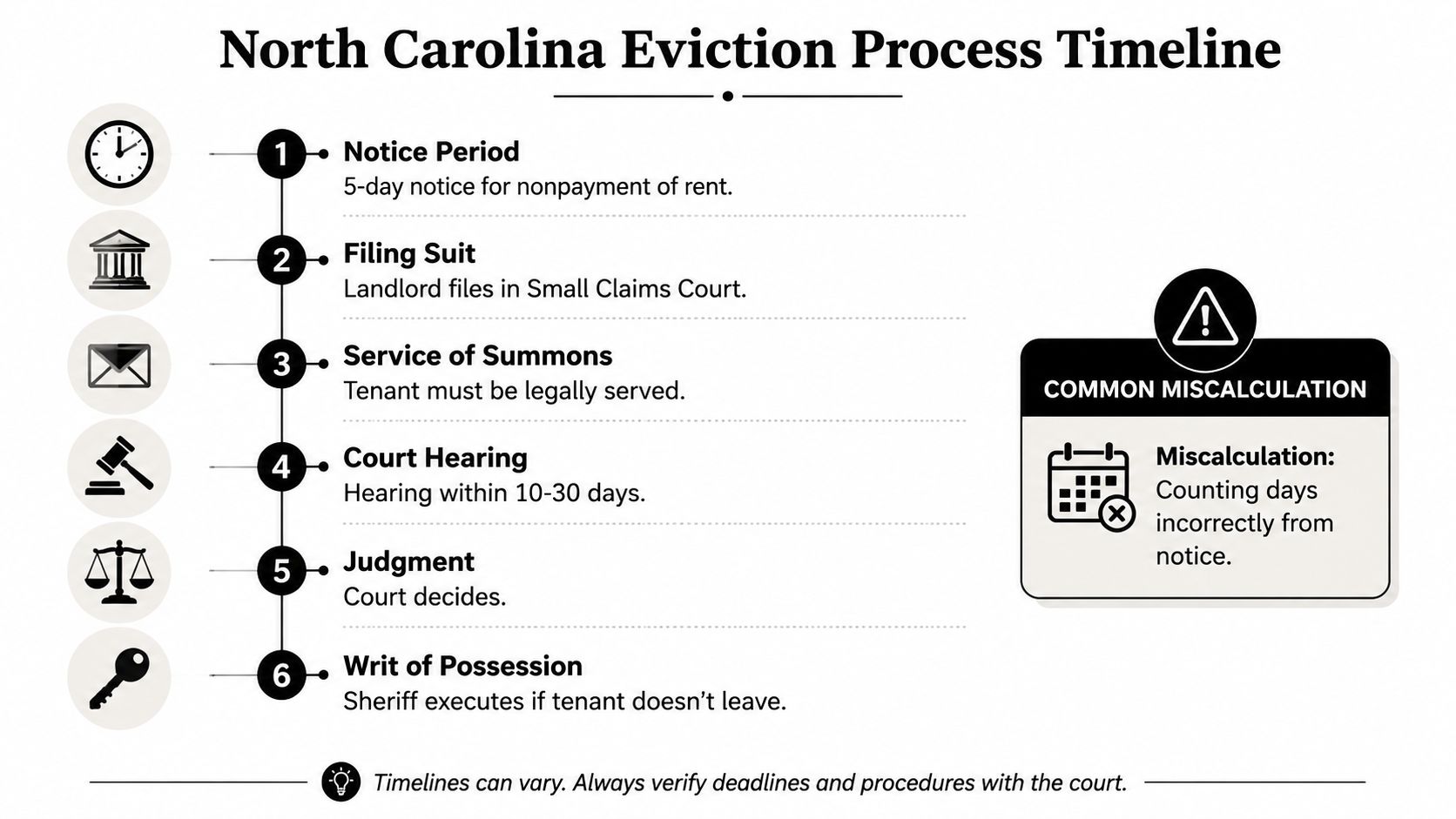
Service mistakes can derail an otherwise supportable claim. Landlords should preserve proof of delivery, posting, or another legally recognized method. Tenants should read every document and respond to the stated deadlines rather than assume the case will be dismissed.
Watch this overview for additional context about the process:
Changing locks, shutting off utilities, or removing belongings without a court order is not a lawful substitute for summary ejectment. A tenant who receives a notice or summons should act promptly. A landlord should confirm the notice, service, filing, and enforcement sequence before attempting to recover possession. The North Carolina civil law practice area addresses disputes where procedural compliance can determine the outcome.
Repairs, Habitability, and Tenant Rights
North Carolina landlords must keep residential premises fit and habitable under the Residential Rental Agreements Act, including N.C. Gen. Stat. § 42-42. The statutory duties include compliance with applicable building and housing codes, safe common areas, and proper maintenance of supplied systems such as heating, plumbing, electrical, and sanitary systems.
Consider a tenant whose furnace stops working in January. The tenant should notify the landlord in writing, describe the problem clearly, preserve the message, and allow reasonable access for inspection and repair. A landlord doesn't necessarily have to cure every problem instantly, but a failed heating system presents a more serious concern than a cosmetic defect, so delay can carry greater legal risk.
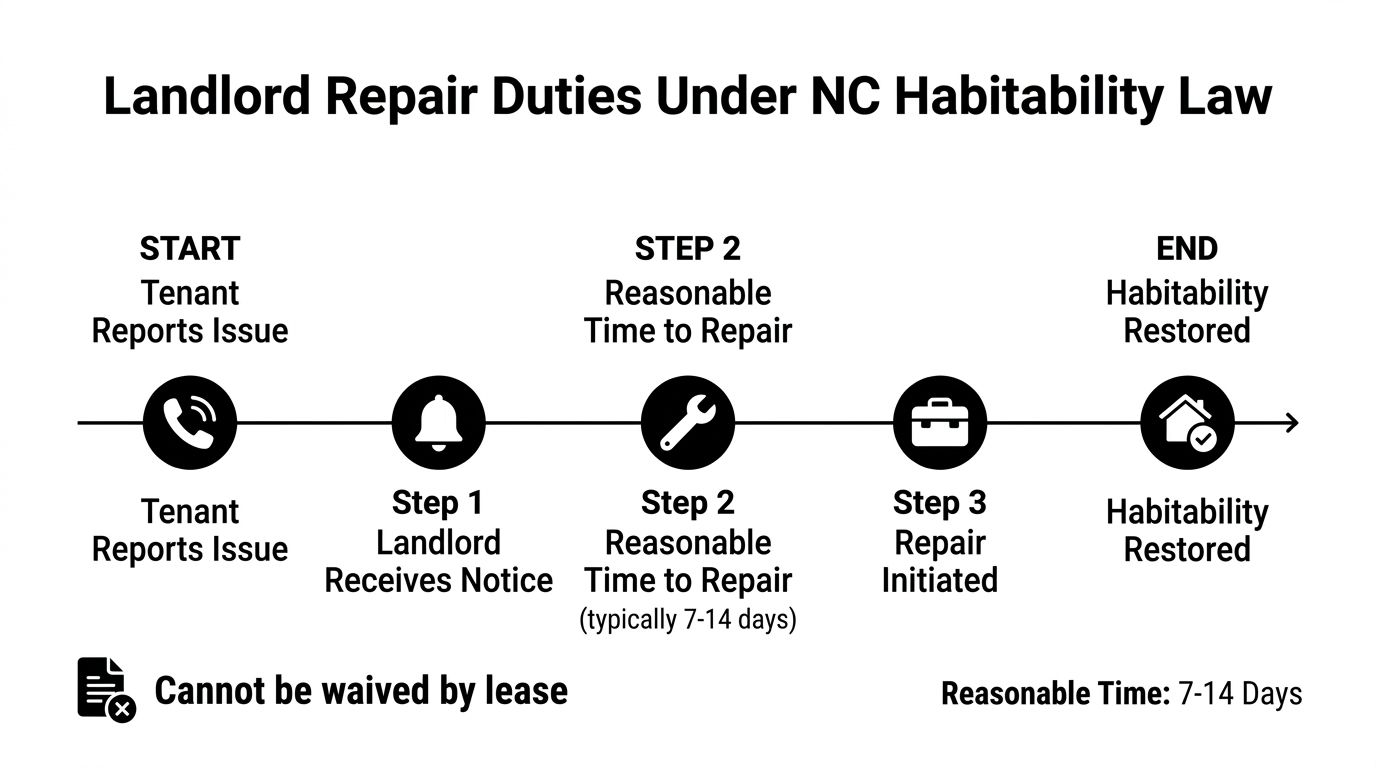
What tenants should and shouldn't do
North Carolina doesn't broadly authorize tenants to withhold rent or repair the property and deduct the cost without legal guidance or court approval. A tenant who stops paying may expose themselves to a nonpayment claim even when the landlord has failed to respond appropriately.
A more defensible process is:
- Give written notice: Identify the defect, its location, and how it affects the home.
- Allow access: Coordinate reasonable entry for contractors or the landlord.
- Document the condition: Keep photographs, messages, work orders, and receipts.
- Escalate carefully: Contact local housing inspectors or pursue a court claim when the landlord doesn't respond.
Local code enforcement and private litigation address related but different questions. An inspector may evaluate code compliance, while a court may decide damages, lease remedies, or possession. Constructive eviction claims also require careful analysis because they generally involve conditions so serious that the tenant's continued use of the premises has effectively been defeated.
Retaliation creates another concern. Under N.C. Gen. Stat. § 42-37.1, tenants may have protection when a landlord responds unlawfully to a good-faith report or exercise of legal rights. That protection doesn't excuse nonpayment or every lease violation, so the timing, communications, and stated reason for the landlord's action matter.
Recent Changes Affecting Squatters and Insurance
Online discussions often treat every unauthorized occupant as a squatter. North Carolina law now requires a more careful distinction. Session Law 2025-88 created expedited removal procedures for true squatters, but it expressly excludes people who have a rental agreement or rent history. A person who entered under a lease, paid rent, or has a plausible tenant relationship may require the ordinary court process.
The expedited procedure isn't a license for a landlord to make a private determination and remove anyone immediately. The landlord must follow the statutory requirements, use the appropriate affidavit process, and involve law enforcement only within the authority provided by the updated law. If the facts are disputed, the safest course is to preserve evidence and obtain legal advice before taking possession.
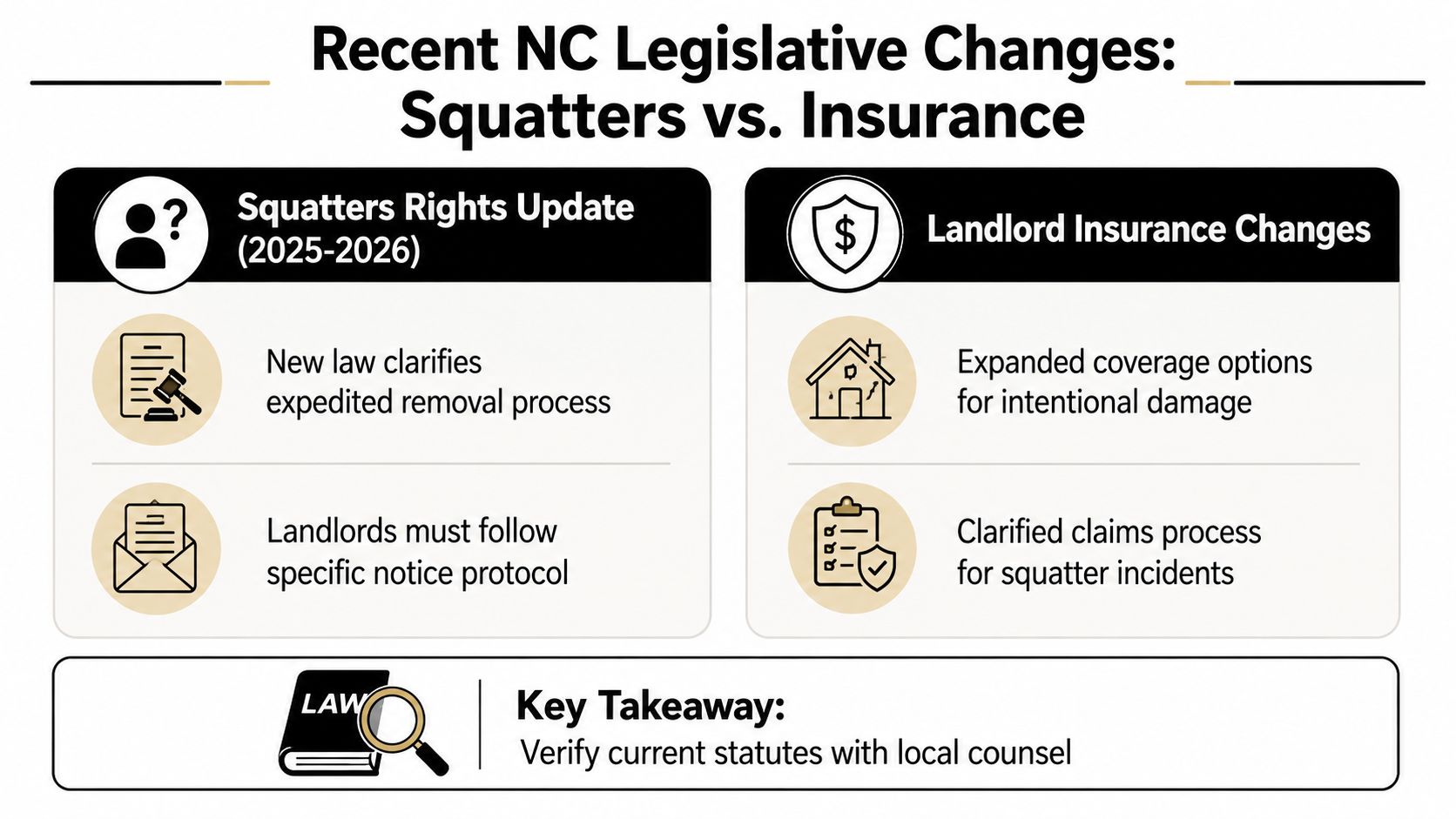
Insurance requirements changed too
A separate 2025 change clarified that a residential landlord can't require a tenant to buy insurance from a particular carrier. If the tenant doesn't provide proof within three business days after the landlord's request, the landlord may obtain coverage and charge the tenant the actual cost plus up to a $50 annual administrative fee, as summarized in the 2026 North Carolina landlord-tenant update from Rentari's statutory guide.
Insurance doesn't transfer every responsibility to the tenant. A renter's policy may address certain tenant losses, but it doesn't automatically eliminate the landlord's obligations concerning maintenance, safety, or legal possession.
Three common assumptions are especially risky:
- “A squatter becomes a tenant after 30 days.” No single online rule should replace a fact-specific review of the person's entry, agreement, rent history, and possession.
- “The landlord can lock out an unauthorized occupant.” The new process has requirements and exclusions. A private lockout remains dangerous when the person may have tenant status.
- “Insurance eliminates landlord liability.” Coverage disputes and premises-liability questions are separate from the landlord's statutory duties.
Practical Steps and When to Seek Legal Help
The most useful first step is to build a chronological file. A landlord or tenant should be able to show what happened, when it happened, what notice was given, and how the other side responded.
Start with an evidence checklist
Keep the following in one folder, preferably with original files preserved:
- Lease documents: Save the signed lease, addenda, guest rules, insurance provisions, and renewal terms.
- Payment records: Preserve receipts, bank records, payment-app confirmations, and ledgers.
- Written notices: Keep notices to pay, notices to quit, repair requests, deposit accountings, and delivery records.
- Condition evidence: Use dated photographs, videos, inspection reports, contractor invoices, and move-out records.
- Court papers: Retain the summons, complaint, proof of service, judgment, and any appeal documents.
Self-resolution may be sensible for a narrow deposit disagreement when the parties agree about the tenancy and the amount is modest. It becomes less attractive when the dispute involves contested possession, retaliation, significant habitability conditions, personal injury, a complex lease, or a potential Fair Housing Act violation.
A calm written demand is often more useful than an angry phone call. It creates a record and gives the other side a clear opportunity to correct the problem.
Choose the right escalation point
A practical escalation ladder begins with direct communication, followed by a formal written demand, mediation where appropriate, and litigation when voluntary resolution fails. Tenants with limited income should also investigate Legal Aid of North Carolina resources and eligibility.
Attorney involvement is particularly important before filing or answering an eviction, challenging an expedited squatter-removal request, asserting retaliation, or pursuing a habitability claim involving injury. Fee arrangements vary by matter. North Carolina lawyers may use a flat fee for a defined eviction service or hourly billing for contested litigation, but the scope should be confirmed in writing.
Bring the complete file to the consultation. A lawyer can't evaluate a notice deadline accurately from memory, and a landlord-tenant dispute often turns on a document that one side initially considers unimportant.
Schedule a Consultation for Your NC Housing Dispute
North Carolina rental disputes often turn on dates and procedure, not just fairness. A landlord may have a legitimate claim for unpaid rent but still face dismissal after an invalid notice or defective service. A tenant may have a serious repair concern but weaken the case by withholding rent without a lawful strategy or failing to document notice.
Self-representation can work for a straightforward lease question, a clearly documented repair issue, or a limited deposit dispute. Eviction filings, retaliation defenses, habitability claims involving injury, contested unauthorized-occupant cases, and complicated lease disputes deserve advice from someone familiar with Chapter 42 and local magistrate-court practice.
Before scheduling a consultation, gather the lease, all notices, payment records, messages, emails, photographs, inspection reports, and court documents. Use the North Carolina consultation scheduling page to discuss the facts and identify the next legally appropriate step. Early advice can clarify whether a notice is sufficient, whether a deduction is supported, or whether a possession dispute requires immediate court action.
The Law Office of Bryan Fagan offers North Carolina-focused legal consultations and representation for civil disputes involving contracts, property, and related conflicts. If you're facing a landlord-tenant problem, visit Law Office of Bryan Fagan to schedule a confidential consultation and discuss your options.