You may be looking at a house that went up in value after you moved out, or a retirement account that kept growing while the divorce was still pending. That's where a lot of North Carolina spouses get blindsided. The instinct is to think, “We separated, so anything that happened after that belongs to the person who's holding it.” North Carolina law doesn't work that way for every dollar.
In this state, the legal category that catches people off guard is divisible property. It sits beside marital and separate property under N.C. Gen. Stat. § 50-20, and it can pull certain post-separation changes back into the equitable distribution math. That timing rule matters because the court is not just looking at what existed on the date you left the house, it's also looking at how certain assets and debts changed before the final distribution date N.C. Gen. Stat. § 50-20.
A Real Scenario That Shows Why Divisible Property Matters
A North Carolina couple separates after years of marriage. One spouse stays in the home, keeps paying the mortgage, and watches the local market climb. The other spouse assumes the house is locked at the date they moved out, while the retirement account is also treated as finished because the marriage is over. Then the financial statements arrive, and the numbers do not match either spouse's assumptions.
Why the surprise happens
The surprise usually comes from one misunderstanding. Separation is not the same thing as distribution in North Carolina. Rights in marital and divisible property arise at separation, but the court still has to value and divide the estate later, and that later valuation can pick up post-separation changes that belong in the divisible category UNC School of Government Bench Book.
A spouse can move out and still be tied to the post-separation math.
The house shows why this matters. If a house has a $400,000 fair market value and a $300,000 mortgage, the distributable equity is $100,000, because North Carolina uses net value, not the headline price, in equitable distribution N.C. Gen. Stat. § 50-21. That point sounds basic, but it changes the whole discussion. The fight is not over the gross number people casually quote. It is over the equity that can be divided.
The same confusion shows up with retirement. A plan that grows from $300,000 to $340,000 during separation adds $40,000 of post-separation growth into the picture if that growth is passive and divisible under the statute and practice materials UNC School of Government Bench Book. That does not mean every increase is shared. It does mean the money does not disappear just because the spouses stopped living together.
The practical lesson is simple. In North Carolina, the date of separation does not freeze every asset at a single number. For many cases, the court still has to ask whether the later increase or decrease was passive, whether it came from market forces or from someone's labor, and which dollars should be added back into the marital pie before the final division.
Defining Marital Separate and Divisible Property in NC
A couple can own the same house, the same retirement account, and the same bank statements, yet North Carolina law may sort those dollars into different buckets. That sorting happens before the court can divide anything. In practice, the court classifies the property, values it, then distributes it.
What is equitable distribution?
The three buckets in plain English
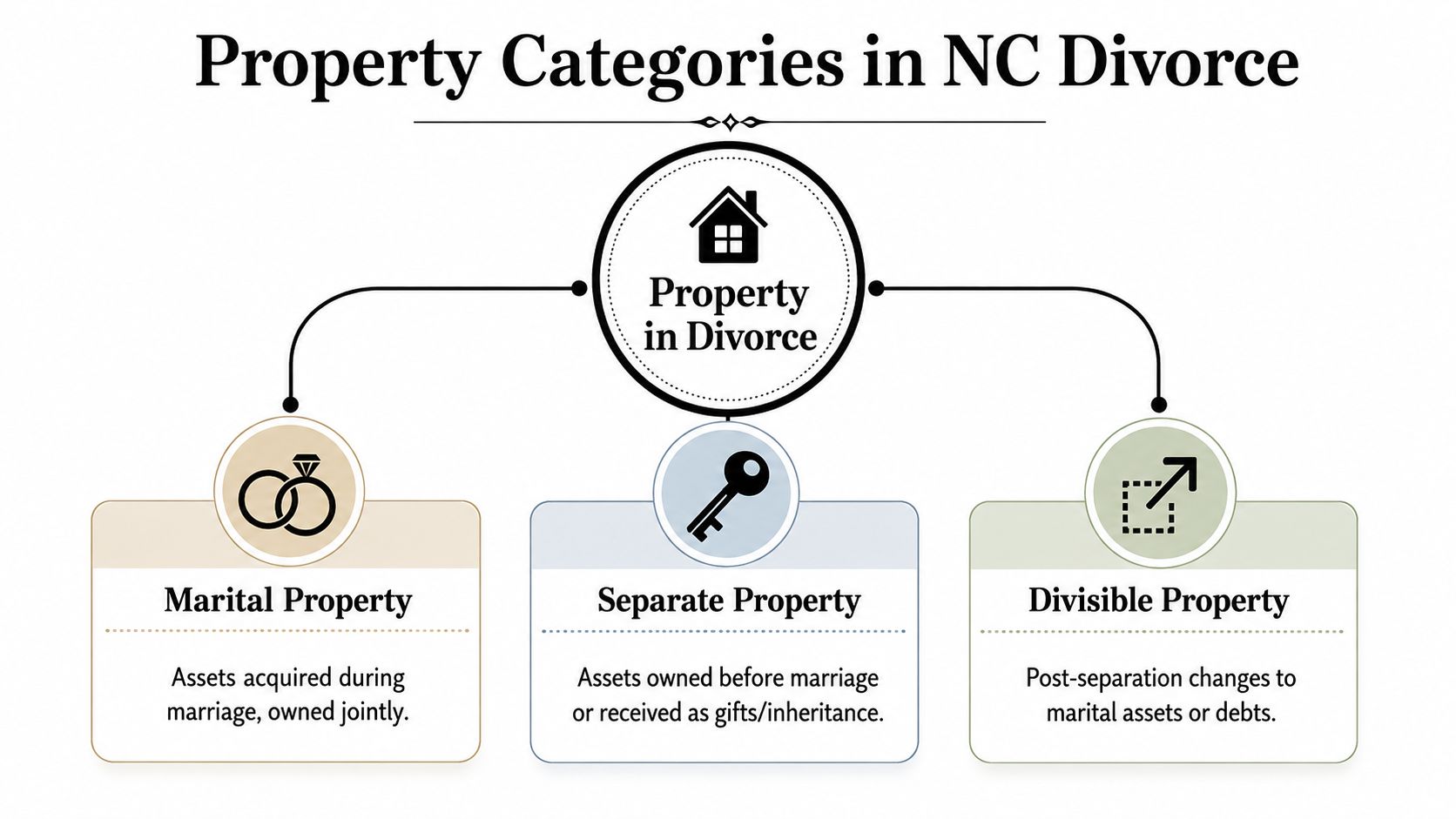
Marital property is usually property acquired during the marriage. That includes the kinds of assets couples commonly build together, a home, retirement contributions made during the marriage, vehicles, and other property earned before separation. Separate property is property one spouse owned before the marriage, or property received by gift or inheritance and kept separate under North Carolina law.
Divisible property is the category that often causes the most confusion. It covers certain post-separation changes in marital assets and debts, including passive appreciation or depreciation, post-separation income such as interest, dividends, and rent, and some compensation earned during the marriage but paid after separation under the statute N.C. Gen. Stat. § 50-20. In plain English, divisible property is the financial ripple left by the marriage, the value that shows up after the spouses separate but before the court finishes dividing the estate.
That rule matters because North Carolina does not treat every post-separation change the same way. A stock account can rise because the market moves, or because one spouse keeps adding money and managing the account. Those are different events, and they do not always land in the same bucket. The statute asks which part of the change came from passive forces and which part came from active effort.
A North Carolina family law guide on equitable distribution should make that timing point clear. The separation date does freeze some things, but it does not erase later gains or losses that belong in the divisible category.
Why the label matters
If an asset is labeled the wrong way, the court may use the wrong date and the wrong value. A property item is not divided just because it has value. The court has to decide whether it is marital, separate, or divisible first, and that first label controls the rest of the analysis.
That is where proof becomes important. A client may know an account changed after separation, but the court still needs evidence showing why it changed. If the increase was passive, it may belong in the divisible estate. If the increase came from one spouse's labor or new contributions, the answer can be different.
How Courts Value Property in a North Carolina Divorce
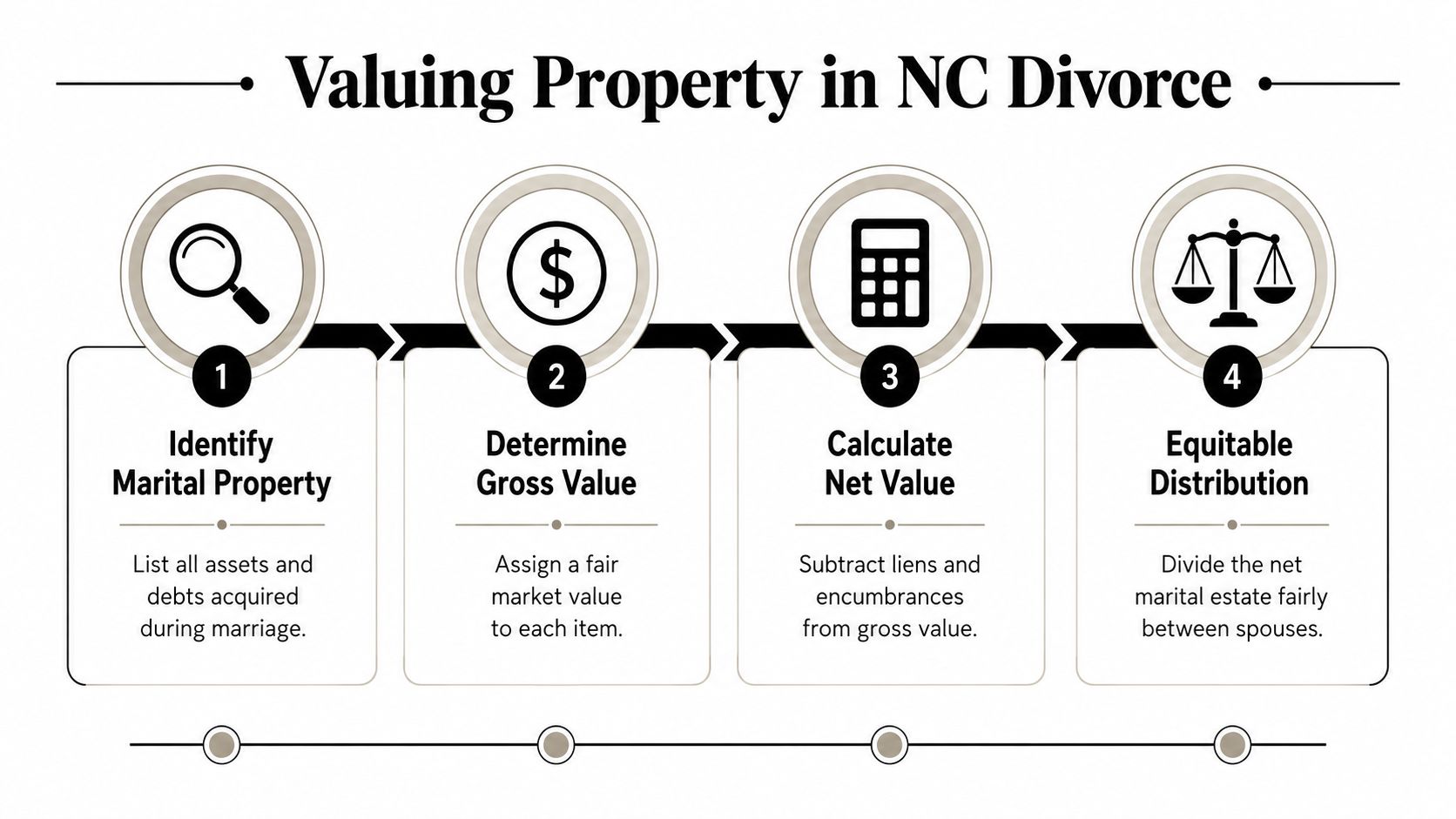
A divorce valuation dispute often starts with a simple question, then turns on a harder one. What was the asset worth when the spouses separated, and what part of the later change belongs in the marital or divisible pot? North Carolina answers that question by using different valuation dates for different categories of property. Marital property is valued as of the date of separation, while divisible property and divisible debt are valued as of the date of distribution. That timing gap is what creates many of the claims in a North Carolina equitable distribution case.
Business valuation for divorce
Net value is the number that matters
Courts look to net value, not just the sticker price. Liens, mortgages, and other deductions come off first, so a house is not divided as though the full market price were sitting there free and clear. The equity is the figure used for the distribution analysis.
That same approach matters in cases with appreciation or depreciation after separation. If a home, retirement account, closely held company, or investment portfolio changes before the court enters its order, the judge still has to sort out what part of that change should be counted. A passive market gain is treated differently from value created by new deposits, a business owner's labor, or other active post-separation efforts. That is the valuation gap lawyers focus on when they trace which dollars belong in the estate.
A business can make that split hard to see, because income, retained earnings, and owner effort may all be moving at once. The article on business valuation for divorce explains why records matter so much in that setting. The same point applies to a brokerage account or a pension, where the paper increase may come from market movement rather than added contributions.
Proof drives the result. A spouse may know an account changed after separation, but the court needs documents, appraisals, statements, or testimony that show why the change happened. If the increase came from passive forces, it may fit the divisible category. If the increase came from one spouse's active effort or new money after separation, that part usually belongs in a different bucket.
North Carolina also allows a distributive award when an in-kind split is not practical. If one spouse keeps a single asset, the court can use that award to balance the overall division under the equitable distribution framework. That comes up often with property that is difficult to divide without selling it, or where keeping the asset intact makes more sense than forcing a sale.
For people who are also dealing with filing questions, the North Carolina Divorce Residency Requirements page describes the six-month residency rule for filing divorce in North Carolina. Residency controls whether a court can hear the divorce filing, while valuation controls how the property is divided, but families often have to address both issues at the same time.
The Presumption of Equal Division and the 12 Statutory Factors
A spouse may walk into court expecting a clean split, then learn that North Carolina starts from a different place. The law begins with a presumption of equal division of the net marital and divisible estate. In plain English, 50/50 is the default, unless the judge finds that another result is more equitable under N.C. Gen. Stat. § 50-20(c).

The factors judges weigh
The statute lists 12 distributional factors, and each one gives the court a reason to keep the equal split or move away from it. The judge looks at the parties' income, property, and liabilities, any support obligation from a prior marriage, the length of the marriage, the age and physical and mental health of the spouses, and the needs of a custodial parent to occupy the marital home.
Other factors focus on the financial details that often decide close cases. The court considers expectations of deferred compensation, each spouse's contribution to acquiring marital property, contribution to the increase in value of separate property, the liquid or non-liquid character of the estate, tax consequences, and the difficulty of valuing business interests. It also considers acts after separation that preserve, waste, devalue, or convert marital or divisible property.
How the presumption changes the numbers
Unequal division does not mean the court ignores the whole estate. It means the judge can adjust the final math after weighing the facts and deciding what is fair. If one spouse keeps a hard-to-sell asset, the court can use a distributive award or another offsetting asset so the overall result fits the equities of the case.
The practical point is simple. A spouse does not win or lose equitable distribution by repeating “50/50.” The result turns on proof, especially the facts that justify a different split.
Passive Versus Active Post-Separation Changes
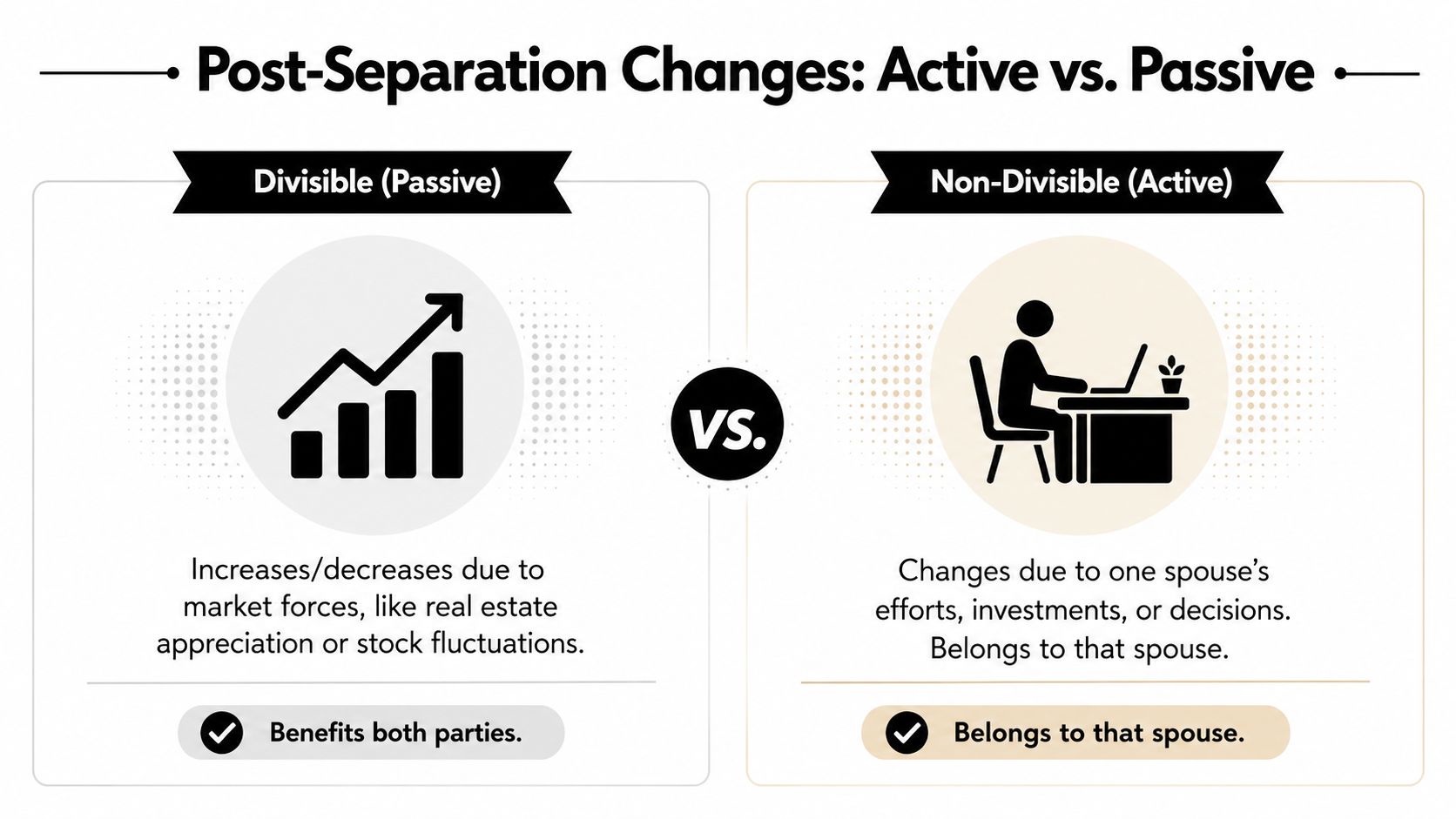
A common dispute starts with a simple question, then turns into a valuation problem. The asset changed in value after separation, so which part belongs in the marital pie, and which part belongs to the spouse who caused the change? North Carolina treats post-separation appreciation or diminution in marital property as divisible unless the movement came from one spouse's post-separation actions or activities. That line matters because the court must sort out whether the change was market-driven or effort-driven, and the proof often decides the answer UNC School of Government course materials.
Passive growth is the usual divisible claim
Passive change means the value moved because outside forces moved it. A house that rises because the local market improved, or an investment account that grows through ordinary market performance, is the kind of change North Carolina often treats as divisible if it fits the statute. Passive income, such as interest, dividends, and rent, can also fall into that category when the timing and character line up with the law N.C. Gen. Stat. § 50-20.
Active change usually stays with the acting spouse
The analysis changes when one spouse's labor, renovations, business decisions, or active portfolio management drove the shift in value. In those cases, the increase is less likely to be treated as divisible property and more likely to be handled as a distribution factor or as a separate issue tied to that spouse's post-separation conduct UNC School of Government course materials.
The distinction is practical, not abstract. A rental property that went up because the neighborhood improved is one thing. A rental property that went up because one spouse repaired it, upgraded it, and managed it day to day is something else.
The key question is simple, even if the proof isn't. Did the value change because the market moved, or because one spouse worked it up?
What the burden of proof looks like
The spouse asking the court to treat the post-separation change as divisible generally has to show that the change happened and quantify it. After that, the other spouse may need to prove that the change came from their own actions after separation. That is why appraisals, monthly account statements, tax records, and business financials matter so much. They help the court separate passive market effects from active effort.
Records usually tell the cleaner story. A spouse who can show the account balance, the market movement, and the dates has a stronger position than a spouse who is only estimating what happened after separation.
Worked Examples of Divisible Property in NC Divorces
A theory-only explanation doesn't help much when you're staring at your own statements. The statute makes more sense when you walk through the numbers the way a court would.
Home equity after separation
A couple separates, and the marital home sits on the market while values rise. If the house appreciated because of market conditions alone, that increase can become part of the divisible estate at the date of distribution, assuming the change fits the statute and the proof supports passive appreciation. The question isn't whether the house was “theirs” during the marriage, it's whether the post-separation change belongs in the marital math.
A retirement account that grows during separation
A 401(k) worth $300,000 at separation and $340,000 at distribution raises a clean divisible-property issue. The $40,000 increase is the post-separation growth that may be divided if it was passive and the valuation supports it UNC School of Government Bench Book. That's the kind of number people often miss because they focus only on the balance they remember from the separation date.
A closely held business interest
Business cases are messier. If one spouse keeps working in the company after separation, the other spouse may argue that any increase in value should be divisible. The working spouse may respond that the growth came from labor, strategy, or new business activity, not passive market forces. That's where valuation experts, business records, and testimony about post-separation operations become decisive.
| Asset Type | Classification Rule | Valuation Date | Likely Treatment |
|---|---|---|---|
| Home | Marital if acquired during marriage, separate if truly separate, divisible if post-separation change qualifies | Separation date for marital value, distribution date for divisible change | Equity at separation plus any divisible post-separation change |
| Retirement account | Marital portion earned during marriage, divisible growth after separation if passive | Separation date and distribution date | Divide marital share, then address passive post-separation growth |
| Closely held business interest | Classified by acquisition and source, with post-separation change analyzed separately | Often needs both dates and expert support | Depends on whether growth was passive or tied to one spouse's work |
Practical Strategies for Protecting Assets Before Settlement
The safest move is usually to preserve the paper trail before anyone starts arguing over numbers. North Carolina property division cases turn on classification and valuation, and both depend on documentation. If you want the separation-date value to be credible later, you need evidence now.
What to gather first
- Account statements: Save retirement, brokerage, bank, mortgage, and credit card records that show the separation-date balance and later changes.
- Property records: Keep appraisals, tax records, and any listing materials for real estate.
- Business records: Hold onto profit-and-loss statements, tax filings, and financial statements if a closely held business is involved.
- Separation proof: Keep a clear record of when the spouses began living separately and intended the separation to be permanent.
What to avoid
Don't commingle separate and marital funds if you're trying to preserve a separate-property claim. Don't make major unilateral renovations without understanding how they might affect the divisible analysis. Don't assume a large retirement contribution after separation will be ignored just because the account is in your name. Timing matters, and so does the source of the money.
Practical rule: If it's important enough to argue about later, it's important enough to document now.
If the spouses can settle, mediation and negotiated agreements can resolve divisible-property disputes outside of court. A postnuptial agreement can also change how property is classified and divided if it's properly drafted and enforceable under North Carolina law, and the details of that agreement deserve close review before anyone relies on it postnuptial agreement in NC.
Common Questions and Next Steps for North Carolina Residents
What's the difference between marital property and divisible property?
Marital property is generally what was acquired during the marriage before separation. Divisible property is the post-separation change in value, income, or debt that North Carolina law treats as part of the equitable distribution analysis when the statute applies.
Can a bonus or commission received after separation be divisible?
Sometimes, if it was earned during the marriage but paid later, North Carolina's divisible-property rules can bring it into the estate. The timing of the work and the timing of the payment both matter.
How do courts handle post-separation debt?
Divisible debt is valued as of the date of distribution, just like divisible property. That means increases or decreases in debt after separation can affect the final net estate if they fit the statute.
How long does equitable distribution take in North Carolina?
It depends on the complexity of the assets, the level of conflict, and the county's court calendar. Straightforward matters move faster, while cases with business valuations or hard valuation disputes take longer.
If you're trying to sort out divisible property, don't guess at the numbers or rely on a generic internet summary. A North Carolina divorce lawyer can review your separation date, your statements, and the documents that show whether a post-separation change is passive or active, then help you decide what belongs in the marital pie and what doesn't.
If you're facing a separation or divorce in North Carolina, the Law Office of Bryan Fagan can help you sort through classification, valuation, and the timing issues that drive divisible property disputes. Visit Law Office of Bryan Fagan to schedule a consultation and talk through your specific facts before the numbers get locked in.