A spouse calls after a hearing in Raleigh and says the same thing I hear all the time, “I thought equitable distribution meant we just split everything down the middle.” That assumption is understandable, but North Carolina law does not require a strict 50/50 split in every divorce. The court starts with a presumption of equal division, then looks at the facts that can justify an unequal distribution under N.C.G.S. 50-20(c). Those facts can change the outcome in a way that surprises people, especially when there's debt, a business, retirement money, or financial conduct after separation.
The phrase unequal distribution factors nc divorce is really about a judge using a statutory checklist, not making a gut-level decision. In practice, that means the court looks at the actual financial picture, including property, liabilities, income, and the kinds of assets that are hard to value or hard to divide cleanly. It also means the most important issues are often not the ones people talk about first. The house matters, but so do credit cards, retirement rights, tax consequences, and whether one spouse helped build the other spouse's earning power over time.
For many North Carolina families, the right question isn't “Will I get half?” It's “What does half mean once the debts, taxes, and future value are counted?” That's where the dispute usually lives.
When Equal Is Not Really Equal in North Carolina
A spouse in Raleigh may hear “equitable distribution” for the first time and assume it means a clean 50/50 split. That's not how North Carolina works. Equitable means fair under the statute, and fair is not always mathematically equal.
The court begins with an equal division presumption, then asks whether the facts make that result unfair. If the answer is yes, the judge can order an unequal distribution after weighing the factors in N.C.G.S. 50-20(c). That structure matters because it keeps the analysis grounded in evidence, not instinct.
Practical rule: the judge does not start by asking, “What feels fair?” The judge starts with equal division, then looks for the facts that justify a different outcome.
That's why a client can leave the marriage with less property on paper but a better overall result after debt, taxes, and future income are considered. A second client may receive more assets, but also more expense, risk, or illiquid property. The net result, not the label, is what matters.
North Carolina's classification rules also matter. Marital property is generally the property acquired during the marriage and before separation, while separate property belongs to one spouse alone and is handled differently. In higher-value cases, this line gets contested quickly, which is why resources like Equitable Distribution of Property in North Carolina matter when you're sorting out what the court can divide and what it cannot.
The law doesn't guess. It applies a checklist to the actual facts, then decides whether equal division would be inequitable. That's the framework that drives the rest of the case, whether the fight is over a home, a business, or debt.
A simple visual guide

For a plain-English overview of how the court treats property division under North Carolina law, the firm's resource on What Is Equitable Distribution is a useful starting point.
How North Carolina Reaches an Unequal Distribution
North Carolina uses a two-step structure in equitable distribution. First, the court presumes that marital property should be divided equally. Then the judge asks whether the statutory factors make that equal split unfair. A good way to think about it is a seesaw with a fixed fulcrum, until the evidence shifts one side enough that balance no longer looks fair.
That is why unequal distribution is not a loophole. It is the result the statute permits when the judge finds the facts justify it. The court is not improvising. It is following N.C.G.S. 50-20(c) and tying the result to the evidence presented.
For everyday use, the main terms need to stay clear. Marital property is generally the property subject to division. Separate property stays with the owning spouse, unless tracing or commingling creates a dispute. Equitable distribution is the process of dividing the marital estate fairly. And the right to ask for equitable distribution exists before the case is cut off by an absolute divorce.
If you wait until the wrong stage of the case, the law can shut the door on claims that would otherwise matter a great deal.
That timing point is why people should treat property division as its own track, not something that can be handled casually after the divorce is already final. The judge can only divide what is properly before the court. If a spouse assumes the paperwork can wait, the chance to ask for distribution can be lost.
The practical takeaway is straightforward. Equal division is the default. Unequal distribution is the exception, but it is a rules-based exception that can be fully justified by the statutory checklist. Once you understand that, the rest of the fight becomes less mysterious.
The Thirteen Factors Courts Must Weigh
The factors in N.C.G.S. 50-20(c) work best when grouped by what the judge is really asking. The first question is financial stability. The second is how long the marriage lasted and where each spouse is in life. The third is whether one spouse's role in the family or in the marital economy changed the fairness analysis.
Money, debt, and future security
The court looks at income, property, and liabilities on both sides. That includes not just what each spouse owns, but also what each spouse owes and what kind of financial pressure each person will carry after the case ends. A spouse with more income may be able to absorb a larger debt share, while a spouse with less income may need a different mix of assets and liabilities to avoid an unfair result.
The judge also considers pension and retirement expectations and tax consequences. Those factors matter because two divisions can look equal on paper and still leave one spouse with more usable value than the other.
Marriage length, age, health, and housing
The court weighs the duration of the marriage, the age of each spouse, and their physical and mental health. Those facts influence earning capacity, retirement planning, and how realistic it is for each spouse to recover financially after separation.
The court also considers the custodial parent's need for the marital residence. If children are involved and one parent is the primary residential parent, the home can carry a value that goes beyond the roof and walls. Stability can matter more than a quick sale.
Contributions and conduct
The statute also looks at each spouse's direct and indirect contributions to acquiring or increasing marital property. That includes financial contributions, homemaking, child care, and other support that made wealth accumulation possible. The court considers the difficulty of valuing business interests and the economic value of keeping a business intact, which becomes important when a forced sale would damage the asset.
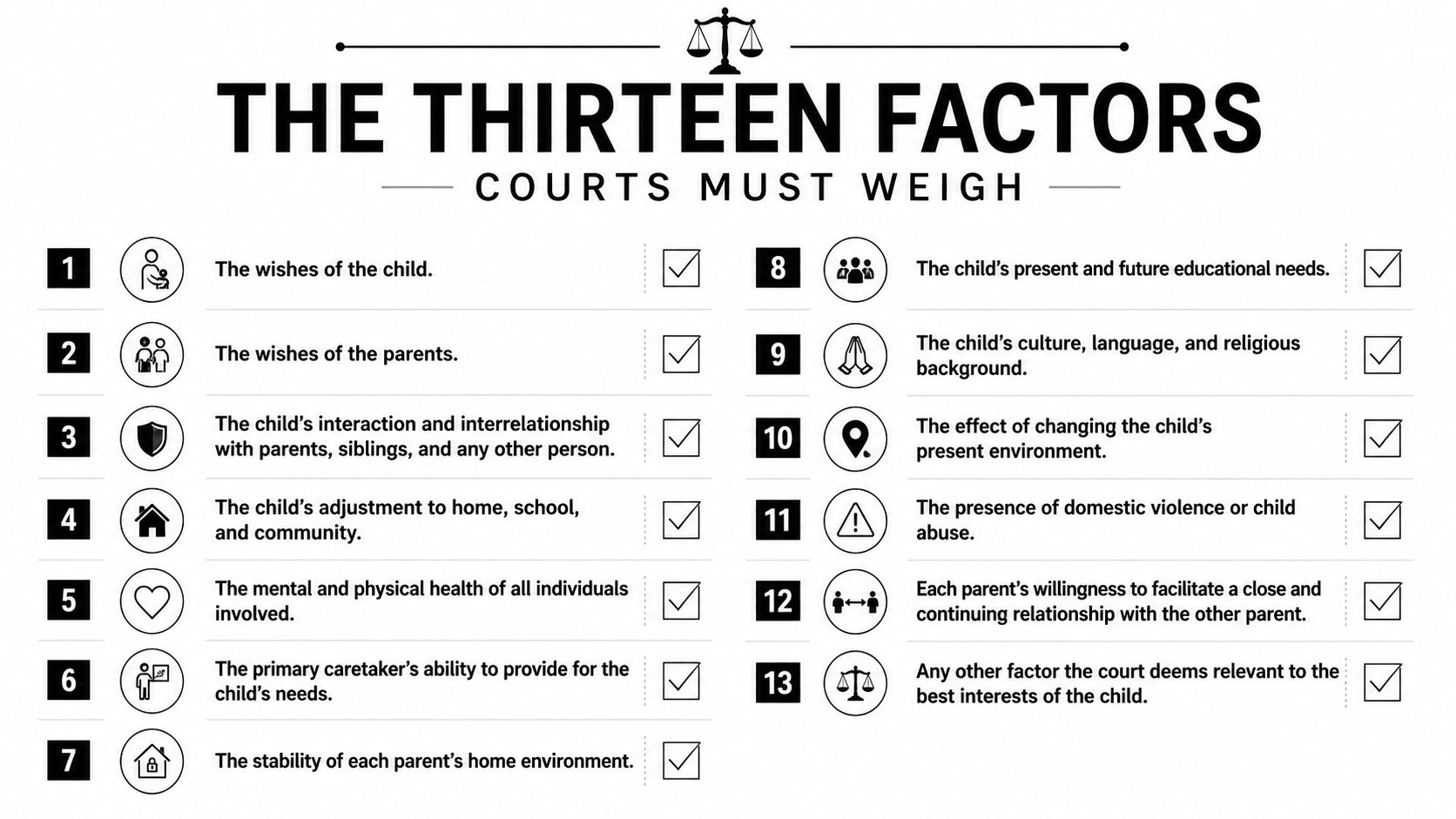
The court can also consider whether a spouse wasted, devalued, converted, or neglected marital property after separation, which becomes much more important once the evidence shows that one spouse made the estate smaller.
Two Real-World Scenarios, Two Different Outcomes
A long marriage often produces the clearest uneven result. One spouse stays home for years to raise children, keep the household running, and support the other spouse's career. The working spouse builds retirement benefits, income, and professional momentum while the at-home spouse's earning history may be thinner. In that setting, the judge can weigh the non-financial contributions and future financial circumstances and decide that a strict 50/50 split would not be fair.
That same statute can produce a very different result in a shorter marriage. A couple separates, and one spouse racks up credit-card debt or continues spending after separation in a way that expands the marital liabilities. The other spouse may still share some assets evenly, but the court can assign a disproportionate share of the debt if the facts support it. In that kind of case, the headline number on the asset side can be less important than the debt allocation.
What clients often miss: unequal distribution isn't only about who gets the house. Sometimes the debt assignment changes the net outcome more than the asset split does.
Those are the kinds of cases where the paperwork matters more than the emotion in the room. A stay-at-home parent who documented caregiving and household support may have a stronger claim to a different distribution. A spouse who can prove post-separation spending, concealment, or waste may have a stronger argument for a shifted debt burden.
The statute is flexible enough to handle both. That flexibility is the point. North Carolina courts are not trying to force one formula onto very different marriages.
Debt, Misconduct, and Tracing Where Splits Actually Diverge
Debt is one of the most under-discussed pieces of equitable distribution in North Carolina. Courts may divide both property and debt unequally, and they must look at each spouse's income, property, and liabilities when deciding whether the final split is fair. In practical terms, a spouse with a stronger income stream may be assigned more debt, while a spouse with less ability to absorb repayment may need a different mix of assets to keep the outcome workable.
That analysis becomes sharper when post-separation conduct enters the case. North Carolina courts consider whether either spouse wasted, devalued, converted, or neglected marital property after separation. Spending marital funds on things that do not preserve the estate can change the division. So can failing to protect an asset that needed ordinary care. The firm's discussion of Marital Misconduct in NC is useful here, because the key distinction is financial misconduct, not general blame.
A recent appellate reminder reinforces that point. North Carolina's distribution analysis focuses on the economic circumstances of the marriage, and non-economic marital misconduct generally does not justify unequal equitable distribution. That distinction matters because people often assume every bad act in a marriage belongs in the property division. It usually doesn't.
Tracing can change the result
Tracing is the other issue people underestimate. If separate money was used in a way that can be followed into marital assets, the court may need to sort out what part of the asset belongs where. That comes up with premarital funds, inheritances, and gift accounts, especially when the money was mixed into other accounts or used to improve a marital asset. The moment the paper trail gets weak, the dispute gets harder.
Business and debt together
The cleanest case to the client is often the messiest case on paper. A spouse can own a business that looks valuable but is hard to divide, while also carrying business-related liabilities that make the asset harder to monetize. In those cases, the court's unequal distribution analysis may turn on preserving the business and assigning obligations in a way that reflects the economics, not just the title.
Valuation, Liquidity, and Tax Issues in High-Asset Cases
High-asset cases often turn on whether the court can divide an asset without breaking the business behind it. That is why the difficulty of valuing a business or professional practice matters so much. If a forced split would put the enterprise at risk, the court may use unequal distribution to keep the asset intact rather than forcing a sale that helps neither side.
The same logic applies to liquidity. Some assets are easy to divide because they are liquid. Others carry value on paper but are difficult to turn into cash without a cost to the underlying asset. A judge can weigh that difference when deciding whether equal division would leave one spouse with too much paper value and too little usable value. Retirement rights and deferred compensation also fit here, because they may look simple on a statement while carrying restrictions, timing issues, or valuation problems that complicate division.
Tax consequences matter too. The statute tells courts to consider them, and that makes sense. A division that looks balanced before taxes can shift once tax costs are factored in. The question is not just who gets the account or the business interest. It is what that asset is worth after practical costs are counted.
In a high-asset case, equal division can be the unfair outcome if it ignores valuation risk, tax drag, or the cost of turning a going concern into cash.
Business valuation, retirement analysis, and tracing all influence whether the court should preserve an asset intact and adjust the division elsewhere. See our guide on business valuation for divorce for more detail. North Carolina guidance continues to emphasize those issues, which is why current disputes often look less like simple property splits and more like economic reconstruction.
Practical Steps to Build Your Case Early
The most useful documents are usually the ones people wish they had saved earlier. Start with pay stubs, tax returns, bank statements, retirement statements, business records, loan documents, and credit-card statements. Add any evidence of post-separation spending, account changes, or transfers, because those details can matter when the court looks at debt allocation or financial conduct.
The timing matters just as much as the documents. An equitable distribution claim has to be filed before the absolute divorce is granted, so waiting can create a permanent problem. Many people assume they can sort out property later. In North Carolina, that assumption can cost them the claim itself.
| Factor Cluster | What to Gather | Why It Matters |
|---|---|---|
| Income and Liabilities | Pay stubs, tax returns, debt statements, credit-card records | Shows who can absorb debt and how the net estate really looks |
| Duration and Ages | Marriage timeline, medical records if relevant, retirement estimates | Helps the court assess future earning ability and life-stage differences |
| Health and Custodial Housing | Child-related housing records, school or care schedules, medical documentation | Supports arguments about the marital residence and daily stability |
| Pensions and Taxes | Retirement statements, deferred compensation documents, tax summaries | Helps measure future value, liquidity, and tax consequences |
| Contributions and Misconduct | Records of homemaking support, business growth, post-separation spending logs | Shows who contributed to the estate and whether conduct changed the value |
Start organizing the file now, even if you have not yet hired counsel. That preparation makes the first strategy conversation much stronger and helps avoid the common mistake of treating equitable distribution like a side issue.
Questions Readers Ask Most Often
How is unequal distribution different from alimony in North Carolina?
Unequal distribution divides marital property and debt. Alimony is separate and deals with ongoing support. The two claims can overlap factually, but they are not the same legal issue.
What happens if absolute divorce is granted before I file equitable distribution?
That can be a serious problem. North Carolina treats the timing of the filing as critical, so the property claim should be asserted before the absolute divorce is entered.
Can a judge revisit an unequal distribution order later?
Usually not just because one side is unhappy with the outcome. The issue is decided through the court process, and later changes are limited.
What if my spouse hid assets?
Hidden assets can become a major issue in equitable distribution. If the evidence shows concealment or financial misconduct, the court can treat that conduct as relevant to the division.
Can unequal distribution help with business valuation disputes?
Yes. When a business is hard to value or should be kept intact, unequal distribution can be part of a practical solution rather than a punishment.
If you're dealing with divorce in North Carolina, or you're already in the equitable distribution stage, get legal help early. The firm handles equitable distribution, debt allocation questions, business valuation disputes, and high-asset divisions, and it can also help you think through the deadline pressure that comes before absolute divorce is granted. For more background, review the firm's North Carolina property-division resources, then schedule a consultation before the filing window closes.
Law Office of Bryan Fagan helps North Carolina residents handle equitable distribution, debt disputes, and complex property division with a strategy built around the facts that matter. If you're trying to protect your share of the marital estate or respond to a claim involving business value, tracing, or hidden debt, visit Law Office of Bryan Fagan to schedule a consultation and discuss your next step.