You may be weeks into a separation and still not know which date matters most. One spouse says the marriage ended when the moving truck left the driveway. The other says it ended later, after a few more nights under the same roof and a few more arguments about money, the house, and the retirement account. In North Carolina, that disagreement can change what gets divided, what gets excluded, and how a judge values the marital estate.
Why One Date Controls Your Entire Property Division
A separation-date dispute can look narrow at first. It rarely stays that way once the property schedule is in front of the court.
A difference of only a few weeks can change whether a retirement contribution stays in the marital estate or falls out of it. The same problem shows up with a business that gained value late in the marriage, or a home that appreciated after one spouse moved out. North Carolina's equitable distribution rules make the date of separation the legal anchor for that analysis, because marital property is valued as of that date and later evidence is only corroborative of that value.
The date is not a filing date problem
Clients often assume the controlling date is when the divorce was filed or when the hearing finally happens. That assumption causes real trouble. The court looks to the day the spouses separated, then uses the asset values that existed on that day, not the date the judge signs the order.
Practical rule: if the separation date moves, the entire inventory can move with it.
That matters because the court has to identify the separation-date value of each marital asset and marital debt. UNC's School of Government explains that every equitable distribution judgment has to do that, which is why the separation date is not a minor detail, it is the starting point for classification, valuation, and distribution. A lawyer who does not lock down that date early can end up fighting over every account statement, payoff balance, and appraisal.
When the numbers swing, the dispute gets sharper. Retirement accounts rise and fall. Business interests change with contracts, debt, and cash flow. Real estate can gain or lose value while the case is pending. None of that changes the valuation date just because the case is still open.
Why high-value cases turn on timing
A home that was worth one amount on the separation date is treated differently from the same home months later. The same is true for a practice, a closely held company, or a brokerage account with active trading. If you are trying to protect your position, the first question is often not what the asset is worth now, but what it was worth when the marriage ended for property purposes.
That is why date of separation disputes NC equitable distribution cases are often evidence battles. The law gives the cutoff. The facts decide whether you can prove it. A spouse who keeps bills, texts, lease records, or move-out documents in order usually has a better shot at defending the date that helps the property case.
What Date of Separation Means Under North Carolina Law
North Carolina doesn't treat separation as a paperwork event. Spouses have to begin living separate and apart with the intent that the separation be permanent. Separate bedrooms in the same house don't satisfy that standard by themselves, because the law looks at the actual relationship, not just a changed bedtime routine (North Carolina courts on separation and divorce).
Physical separation and intent both matter
There are two pieces to keep straight. First, the spouses must stop living together as a married couple. Second, at least one spouse must intend the separation to be permanent. If both elements aren't present, the legal separation date may not have started yet, even if the marriage felt over.
That's why vague statements like “we were basically separated” create problems. Judges want a clean factual record. They look at where people slept, whether they shared meals, whether they presented themselves socially as a couple, and whether they kept acting like a single household.
The one-year-and-one-day waiting period for absolute divorce is a different issue. A divorce case can't go forward until that time has passed, but equitable distribution can be filed and decided independently once separation occurs (UNC Family Law materials). That split trips people up all the time.
The divorce clock and the property clock are not the same clock.
The separation date is also the property cutoff
Property acquired after separation is generally excluded from the marital estate. Property acquired before separation is generally included and valued at the separation date. That rule is simple in theory and messy in real life, especially when one spouse keeps working, investing, or managing a business after the breakup.
If the marital home, a pension, or a stock portfolio changes after the couple stops living together, those later changes don't automatically rewrite the value used in equitable distribution. The court starts with the separation-date snapshot and then classifies everything against that snapshot.
If you want a plain-English overview of how separation agreements can fit into that picture, Separation Agreements in North Carolina can resolve property, support, and custody in one document when the spouses are able to reach terms.
For a related explanation of the waiting period tied to divorce eligibility, the one-year separation rule is also addressed in this North Carolina divorce resource.
How the Separation Date Determines Marital Property Value
A separation date dispute changes the value picture fast. A house, retirement account, or business interest can look very different depending on whether the court fixes the cutoff one day earlier or later, because equitable distribution starts with the value of the marital estate as of separation.
What gets included and what doesn't
Property acquired before separation usually belongs in the marital estate and is valued as of that date. Property acquired after separation is generally excluded. That line affects homes, vehicles, savings accounts, retirement accounts, business interests, and the debts tied to those assets.
The court is not asking what the asset is worth today. It is asking what it was worth when the spouses separated. That date-centered approach is part of North Carolina law and is also explained in what equitable distribution means in North Carolina, which helps show why timing and classification carry so much weight.
Volatile assets make the dispute more intense
Retirement accounts can move with the market. Real estate can rise or fall. Business interests can change with revenue, debt, or a single contract. Once a case involves any of those assets, the separation date becomes a financial fault line, not a technical detail.
A spouse who says “we separated sometime in the spring” may be only a few days off, but those days can decide whether later growth stays outside the marital estate. That is why lawyers press for exact proof. If the date moves, the balance sheet moves with it.
Example in plain English: if a marital home was worth one amount on the separation date, that is the number used for division, even if the house later sells for more.
Why the inventory matters
North Carolina's equitable distribution process also requires the inventory affidavit to list estimated date-of-separation values. That means the case does not wait for perfect certainty before valuation starts. It forces the parties to commit to a date and then build the case around it.
That is where the procedural trap starts. A date written into a divorce judgment may still be open to relitigation later in the equitable distribution case, so the safer course is to preserve evidence as though the date will be challenged. Bank records, account statements, appraisals, business documents, and testimony about when the spouses stopped living as a married unit all matter when the cutoff is disputed.
The Hidden Trap of Divorce Judgments and Equitable Distribution
Many people assume that once a divorce judge says the separation date out loud, the issue is finished. In North Carolina, that assumption can be expensive.
A prior divorce finding may not bind the property case
Appellate guidance says a date of separation found in a divorce judgment usually does not control the later equitable distribution case if the date was not in dispute in the divorce action. That leaves room for relitigation, even if someone already sees a court order that appears to settle it. The question becomes whether the issue was litigated, preserved, and precluded, not just whether a judge wrote down a date.
That gap catches people off guard. They believe the earlier order solved the problem forever, then find out the property judge can still revisit the issue. If the evidence wasn't preserved, the later case becomes harder to win.
Why the trap matters in practice
The inventory affidavit requirement makes this even more dangerous. If the separation date shifts, the classification and valuation of assets and debts can shift too. A spouse who waited to gather records may suddenly have the wrong bank statements, the wrong account values, or the wrong support for when control of the marital home changed.
Issue preclusion and evidence preservation matter more than legal jargon. If you think the date is uncontested, you still need to document it as if it will be challenged later. Texts, lease records, account closures, move-out evidence, and witness statements should all line up.
A divorce judgment is not a guarantee that the property court will treat the date as locked forever.
The safest approach is to treat the separation date as a live issue through the divorce case and the equitable distribution case. That doesn't mean every case turns into a fight. It means the evidence has to be ready if the other side decides to reopen the question.
For a deeper look at the discovery side of these disputes, North Carolina divorce discovery and financial affidavits is a useful companion topic because the financial paper trail often decides whether the court accepts one date or another.
Common Dispute Scenarios and the Evidence Courts Rely On
Separation date disputes usually don't arise from one dramatic event. They come from murky timelines, mixed signals, and people who kept living in the same orbit for practical reasons.
The scenarios courts see most often
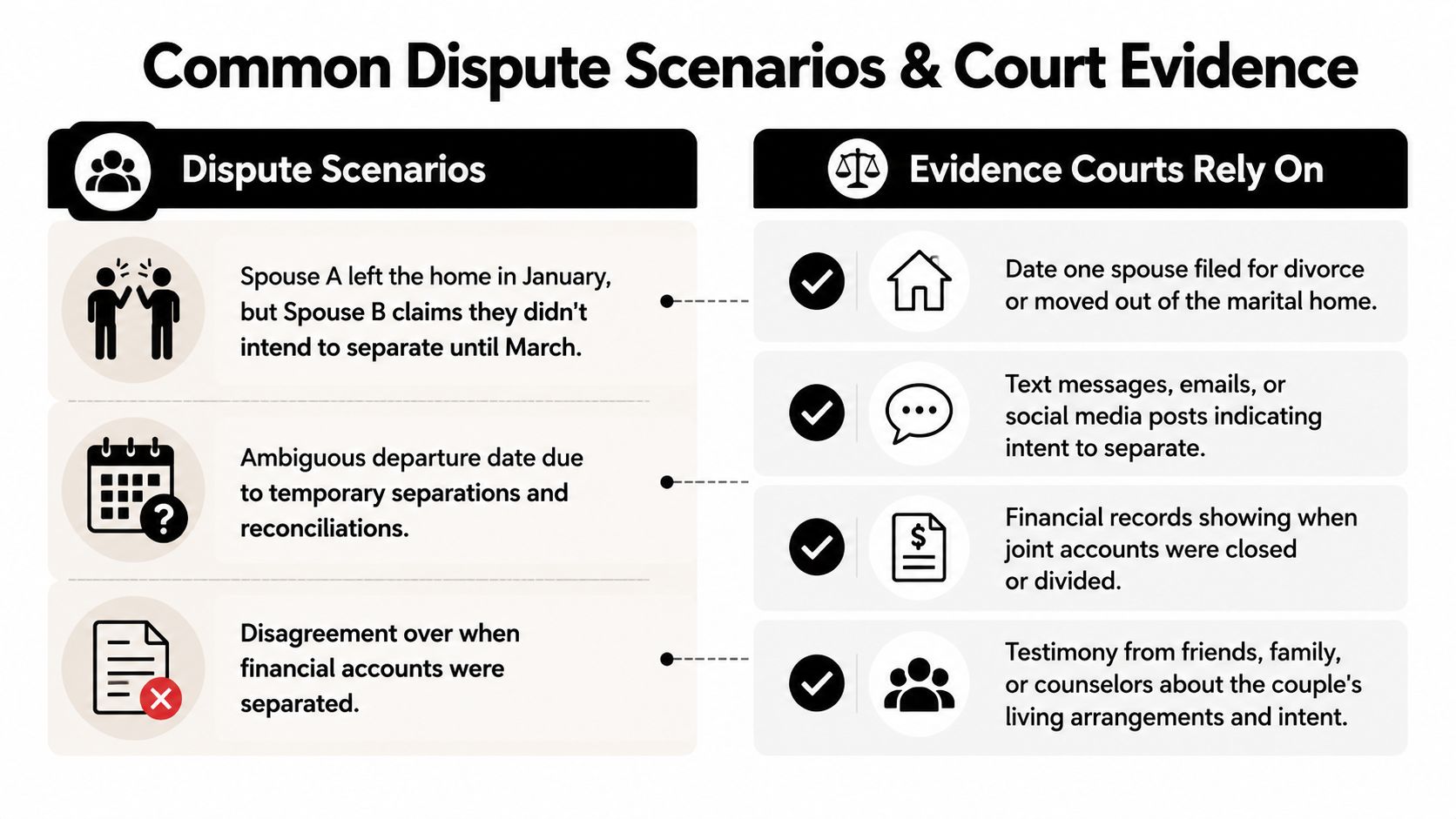
A spouse moves out, but the other spouse says the breakup wasn't permanent until later. A couple lives under one roof for a while because housing is expensive, but one of them says the marriage had already ended. One spouse treats a temporary break as a trial separation, while the other sees it as the final cutoff. Sometimes the fight starts only after a major financial event, like a sale, bonus, or account change.
The court usually cares about evidence that shows both where the spouses were living and what they intended. That can include lease paperwork, utility records, text messages, emails, witness testimony, account closure documents, and even social media posts if they show the relationship had ended.
Useful evidence is usually boring evidence. Utility bills, account statements, and messages often help more than dramatic testimony.
What tends to help and what tends to hurt
A strong file often includes:
- Move-out proof: lease agreements, moving receipts, forwarding addresses, or photos showing a spouse established a separate residence.
- Intent evidence: texts or emails where one spouse says the marriage is over or they're done living together as a couple.
- Financial separation records: bank changes, closed joint accounts, or documentation showing each spouse began handling money separately.
- Third-party testimony: friends, family members, counselors, or neighbors who saw the living arrangement change.
A weak file often relies on memory alone. “I thought we were separated” is not enough if the documents point the other way. Social media can help or hurt depending on how the spouses presented themselves after the claimed separation date.
If you're gathering proof, start with the facts that can be dated. That is where most separation date disputes are won or lost.
Strategic Options for Protecting Your Position
The best strategy depends on whether the separation date is still negotiable or already headed for a hearing. Either way, the goal is the same, build a record that makes your version of events believable and complete.
Settlement language beats memory
If the other side is willing to negotiate, the cleanest fix is to put the agreed separation date in writing. That reduces the chance of a later fight and keeps the property case focused on division instead of timeline litigation. A separation agreement can do more than settle one issue, it can resolve property, support, and custody if the spouses are ready to sign a complete deal.
If negotiation is not realistic, the documentation has to do the work. Keep copies of texts, emails, lease documents, utility records, bank statements, and anything else that shows when the marriage functionally ended. Don't rely on screenshots alone if you can get account records or original metadata from the source.
Post-separation conduct still matters
What happens after separation can affect the economics of the case, even though the cutoff date matters most. If one spouse controls the marital home, manages a business account, pays debt alone, or spends marital funds after separation, those facts can affect divisible property, credits, distributional factors, and interim relief. The evidence needs to show who had control, who paid what, and whether any value was preserved, improved, or wasted.
That's especially important when one spouse is still living in the home or running the business while the other has moved out. Courts pay attention to who maintained the asset and who had access to records.
When you need to litigate
If the date has to be fought, get witness statements early. Memories fade, and people become harder to locate. If there's a disagreement about intent, third-party testimony can be critical because it helps the judge see how the spouses lived, not just what one side says now.
You also need to treat interim relief seriously. If a spouse is exclusively controlling marital assets after separation, the immediate issue may be preservation, access, or reimbursement, not just final distribution. The sooner that's addressed, the less likely the record gets distorted by one-sided control.
Law Office of Bryan Fagan helps North Carolina clients sort through these same property, support, and evidence issues in separation and divorce matters, but the right strategy still depends on the facts in your case.
Frequently Asked Questions About Separation Date Disputes
Does a divorce judgment permanently fix the date of separation?
Not always. If the date was not disputed in the divorce action, North Carolina appellate guidance says the later equitable distribution court usually isn't bound by that finding. That's why you should preserve the evidence even if the divorce judge already wrote down a date.
Can spouses be separated if they still live in the same house?
Sometimes people assume yes, but separate bedrooms alone do not establish separation. North Carolina looks for living separate and apart plus the intent that the separation be permanent. Shared housing creates proof problems, so the surrounding facts matter a lot.
What if we got back together briefly after separating?
A short reconciliation can create a new factual dispute about whether the separation was continuous. The court will look at whether the couple resumed living together as spouses or just shared space for convenience. The answer often turns on communications and conduct, not labels.
Does social media matter in a separation date case?
It can. Posts that show vacations, shared celebrations, or continued couple-like behavior may undermine a claimed separation date. Posts that show a move, a new residence, or a clear statement about ending the marriage can help support the timeline.
Does the separation date affect alimony too?
Yes, timing matters in support cases as well, but the analysis is not identical to equitable distribution. Property division still hinges on the separation-date cutoff, while support issues bring their own legal standards and evidence. A lawyer should look at both together so the cases don't undercut each other.
Get Strategic Guidance for Your North Carolina Property Division Case
A separation date dispute can change the entire financial shape of a divorce. If you're unsure whether the date is solid, or you already see the other side trying to move it, you need a plan that protects the record before documents disappear and memories fade.
The Law Office of Bryan Fagan works with North Carolina families on divorce and equitable distribution matters, including cases where the separation date drives the property fight. If you want help reviewing your timeline, gathering proof, and protecting your rights before a judge decides what counts as marital property, schedule a consultation and talk through your options with a lawyer who understands how these disputes play out.
If you're dealing with a separation date dispute in North Carolina, the Law Office of Bryan Fagan can help you build the evidence, evaluate the property issues, and prepare for equitable distribution with a practical plan. Visit Law Office of Bryan Fagan to schedule a consultation and get focused guidance before the record gets harder to fix.