An arrest for Driving While Impaired (DWI) in North Carolina is far more serious than a simple traffic ticket. The consequences begin the moment you are charged, immediately threatening your freedom, your finances, and your ability to drive.
Understanding what you are up against is the critical first step toward protecting your future. This guide explains North Carolina's DWI laws in plain English to help you navigate this stressful situation.
What a North Carolina DWI Charge Means for You
Being charged with drunk driving in North Carolina means the state is alleging you operated a vehicle while impaired by alcohol, drugs, or a combination of both. The legal basis for this is found in North Carolina General Statute § 20-138.1, which makes it illegal to drive with a Blood Alcohol Concentration (BAC) of 0.08% or higher, or while "appreciably impaired" by any impairing substance.
This isn't a minor infraction; it's a serious criminal charge. The statistics paint a stark picture of the real-world impact of impaired driving on families across our state. In a single recent year, North Carolina reported 11,345 drunk driving crashes, which tragically resulted in 411 fatalities and 7,602 injuries. You can learn more from this analysis of drunk driving stats to see the full scope of why these laws are enforced so aggressively.
To help you quickly understand the basics, here’s a look at the key legal limits and what happens right after an arrest.
Key North Carolina DWI Facts at a Glance
| Violation Type | Legal BAC Limit (N.C.G.S. § 20-138.1) | Immediate Consequence |
|---|---|---|
| Standard Drivers (21+) | 0.08% | 30-day civil license revocation |
| Commercial Drivers | 0.04% | 30-day civil license revocation |
| Drivers Under 21 | Any amount (0.00%) | 30-day civil license revocation |
| Refusal to Test | Not applicable | Immediate one-year license revocation |
This table only scratches the surface. The consequences escalate significantly depending on the specifics of your case and whether you are ultimately convicted.
Immediate Consequences of a DWI Arrest
The moment you are charged with DWI, the penalties begin—long before you ever step into a courtroom. Your driver's license is immediately hit with a 30-day civil revocation. This is an administrative penalty, separate from any criminal punishment that may come later.
Common Misconception: Many people believe nothing happens to their license until they are found guilty. In North Carolina, this is false. The civil revocation is an automatic administrative action handled by the NCDMV, triggered if your BAC is 0.08% or higher or if you refuse a chemical test.
Potential Penalties Upon Conviction
A DWI charge is your entry point into a complex legal system where a conviction can carry severe penalties. A judge will weigh various factors during sentencing, which can lead to a wide range of outcomes. These can include:
- Jail Time: Sentences range from a minimum of 24 hours to several years in prison for the most serious offenses.
- Substantial Fines: Fines can run from a few hundred dollars to as much as $10,000.
- License Suspension: A conviction will lead to a longer-term license suspension, often for at least one year.
- Ignition Interlock Device: You may be required to install this device in your vehicle at your own expense.
An arrest can leave you feeling completely overwhelmed and uncertain about what to do next. The stakes are incredibly high, with the potential to affect your job, your family, and your financial stability for years to come. Moving forward requires a clear understanding of North Carolina's laws and a strategic plan to fight the charges against you.
The DWI Arrest and Court Process in North Carolina Explained
Getting pulled over and charged with a DWI in North Carolina can throw your entire world into a spin. It’s a confusing, fast-moving process, and knowing what’s coming next is the first step toward protecting your rights.
It all starts with a traffic stop. An officer cannot pull you over for no reason; they need what’s called reasonable suspicion—a lawful justification like speeding, weaving between lanes, or even a broken taillight. If, during that stop, the officer suspects you’re impaired, the encounter shifts into a full-blown DWI investigation.
What to Expect During the Initial Stop
The officer will likely ask you to exit the vehicle and perform a series of Standardized Field Sobriety Tests (SFSTs). These are physical coordination tests meant to reveal signs of impairment. It is important to know that you are not legally required to perform these roadside tests in North Carolina.
Next, the officer will likely ask you to blow into a portable breath test. Then comes the critical part. Under North Carolina's implied consent law (N.C.G.S. § 20-16.2), you are required to submit to an official chemical test—usually a more accurate breathalyzer at the police station or a blood draw. Refusing this official test triggers an immediate one-year driver's license revocation.
Real-World Scenario: You leave a restaurant in Charlotte and are stopped at a DWI checkpoint in Mecklenburg County. The stop is legal as long as it follows a pre-approved, non-discriminatory plan. If the officer smells alcohol on your breath, that alone is enough to begin a DWI investigation and request field sobriety and chemical tests.
From Arrest to Your First Day in Court
If the officer gathers enough evidence to establish probable cause—based on your driving, physical appearance, performance on tests, or a BAC reading—you will be arrested for DWI. You’ll then go through the booking process, which involves being photographed and fingerprinted while formal charges are filed against you.
Your first court date is an arraignment or first appearance. This is not a trial. Here, the judge will formally read the charges, ensure you understand your rights, and ask for your plea. This is where you enter a plea of "not guilty" to get the legal process started; it’s not the time to argue your case or present evidence.
The infographic below shows a high-level view of how a stop can quickly escalate.
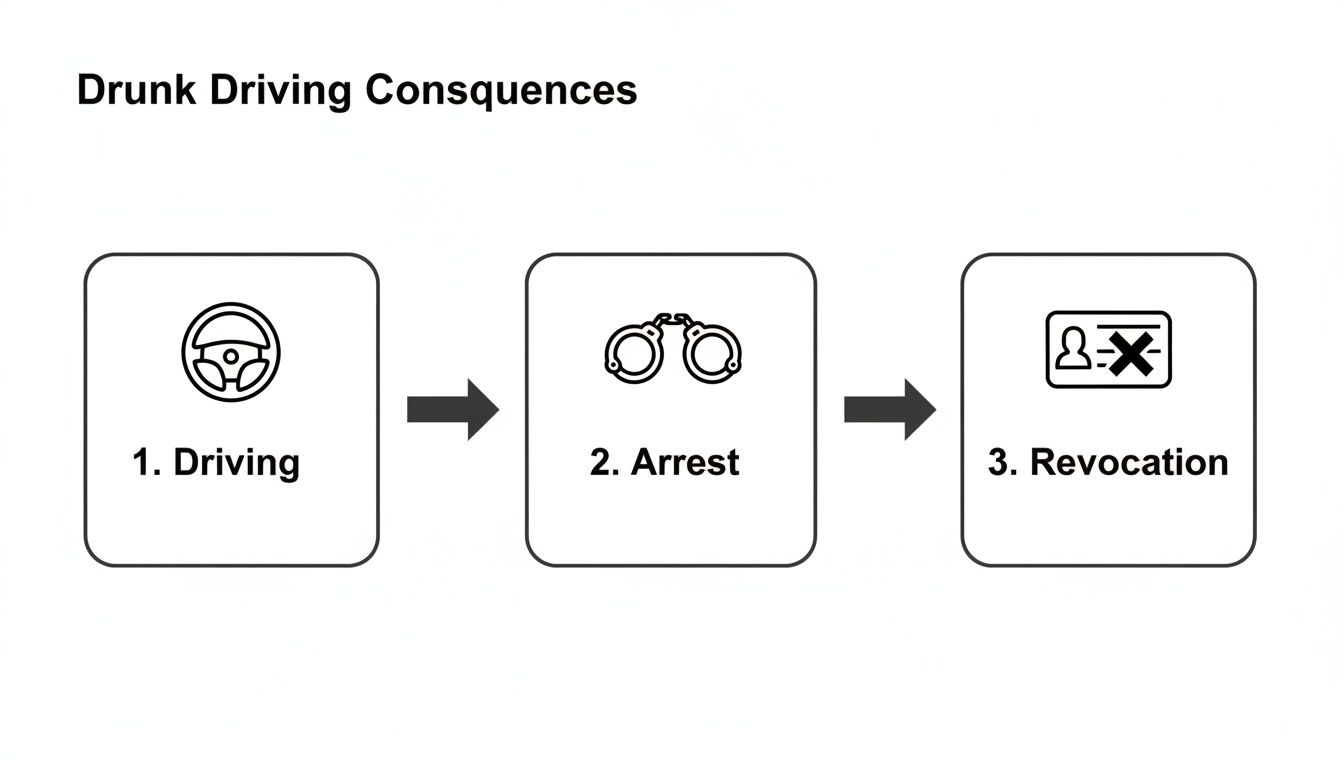
As you can see, the path from being behind the wheel to facing an arrest and the automatic civil penalty of losing your license is surprisingly direct.
The Pre-Trial and Trial Phases
After your arraignment, your case moves into the pre-trial phase. This is where the real work on your defense begins. Your attorney will take several crucial actions:
- Discovery: We formally request and scrutinize every piece of the state's evidence. This includes police reports, body and dash cam videos, maintenance logs for the breathalyzer, and any witness statements.
- Motions: We file strategic legal motions to challenge the prosecution's case. For example, a motion to suppress could argue the initial traffic stop was unlawful or that evidence was collected improperly, potentially getting it thrown out of court.
- Negotiations: We might enter into discussions with the prosecutor about a possible plea agreement, but this depends entirely on the specific facts and strength of the evidence in your case.
If your case doesn't resolve during the pre-trial phase, it will go to trial. In North Carolina, misdemeanor DWI trials happen in district court before a judge—there are no jury trials at this level. Both the prosecutor and your defense lawyer will present evidence and arguments, and the judge will issue a verdict.
DWI enforcement is taken very seriously here. While drunk driving fatalities have dropped significantly nationwide since the 1980s, repeat offenders with a BAC of 0.15% or higher remain a major concern and are responsible for most known alcohol-related traffic deaths, as you can see in this analysis of drunk driving stats.
Decoding North Carolina's DWI Sentencing Levels
If you’re convicted of **drunk driving in North Carolina**, there isn’t a one-size-fits-all penalty. The consequences are decided by a structured sentencing system outlined in North Carolina General Statute § 20-179. A judge is required to weigh a specific list of factors to determine which of the six sentencing levels is appropriate for your case.Think of it like a set of scales. On one side, the judge places factors that make the offense more serious (aggravating factors). On the other, they place factors that might lessen its severity (mitigating factors). The way these scales tip ultimately determines your sentence.
The Factors That Shape Your Sentence
A judge must consider three types of factors: grossly aggravating, aggravating, and mitigating. The presence of even a single grossly aggravating factor will dramatically escalate the penalties you face.
Grossly Aggravating Factors are the most serious and include:
- A prior DWI conviction within the last seven years.
- Causing a serious injury to someone else as part of the DWI offense.
- Driving with a child under the age of 18 in the vehicle.
- Driving while your license was already revoked due to a previous impaired driving charge.
Aggravating Factors are less severe but still weigh against you. Common examples are:
- A "high" BAC of 0.15% or higher.
- Engaging in reckless or dangerous driving.
- Causing an accident.
- Driving with a license revoked for any reason.
- A prior conviction for a driving offense that assigned three or more license points.
Mitigating Factors are points in your favor that can help balance the scales. These might include:
- A clean and safe driving record.
- Showing only slight impairment with a BAC no higher than 0.09%.
- Proving a mental or physical condition played a significant role in the impairment.
- Voluntarily getting a substance abuse assessment and completing the recommended treatment program.
Practical Example: A driver with a perfect record is found to have a BAC of 0.09% and immediately enrolls in a treatment program. These mitigating factors could result in a lower-level sentence. In contrast, if another driver has a 0.16% BAC and was driving recklessly, the aggravating factors will almost certainly lead to a much tougher outcome.
The Six Sentencing Levels Explained
After weighing all the factors, the judge assigns one of six sentencing levels. Five of these are misdemeanors, while the most severe is a felony-level offense reserved for habitual offenders. The penalties climb steeply from one level to the next.
Aggravated Level One DWI is the most serious misdemeanor level, triggered when three or more grossly aggravating factors are present.
Level One DWI applies when there are two grossly aggravating factors.
Level Two DWI is assigned when just one grossly aggravating factor exists. A common scenario we see that lands people here is having a child in the car or a recent prior DWI conviction.
Level Three DWI is assigned when aggravating factors outweigh mitigating factors. This often happens in cases with a high BAC combined with a poor driving history.
Level Four DWI is used when factors are balanced or when no specific factors are present. This is a frequent outcome for a standard first-time DWI.
Level Five DWI is the least punitive level. It is reserved for cases where mitigating factors outweigh aggravating factors, like having a very low BAC and an excellent driving record.
The table below breaks down the jail time and fines you could be facing for a misdemeanor conviction.
North Carolina DWI Misdemeanor Sentencing Levels and Penalties
| Sentencing Level | Minimum Jail Time | Maximum Jail Time | Maximum Fine |
|---|---|---|---|
| Aggravated Level One | 12 months | 36 months | $10,000 |
| Level One | 30 days | 24 months | $4,000 |
| Level Two | 7 days | 12 months | $2,000 |
| Level Three | 72 hours | 6 months | $1,000 |
| Level Four | 48 hours | 120 days | $500 |
| Level Five | 24 hours | 60 days | $200 |
This framework shows that the outcome of a DWI case is never predetermined. An experienced attorney can challenge aggravating factors and present compelling mitigating evidence, fighting to secure the lowest possible sentencing level. This proactive approach could be the difference between facing significant jail time and achieving a much more manageable result.
Civil Penalties and Long-Term Consequences of a DWI Conviction
The criminal penalties for drunk driving in North Carolina are only half the battle. A DWI conviction sets off a chain reaction of civil penalties and personal consequences that can disrupt your life for years. These issues are handled outside the criminal courtroom, primarily by the North Carolina Division of Motor Vehicles (NCDMV), and they hit your wallet, your career, and your family hard.
Even before you're convicted, the moment you are arrested for DWI, an immediate 30-day civil license revocation begins. If you are later convicted, the NCDMV imposes a much longer suspension—usually one year for a first offense. For most people, this is the point where a bad situation becomes a true crisis.
Regaining Driving Privileges
After a conviction, you can’t simply wait out the suspension and get your license back. Your first step may be to petition the court for a Limited Driving Privilege (LDP), but getting one is not a guarantee. An LDP only allows you to drive for essential purposes like work, school, or required substance abuse treatment.
To be considered for an LDP, you must meet strict requirements:
- You must obtain a substance abuse assessment and comply with any recommended treatment.
- You must provide proof of insurance using a Form DL-123.
- For most DWI convictions, you will be required to install an Ignition Interlock Device (IID) in your vehicle at your own expense.
The IID is a small breathalyzer connected to your car's ignition. To start the car, you must provide an alcohol-free breath sample. You’ll also have to provide random "rolling samples" while driving. Any failed test is reported directly to the court and can lead to your LDP being revoked.
The consequences of a DWI extend far beyond the courthouse. They seep into every aspect of daily life, creating long-term financial and personal hurdles that can feel insurmountable without proper legal guidance.
The Financial and Personal Fallout
The financial pain from a DWI conviction goes far beyond court fines and legal fees. Your car insurance rates will skyrocket. Insurers will reclassify you as a high-risk driver, forcing you into a more expensive policy. It’s not unusual to see premiums jump by 400% or more after a conviction.
Beyond the cost, a DWI on your permanent criminal record creates major obstacles:
- Employment: Many employers run background checks. A DWI can disqualify you from jobs, especially any that involve driving, working with children, or handling sensitive information.
- Professional Licenses: If you’re a nurse, teacher, or lawyer, a conviction could trigger a review by your licensing board, potentially leading to suspension or revocation.
- Child Custody: In family law cases, a DWI can be used against you as evidence of poor judgment, making it much harder to secure favorable custody and visitation arrangements.
Studies show that repeat offenses are a serious concern, with some data suggesting nearly 34% of individuals in treatment programs have two or more prior DWIs. For a parent in a custody dispute, a conviction creates a massive hurdle. You can learn more about how courts view these issues by exploring the findings on DWI offender treatment. These long-term consequences are exactly why it's so important to build a strong defense from day one.
Building a Strategic Defense Against a DWI Charge in North Carolina

Getting arrested for drunk driving in North Carolina is a terrifying experience. It’s easy to feel like your fate is sealed, but it's critical to remember that an arrest is not a conviction. The state carries the heavy burden of proving every element of its case beyond a reasonable doubt.
A strong DWI defense is built by carefully examining every detail of the case. We look for procedural mistakes, weaknesses in the evidence, and constitutional violations. It’s a methodical process that can uncover opportunities to challenge the state's narrative and fight for a better outcome, though we can never guarantee a specific result.
Challenging the Initial Traffic Stop
Every DWI case starts with a traffic stop, and that stop must be legal. An officer can’t pull you over on a hunch; they need reasonable suspicion that you have broken a law. If the stop itself was unjustified, any evidence collected afterward—including breath tests—can often be suppressed.
- Real-World Scenario: An officer pulls you over for "weaving." We immediately pull the dash-cam and body-cam footage. If it shows your car barely drifted within its lane, which is normal driving, we can argue the officer lacked legal grounds for the stop. A successful motion to suppress this evidence can dismantle the prosecution's case.
Scrutinizing Field Sobriety and Chemical Tests
The prosecution’s case often relies heavily on field sobriety tests (FSTs) and the breathalyzer. But these tests are far from perfect. Their results are only as reliable as the person administering them and the equipment they use.
What we investigate: We dig into the officer’s training records to see if they were qualified to perform the FSTs and if they followed the strict, standardized protocol. For breath tests, we demand the machine's maintenance and calibration logs. A device that hasn't been properly maintained can give a falsely high reading.
A simple mistake, like an officer giving confusing instructions during a Walk-and-Turn test, can make a sober person seem impaired. These technical details are where cases are won and lost. Our deep experience with these scientific and procedural challenges is a cornerstone of our criminal defense representation.
Questioning Blood Test Results and Medical Factors
If the state uses a blood test, a new layer of potential defenses opens up. We investigate the "chain of custody"—the unbroken, documented trail of everyone who handled your blood sample. Any gap or mistake can render the evidence inadmissible.
Your own health can also play a role. Certain medical issues can mimic signs of impairment or cause an inaccurate BAC reading.
- Acid Reflux or GERD: These conditions can trap mouth alcohol, leading to a falsely high breathalyzer result.
- Diabetes: A person having a diabetic event can seem confused or have a "fruity" smell on their breath that an officer might mistake for alcohol.
- Neurological or Physical Issues: Past injuries or balance disorders can make it physically impossible to perform FSTs, regardless of sobriety.
We explore every one of these possibilities. By analyzing police reports, challenging procedural missteps, and scrutinizing the science, we build a defense designed to protect your rights. A drunk driving charge is serious, but a strategic defense gives you the power to fight back.
Frequently Asked Questions About Drunk Driving in North Carolina
A DWI charge brings a flood of urgent and confusing questions. Here are clear, direct answers to some of the most common concerns we hear from North Carolina residents.
What should I do immediately after a DWI arrest in NC?
First, remain calm and be cooperative, but remember your right to remain silent. You are not required to answer questions about where you were coming from or whether you had been drinking. Politely decline to answer any incriminating questions. As soon as you are able, contact an experienced DWI defense attorney. The sooner a lawyer gets involved, the faster they can start gathering evidence, advising you on crucial next steps like the 30-day license revocation, and building your defense.
Can I refuse a breathalyzer test in North Carolina?
Yes, you can refuse, but it comes with immediate and serious consequences. Under North Carolina’s implied consent law (N.C.G.S. § 20-16.2), driving on public roads means you have already agreed to a chemical test if an officer has probable cause to believe you are impaired. A refusal to submit to the official breathalyzer at the station or a blood draw will trigger an immediate one-year revocation of your driver's license by the NCDMV. The prosecutor can also use your refusal against you in court as evidence of guilt.
Is it possible to get a DWI charge reduced in NC?
It is difficult, but not impossible in certain situations. North Carolina's DWI laws are strict, and prosecutors are often reluctant to reduce these charges. A reduction to a lesser offense, such as reckless driving, depends entirely on the specific facts of your case. An experienced attorney can scrutinize the state's evidence for weaknesses. If there were problems with the traffic stop, how the FSTs were administered, or the breathalyzer's calibration, it might provide leverage to negotiate a better outcome. However, no specific result can ever be guaranteed.
How long will a DWI stay on my record in North Carolina?
A DWI conviction in North Carolina is permanent and remains on both your criminal and driving records. It cannot be expunged under current law, unlike many other misdemeanors. A prior conviction will also be used as a grossly aggravating factor if you are charged with another DWI within seven years, leading to much more severe penalties. This is why fighting the charge from the very beginning is so critical.
How the Law Office of Bryan Fagan Can Protect North Carolina Residents
A drunk driving charge in North Carolina can make your world feel like it's spinning out of control. Your freedom, your financial stability, and your family life are suddenly at risk. At the Law Office of Bryan Fagan, we provide the clear-headed, strategic legal guidance North Carolina residents need to navigate this challenge.
Your Ally in a Complex System
We understand the fear and uncertainty that follow an arrest. Our mission is to see the person behind the case number—someone whose life has been thrown into chaos. We have a deep, practical knowledge of North Carolina’s DWI laws and the procedures of local courts in counties like Mecklenburg, Wake, and Guilford. Because our firm's experience extends into family law, we also know how a DWI can complicate a child custody battle or divorce and how to build a comprehensive strategy that protects you on all fronts.
- Clear Communication: We cut through legal jargon and explain your options in plain English so you always know where your case stands.
- Strategic Planning: We dig into every piece of evidence to build a defense aimed at the best possible outcome for your specific situation.
- Empathetic Advocacy: We fight fiercely for your rights while providing the supportive counsel you and your family need.
For more information on our client-first philosophy, we invite you to learn about our firm and what drives us to protect North Carolina families.
A DWI charge is not a conclusion—it is the beginning of a legal fight. With the right legal ally, you can confront the allegations with confidence, armed with a strategy designed to safeguard your future.
Schedule a Consultation to Protect Your Future
Don’t wait while the state builds its case against you. The single most important step you can take right now is to secure experienced legal counsel. Your rights, your record, and your peace of mind are far too important to leave to chance.
If you or a loved one is facing a DWI charge in North Carolina, the Law Office of Bryan Fagan is here to help. Contact us today for a confidential consultation to discuss the specifics of your case and learn how we can help protect what matters most to you.