You can live together for years, split the mortgage, buy furniture, and still discover that North Carolina law doesn't treat you like spouses. That surprise usually shows up when one partner paid the down payment, one name is on the deed, or the relationship ends and nobody agrees on who owns what. A cohabitation agreement NC couples sign before trouble starts can turn that uncertainty into clear, enforceable contract terms.
North Carolina is one of the states that does not recognize common-law marriage, so unmarried couples don't get the automatic property, support, or inheritance protections married spouses receive. A written agreement fills that gap by setting out who owns what, who pays what, and what happens if the relationship ends, which is why a simple living-together arrangement can become a real legal and financial document. If you've been told that “living together long enough” creates rights, that's exactly the kind of myth that creates avoidable disputes, and this North Carolina common-law marriage overview helps explain why.
Introduction to Cohabitation Agreements in North Carolina
A couple in Raleigh buys a home together, but only one partner's name goes on the deed because that made closing easier. For a while, everything feels fair, one partner pays part of the mortgage, the other pays utilities, and they both help with renovations. Then the relationship breaks down, and suddenly the question isn't who loved whom more, it's who can prove their financial contributions and what the house is worth to each person.
That is the purpose of a cohabitation agreement NC couples can rely on. North Carolina doesn't give unmarried partners the default protections that come with marriage, so the agreement acts like a private roadmap for property, debt, support expectations, and what happens if the relationship ends. Without that roadmap, disagreements often turn into expensive litigation, or worse, a breakup that also becomes a property case.
Practical rule: If the home, bank account, or business is shared in daily life, the contract should spell out the legal ownership in writing instead of assuming the relationship status will do the work.
A good agreement is not about predicting a breakup. It's about making sure each person knows where they stand before emotions and influence change. North Carolina law recognizes that unmarried partners can create enforceable contract rights, which means the document can be a practical substitute for marital defaults when both people want certainty.
Understanding Key Elements of NC Cohabitation Contracts
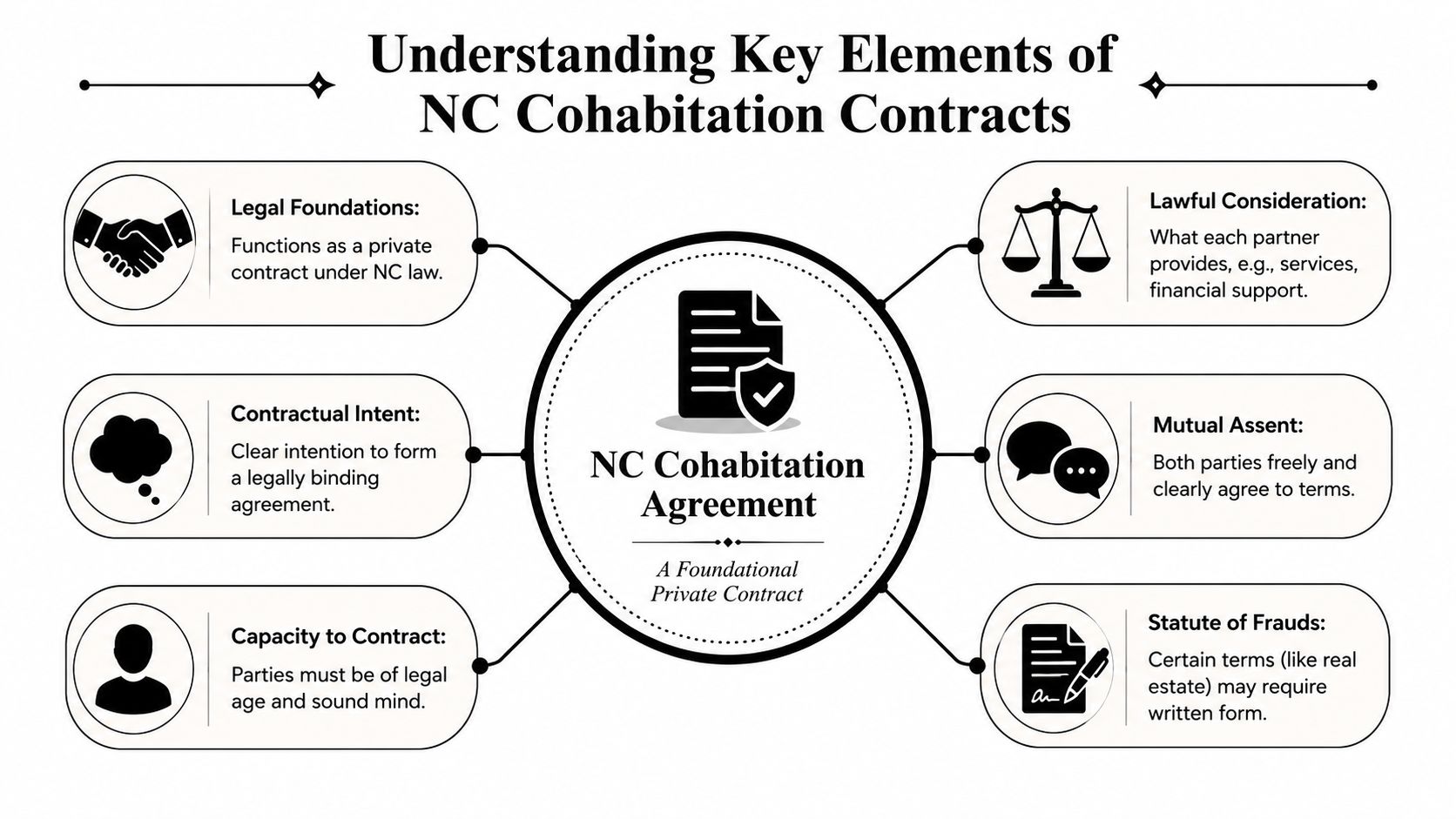
A North Carolina cohabitation agreement works as a private contract because unmarried partners don't have automatic marital rights. For asset protection, it should say who owns the title, how expenses are split, who handles debt, and how the couple will unwind the arrangement if they separate, which is the same basic idea behind a prenup, but for people who aren't married yet. For a related comparison, prenuptial agreements in North Carolina serve a similar function for married or soon-to-be-married couples.
The contract has to say what it means
North Carolina courts have long recognized that finances and property agreements between unmarried cohabitants can be enforced if they rest on lawful consideration, not sexual services, and the old Suggs v. Norris rule is often cited for that principle. In plain English, the agreement needs ordinary contract features, clear consent, lawful purpose, and terms a court can read and apply. If the document is vague, a judge may struggle to decide what the parties meant.
The agreement also can't override everything. Child support and custody belong to the court, not to private bargains, even if both adults sign a document saying otherwise. That's why a cohabitation agreement should focus on the adult financial issues the law allows parties to settle in advance.
The clauses should match real life
If one partner pays rent while the other pays the mortgage, the contract should say exactly how that tradeoff works. If one partner puts more money into a home or renovation, the agreement should say whether that contribution creates reimbursement, a share of equity, or some other defined remedy. North Carolina law also treats cohabitation differently from marriage, and older state materials note that support law has long recognized cohabitation as a legally meaningful event under G.S. 50-16.9(b) as amended by S.L. 1995-319.
Separation Agreements in North Carolina can resolve property, support, and custody for married spouses, but unmarried couples need their own contract because the legal starting point is different.
Common Clauses and Legal Requirements
The clauses that matter most are the ones that translate daily life into legal terms. A cohabitation agreement should not just say “we'll be fair,” because fairness is too vague when one person paid cash for cabinets and the other handled the mortgage. It needs a written formula the couple can follow later if they split.
Property, expenses, and debt
Start with property ownership. If only one partner is on the deed, say so, and then explain whether the non-titled partner gets reimbursement for a down payment, a percentage of equity, or a buyout right if the relationship ends. The same approach should cover mortgage payments, utility bills, repairs, and debt, because those contributions often become the core of a later dispute.
Good drafting rule: Tie every contribution to a legal consequence. If a partner pays for renovations, the agreement should say whether that money becomes reimbursement, additional equity, or a fixed offset at breakup.
Occupancy and buyout mechanics
The strongest agreements answer the hard question before it becomes a fight, who stays in the house, and who has to leave. If one person wants to keep the home, the contract should give a timeline for notice, valuation, and a buyout process. If neither person can refinance, the agreement should say whether the property will be listed for sale, how the listing price will be set, and how the proceeds will be divided after mortgage payoff and sale costs.
What courts won't enforce
North Carolina courts enforce cohabitation agreements supported by lawful consideration and not based on sexual services. That means the contract should be about money, property, expenses, and other lawful obligations, not personal promises the law won't treat as valid consideration. Financial contributions like household bills or renovations can be tied to specific repayment or ownership terms, but only if the document is written clearly enough for a judge to read without guessing.
A clean agreement also benefits from amendment language. If the couple later refinances, buys another property, or changes how bills are paid, the contract should say how updates get made so the document doesn't become outdated the moment life changes.
Steps for Drafting and Executing an Agreement

Drafting starts with records, not with romance. Each partner should gather bank statements, closing papers, mortgage statements, renovation receipts, and any documents showing who paid what. The point is to make the agreement reflect real contributions, not memory or guesswork.
Build the document around facts
The contract should identify the property, the ownership structure, and the contribution structure. If one partner put in the down payment and the other covered monthly expenses, that difference should appear in the language, not in a side conversation. If the couple wants mediation or arbitration for disputes, the agreement should say so up front.
Sign it like a real contract
North Carolina cohabitation agreements are strongest when they're written, signed, and executed with the seriousness of any other binding contract. Both partners should review the document carefully, ask questions, and make sure the terms match their intent before signing. Notarization and witnesses add formality, and that formality helps later if someone tries to argue the contract was casual or incomplete.
Store and update it
After signing, keep the original in a safe place and keep a scanned copy with your other important records. If the couple refinances, changes title, or makes another large contribution, the agreement should be reviewed and updated in writing so the legal paper trail matches the financial reality. That habit matters because the court will care far more about documented terms than about what the couple thought was “understood.”
Practical rule: If a contribution would matter in a breakup, document it the same day or as close to the payment as possible.
Enforcing Agreements and Addressing Real Estate Risk

North Carolina courts usually start with the basics of contract enforcement, clear terms, lawful consideration, and proof that both partners intended the agreement to control their financial arrangement. The housing issues tend to create the hardest disputes, especially when only one partner is on the deed but both people have been paying into the home. A written agreement can still protect the non-titled partner, but it has to explain the money trail in a way that can be proved later.
The deed is not the whole story
A lot of people assume the deed ends the discussion. It does not, especially when the agreement spells out reimbursements, equity sharing, or a buyout formula. The better question is whether the document explains the down payment, mortgage payments, and renovation costs in a way that can be shown later through statements, receipts, and closing records.
The weak point in many disputes is documentation, not legal theory. If the non-titled partner contributed money but never kept records, the disagreement becomes harder to resolve. A cohabitation agreement reduces that risk by identifying exactly how the contributions will be treated, which is a key part of learning how to protect assets from creditors: https://bryanfaganlaw-nc.com/how-to-protect-assets-from-creditors/
Real estate clauses need to be specific
A clause that says “we'll divide the house fairly” leaves too much room for argument. A clause that gives one partner the first right to buy out the other, with value tied to a named appraisal process, gives the couple a workable exit. If refinance is not possible, the agreement should say when a sale is triggered and how long each person may stay in the home while that process is handled.
Real estate language deserves special attention in a cohabitation agreement NC homeowners sign. North Carolina materials on unmarried cohabitants make clear that the state does not create automatic marital property rights for unmarried partners, so contract terms are often the main way to protect a non-titled partner's investment in the home.
Why real estate risk deserves lawyer review
DIY templates often stop short. They may cover rent and groceries, but leave out title, buyout timing, occupancy rights, and what happens if one person cannot refinance after separation. For couples with a shared home, an attorney can draft terms that match the deed, mortgage, and payment history. For those situations, the Law Office of Bryan Fagan can be one option for North Carolina residents dealing with those issues.
Costs and Fee Considerations in North Carolina
People often delay a cohabitation agreement because they assume the process will be expensive. The cost usually depends on how much needs to be documented, how much negotiation is involved, and whether the couple has real estate, debt, or a prior financial history that needs careful drafting. When a home is involved, the work takes more time because the agreement has to line up with title, mortgage, and contribution records.
North Carolina law has treated cohabitation as a meaningful legal event for a long time, and state materials note that the 2000 census counted 144,000 unmarried couples living together in the state UNC School of Government bench book. That scale helps explain why private contracts matter so much, couples are common enough that property planning has to be practical, not theoretical.
| Service | Cost Range |
|---|---|
| Simple agreement review | Varies by attorney and complexity |
| Custom agreement for one home or major asset | Varies by attorney and complexity |
| Negotiated agreement with edits from both sides | Varies by attorney and complexity |
| Notarization and witnessing | Typically limited to modest administrative cost |
The biggest price drivers are usually the number of assets, whether one partner is on the deed, how much buyout language needs to be negotiated, and whether the couple wants the agreement tied to broader estate planning. A short, clean contract costs less to draft than a document that has to account for multiple accounts, a home, renovation contributions, and future refinance issues. The smarter move is usually to address those issues now, before a breakup turns them into a court fight.
When to Seek Legal Advice and Next Steps
If your agreement involves a house, a mortgage, a refinance possibility, or one partner's money being more significantly tied to the property, professional drafting makes a real difference. DIY forms often miss the exact clauses that matter most in North Carolina, especially buyout terms, reimbursement language, and the evidence needed if a dispute ever reaches court. That's where a lawyer can help turn a general promise into a contract that precisely matches the financial facts.
The same is true if the couple disagrees about who paid what, if one person already moved money into renovations, or if the title and the mortgage don't match the lived reality. Those are the situations where loose language becomes expensive later. A North Carolina family lawyer can also make sure the agreement doesn't try to do things the court won't enforce, like controlling child support or custody.
For many couples, the safest next step is to sit down with counsel before signing anything. The Law Office of Bryan Fagan can help North Carolina residents draft, review, or refine a cohabitation agreement NC couples can use to protect property, clarify responsibilities, and reduce the chance of future conflict.
FAQs for North Carolina Cohabitation Agreements
Can a cohabitation agreement waive child support or custody rights?
No. North Carolina law does not let parents privately contract away a child's rights, so child support and custody stay under court control even if both adults sign something different.
How often should I update my agreement?
Update it whenever the finances change in a meaningful way, such as a refinance, a new home purchase, or a major renovation contribution. If the facts change, the contract should change too.
What happens if one partner breaches the agreement?
The non-breaching partner may be able to enforce the contract in court if the terms are clear, written, and supported by lawful consideration. The better the documentation, the stronger the enforcement position.
Are oral cohabitation agreements ever enforceable in North Carolina?
For real property and other important terms, a written agreement is far safer and often necessary. Oral promises are much harder to prove, especially when the dispute involves a home, debt, or equity.
If you're living together in North Carolina and sharing a home, don't wait for a breakup to learn what the law will and won't protect. Schedule a consultation with Law Office of Bryan Fagan to review your property situation, discuss contribution and buyout language, and put a written plan in place before the next dispute starts.