
When you're navigating a custody case in North Carolina, the term "primary physical custody" is one you'll hear often. But what does it actually mean for you and your child?
Simply put, it designates the parent with whom the child lives for the majority of the year. This parent's home becomes the child's home base—the place where they do homework, eat dinner, and lay their head down at night. Understanding this concept is critical, as it shapes your daily life, your finances, and your child's routine.
Understanding Primary Physical Custody in North Carolina

When a North Carolina judge awards a parent primary physical custody, they are entrusting that parent with the child's day-to-day care and supervision. This parent becomes responsible for the daily rhythm of the child's life, from school drop-offs and doctor's appointments to helping with homework and managing bedtime routines.
This arrangement is designed to provide stability and a consistent environment, which North Carolina courts see as essential for a child’s well-being.
Primary vs. Other Custody Types
It’s easy to get legal terms confused, but the distinctions are critical in a North Carolina custody order. Primary custody is not the same as sole custody. While they sound similar, they have very different meanings and legal implications.
To help clear things up, here’s a breakdown of the common physical custody arrangements you'll encounter in North Carolina.
Comparing Custody Arrangements in North Carolina
| Custody Type | Parenting Time (Overnights) | Common Scenario in NC |
|---|---|---|
| Primary Physical Custody | One parent has the child for the majority of the year (more than 182 nights). | One parent's home is the child's main residence for school and daily life, while the other parent has a set visitation schedule (often called secondary custody). |
| Joint Physical Custody | Both parents have significant time, often close to a 50/50 split. | Parents share day-to-day responsibilities more equally, requiring a high degree of cooperation and communication. |
| Sole Physical Custody | One parent has the child 100% of the time, with the other parent having no physical time. | This is rare and usually only ordered in extreme cases where a parent poses a danger to the child, such as situations involving abuse or severe neglect. |
This table shows how primary custody establishes a main home base while still ensuring the other parent, who typically has secondary physical custody, remains a consistent and involved part of the child's life. Our firm provides a more detailed look at how these schedules work in our guide to North Carolina child custody.
How It Is Determined in Court
To be designated the primary physical custodian in North Carolina, the child must reside with you for more than half the year. This parent is then responsible for the child's daily needs.
Courts often favor this setup because it provides a predictable routine and a stable "home base" for the child. This legal designation is significant for several reasons. It directly impacts how child support is calculated and often determines which parent can claim the child for tax purposes, making it a key factor in your case's financial outcome.
Physical vs. Legal Custody: A Critical Distinction in North Carolina

One of the biggest points of confusion in North Carolina custody cases is the difference between physical and legal custody. Getting this right is vital, as these two concepts shape both your daily routine and your long-term rights as a parent. A judge can award them completely separately.
Here’s the simplest way to think about it:
- Physical Custody answers the question, "Where will the child live?" It establishes the day-to-day parenting schedule and determines which parent’s house is the child's primary home.
- Legal Custody answers, "Who gets to make the big decisions for the child?" This covers the right to weigh in on major issues affecting your child's health, education, religion, and general welfare.
So, even if one parent has primary physical custody and handles the daily logistics, that doesn't automatically mean they get to make all the major decisions alone.
What Legal Custody Covers
In North Carolina, courts strongly prefer to grant joint legal custody, where both parents share the responsibility for making major life decisions. This means parents are legally required to consult with each other and try to reach an agreement on important matters.
This shared authority is a cornerstone of North Carolina family law. The court's goal is to keep both parents deeply involved in their child’s upbringing, recognizing that each parent brings value, regardless of the physical custody schedule.
Even if your child lives primarily with your ex-partner, having joint legal custody means you still have a voice in the decisions that matter most. These typically include:
- Education: Choosing a school, arranging for tutoring, or consenting to special educational programs.
- Non-Emergency Healthcare: Agreeing on doctors, dentists, or orthodontists, and deciding on elective medical treatments.
- Religious Upbringing: Making joint decisions about the child's faith and religious education.
- Major Extracurriculars: Deciding whether the child can join a travel sports team or other demanding activity that impacts schedules and finances.
A very common outcome in North Carolina is for one parent to have primary physical custody while both share joint legal custody. This arrangement gives the child a stable home base while ensuring both parents collaborate on the important decisions that will shape their future.
Real-World Example: How Joint Legal Custody Works
Imagine your child's dentist recommends braces. If you and the other parent share joint legal custody, one of you can't unilaterally schedule the appointments. You are both expected to discuss the orthodontist, the treatment plan, and how to handle the cost. If you can't agree, you may need to attend mediation or ask a judge to resolve the dispute.
This requirement to co-parent can be difficult, especially if communication is strained. However, it is the court's clear expectation. If one parent makes a major unilateral decision that violates a joint legal custody order, they could be brought back to court on a motion for contempt.
How North Carolina Courts Decide Primary Physical Custody

When parents cannot agree on a custody arrangement, a North Carolina judge must make the decision. Every choice the court makes is guided by one single, overarching principle: the "best interest of the child."
This isn't just a general idea; it's the strict legal standard that governs every custody case in the state. Under North Carolina General Statute § 50-13.2(a), a judge must set aside any personal biases and act as a neutral fact-finder, weighing all relevant circumstances to determine which parenting arrangement will "best promote the interest and welfare of the child."
The "Best Interest" Standard in Action
What does “best interest” actually look like in a courtroom? The statute doesn't provide a simple checklist. The law is written broadly on purpose, giving judges wide discretion to consider any factor relevant to a child's well-being. Every family is unique, and the court’s job is to look at the entire picture of the child’s life to decide which parent is in the best position to provide the stability, care, and emotional support they need to thrive.
The responsibility on the court is enormous, especially when you consider that nationally, about 12.9 million custodial parents are raising 21.9 million children, often in arrangements where one parent has primary custody. In North Carolina, this means the court is tasked with creating a stable home base that supports a child’s education and emotional health. You can explore more about these demographic trends and what they mean for family law.
Key Factors a Judge Will Consider
While a judge can consider any relevant evidence, North Carolina courts consistently focus on a handful of key areas when deciding who gets primary physical custody. No single factor is determinative; instead, the judge looks at the totality of the circumstances.
Some of the most important factors a judge will analyze include:
- Each Parent's Ability to Provide a Stable Home: This is about more than just a nice house. It includes the physical safety of the home, the parent’s emotional stability, and their ability to create a consistent routine for the child.
- The Parent-Child Relationship (Primary Caregiver Role): The court will look closely at the existing bond between each parent and the child. Who has historically been the primary caregiver? Who gets the child ready for school, helps with homework, goes to doctor’s appointments, and offers comfort when they’re upset?
- History of Domestic Violence: This is a major red flag. Under North Carolina General Statute § 50-13.2(a), any act of domestic violence is a critical factor. A proven history can severely limit or even prevent a parent from being awarded custody.
- Each Parent's Physical and Mental Health: The court may consider whether a parent's health issues could negatively impact their ability to care for their child. This is not about penalizing a parent for a health condition but ensuring the child’s needs will be consistently met.
- The Child's Adjustment: How is the child doing in their current home, school, and community? Judges are often hesitant to disrupt a stable situation unless there is a compelling reason.
Real-World Example: A Common NC Custody Scenario
Let's imagine a scenario. Parent A works a standard 9-to-5 job, lives in a stable home close to the child's school, and has always handled school pickups and doctor's visits. Parent B has a higher-paying job but one that requires frequent, last-minute travel, forcing them to rely on babysitters and family members for childcare.
In this situation, a judge would likely place significant weight on Parent A’s consistent availability and deep involvement in the child's daily life. While Parent B’s income is a factor, the court's main focus is the child's need for routine and direct parental care. A judge would likely conclude that awarding primary physical custody to Parent A is in the child’s best interest because it offers the most stability, even if both parents are equally loving and capable.
This shows that a custody decision isn't a judgment on who is a "better" person. It's a practical assessment of which parent is better positioned to meet the child's day-to-day needs.
How Primary Physical Custody Impacts Your Daily Life
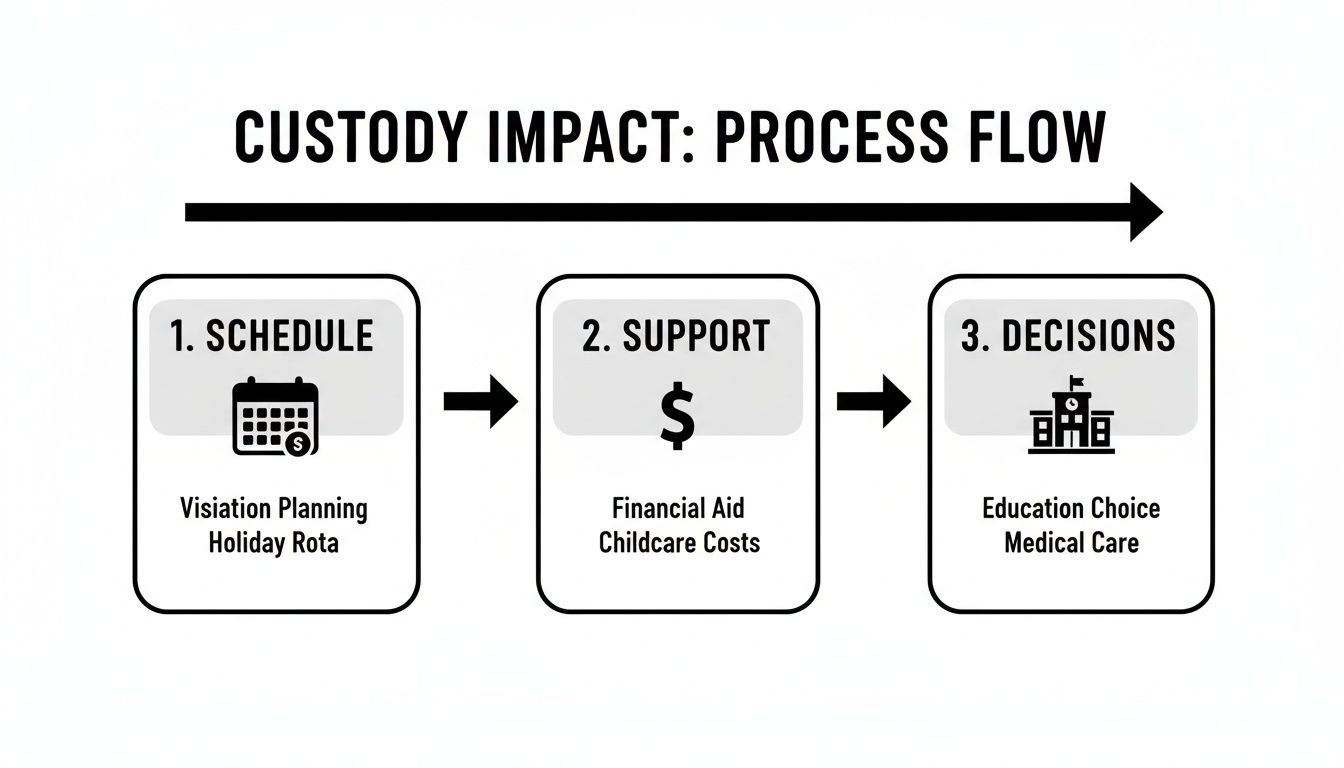
Once a judge’s order is signed, the legal jargon fades. What truly matters is how a primary physical custody arrangement changes your family’s day-to-day life. The order becomes the practical blueprint for co-parenting, shaping schedules, finances, and daily decisions.
Understanding these real-world impacts helps you move beyond the legal definition of "primary custody." It’s about knowing what this means for school pick-ups, paying for expenses, and planning summer vacations.
Crafting a Practical Parenting Time Schedule
The most immediate effect of a custody order is the parenting time schedule. This is the calendar that dictates when your child will be with each parent. While many people think of the "every-other-weekend" setup, North Carolina courts can approve any schedule that serves the child’s best interests.
A common schedule might look like this:
- The secondary parent has the child every other weekend, from Friday afternoon until Sunday evening.
- Major holidays like Thanksgiving and Christmas are alternated each year.
- Summer vacation is divided, often giving the secondary parent several weeks of uninterrupted time.
Schedules are highly customizable. If a parent works a non-traditional schedule, the arrangement can be tailored to include weekday visits or different exchange times. The goal is to create consistency and ensure the child maintains a strong, healthy relationship with both parents.
How Custody Influences Child Support Calculations
A primary physical custody order has a direct and significant impact on child support. North Carolina uses specific guidelines to calculate support, and a key factor in the formula is the number of overnights the child spends with each parent.
Because the primary custodial parent has the child for the majority of the time, the law presumes they cover most of the child's daily expenses—food, housing, clothing, and utilities.
As a result, the non-primary (secondary) parent is almost always ordered to pay child support to the primary parent. This isn't a fee to see your child; it's a financial contribution to ensure the child’s needs are met consistently across both homes. This is a standard approach that provides stability for families. You can review key findings on custodial arrangements to learn more about these family structures.
Managing Daily Logistics and Decisions
Beyond schedules and support, the primary parent typically manages the bulk of the family’s day-to-day logistics. Even with joint legal custody, the primary parent is usually the one who handles the daily execution of those choices.
This often includes responsibilities like:
- School Enrollment: The child’s legal address for school registration is almost always the primary custodian’s. This parent handles enrollment paperwork, attends parent-teacher conferences, and serves as the school's main point of contact.
- Medical Appointments: While both parents may have the right to attend, the primary parent usually schedules routine check-ups, dentist visits, and manages care when the child is sick.
- Daily Routines: This parent is responsible for the home front, establishing and enforcing daily routines for homework, chores, bedtimes, and meals.
A primary custody order provides a clear framework designed to reduce conflict and create a predictable, stable environment where your child can thrive.
How to Request or Modify a Custody Order in NC
Whether you are establishing custody for the first time or need to change an existing order, you must follow specific legal steps in North Carolina. The path you take depends on whether an official court order is already in place.
Filing an Initial Custody Complaint
If you have no formal custody order, you will begin by filing a Complaint for Child Custody. This is the official court document that initiates your case. It must be filed in the North Carolina county where the child lives or is currently located.
The process generally follows these steps:
- Drafting and Filing: After filing the Complaint, you must have the other parent formally served with a copy and a summons. This gives them official notice and 30 days to file a response.
- Mandatory Mediation: Before going to trial, North Carolina law requires most parents to attend custody mediation. This is a chance to negotiate an agreement with a neutral third-party mediator. Many cases are resolved at this stage.
- Preparing for Court: If mediation is unsuccessful, your case moves toward a court hearing. This is when you and your attorney will organize evidence to present to the judge.
Building a Strong Case for Primary Physical Custody
A judge's decision comes down to the evidence. Your job is to show the court that awarding you primary physical custody is in your child's best interest. Vague claims are not enough—you need concrete proof.
Strong evidence often includes:
- Communication Logs: Records of texts, emails, and app messages can highlight your efforts to co-parent or show a pattern of conflict from the other side.
- School and Medical Records: Documents showing you attend parent-teacher conferences and manage your child's doctor visits are powerful proof of your role as the primary caregiver.
- Witness Testimony: Testimony from teachers, daycare providers, or family members who have seen your parenting firsthand can be incredibly compelling.
- Your Own Testimony: You will have the chance to tell the judge about your role in your child’s life and why your requested schedule is the best fit.
If you need an order quickly while your main case is ongoing, it's worth exploring how to get temporary custody in North Carolina.
Modifying an Existing Custody Order
If you already have a custody order but it is no longer working, you can file a Motion to Modify. However, you cannot change an order simply because you dislike it.
To successfully modify a North Carolina custody order, you must prove there has been a "substantial change in circumstances" that affects the child’s welfare, and that changing the order is now in the child's best interest.
This is a high legal bar to clear. The change must be significant and must have occurred after the current order was signed. Examples include:
- One parent plans to relocate a significant distance away.
- A major, long-term shift in a parent’s work schedule impacts their ability to care for the child.
- The child’s needs change dramatically due to age or health.
- A parent develops a substance abuse problem or engages in behavior that puts the child at risk.
The modification process is similar to an initial case: file a motion, serve the other parent, attend mediation, and, if you cannot agree, present your evidence to a judge.
Frequently Asked Questions About NC Primary Physical Custody
Facing a custody battle brings up endless questions. Below are answers to some of the most common questions North Carolina parents ask, designed to give you the clarity you need.
Does the mother automatically get primary custody in North Carolina?
No. This is a persistent myth. North Carolina law is gender-neutral. The court is legally prohibited from favoring a mother over a father, or vice versa. The only standard a judge uses is the "best interest of the child." A judge evaluates each parent's ability to provide a safe, stable home and meet the child’s needs based on evidence, not outdated gender roles.
Can a child decide who they want to live with in NC?
No, a child does not get the final say. A North Carolina judge is allowed to hear and consider the wishes of a child who is of "sufficient age and maturity to form an intelligent preference." There is no magic age for this. A judge will weigh the child’s preference against all other factors to determine what is truly in their long-term best interest. The final decision always rests with the court.
How does having primary physical custody affect my taxes?
Generally, the primary custodial parent—the one the child lives with for more than half the year—is the parent who can claim the child as a dependent on their taxes. This may allow them to claim significant tax benefits, like the Child Tax Credit. However, this right can be negotiated. A court order or a signed IRS Form 8332 can assign the dependency exemption to the non-custodial parent, often on an alternating-year basis.
What happens if the other parent doesn't follow the visitation schedule?
If the other parent consistently violates the custody order by denying your parenting time, you should not retaliate by withholding child support or denying their next visit. The proper legal response is to file a Motion for Contempt with the court. This asks a judge to enforce the order. If the judge finds the other parent willfully violated the order, they can impose penalties, including ordering make-up visitation time, attorney's fees, fines, or even jail time for repeated violations.
Secure Your Child's Future with a North Carolina Custody Attorney
Navigating a North Carolina custody case is one of the most difficult challenges a parent can face. The decisions made will define your child's future and your relationship with them for years to come. Understanding primary physical custody is a crucial first step, but applying that knowledge to your family’s needs requires skilled legal guidance.
This guide provides a solid overview, but it cannot replace personalized advice from a family law attorney who knows the local courts and judges. An experienced lawyer acts as your advocate, guiding you through this complex process with a clear, forward-looking strategy.
How an Experienced NC Attorney Can Help
A dedicated custody lawyer does more than just file paperwork. They play an essential role in building a compelling case, gathering the right evidence, and presenting your story in a way that aligns with your child's best interests.
An experienced North Carolina custody lawyer can provide invaluable assistance by:
- Gathering Persuasive Evidence: They know what judges look for and can help you collect communication logs, school records, and witness testimony that demonstrates your fitness as a primary parent.
- Navigating Court Procedures: From filing the initial complaint to preparing for mediation and trial, your attorney ensures every deadline and legal requirement is met.
- Advocating for You: In negotiations and in the courtroom, your lawyer is your voice, articulating why your requested custody arrangement serves your child's best interests.
If you are a North Carolina resident facing a custody dispute, you don’t have to go through it alone. Our dedicated family law team is here to help you protect your parental rights and secure your family's future.
At the Law Office of Bryan Fagan, we are committed to guiding North Carolina families through their most difficult legal challenges. To discuss your case and learn how we can help, please schedule a confidential consultation with us today.