If you're searching for who pays attorney fees in divorce in NC, you're probably dealing with a very practical fear. One spouse has access to the money. The other is staring at court papers, a retainer request, or an upcoming hearing and wondering how they're supposed to keep up.
In North Carolina, the short answer is this: most of the time, each spouse pays their own lawyer. But that rule has important exceptions. In alimony, post-separation support, child custody, child support, and some property division disputes, a judge may shift fees if specific legal standards are met. The details matter, and timing matters even more.
A lot of people get tripped up by two issues that many NC divorce fee guides barely explain. First, fee requests usually must be made properly and early, not casually at the end of a hearing. Second, in property division cases, fees usually aren't available unless the other spouse crosses into bad-faith obstruction, not just ordinary stubbornness.
Why Attorney Fees Matter in NC Divorce
A common North Carolina scenario looks like this. One spouse stayed home with the children or worked part-time while the other handled most of the income and accounts. Then the separation turns into litigation, and the financially dependent spouse worries they'll have to choose between paying household bills and hiring counsel.
That concern is legitimate because attorney fees can affect almost every part of a divorce case. If one side can afford legal help and the other can't, that imbalance can shape temporary support, custody arrangements, settlement pressure, and even whether hidden financial issues come to light.
The practical problem behind the legal rule
Attorney fees aren't just a side expense. They alter the balance of power. A spouse who can't afford representation may feel pushed to agree too early, overlook claims for support, or fail to respond fully to property and custody filings.
Fees also matter because divorce cases often move in stages. Early hearings can decide where children stay, who pays support, or who remains in the home. If one spouse appears with counsel and the other doesn't, the case may start from an uneven position.
Practical rule: In North Carolina family law, fee requests are less about “punishing” the other spouse and more about whether the court needs to create fair access to the process.
Where people get confused
Many people assume one of two things, and both are often wrong:
- “The higher earner automatically pays.” Not in North Carolina. Income difference alone usually isn't enough.
- “No one can ever recover fees.” Also not true. Certain statutes allow fee awards in specific kinds of family law claims.
- “If I ask the judge at the hearing, that's enough.” Often it isn't. Procedure can make or break the request.
The rest of the answer depends on what claims are in your case.
Statutory Basis for Attorney Fee Awards in NC
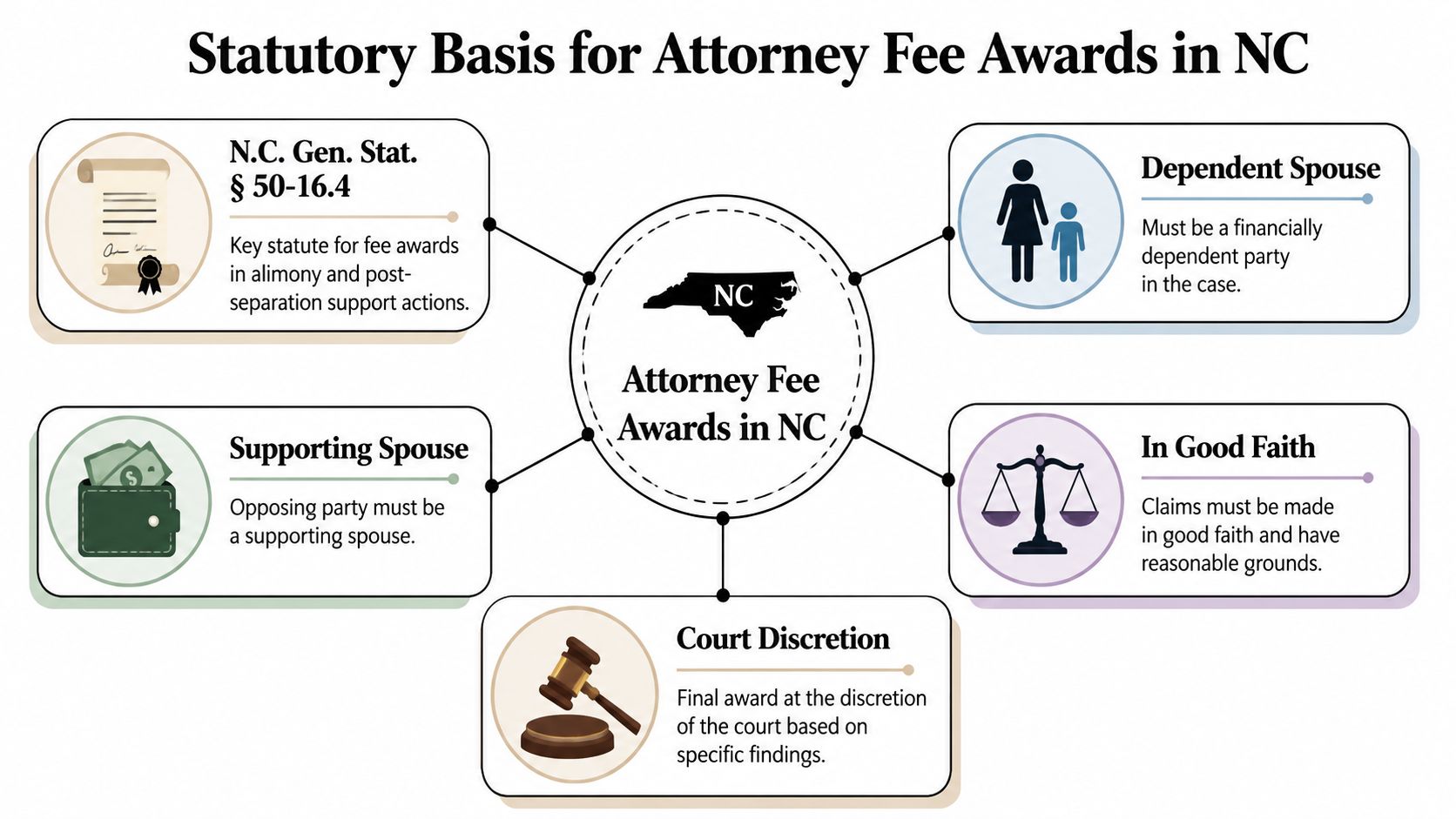
North Carolina starts from a default rule. In divorce litigation, each side usually pays their own attorney fees unless a statute allows fee-shifting. That means you have to identify the legal basis before asking the court to make your spouse contribute.
Alimony and post-separation support
Under N.C. Gen. Stat. § 50-16.4, a court may order a supporting spouse to pay reasonable counsel fees for a dependent spouse seeking alimony or post-separation support, but the award isn't automatic. The spouse asking for fees must show financial dependency and lack of sufficient means to cover legal expenses, as described in this discussion of North Carolina attorney fee awards in alimony matters.
In plain English, that means the court looks at whether one spouse relies financially on the other and whether that spouse realistically has the ability to pay for legal representation.
A North Carolina Divorce Lawyer handles representation for absolute divorce and related claims under North Carolina law. In practice, fee eligibility often depends on how those related claims are pled, not just on the fact that a divorce is pending.
Custody and child support
For custody and support disputes, N.C. Gen. Stat. § 50-13.6 uses a different test. The requesting party must show three things:
| Claim type | What the court looks for |
|---|---|
| Child custody or support | The party is acting in good faith, has insufficient means to pay, and there is a significant disparity in income between the parties |
| Alimony or post-separation support | The party is a dependent spouse and lacks sufficient means to cover legal expenses |
The custody rule is technical and discretionary. The court may still deny fees if it concludes an award wouldn't fit the child's best interests.
Property division and the overlooked obstruction exception
Many readers get bad advice on this point. In equitable distribution cases, fees usually aren't shifted just because one spouse earns more. But there is a narrow path when the other spouse actively obstructs the process.
Fees in property division usually require more than a difficult spouse. The problem has to look like obstruction, such as failing to appear or withholding required documents.
Examples can include failing to show up at scheduling hearings, refusing to provide subpoenaed records, or dragging out the case to prevent fair division of marital assets. That's a very different situation from ordinary conflict or slow settlement talks.
Temporary Attorney Fee Awards in NC Divorce
Temporary fee requests matter most when the case is moving faster than your finances. A pending custody hearing, emergency support issue, or early motion can force a spouse to act before the broader case is resolved.

Why temporary relief can matter so much
North Carolina follows the general rule that each litigant bears their own attorney fees. At the same time, divorce costs can rise quickly. A 2020 Nolo national survey cited in this North Carolina divorce fee analysis reported an average of $4,100 for uncontested divorces and $23,000 for cases that go to trial on at least two issues.
Those figures don't decide your case, but they show why temporary fee relief can matter. If the case includes support or custody disputes, waiting until the end may leave a spouse without meaningful help when key decisions are being made.
A common example
Suppose a mother in Greensboro has limited income after separation and receives notice of an upcoming temporary custody hearing. Her spouse has steady earnings and already hired counsel. She files a motion requesting interim fees tied to her custody claim, supports it with sworn financial information, and asks the court to consider her inability to fund representation on her own.
The judge won't grant fees merely because she asked. But if she meets the statutory standard for the claim involved and provides enough financial detail, the court may award temporary fees so she can participate on more equal footing.
What judges usually expect to see
A strong temporary fee request usually includes:
- A clear legal basis: The motion should connect the request to the claim that allows for fees, such as alimony, post-separation support, custody, or support.
- Specific financial facts: Courts want details showing dependency, limited access to funds, or inability to cover counsel fees.
- A timely filing: Waiting too long can undercut the request, especially if a hearing is already set.
- Good-faith litigation conduct: Judges are more receptive when the requesting party is pursuing legitimate relief, not using fees as a tactic.
Temporary fee awards don't decide the entire divorce. They're meant to help one spouse stay represented while the case is unfolding.
Final Attorney Fee Awards in NC Divorce
By the end of a divorce-related case, the court may decide whether one party should pay some or all of the other party's fees under the statute tied to that claim. Final fee awards are less about broad fairness in the abstract and more about whether the legal requirements were proven with evidence.
What the court is really evaluating
For alimony-related claims, the court focuses on dependency and inability to pay. For custody and support matters, the court looks at good faith, insufficient means, and income disparity. In property division, the key issue is often whether one spouse obstructed the process in a way that prevented fair litigation.
That last point matters in high-asset cases. A spouse may assume, “My husband hid records, delayed disclosures, and ignored requests, but property cases never allow fees.” That's not always correct. The narrow exception is tied to obstruction, not just imbalance.
A realistic property division scenario
Assume spouses are litigating equitable distribution involving business interests, investment accounts, and real estate. One spouse repeatedly fails to produce subpoenaed financial records and misses scheduling obligations. The other spouse spends substantial legal time forcing compliance.
That pattern may support a fee request tied to bad-faith obstruction. But if the other spouse is merely argumentative, negotiates hard, or disagrees on value, that usually isn't enough by itself.
What final awards are not
Final fee awards are not automatic reimbursement. They also aren't a general penalty anytime one spouse behaves poorly.
Courts usually want to see a direct connection between the statute, the facts, and the request. If the case is a simple absolute divorce with no qualifying support, custody, or obstruction issue, the court generally doesn't have authority to shift fees.
The phrase “the judge will make my spouse pay” is too broad for North Carolina. The better question is, “What claim in my case gives the court authority to do that?”
That distinction saves people from spending money litigating a fee request that doesn't have a legal foundation.
Requesting and Contesting Fee Awards
One of the biggest procedural traps in North Carolina is simple but costly. A spouse waits until the hearing, or even the end of the hearing, to ask for attorney fees. Courts often reject that approach because the other side didn't receive proper notice.
The timing problem that catches people off guard
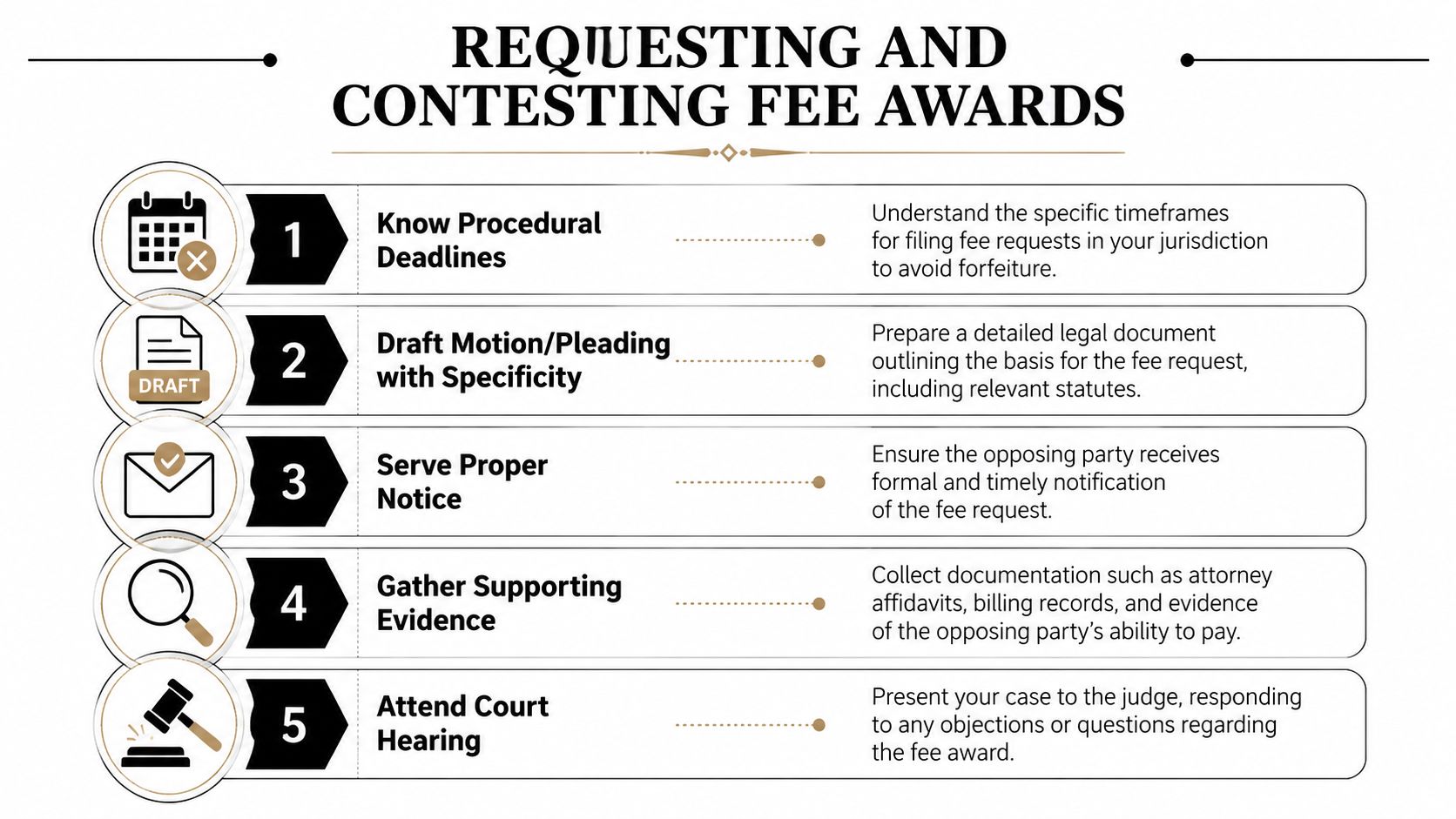
Many clients mistakenly wait until the final hearing to request attorney fees, but courts often deny late requests due to lack of notice. Fee motions must be filed and served before the hearing so the other side can prepare, as explained in this discussion of who pays legal fees in a North Carolina divorce.
If you're heading toward a court date, it also helps to understand the broader hearing process described in this guide to what happens at a North Carolina divorce court hearing. Fee issues don't exist in a vacuum. They usually rise or fall with the pleadings, notice, and evidence already in place.
How to request fees the right way
Use a disciplined approach:
- Identify the statute first. Don't start with “it seems fair.” Start with alimony, post-separation support, custody, support, or a provable obstruction issue in equitable distribution.
- Put the request in a pleading or motion. A hallway conversation, oral comment, or last-minute request usually won't protect you.
- Serve the other side properly. Notice matters because the opposing party has a right to respond.
- Support the request with evidence. Financial affidavits, income information, access-to-funds facts, and attorney billing support can all matter.
- Be ready for objections. The other side may argue you're not financially dependent, you have access to funds, you didn't act in good faith, or your request came too late.
How fee requests get contested
A spouse opposing fees often attacks one of the required elements. They may argue the requesting spouse has enough resources, isn't dependent, filed too late, or is trying to recover fees for claims that don't allow fee-shifting.
That's why specificity matters. General complaints about unfairness rarely work. A focused motion with the right legal basis gives the court something it can grant.
Cost Saving Strategies for NC Divorce Proceedings
Even when a fee award might be available, it's smart to control costs from the start. Good cost management doesn't mean cutting corners. It means matching the legal work to the issues that require court involvement.

Practical ways to reduce legal spend
Some strategies are simple, but they work:
- Organize documents early: Bring tax returns, pay information, account statements, and court papers in one folder instead of sending them piece by piece.
- Use legal help strategically: Some people need full representation. Others may benefit from limited-scope or unbundled help for drafting, review, or hearing preparation.
- Try negotiation where appropriate: Mediation or settlement discussions can reduce the number of issues that require court time.
- Keep communications focused: Long emotional emails to counsel can increase billable time without moving the case forward.
- Separate the divorce from the side issues: A simple absolute divorce may be straightforward, but related claims can change the cost picture quickly.
Know the filing cost and its limit
The absolute divorce filing fee in North Carolina is $225, made up of a $150 District Court fee and a $75 absolute divorce fee, according to this explanation of North Carolina divorce filing costs. That article also notes an additional $30 cost for sheriff service and $10 for a name-change request tied to the filing.
Those filing fees are important, but they're only part of the total expense. For a closer look at the broader cost picture, see this page on NC divorce cost.
One option among others
For people comparing representation options, the Law Office of Bryan Fagan offers Alimony in North Carolina Dependendent and Supporting Spouses, which addresses how North Carolina determines dependent and supporting spouse status. That issue often intersects with whether fee requests are even available in support-related litigation.
Next Steps and Consultation for NC Residents
If you're trying to answer who pays attorney fees in divorce in NC, don't stop at the general rule. The useful question is whether your case fits one of the specific North Carolina paths that allow fee-shifting, and whether you've preserved that request correctly.
A simple action list
Before you meet with a lawyer, gather:
- Your court papers: Complaints, motions, notices of hearing, and any prior orders
- Financial records: Income information, bank statements, debt records, and proof of who controls household funds
- Attorney billing or retainer information: If you've already hired counsel or consulted one
- Examples of obstruction: Missed hearings, ignored document requests, or withheld records if property division is part of the dispute
Questions worth asking in a consultation
Ask direct questions:
- Does my claim allow attorney fees under North Carolina law?
- Do I qualify as a dependent spouse?
- If custody or support is involved, what evidence shows insufficient means and income disparity?
- If property division is the main fight, does the other spouse's conduct rise to obstruction?
- Have I already missed a deadline to request fees?
A consultation is also the right time to prepare for the practical side of the case. This guide on how to prepare for a divorce consultation in North Carolina can help you organize what to bring and what to ask.
North Carolina fee rules are technical, and small procedural mistakes can close the door on relief that might otherwise be available. If money control, support, custody, or obstructive property conduct is part of your case, early legal advice can protect both your position and your budget.
Common Questions About Attorney Fees in Divorce NC
Can a spouse get attorney fees in an uncontested NC divorce
Usually not for the simple divorce itself. North Carolina generally requires each side to pay their own fees unless a statute authorizes fee-shifting. A pure absolute divorce usually doesn't create that authority.
What proves obstruction in equitable distribution
Courts look for conduct that interferes with fair property litigation, such as failing to appear or withholding subpoenaed documents. Ordinary conflict or hard bargaining usually isn't enough.
Do mediation fees get awarded the same way as attorney fees
Not automatically. Whether the court can shift costs depends on the legal basis and the specific claim before the court.
Is income difference alone enough for fees
Usually no. North Carolina statutes require more specific findings, such as dependency, insufficient means, good faith, or a qualifying disparity depending on the claim.
If you're dealing with divorce, custody, support, or property division in North Carolina and need a clear answer about attorney fees, schedule a consultation with the Law Office of Bryan Fagan. A focused case review can help you determine whether a fee request is available, whether a procedural mistake needs to be fixed quickly, and what steps make sense for your specific situation.