Your ex missed the exchange again. Or the child support payment didn't show up. Or you've been told there's a hearing because the other side says you ignored the court order, and now you're trying to figure out whether this is about punishment, pressure, or both. In North Carolina family court, contempt of court is the enforcement tool judges use when an existing order is being ignored, and the details matter more than many expect.
A contempt case is not just a heated argument dressed up as a motion. It usually turns on a specific order, a specific violation, and whether the person accused had the present ability to comply. That's why people are often surprised when a judge asks for pay records, text messages, custody exchange logs, or proof of what happened on the dates in dispute. The record, not the drama, drives the result.
When a North Carolina Family Court Order Is on the Line
A parent calls because the other parent has stopped following the custody schedule. A spouse says alimony has gone unpaid for months. Another person is dealing with equitable distribution obligations spelled out in a final order, but the other side is acting like the paperwork never existed. Those situations feel personal, yet in court they become an enforcement question.
North Carolina uses contempt when a party is not following an existing order. That order might involve child support, custody, visitation, alimony, or equitable distribution, and the court must decide whether the violation is the kind that contempt can reach. Civil contempt is aimed at getting compliance with the order, not punishing the relationship fallout, and that distinction matters from the first filing to the hearing.
What readers usually want to know first
Individuals often have one of two questions. “Can the court make the other person follow the order?” or “Can the court jail me for what already happened?” The answer depends on whether the judge is dealing with civil contempt or criminal contempt, and whether the evidence shows willful noncompliance.
Practical rule: if the order can still be obeyed, meaning the support payment is still owed, the custody exchange can still occur as scheduled, or the person can still take the required step, contempt is often about making compliance happen now, not reliving every bad decision from the past.
That is why these hearings are so document-heavy. A judge is looking for the order, the violation, and proof that the situation was not just messy or unfair, but legally contemptuous under North Carolina standards. If you are trying to understand contempt of court family law NC in plain English, start with this idea, the court cares less about the argument and more about whether the order was ignored in a provable way.
Civil Contempt and Criminal Contempt in NC Family Law
North Carolina treats contempt in two separate ways, and the difference matters. Civil contempt is designed to pressure compliance with a court order, while criminal contempt is designed to punish conduct that already happened. In family court, that split often determines whether the judge is trying to get a parent to follow a custody schedule, a spouse to obey an alimony order, or someone to answer for violating the court's authority in a completed act.

Civil contempt works like pressure, not punishment
Civil contempt is the court's way of saying the order still has to be followed. The point is compliance, not revenge or a clean break from the dispute. That is why it shows up so often in family-law matters involving support, custody, visitation, alimony, and equitable distribution, where the order usually still has something left to be done.
Under N.C. Gen. Stat. § 5A-21, the court may use civil contempt only if the order remains in force, the violation is willful, and the person can comply or take reasonable measures that would allow compliance. N.C. Gen. Stat. § 5A-21
That last point is where a lot of confusion starts. Civil contempt is not just a label for “someone did not follow the order.” The judge has to see that the order can still be obeyed and that the person is choosing not to do it. If the person cannot comply at all, the court is usually not using civil contempt for that situation.
Criminal contempt punishes completed misconduct
Criminal contempt works differently. It addresses conduct that is already over and imposes punishment for the violation itself. The focus is on the completed act, not on whether the person can still fix it. In North Carolina family cases, that can matter when the issue is a direct affront to the court's authority rather than an ongoing failure to perform a required act.
The benchbook and training materials describing G.S. 5A-12(a) explain that criminal contempt can result in censure, imprisonment up to 30 days, a fine not exceeding $500, or a combination of those sanctions.
That difference changes the hearing almost immediately. Civil contempt asks whether the court can still make compliance happen. Criminal contempt asks whether the past conduct was contemptuous and what punishment is authorized. If you are trying to sort out contempt of court family law NC, that is the dividing line that usually controls the rest of the case.
What a North Carolina Court Must Find to Hold You in Contempt
A contempt hearing in North Carolina begins with proof, not frustration. Under N.C. Gen. Stat. § 5A-21, the moving party has to show that the order is still in force, the noncompliance is willful, and the person can comply now or can take reasonable steps that would make compliance possible. In practical terms, the judge is looking for a current order, a deliberate violation, and a real ability to do something about it.

The elements in plain English
First, the order has to still exist. A judge cannot enforce an order that is no longer effective. Second, the court has to see that obedience can still serve the order's purpose. That matters because contempt is meant to make the order work, not punish someone for a dead issue.
Third, the violation has to be willful. A parent who misses one exchange because of a genuine emergency is in a very different position from a parent who ignores repeated instructions and refuses to follow the schedule. Fourth, the person must have the present ability to comply, or at least the ability to take reasonable measures that would get them there.
In court, that last point is usually where the fight happens. The moving party often tries to prove present ability with payroll records, bank statements, work history, parenting messages, calendars, or other documents showing what the person knew and what they could have done. If the issue is missed support, the judge may look for proof of income, spending, job searches, or any effort to meet the order. If the issue is a custody exchange, the messages and timeline often matter more than speeches from the bench.
A judge is not supposed to hold someone in civil contempt for failing to do the impossible.
Why evidence decides the hearing
Records matter more than argument. Payment ledgers, payroll records, bank statements, and text or email exchanges often show whether someone had the ability to pay, whether they knew about the order, and whether the violation was intentional. A parent who lost a job and documented the job search is in a different posture from someone who kept spending freely and stopped paying support without explanation.
The same logic applies in custody cases. If a parent says a missed exchange happened because of an emergency, the judge will want to see the timing, the messages, and the surrounding facts. That is how contempt of court family law NC cases often turn out, because the paper trail usually shows whether the court has a real reason to act.
Typical Penalties and Remedies in NC Contempt Cases
A contempt order in a North Carolina family law case is not one-size-fits-all. The court's response depends on whether the judge is trying to force compliance, punish a violation, or address a separate protection-order problem that has its own criminal consequences. That is why a parent dealing with missed custody exchanges, blocked visitation, or unpaid support needs to look past the headline word “contempt” and focus on the remedy the court can use.
In civil contempt, the court's pressure point is compliance. The judge can order confinement, but the person must have a way to end it by doing what the order requires. In the materials summarized by legal commentary, that confinement can be set in successive 90-day periods, with a cap of one year total for the same offense. Civil contempt also uses purge conditions, so the person can end the confinement by coming into compliance. Rosen law commentary
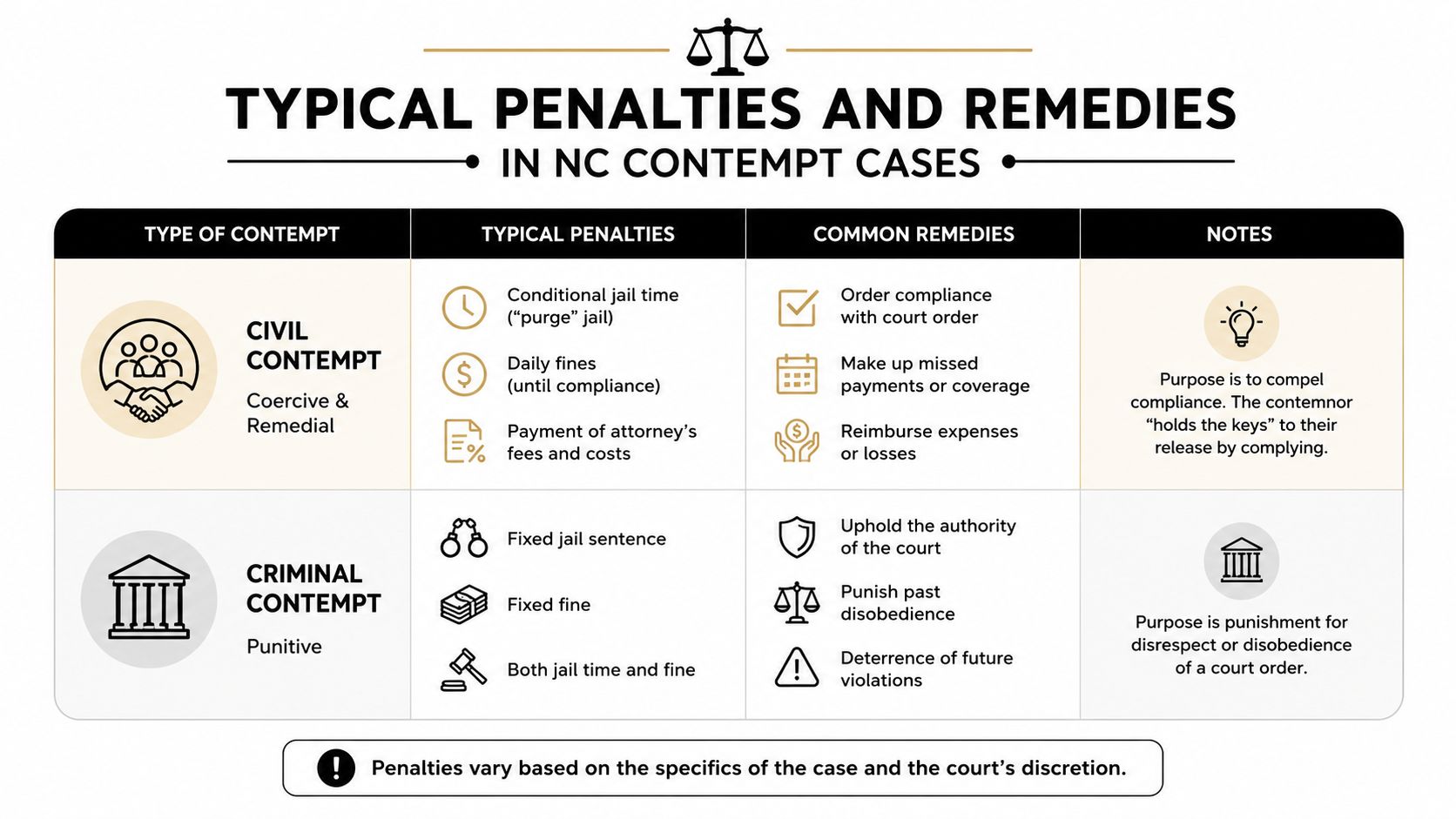
Civil contempt aims at compliance
Civil contempt works like a court-ordered pressure valve. The judge is not trying to punish the past violation for its own sake, but to get the order obeyed. If the person can still comply, the court may keep the sanction tied to that obligation until the violation is cured.
That is why civil contempt matters so much in family court disputes. A parent who still has the ability to pay support, or a parent who can still produce a child for a scheduled exchange, may face confinement until the order is followed. For a practical example of how courts treat support nonpayment, see this guide on what happens if an ex refuses to pay child support in North Carolina.
Criminal contempt sets fixed limits
Criminal contempt is different because the sanction is fixed and punitive. Under the benchbook materials tied to G.S. 5A-12(a), the ordinary ceiling is 30 days in jail and a $500 fine, with censure also available. The punishment does not depend on later compliance, which is why criminal contempt is handled as a penalty for the violation itself. UNC School of Government contempt PPT
Protective-order violations can become much more serious
Some family law disputes overlap with domestic-violence protective orders, and those cases can move well beyond ordinary contempt sanctions. The materials provided note that a first violation may be charged as a Class A1 misdemeanor and a later violation as a Class H felony. That is a different level of exposure than the contempt penalties described above, so the exact order and the exact charge matter a great deal when someone is responding to court papers.
If you receive a contempt notice, do not stop at the word “jail.” Ask what kind of contempt the court is considering, whether the judge is seeking compliance or punishment, and whether there is a purge path that lets you end the case by fixing the violation.
How to File or Respond to a Motion for Contempt in NC
A civil contempt case usually starts inside the same district-court file where the original order was entered. The moving party files a written motion, serves the other side with a notice of hearing or an order to show cause, and identifies the exact order that was violated. North Carolina practice materials say the motion and notice generally must be served at least five days before the hearing unless the court finds good cause for a shorter period. Pierce Law contempt motion guidance

What a strong motion usually includes
A useful motion names the order, lists each violation, and gives dates, amounts, or missed events with enough detail for the other side to respond. Supporting proof often includes:
- Prior court orders: so the judge can see the exact obligation being enforced.
- Payment records or payroll records: to show support history or the ability to pay.
- Bank statements: when money is the issue and spending patterns matter.
- Custody exchange logs: to document missed handoffs or repeated lateness.
- Texts or emails: to show notice, refusal, excuses, or acknowledgments.
If the dispute is tied to a divorce case, the procedural backdrop can matter too. The steps, residency rule, and filing requirements in How to File for Absolute Divorce in North Carolina help explain why family-law orders remain enforceable long after the marriage itself is over.
How to respond without making things worse
If you got served, read the motion line by line and match every allegation to your records. Don't ignore the hearing date, and don't assume an informal conversation will fix a formal contempt motion. If you can show the order was unclear, that compliance was impossible, or that you took reasonable steps to comply, those facts need to be organized before the hearing, not after.
For parents dealing with support disputes, this issue often overlaps with questions about unpaid support and changed finances. A related resource is what to do if my ex refuses to pay child support in NC, especially when the core problem is enforcement, not a brand-new dispute.
Contempt for Custody and Visitation Violations in NC
Not every contempt case is about money. A parent can also face contempt for refusing visitation, failing to present the child for exchanges, interfering with phone time, or relocating a child in a way that breaks the court's custody order. North Carolina courts can use civil or criminal contempt depending on the facts, and the core question stays the same, did the person willfully violate an order they could comply with? North Carolina custody contempt commentary
The most common non-monetary disputes
A father shows up for pickup, and the child is not ready because the other parent decided to “skip this weekend.” A mother is told that phone calls won't happen because the child is “busy.” A parent moves the child without approval and then says the other parent can work around the new schedule. Those facts can support a contempt motion when they violate an existing order.
The hard part is that parents often bring safety concerns, illness, or emergencies into the conversation. Sometimes those concerns are real. Sometimes they are excuses used to block the other parent, and the records tell the difference.
Why documentation matters even more here
In custody and visitation disputes, judges look closely at messages, timing, and consistency. If a parent had to miss an exchange because of a medical issue or emergency, the messages should reflect that problem as it unfolded. If the parent decided not to follow the order, texts often show delay, refusal, or shifting explanations.
Best practice: save the exchange message, the call log, and the calendar entry. In custody contempt, the timeline is often the story.
If the other side keeps violating the same order, contempt can be the fastest way to force compliance without reopening every issue in the custody case. The linked commentary on custody violations, along with what to do if the other parent violates a custody order in NC, shows why these cases often turn on whether the court sees a pattern, not a one-time mistake.
Defenses and Strategic Angles in NC Contempt Hearings
A contempt hearing is not a one-way street. The respondent can challenge the motion by showing inability to comply, lack of willfulness, ambiguity in the order, or a real change that made performance impossible. In civil contempt, the court should not enter confinement unless it can find present ability to comply, because the point is to force compliance, not punish someone for what they cannot do.
Common defenses that actually matter
One defense is financial inability. A parent who lost a job and documented a serious job search may have a real argument if support was not paid because the money was not there. That is very different from a parent who kept working, spent on nonessentials, and ignored the order. If the question is whether child support can be adjusted after a layoff, the discussion in can child support be lowered after job loss in NC helps show why records matter so much.
Another defense is lack of willfulness. A parent who missed an exchange because of a documented hospital emergency has a stronger argument than one who forgot and offered no proof. If the order was unclear, or both parents informally agreed to do something different, the respondent may argue the violation was not intentional. A private agreement still does not replace a court order, though, so informal arrangements are risky unless a judge changes the order.
A third angle is modification. If the order no longer fits the family's reality, the better move may be to ask the court to change it instead of waiting for more contempt filings. That matters in support cases too, especially where job loss is real and the person needs formal relief rather than relying on the other parent to be flexible.
These defenses work best when the timeline, texts, pay stubs, medical records, and job search records all point in the same direction. A judge is usually trying to answer a simple question, whether the person could comply and chose not to, or whether the person could not comply and needs the order changed instead.
Frequently Asked Questions and Next Steps for NC Residents
What kinds of orders can contempt enforce in North Carolina family law?
Contempt can enforce many existing family court orders, including child support, custody, visitation, alimony, and equitable distribution. The focus is on whether a party ignored a specific court command, not on punishing the breakup itself.
How long can someone actually be jailed for civil contempt?
Civil contempt is meant to pressure compliance, not punish past conduct. As noted earlier in the penalties discussion, confinement can continue in successive 90-day periods with a one-year total cap for the same offense, so long as the person still has a path to purge the contempt by complying.
What if a parent couldn't pay because of job loss?
Job loss can matter, but it does not end the inquiry by itself. The court still looks at whether the person had a real present ability to comply and whether the failure was willful, so records of layoffs, job applications, unemployment paperwork, and changes to the household budget can matter a great deal.
Can parents' private agreement override a court order?
No. A private agreement may help explain what happened, but it does not replace the court order. Until a judge changes the order, the written order still controls, and that is where many contempt disputes begin.
How should someone prepare for a contempt hearing?
Bring the order, payment records, every relevant text or email, exchange logs, and any proof of emergency or inability to comply. The hearing usually turns on a narrow set of questions, whether the court believes the violation was willful and whether compliance was realistically possible.
For North Carolina residents dealing with these issues, the Law Office of Bryan Fagan, PLLC advises clients on contempt, custody, support, and post-divorce enforcement matters statewide. If you are facing a motion for contempt or trying to enforce an order that keeps getting ignored, schedule a consultation before the next hearing date adds more pressure.
If you need help responding to a contempt motion, enforcing a custody or support order, or sorting out whether civil contempt or criminal contempt applies to your case, Law Office of Bryan Fagan can review the order, the evidence, and the hearing procedure with you. The firm works with North Carolina families on contempt, custody, support, and post-divorce enforcement matters, and a consultation can help you understand the next step before the court date arrives.