
You’ve made the decision that the marriage is over, or you’re close to it. Then the practical questions hit all at once. Who moves out. Can you afford two places. What happens with the kids. What if your spouse won’t cooperate. And the biggest surprise for many people in North Carolina is this: you usually can’t file for a no-fault divorce right away.
That delay feels unnatural when the relationship has already broken down. People often assume that if both spouses agree the marriage is finished, the court will let them move forward. North Carolina doesn’t work that way. For most couples, the legal process starts with living apart for a full year before an absolute divorce can be filed.
That waiting period shapes almost every important decision you make next. It affects where you live, how you handle money, what proof you need to keep, and whether you protect yourself with a written agreement or leave major issues unresolved for months.
Navigating the First Step Toward Divorce in North Carolina
A common situation looks like this. One spouse is sleeping on a friend’s couch for a few weeks, planning to save money before getting an apartment. The other stays in the marital home with the children. Both believe they’re “basically separated” and can deal with the paperwork later.
That assumption causes problems.
In North Carolina, separation isn’t just an emotional decision. It has a technical legal meaning, and mistakes at the beginning can delay the divorce, create disputes over property, and weaken your position on support or custody issues. The law cares about the facts on the ground, not just what the couple intended in conversation.
Many people are also dealing with fear, guilt, or financial pressure at the same time. Some are trying to keep life stable for children. Others are worried about paying rent, protecting a bank account, or avoiding another fight at home. Those concerns are real, and they often matter just as much as the divorce itself during the first weeks apart.
A separation year in North Carolina isn’t a pause button. It’s an active legal period that can either protect your future or create avoidable damage.
The one year separation rule nc is the starting point for most no-fault divorces in this state. If you understand it early, you can make better choices about housing, evidence, finances, and parenting arrangements. If you misunderstand it, you may think the clock is running when legally it isn’t.
Understanding North Carolina's One-Year Separation Law
North Carolina law sets out a clear rule for no-fault divorce. Under N.C. General Statutes § 50-6, spouses must live separate and apart for one full year before filing for an absolute divorce, and either the plaintiff or defendant must have lived in North Carolina for six months before filing. The rule traces back to statutory origins in 1931, which helps explain why the state remains one of the strictest on waiting periods for divorce, as discussed by George Moore Law Firm’s review of North Carolina’s separation requirement.
What the statute requires
Generally, the rule has two practical parts:
Residency requirement
At least one spouse must meet the six-month North Carolina residency requirement before the divorce is filed.Continuous separation
The spouses must live separate and apart for one full year with at least one spouse intending the separation to be permanent.No formal filing to become separated
North Carolina doesn’t require a court filing to create a legal separation. The separation begins when the facts support it.
That last point surprises people. There’s no official “legal separation certificate” issued by the court. The separation starts when one spouse moves into a separate residence and at least one spouse intends the break to be permanent.
Why North Carolina uses this rule
The policy behind the law is deliberate. North Carolina has long treated divorce as a serious decision that shouldn’t happen immediately after a crisis or argument. The waiting period is designed to force time, distance, and reflection before the marriage is legally dissolved.
Whether that policy feels protective or punishing depends on the family. In some cases, the time helps people sort out parenting schedules, support, and property issues. In others, it prolongs instability and keeps people tied together longer than they want.
A practical way to think about it is this:
| Requirement | What it means in real life |
|---|---|
| One full year apart | You need a continuous separation period before filing for no-fault divorce |
| Six months residency | At least one spouse must qualify North Carolina as the proper state for filing |
| Intent for separation to be permanent | The separation can’t be temporary trial living apart |
Who has to follow it
If you want an absolute no-fault divorce in North Carolina, this rule applies to you regardless of how long you’ve been married. It also applies whether the split is friendly or hostile.
Practical rule: If you’re planning a no-fault divorce in North Carolina, treat the date of separation like a legal deadline from day one. Don’t guess about it later.
What Living Separate and Apart Really Means in NC
The phrase separate and apart sounds simple. In practice, it’s where many people make expensive mistakes.
North Carolina requires distinct residences. Living in separate bedrooms inside the same house does not satisfy the rule. Neither does taking turns on the couch, using different bathrooms, or telling friends you’ve broken up while still sharing the same roof.
Separate homes means separate homes
If one spouse stays in the marital home and the other moves into an apartment, a relative’s house, or another residence, that can qualify. If both spouses remain in the same house because it seems easier for the children or cheaper for the budget, the separation period usually isn’t running.
That’s the misconception I correct more than almost any other. People often think physical distance inside the house is enough. It isn’t.
A few simple examples show the difference:
Qualifies
One spouse moves into a rental and starts receiving mail there. The other remains in the marital residence.Does not qualify
Both spouses keep living in the same house but stop sharing a bedroom.Likely qualifies, if handled carefully
One spouse moves in with a parent while looking for long-term housing, and the move is real, continuous, and intended to be permanent.High risk
One spouse “moves out” but regularly returns to stay overnight in a way that looks like renewed cohabitation.
For a plain-language explanation of how separation works generally, this overview on what is legal separation in NC is a helpful starting point.
What resets the clock
A true reconciliation can reset the separation period. If the spouses resume cohabitation, the one-year clock starts over. That’s why informal attempts to “see if we can make it work” can create legal confusion very quickly.
Under N.C.G.S. § 50-6, isolated sexual intercourse by itself does not toll the separation period. That specific point matters because many people fear a single lapse automatically destroys the timeline. It doesn’t. But resuming life together as spouses can. The distinction is explained in Charles Ullman’s discussion of proving separation in North Carolina.
Common myths that cause trouble
The safest approach is to ignore what friends say and focus on what a judge would see from the facts.
| Myth | Reality |
|---|---|
| “We can stay in the same house if we act like roommates.” | Usually no. Separate bedrooms are not the same as separate residences. |
| “If we spend a weekend together, that’s harmless.” | Maybe not. Overnight stays can trigger scrutiny if they suggest reconciliation. |
| “We need to file something with the court to be separated.” | No formal separation filing is required to begin separation. |
| “A brief attempt to work things out doesn’t matter.” | It can matter a great deal if it looks like cohabitation resumed. |
If you want the one year separation rule nc to protect your filing date, your living arrangement has to match the legal standard, not your personal definition of being “done.”
What works and what doesn’t
What works is consistency. One spouse moves out. Each person establishes a separate residence. Finances start separating. Mail goes to the new address. Friends and family know the move was real.
What doesn’t work is a half-step arrangement that exists only on paper. If the setup still looks like a married couple sharing a household, the court may treat it that way.
How to Prove Your Date of Separation to the Court
The separation date isn’t just a date you remember. It’s a fact you may have to prove.
When the divorce is filed, the court expects evidence that the separation began on a specific day and continued in a way that meets North Carolina law. If your spouse contests the date, weak documentation can turn a routine divorce into a dispute.
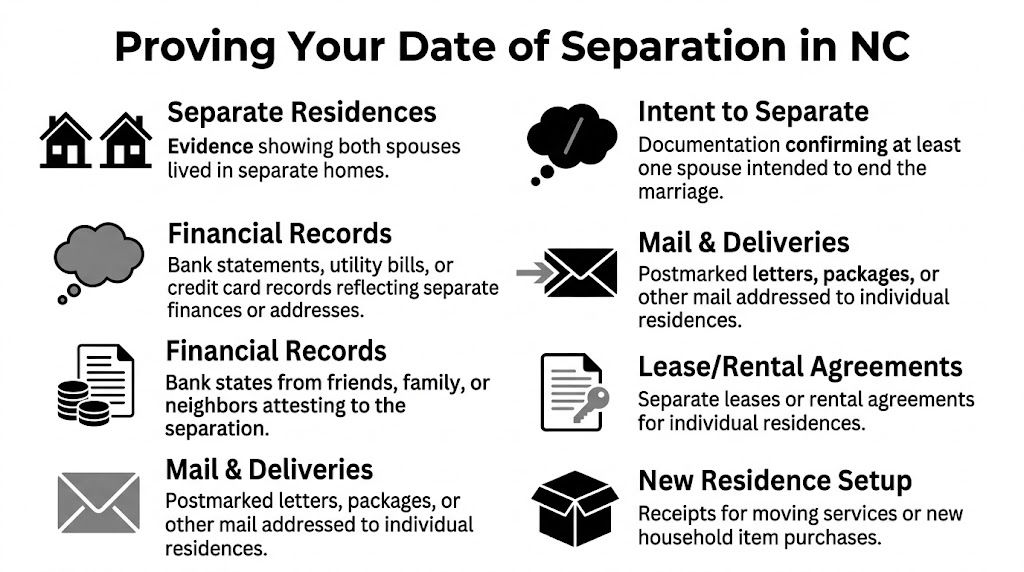
Documents that usually help most
The strongest proof usually comes from ordinary records created at the time of the move, not documents assembled much later.
Housing records
A lease, rental agreement, mortgage statement, or move-in paperwork can show when a separate residence began.Utility and service records
Power, water, internet, or similar accounts in one spouse’s name at a new address often help show actual occupancy.Government and identification records
An updated driver’s license, voter registration, or other official address change can support the timeline.Financial records
Bank statements, credit card statements, and similar documents may show different addresses and separate spending patterns.Mail and deliveries
Regular mail sent to the new residence is often useful because it shows the move wasn’t temporary.
Witnesses also matter
Judges don’t rely only on paperwork. People who saw the move happen can help confirm the date.
Useful witnesses can include:
- A landlord or property manager
- A neighbor who observed the move
- Family members who know where each spouse lived
- Friends who helped with the move or visited the new residence
A practical guide on early separation logistics is available at how to file for separation in NC.
A simple checklist to use from day one
If you’re newly separated, build your file now instead of trying to reconstruct it later.
- Save the move-out date in writing.
- Keep copies of lease or housing documents.
- Update your mailing address where appropriate.
- Preserve bills that show the new residence.
- Keep texts or emails that reflect the decision to live apart.
- Identify one or two witnesses who can verify the move.
Keep your proof boring and consistent. Routine records created in real time usually carry more weight than a detailed explanation written months later.
Some people also prepare a notarized affidavit describing the date of separation and the move. That can be useful, especially when paired with objective records. It isn’t a substitute for real evidence, but it can help organize the timeline.
Strategic Planning During the Mandatory Separation Year
The separation year isn’t just about waiting long enough to file. It’s often the most important planning window in the entire case.
If you do nothing during this period, problems tend to expand. Bills go unpaid. Joint accounts stay open. Parenting routines become informal and unstable. One spouse may make large financial decisions without the other’s agreement. By the time the divorce is filed, the conflict is harder and more expensive to untangle.

Why a separation agreement matters
In North Carolina, there’s no court-created “legal separation” case that automatically sets rules for you. That’s why a separation agreement is so important.
A well-drafted agreement can address:
- Who pays which bills
- How bank accounts and credit cards are handled
- Temporary or longer-term spousal support terms
- Custody and parenting schedules
- Child support arrangements
- Who stays in the home or how the home will be handled
- How property and debts will be divided later
A formal separation agreement must be written, signed by both parties, and notarized to be enforceable in North Carolina. Properly executed agreements are upheld over 95% of the time and can be incorporated into the final divorce judgment, which often helps avoid later litigation over property division and support, according to PRJ Law’s discussion of divorce without waiting a year in NC.
What a good agreement does in real life
A strong agreement reduces avoidable ambiguity.
If the spouses agree that one person will remain in the home temporarily, the document can spell out who pays the mortgage, taxes, insurance, and utilities. If there are children, the agreement can identify school-week routines, holiday schedules, transportation responsibilities, and how parents will communicate.
Without that structure, small disagreements tend to turn into recurring fights.
The biggest mistake during separation is treating major issues as if they’ll “work themselves out” later. Most of them don’t.
Requirements for enforceability
An agreement that’s rushed, vague, or signed under pressure may create new problems instead of solving old ones.
Focus on these points:
| Requirement | Why it matters |
|---|---|
| Written terms | Oral promises are hard to prove and harder to enforce |
| Signed by both spouses | Mutual execution matters |
| Notarized | North Carolina requires notarization for enforceability |
| Full and fair disclosure | Hidden information can undermine the agreement |
Planning issues that deserve attention early
Some topics shouldn’t be left to chance during the one-year wait.
Financial boundaries
Close the gap between “we’re separated” and “we still have unrestricted access to each other’s money.” If joint accounts remain open, decide who can use them and for what. If debt continues to accrue, identify who is responsible.
Parenting structure
Children usually do better when the adults create a predictable schedule. Informal flexibility can sound appealing, but unclear handoffs and shifting expectations often become conflict points.
After you’ve thought through those issues, this video offers a useful general perspective on planning for the process ahead.
Property protection
Don’t assume valuable property will remain untouched during separation. Vehicles, retirement issues, household contents, and debt management all deserve attention before resentment builds.
What works better than waiting
The clients who usually manage this year more effectively are the ones who treat it as a planning period, not dead time. They document the move. They stabilize finances. They create written expectations. They make temporary arrangements that can survive daily life.
That doesn’t guarantee a smooth divorce. It does reduce the number of preventable crises.
Common Pitfalls and Exceptions to the Separation Rule
The hardest part of the one year separation rule nc is often practical, not legal. Many families can’t afford two fully separate households without strain.
That pressure leads people to improvise. One spouse sleeps in the basement. A couple rotates who stays in the home. Someone moves out for a few days, then comes back because childcare falls apart or money runs short. Those arrangements may feel understandable, but they can undermine the separation period.
When money makes separate homes difficult
North Carolina courts strictly interpret the requirement to maintain separate residences. Claims of separation have been rejected where spouses continued sharing a home for economic or childcare reasons, which can restart the clock. That hardship is one reason alternatives like post-separation support claims may be important for people who can’t realistically fund two homes, as noted by WomensLaw’s North Carolina divorce guidance.
This is where legal advice matters. If the budget is tight, the answer usually isn’t to create a “partial separation” under one roof and hope it counts. The safer approach is to discuss realistic housing options, support claims, and protective agreements before the timeline is damaged.
Fault-based options for urgent situations
Some people need relief before a no-fault divorce becomes available. In those cases, a fault-based claim such as divorce from bed and board may be relevant.
That remedy does not dissolve the marriage. It can, however, address serious situations involving conduct like abandonment or abuse and may help create legal and financial structure while the parties remain married. It’s not right for every case, but it’s worth discussing when the standard separation path is unsafe or unworkable.
Dating during separation
People often ask whether they can start dating once they separate. The practical answer is that dating can create complications even if the marriage feels over emotionally.
For some cases, new relationships may affect the tone of negotiations. They may also matter in disputes involving alimony or parenting dynamics. The legal risk depends on the facts, so this isn’t an area to handle casually.
If your spouse won’t “agree” to separate
A spouse doesn’t need to sign off on the separation date for separation to begin. What matters is the facts. If one spouse moves into a separate residence and intends the separation to be permanent, the legal process can still move forward.
That said, disagreement about the date often becomes an evidence issue. The cleaner your records, the less room there is for a later dispute.
Pitfalls that repeatedly cause trouble
Trying to save money by staying under one roof
This is one of the most common mistakes, and it can void the timeline.Leaving finances untouched
Open access to joint funds can invite conflict and allegations of unfair spending.Making informal parenting plans with no written terms
Memory-based arrangements often fall apart under stress.Assuming reconciliation attempts are harmless
Living together again can reset the separation period.
If you can’t afford a perfect separation setup, don’t improvise your way into a legal problem. Get advice about the least risky option available to you.
Frequently Asked Questions About the One-Year Separation Period
Can we really not live in the same house at all
For a no-fault divorce based on the standard separation rule, the safe answer is no. North Carolina requires separate residences, not just separate bedrooms or a roommate-style arrangement inside one home.
If finances make that difficult, don’t guess. Explore whether support claims, a negotiated agreement, or another legal strategy can help you create a living arrangement that meets the rule.
What happens if my spouse moves out of state during the separation year
A spouse can move out of state without automatically preventing the divorce. The key issue for filing is that either the plaintiff or defendant must satisfy North Carolina’s residency requirement before the divorce is filed.
The more practical concern is proof and logistics. If the move happens, preserve records that show where each spouse lived and when. Distance can also complicate parenting schedules, support payments, and communication.
Does it matter who moves out of the marital home
Not automatically. North Carolina’s no-fault divorce law focuses on living separate and apart, not on assigning fault based on who left first.
Still, the decision can have practical consequences. The spouse who leaves may need to think about access to personal property, parenting time, and financial records. The spouse who stays may need clear written terms about bills, home expenses, and temporary occupancy. Moving out without a plan can create avoidable disadvantages.
Do we need a formal separation agreement
You don’t need one to start the separation period. But in many cases, a written, signed, and notarized agreement is one of the smartest things you can do during the year apart.
It can set expectations for support, custody, debts, use of the home, and property issues while the divorce itself is still unavailable. Without it, people often spend the year in a kind of legal limbo.
Is North Carolina likely to shorten the one-year separation rule
There have been reform efforts. N.C. S626 proposed reducing the separation period to six months and creating waivers in some situations, including for certain abuse victims. But as of 2026, the bill remains stalled in committee, so the existing one-year requirement is still the law, according to this update on North Carolina’s mandatory separation period.
That means people planning a divorce should proceed based on the current rule, not on the hope that legislation may change soon.
Secure Your Future with a North Carolina Divorce Attorney
North Carolina’s separation period isn’t just a waiting requirement. It’s a legal threshold with real consequences for housing, evidence, parenting, support, and property.
The choices made during that year often shape what the divorce looks like later. A weak start can lead to disputes about whether the separation counted at all. An unplanned year can leave accounts exposed, bills unpaid, and family routines unstable. Careful planning usually puts people in a far better position when it’s finally time to file.
If you’re dealing with separation, divorce planning, child custody concerns, or financial uncertainty, it helps to speak with counsel before small issues become expensive ones. A North Carolina attorney can help you identify your true date of separation, protect your documentation, evaluate support options, and decide whether a separation agreement makes sense in your case. If you need guidance, speaking with a North Carolina divorce lawyer is often the most efficient next step.
No article can answer every question your family situation raises. The law is specific, but real life rarely is. A consultation lets you apply the rule to your actual facts, especially if you’re balancing children, shared debts, housing pressure, or a spouse who may challenge the timeline.
If you’re preparing for divorce or trying to understand whether your separation qualifies under North Carolina law, contact the Law Office of Bryan Fagan to schedule a consultation. The firm helps North Carolina residents evaluate separation dates, protect financial interests, address custody and support concerns, and build a practical plan for the road ahead.