You've been served with discovery in a North Carolina divorce, and the papers feel heavier than they look. One envelope asks for answers under oath, another demands bank statements and tax returns, and a third mentions a financial affidavit with a deadline you can't afford to miss. That mix is stressful because it is supposed to be. nc divorce discovery and financial affidavits are the court's way of forcing both sides to put the financial picture on the table early, not after the case has dragged on.
If you're wondering whether you can wait until mediation or a hearing to sort it out, North Carolina law usually doesn't give you that luxury. In equitable distribution cases, the first party asserting the claim must serve an inventory affidavit within 90 days, the responding party must answer within 30 days after receiving it, and the filing party must apply for a scheduling and discovery conference within 120 days of the initial pleading or motion. That structure makes disclosure part of the case from the start, not an optional cleanup task at the end.
When Discovery Shows Up in a North Carolina Divorce
A lot of people expect discovery to wait until a divorce turns ugly or the case gets close to trial. In North Carolina, it often shows up much sooner, sometimes right after filing, before anyone has sorted records from a kitchen drawer, a shared cloud account, or an accountant. The first envelope usually includes interrogatories, requests for production, and a demand for a financial affidavit.
That paperwork can look repetitive at first glance. It serves different purposes. The court is asking the same financial story in more than one format so the other side can compare sworn answers with documents and so the judge can later see whether the numbers match. In cases involving equitable distribution, alimony, child support, and attorney's fees, North Carolina family law uses those tools to build a record of income, assets, debts, and property values from the start.
A simple example clears up the timing issue. A spouse may think, “I can bring my pay stubs later if the judge asks.” Discovery already is that request, and it comes before a hearing, under oath, and on deadline. If the case involves property division, the statutory deadlines also require an early snapshot of the marital estate, so waiting usually creates more problems than it solves.
Practical rule: if the papers ask for financial information, treat them as a required answer, not a place for a partial reply.
This is also the point where a worried client often needs both legal direction and document sorting at the same time. A North Carolina Divorce Lawyer can address absolute divorce and related claims under North Carolina law while you gather records and avoid deadline mistakes. For a broader overview of divorce issues in the state, see North Carolina divorce information.
The Four Discovery Tools Used in NC Divorce Cases
A North Carolina divorce case often starts with a question, then a stack of papers, then sworn follow-up. Discovery is the set of tools that turns that uncertainty into usable facts. Under the North Carolina Rules of Civil Procedure, the four main tools are interrogatories, requests for production, requests for admissions, and depositions.
Written questions, document demands, admissions, and live testimony
Interrogatories are written questions that must be answered under oath. They work like a detailed financial questionnaire, except each answer can later be compared with documents, testimony, and the financial affidavit.
Requests for production ask for documents. In a divorce case, that usually means bank statements, tax returns, pay stubs, retirement records, mortgage papers, business records, and anything else that helps verify what was said on the financial affidavit.
Requests for admissions are short statements the other side must admit or deny. They help narrow disputes. If both spouses agree that a bank account exists or that a vehicle was titled in one name, that fact does not need to be fought over at trial.
Depositions are live, sworn questioning before a court reporter. They matter when written answers feel incomplete, evasive, or inconsistent. A deposition lets an attorney pin down the numbers, ask follow-up questions, and compare what a person says with what the records show.
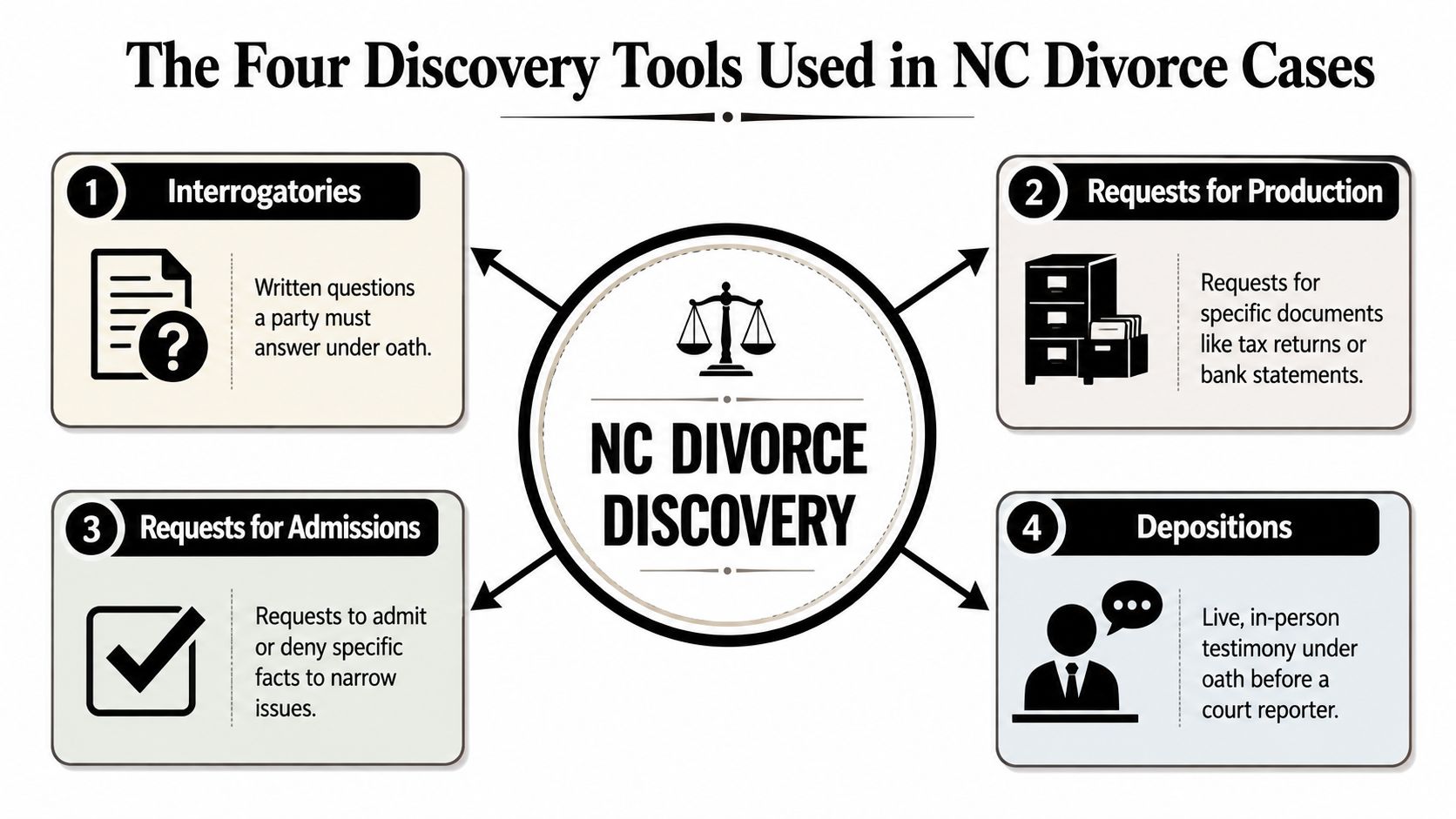
These tools usually work together. Interrogatories identify the account, production gets the statements, admissions narrow the facts, and the deposition fills the gaps. A divorce case with only one of those tools is often underdeveloped, especially when money is contested.
Why lawyers use them as a sequence
A sound discovery plan usually starts broad and then narrows. The first round may ask for general financial information, then the lawyer follows up with targeted requests once the documents arrive. That approach matters because family-law disputes often turn on small mismatches between the affidavit and the records, not on one dramatic admission.
A client may wonder why the same financial story keeps appearing in different forms. The answer is that each tool checks a different part of the picture. Written answers show what a spouse says happened. Documents show what the records say. Admissions remove points that are no longer in dispute. Depositions test the weak spots and clear up statements that do not line up.
In many North Carolina matters, a lawyer who handles North Carolina divorce issues will use those tools alongside the rules that govern disclosure deadlines. The point is not to overwhelm you with forms. The point is to build a financial record the court can trust.
The Equitable Distribution Inventory Affidavit Under NC Law
North Carolina's equitable distribution inventory affidavit is not a courtesy document. It is a sworn disclosure required by statute, and the timing is built into the process. The first party asserting an equitable distribution claim must serve the inventory affidavit within 90 days after service of the claim, the responding party must serve their own affidavit within 30 days after receiving the first affidavit, and the filing party must apply for a scheduling and discovery conference within 120 days after the initial pleading or motion. Those deadlines make early disclosure a core part of the case.
What the affidavit has to show
The affidavit must list property claimed as marital, separate, or divisible, and it must provide the estimated fair market value for each item as of the date of separation. That date matters because it gives the court a fixed financial snapshot, so later spending, gains, or losses don't blur the picture.
In plain English, this is the form where you say what you think exists, what type of property it is, and what it was worth when the marriage ended for property-division purposes. If you leave out an account, understate a vehicle, or mislabel a retirement asset, the other side can challenge it through discovery and the court can question your credibility.
Why the statute treats it seriously
North Carolina court materials and the statute treat these affidavits like answers to interrogatories. That matters because they are sworn disclosures, not informal estimates scribbled for a mediator. If you sign one, you're certifying that the information is complete and accurate to the best of your knowledge.
The deadline clock starts early, and it usually starts before people feel ready.
For more on the property-division side of the case, what is equitable distribution is the right starting point. Once the affidavit is in play, the discovery conversation changes from “What do we think is there?” to “What can we prove with records?”
Financial Affidavits Across ED, Alimony, and Child Support
North Carolina lawyers use the phrase financial affidavit in more than one setting, and that's where people get mixed up. The equitable distribution inventory affidavit is a specific statutory form for property division. Other claims, such as alimony, post-separation support, child support, and attorney's fees, usually involve broader financial disclosures about income, monthly expenses, insurance, and debt.
Different claims, different disclosure focus
Here's the cleanest way to think about it. Equitable distribution asks what property exists and what it was worth at separation. Support claims ask what money comes in, what money goes out, and what the household needs. Attorney-fee requests may also require the court to see the parties' financial picture.
A spouse in a child support case may be asked for recent pay stubs, tax records, and expense information. A spouse in an alimony case may need to disclose monthly income, recurring bills, insurance costs, and debt payments. The point is that the claim drives the disclosure, not just the fact that the parties are divorcing.
| Claim Type | Primary Affidavit Form | Key Deadlines | Core Items Disclosed |
|---|---|---|---|
| Equitable distribution | Inventory affidavit | 90 days for the first party, 30 days for the response, 120 days to seek the scheduling and discovery conference | Marital, separate, and divisible property, with date-of-separation values |
| Alimony | Financial affidavit plus supporting records | Often county-specific and sometimes tied to hearing schedules | Income, expenses, assets, liabilities, insurance |
| Post-separation support | Financial affidavit plus supporting records | Often county-specific and sometimes tied to hearing schedules | Current income, cash flow, household expenses |
| Child support | Financial affidavit plus income documentation | Often county-specific and sometimes tied to hearing schedules | Income, deductions, child-related expenses |
| Attorney's fees | Financial affidavit plus supporting records | Often tied to the underlying motion or hearing | Financial need, income, and resources |
Local rules can change the delivery method
Some counties require the affidavit to be served, not filed, and other local rules set hard exchange deadlines before hearings. One official district rule set requires the affidavit to be served with required disclosures and the certificate of service filed instead. Another local notice requires exchange in support cases, with deadlines such as 30 days after the moving party's filing and 45 days for the responding party, plus hearing cutoffs measured in business days.
That means the same “financial affidavit” label can hide very different local practices. You need to know which claim you're facing and which county rule controls. If you're not sure, that's a sign to get the timeline checked before you miss a service date or show up at a hearing with an incomplete packet.
A Real-World Example of Discovery in a Self-Employed Spouse Case
A common North Carolina problem starts with a spouse who says, “My income dropped.” The other side sees a business that still looks busy, cash moving through the books, and personal expenses mixed into company accounts. The first financial affidavit may list a modest salary, but the lifestyle doesn't match the number on the page.
That's where discovery has to do real work. The first pass usually starts with interrogatories asking about the business structure, income sources, owners, accounts, and any payments made through the business. Then come document requests for bank statements, tax returns, QuickBooks reports, invoices, and business records. If the records still don't add up, subpoenas may go to the accountant, payroll provider, or financial institution.
Why the sequence matters in a business-owner divorce
The timing matters because the equitable distribution inventory affidavit has to be served within 90 days, and the response comes within 30 days after that. Those deadlines force issue-spotting early, especially when a spouse is self-employed, paid in cash, or blending business and personal spending. If you wait too long, missing records can become harder to chase down.
A deposition is often the last step because it lets counsel confront the mismatch directly. If the tax return shows one number, the bank records show another, and the affidavit says something different again, the questions become pointed very quickly. That's also where business valuation issues can enter the case, especially if the business itself is part of the marital estate. For that larger valuation problem, see business valuation for divorce.
What the attorney is looking for
The goal is not just to accuse someone of hiding income. It's to reconstruct the financial story in a way the court can test. In a self-employed case, small details matter, like whether a transfer was really a loan, whether a “business expense” paid the mortgage, or whether the affidavit omits a source of cash flow that the tax return suggests exists.
When the affidavit, the tax return, and the bank records tell three different stories, discovery has already done its job.
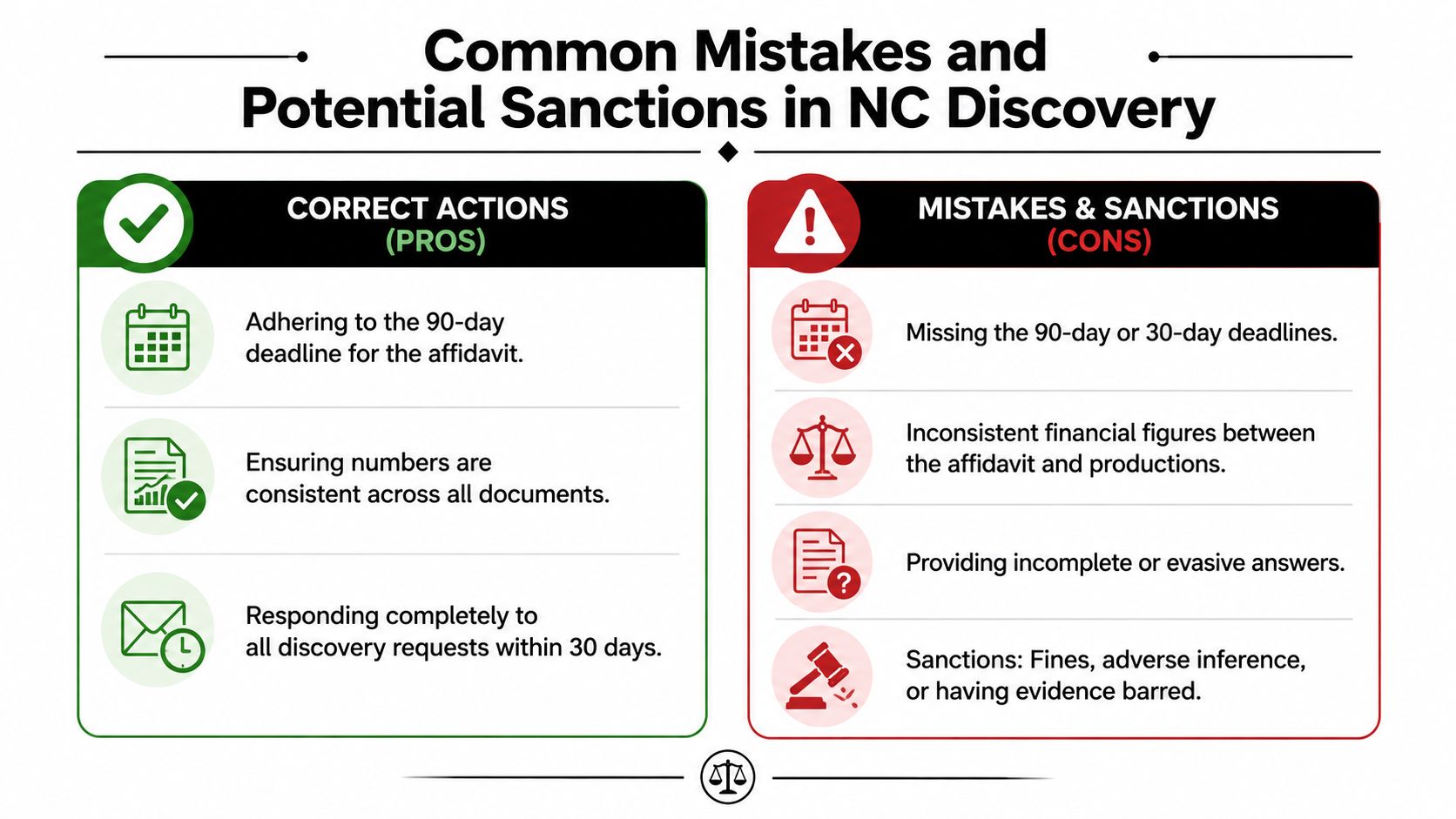
Common Mistakes and Potential Sanctions in NC Discovery
The biggest mistake in discovery is acting like the affidavit is just paperwork. It isn't. The court compares the sworn statement against the supporting records, and any mismatch can create immediate credibility problems. Once that happens, the other side may push harder, ask for more documents, or force a hearing delay while the record gets cleaned up.
The errors that cause the most trouble
Missed deadlines cause obvious problems, but incomplete answers are just as damaging. If the affidavit leaves out a bank account, omits retirement information, or lists vague monthly expenses without support, the other side can argue that the disclosure was evasive. If the tax returns or pay stubs don't match the numbers on the affidavit, the court may question the whole submission.
Ignoring local rules is another mistake that catches people off guard. A county may require service instead of filing, or may set hearing-related exchange deadlines that come much earlier than a party expected. If you miss those rules, you can walk into a support hearing without the record you need.
What the court can do
Discovery violations can lead to expanded follow-up discovery and, in serious cases, Rule 37 sanctions. Those sanctions can include evidence exclusion or monetary penalties. Even before sanctions enter the picture, the practical damage can be enough to hurt your case because the judge now has a reason to doubt the numbers you provided.
The video below is a useful reminder that discovery problems rarely stay small once they start affecting hearing preparation.
The safest approach is simple. Give complete answers, make sure the affidavit and documents tell the same story, and respond within the stated deadline. If something is missing, explain why rather than hoping no one notices.
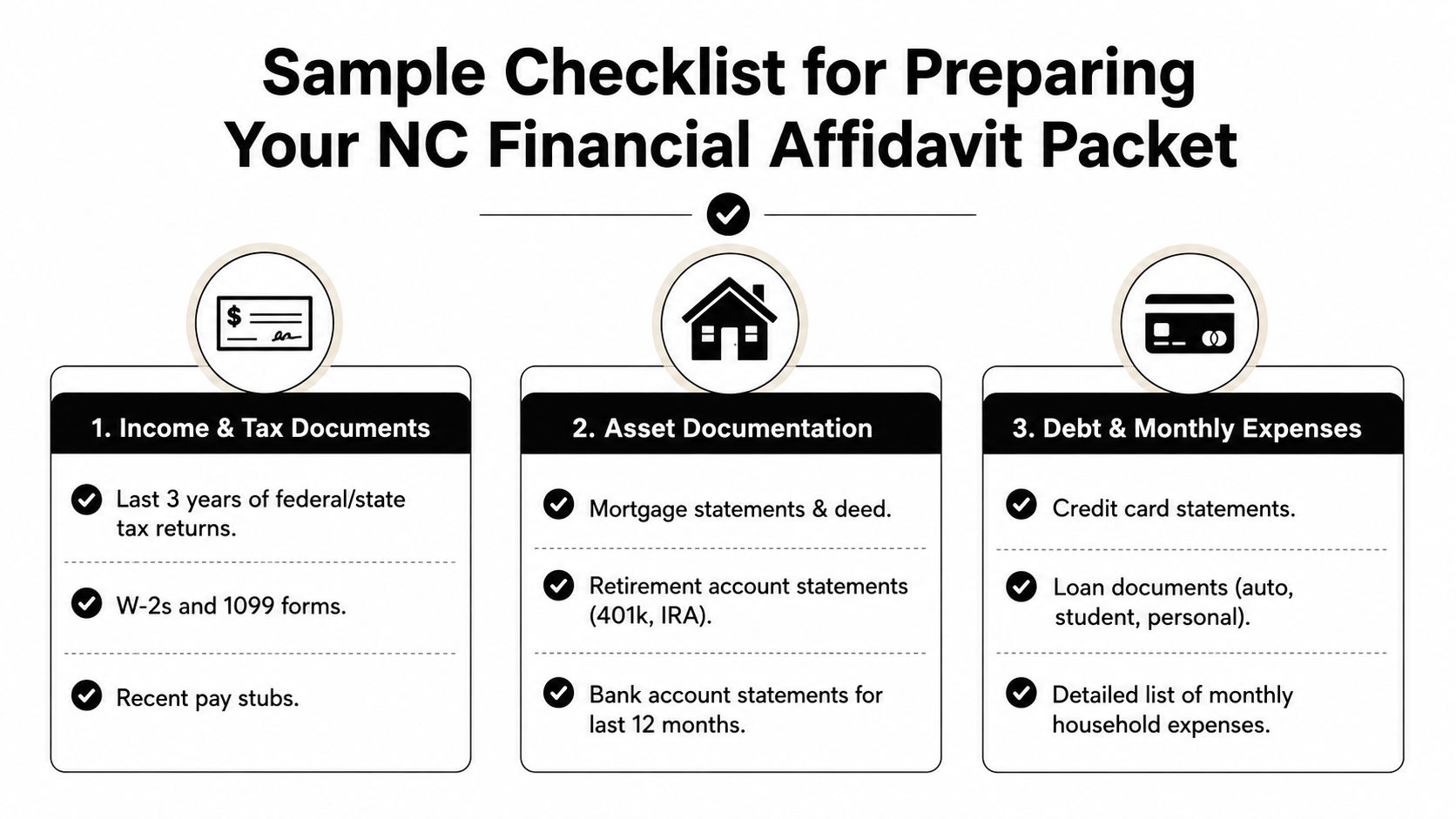
Sample Checklist for Preparing Your NC Financial Affidavit Packet
A good affidavit packet is built from records, not memory. If you're trying to organize your materials before service or exchange, start with the categories the court is likely to care about most: identity, income, assets, debts, and expenses. The packet should be complete enough that someone else can trace the numbers back to the documents.
Use the documents to build the affidavit
For income, gather recent pay stubs, tax returns, and any W-2s or 1099s. For property and accounts, collect bank statements, retirement statements, and mortgage or lease papers. For debts and expenses, collect credit card statements, loan records, insurance policies, and a list of monthly household costs.
North Carolina court forms and local-rule instructions commonly require documents covering the full calendar year before separation through the date of service of the initial disclosures, so don't stop at the most recent statement. The court wants a paper trail that shows how the financial picture looked over time, not just on one good or bad month.
A reusable checklist
- Income and tax documents: gather the last three years of federal and state tax returns, W-2s, 1099 forms, and recent pay stubs.
- Asset documentation: collect mortgage statements, the deed, retirement account statements for 401(k) and IRA accounts, and bank statements for the last 12 months.
- Debt and monthly expenses: save credit card statements, auto, student, or personal loan documents, and a detailed list of monthly household expenses.
- Property and separate-property records: keep titles, appraisals, inheritances records, and documents showing when and how property was acquired.
- Deadline tracking: mark the 90-day equitable distribution deadline, any county-specific exchange deadline, and the hearing cutoff dates that apply in your district.
If you're missing a document, ask for it now instead of waiting until a motion is already on file. That simple move often prevents last-minute scrambling and makes the affidavit much easier to defend.
NC Divorce Discovery FAQs and Next Steps
A spouse receives a request for financial disclosure and wonders whether the same paperwork applies to every issue in the case. In North Carolina, the answer depends on the claim, but the pieces still fit together. The inventory affidavit focuses on equitable distribution, and it must identify marital, separate, and divisible property with date-of-separation values. Financial affidavits, by contrast, are often used to show income, expenses, and cash flow in support disputes, so the court can compare what each spouse says with what the records show.
If your spouse misses the 90-day deadline for the equitable distribution inventory affidavit, do not treat that as a harmless delay. Deadlines shape the case, and a missed deadline can affect how the court manages disclosure and scheduling. Your lawyer may need to use discovery tools, local rules, or a scheduling conference to press for compliance and keep the case moving in an orderly way.
Bank statements and tax returns are common in many divorce and support cases, but the exact packet depends on the claim and the county. Some courts expect a fuller financial picture than others, and some disputes call for documents that go beyond the usual checklist. A support case may call for earnings records, expense records, and tax materials, while a property case may require account histories, appraisals, and records showing when an asset was acquired.
If you suspect the other side is hiding income, start by comparing the affidavit to the underlying records. Then use targeted discovery, document requests, subpoenas, and depositions to fill the gaps. Self-employed and cash-heavy cases often require that layered approach because the paper trail may be scattered across business accounts, tax filings, and personal spending records.
If you are facing disclosure deadlines now, do not wait until the file is incomplete and the hearing is close. The Law Office of Bryan Fagan helps North Carolina residents with divorce, equitable distribution, child support, and spousal support matters, including the financial disclosure issues that can decide the case. You can visit Law Office of Bryan Fagan to schedule a consultation and get a plan in place before the first deadline passes.