You may be deep into a North Carolina divorce and only now realize the retirement account is the asset that could change everything. A 401(k), pension, or government retirement benefit is easy to overlook until the paper trail gets serious, the settlement talks tighten, and someone asks whether a QDRO is needed to make the division work.
In practice, a divorce decree alone often isn't enough to move retirement money. A Qualified Domestic Relations Order is the court order that lets an ERISA-governed plan pay an alternate payee, which can be a former spouse, child, or dependent, without breaking the plan's rules. North Carolina's property-division rules, the type of retirement plan involved, and the timing of the order all matter, especially in cases where the divorce is already final and the retirement division never got done.
This guide focuses on qdro to divide retirement nc divorce issues the way they come up in practice, with North Carolina-specific rules, plan-type distinctions, and the post-divorce problems people run into when the order was never entered on time. It also gives you the working sequence that tends to avoid rejected orders, delayed distributions, and avoidable tax trouble. For a broader overview of marital-property issues, see Equitable Distribution of Property in North Carolina.
Introduction to QDROs in North Carolina Divorce
A lot of people find out about the retirement issue late. The house and vehicles get discussed first, then a spouse looks at account statements and realizes the pension or 401(k) may be the largest marital asset on the table. That is usually the point where the question changes from whether the account is divisible to how it can be divided without disrupting the plan or giving up part of the benefit.
A QDRO exists for that exact reason. ERISA requires retirement plans to honor a qualified domestic relations order that assigns benefits to an alternate payee, but the order has to include the right details, such as the participant's and alternate payee's names and addresses, the plan name, the amount or percentage assigned, and the payment period. Without that structure, a divorce decree can leave the retirement division unfinished.
North Carolina divorce practice adds another layer. Retirement benefits earned during the marriage are handled through equitable distribution, and the plan type determines whether a QDRO, another type of domestic relations order, or a plain transfer instrument is the right tool. For a broader overview of marital-property issues, see What is Equitable Distribution in North Carolina?. That is why the same divorce can involve a QDRO for a private 401(k), a different order for a state plan, and a non-QDRO transfer for an IRA.
Practical rule: if the divorce judgment says retirement will be divided, the plan administrator still needs the correct order before it can move the money.
A clear process matters more than legal jargon. Once you understand what the court can divide, what the plan will honor, and what documents the administrator needs, the rest becomes much more manageable.
When QDROs Are Required in NC
North Carolina divides marital retirement benefits through equitable distribution, and the retirement-specific rule for pensions and similar plans uses the coverture formula in N.C.G.S. § 50-20.1, where marital months of service are divided by total service months to determine the divisible marital portion. That means the part earned during the marriage is the focus, not necessarily the whole account. A spouse who worked longer than the marriage lasted may have a mixed asset, with marital and separate components.
A QDRO becomes necessary when the retirement plan is an ERISA-governed private plan, such as many 401(k)s, 403(b)s, and private pensions. ERISA requires a qualified domestic relations order so the plan can pay an alternate payee without violating anti-assignment rules. By contrast, IRAs do not require a QDRO, and military, federal, and state-government plans follow different qualified-order rules, often through non-QDRO forms. The NC Judicial College bench card makes that distinction explicit.
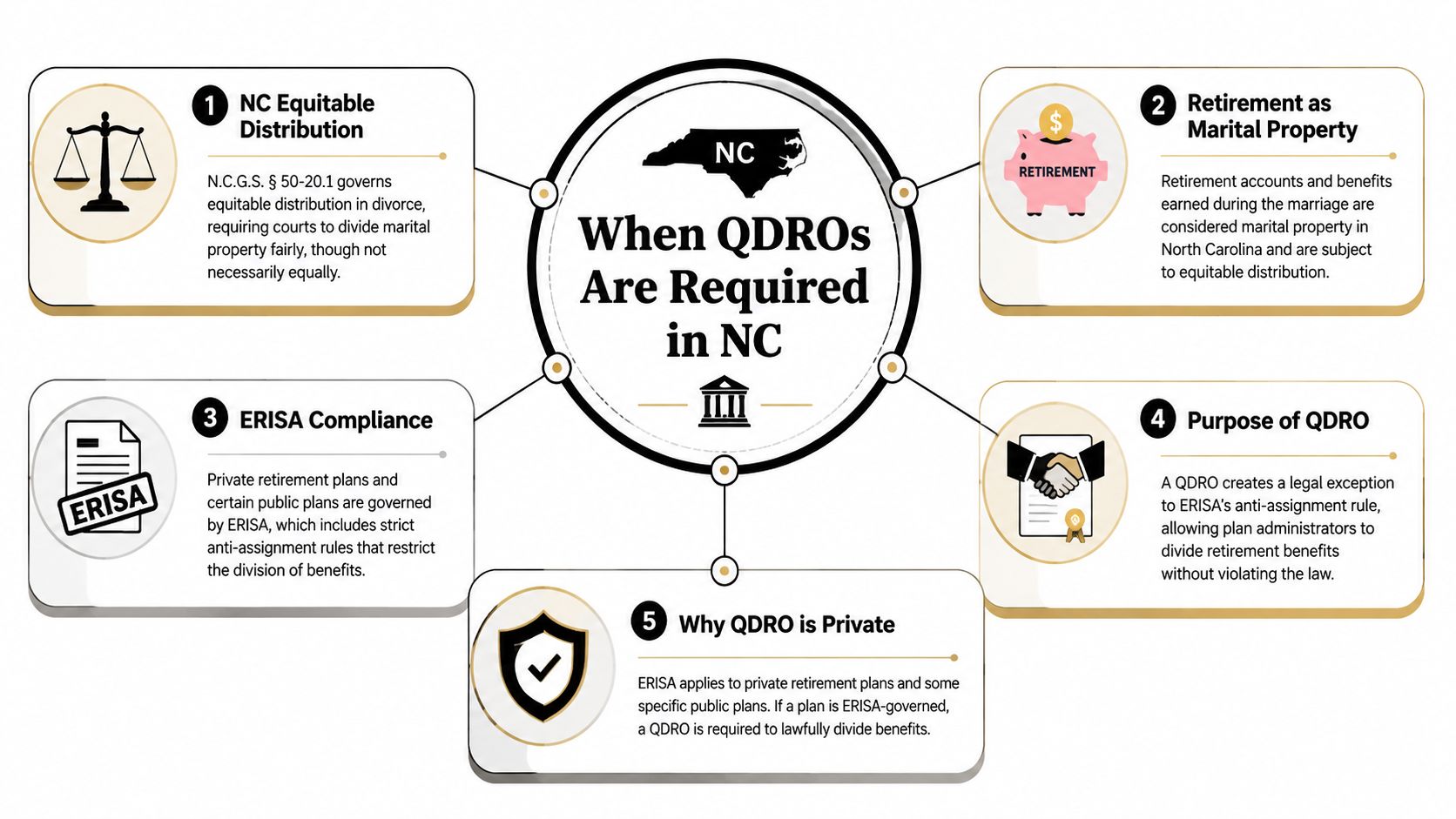
A simple way to think about it is this. If one spouse has a private employer plan, the order usually has to be drafted as a QDRO. If the spouse is a state employee with TSERS or LGERS-style retirement, the label and procedure are different. If the asset is an IRA, a direct transfer incident to divorce is usually the cleaner path.
The wrong label can slow everything down. A plan administrator can reject an order that uses QDRO language for a plan that doesn't follow ERISA.
If one spouse works for the State of North Carolina and the other has a private company 401(k), the order process is rarely the same for both accounts. The state plan may need its own plan-specific domestic relations order, while the 401(k) needs a QDRO. That split is one of the most common sources of delay in North Carolina divorce cases.
Gathering Plan Details and Drafting the QDRO
The best orders start with the plan documents, not the divorce decree. The working sequence is straightforward, but each step matters because the administrator will only qualify an order that fits the plan's rules. Start with the summary plan description and the plan's QDRO procedures, then ask for the administrator's model order if one exists, then draft the order with the participant and alternate payee information, payment formula, and payment period.
A custom order is usually safer than a generic form because every plan handles details a little differently. Defined-contribution plans, such as a 401(k), need attention to the cutoff date and how gains or losses are handled until distribution. Pension orders need a clear statement about how future payments are divided. The IRS warns that leaving out the plan-specific instructions on gains or losses can materially change the economic result.
The practical drafting checklist is short but exacting:
- Plan identity: use the full plan name and the correct administrator.
- Parties: list the participant and alternate payee exactly as the plan expects.
- Division method: state whether the share is a percentage, fixed amount, or formula.
- Time period: identify when the marital share ends and how long the order applies.
- Investment treatment: spell out gains and losses on defined-contribution accounts.
- Payment trigger: say when the alternate payee can receive or roll over the funds.
If the order needs to track North Carolina distribution dates, match the formula to the separation and valuation framework used in the case. That's where disputes often start, especially when one spouse is trying to use an outdated balance or an incomplete employment history.
You can also coordinate retirement discovery with the broader financial disclosures in NC Divorce Discovery and Financial Affidavits. That step helps confirm account titles, plan names, and statement dates before the drafting stage locks in the wrong numbers.
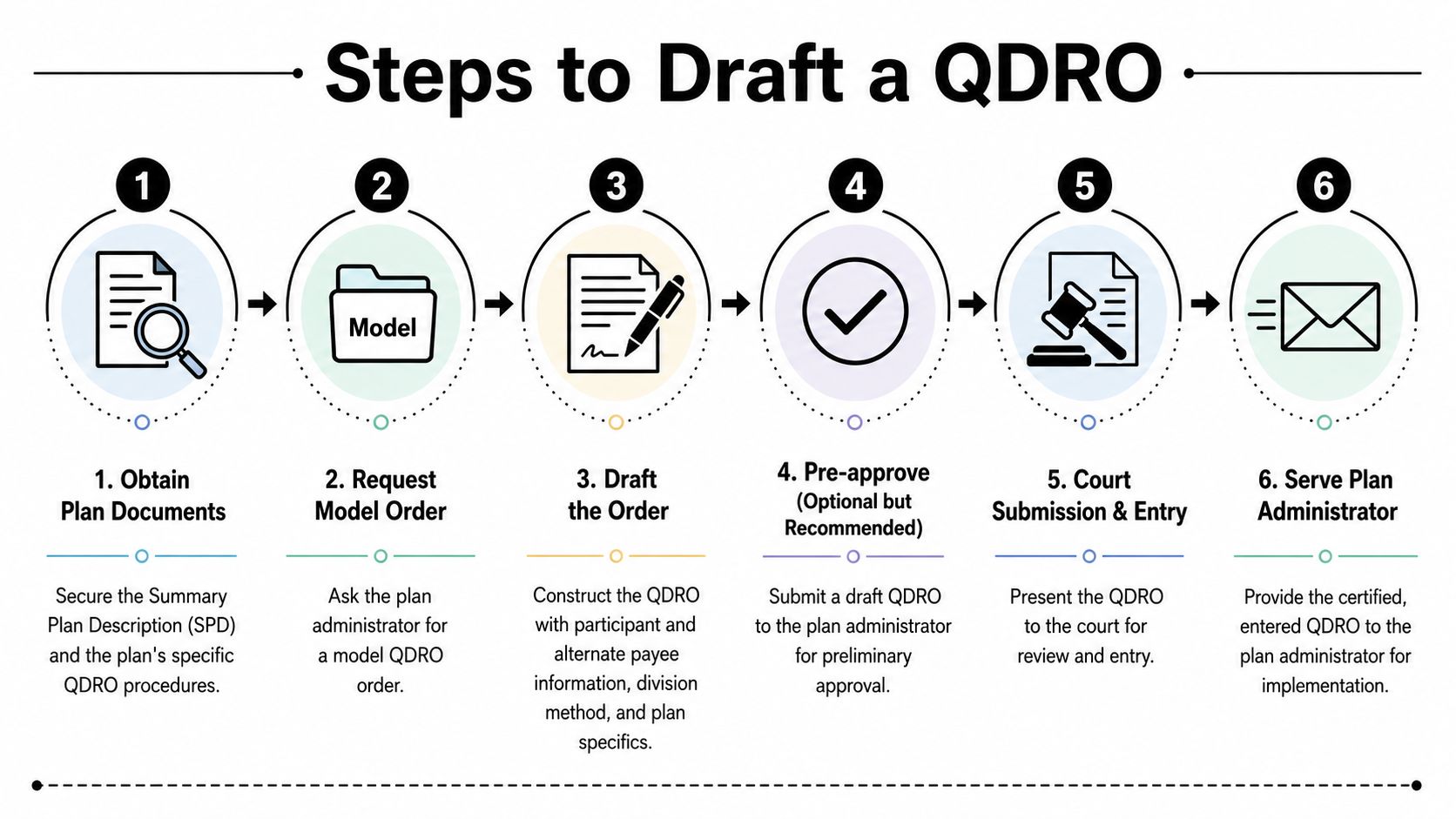
Practice point: ask for plan review before the court signs the order if the administrator allows it. Rejection after entry usually costs more time than a precheck ever does.
Obtaining Court Entry and Administrator Qualification
Once the draft is ready, the next step is court entry in North Carolina. The order may be presented through motion practice, and in many cases it should be tied directly to the divorce decree or incorporated settlement terms so the court record shows why the retirement division is authorized. That matters because the plan administrator needs a state-court order that is valid on its face before it can treat the alternate payee as entitled to benefits.
After the judge signs the order, it doesn't take effect until the administrator qualifies it. That's the point where the plan checks whether the wording matches its rules, whether the participant and alternate payee are properly identified, and whether the order tries to do something the plan doesn't allow. The Department of Labor explains that a QDRO is the legal mechanism used to divide ERISA-governed retirement benefits in divorce because ERISA requires a qualified domestic relations order assigning benefits to an alternate payee.
The qualification review is where small ambiguities become big delays. If the order leaves out the payment period, uses the wrong plan name, or refers to a benefit the plan doesn't offer, the administrator will usually ask for clarification or refuse to qualify it. That's why the court step and the administrator step are different. One gives the order legal force, the other makes the plan honor it.
A good filing strategy keeps those steps separated but coordinated. The court should enter an order that is precise enough for the administrator to process, and the signed order should then be served on the plan as soon as possible. If the divorce judgment was already final, the remediating order still has to fit the procedural path available in the case, which is where North Carolina post-judgment practice can get complicated.
Managing Timing Tax Issues and Common Errors
Timing is one of the easiest ways to lose value in a retirement division. People often wait until after the divorce is over, then discover that the account can't be touched because the order was never entered or the plan needs a revised form. That delay can be especially frustrating when the retirement account was part of the settlement everyone thought was already done.
A proper QDRO can protect the transfer from immediate income tax and early-withdrawal penalties, but only if the transfer follows the plan rules and the account type. That's a real practical advantage of doing the order right instead of just relying on a sentence in the judgment. The tax result changes if the beneficiary takes a distribution instead of completing the qualified transfer.
The most common drafting failure is leaving out the plan-specific instructions on how gains or losses are allocated until distribution, which the IRS notes can materially change the economic result. That mistake shows up often in defined-contribution plans because people assume the account balance on the day of separation will stay static. It won't. If the order doesn't say who bears market movement between the valuation date and the payout date, the final number can shift.
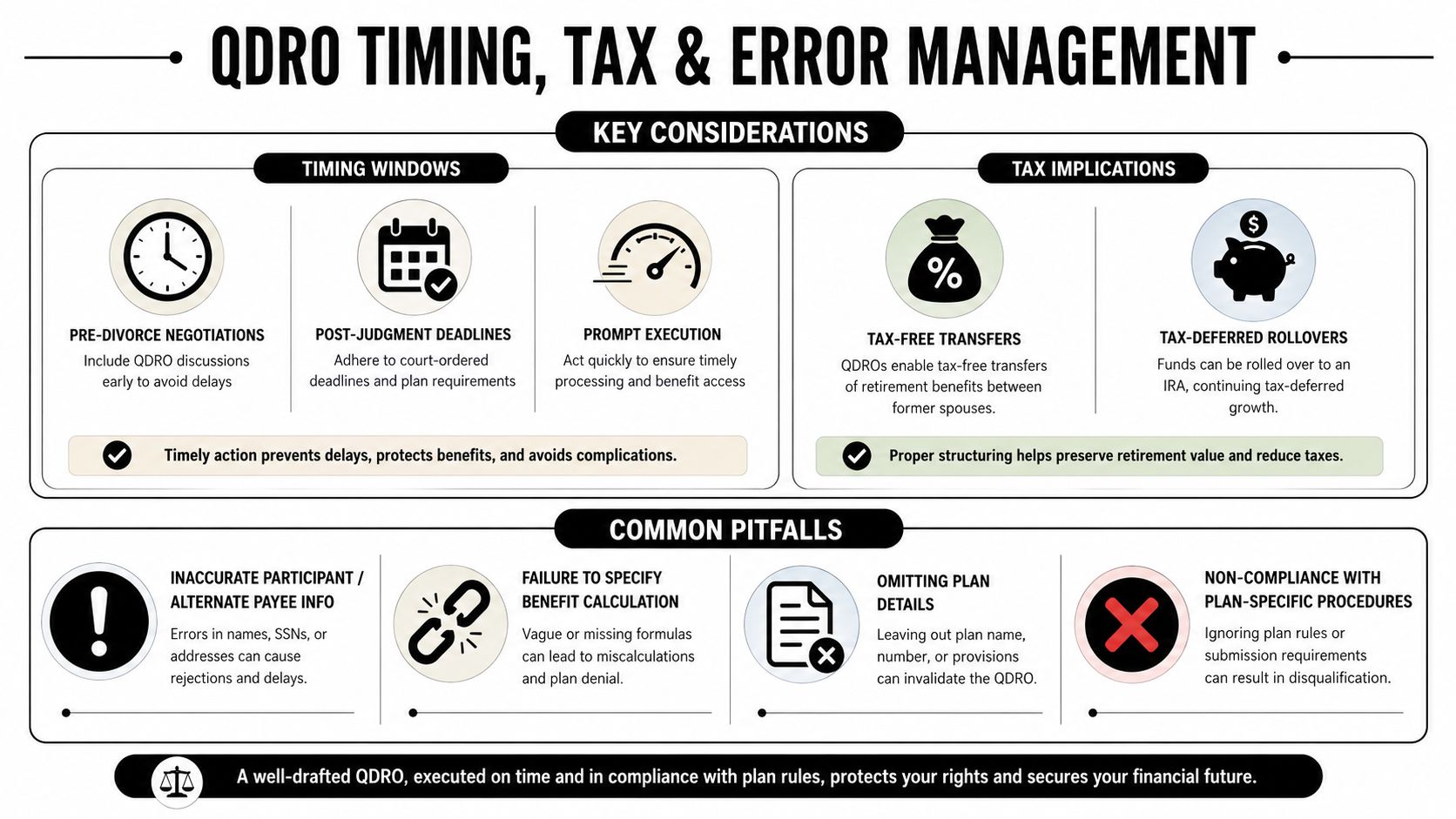
A few errors come up again and again in North Carolina cases:
- Wrong account type: using QDRO language for an IRA or a government plan that needs a different order.
- Missing valuation logic: failing to say how the marital portion is calculated.
- No division mechanics: omitting whether the award is a percentage, flat dollar amount, or formula share.
- Incomplete plan data: leaving out administrator-specific details that trigger rejection.
You can reduce those mistakes by comparing the retirement asset against the rest of the property division work, including the high-asset issues discussed in High Net Worth Divorce. Retirement plans rarely stand alone, and the drafting choices in one part of the case can affect the rest of the settlement.
If the plan can't process the order as written, the language is too vague, even if the divorce agreement feels clear to the spouses.
Sample QDRO Clauses Checklist and Other Division Paths
A strong retirement order is built from clauses that are specific enough for the plan to follow and narrow enough to avoid overreaching. A practical checklist for a private plan usually includes the participant's and alternate payee's full identifying information, the exact plan name, the division method, the valuation date, survivorship language if applicable, the payment timing, and the governing law. Those items sound basic, but they're the difference between a usable order and one that gets bounced back.
For private pensions and 401(k)s, the order should say whether the alternate payee receives a percentage of the account, a fixed amount, or a formula share. For pension benefits, clarity on survivorship rights matters because the plan may need to know whether the former spouse is supposed to be protected if the participant dies first. For defined-contribution accounts, the clause should address how gains and losses are handled after the division date.
Some assets are easier handled outside the QDRO framework. The NC Judicial College bench card notes that IRAs do not need an extra order, and military, federal, state-government, railroad, and some church plans use different forms and rules. That means the label “QDRO” is not a universal shortcut. It's a precise tool for a specific class of plans.
A workable way to choose the right path is to match the asset to the plan system:
- Private 401(k)s and pensions: usually need QDRO language.
- State-government retirement: often needs a plan-specific domestic relations order.
- Federal retirement: follows federal procedures, not ERISA QDRO language.
- IRAs: usually transfer by divorce-related transfer language, not a QDRO.
North Carolina families with mixed retirement assets often need more than one document package. A private-plan order can move alongside a separate non-QDRO transfer for an IRA and a different government-plan order for state service retirement. That's normal, and it's often the cleanest way to avoid rejection.
Common Questions and Next Steps in NC
Can a North Carolina court enter a QDRO after the divorce is final? Sometimes, yes, but the safest path depends on how the retirement claim was preserved and what procedural vehicle still exists. UNC's School of Government notes that a valid equitable-distribution claim generally must be filed before the absolute divorce judgment, although a breach-of-contract claim or incorporation of a settlement agreement can still support later entry in some cases.
What if the retirement plan changes after the divorce? The order still has to match the plan's current rules, so a stale form can get rejected. That's why plan review matters even after settlement, especially if the administrator updates its model language or processing requirements.
What if the QDRO was never entered and years have passed? Don't assume the right is gone. The best next step is to confirm whether the divorce order, settlement agreement, or another court filing still gives the court a path to enter the division order under North Carolina law.
Do all retirement accounts need the same document? No. Private ERISA plans, government plans, and IRAs each follow different rules. Getting that wrong is one of the fastest ways to delay distribution.
If you're dealing with a retirement issue in a North Carolina divorce, the cleanest move is to get the documents reviewed before the order is filed or refiled. A consultation can help identify the correct plan type, the proper order format, and whether post-divorce entry is still available in your case.
If you need help dividing retirement benefits in a North Carolina divorce, the Law Office of Bryan Fagan can review the plan type, settlement language, and QDRO path that fits your case. Visit Law Office of Bryan Fagan to schedule a consultation and get guidance specific to your divorce, retirement accounts, and North Carolina court process.