Your father has just had a stroke, and the bank won't let you access the account. Or your mother wants to sell her home but can no longer manage the paperwork herself. In both situations, the family may reach for a power of attorney in North Carolina, only to discover that the document must match the state's rules and the transaction's demands.
A power of attorney lets one person, called the principal, authorize another person, called the agent, to act on the principal's behalf. The important question isn't just whether your parent has “a POA.” You need to know what kind of POA exists, when it becomes effective, what powers it grants, and whether it was properly signed and recorded.
North Carolina separates financial authority from health-care authority. Chapter 32C governs financial powers of attorney, while Chapter 32A governs health-care powers of attorney. The distinction matters most when incapacity, real estate, divorce, or a bank's review process enters the picture.
When You Might Need a Power of Attorney in North Carolina
Families usually start thinking about a POA after a crisis. A parent is hospitalized, bills are piling up, an investment account needs attention, or a closing attorney says the seller's paperwork isn't acceptable. By then, the parent may have difficulty signing documents or explaining what authority should be given.
A financial power of attorney can allow an agent to handle matters such as banking, property management, and other financial transactions. It doesn't transfer ownership of the principal's property. Instead, it creates a legal relationship in which the agent acts within the authority written in the document.
Start with the decision your parent needs help making
Ask three practical questions:
- What needs to be handled? Banking, taxes, investments, business matters, and property transactions may require different authority.
- When should the agent act? A financial POA generally becomes effective when signed unless the document uses a future trigger.
- What happens if your parent loses capacity? Under North Carolina's default rule, a properly created financial POA generally continues through incapacity unless the document says it ends then.
A parent who wants help with routine banking may prefer immediate authority. Another parent may want an agent to act only after a specified incapacity determination. The document must express that choice clearly.
Practical rule: Don't wait until the parent can't participate. A POA depends on the principal's legal capacity when the document is created.
A financial POA also isn't a substitute for a court proceeding in every circumstance. If no usable POA exists, a family may need to explore an incompetency proceeding or guardianship. Understanding the difference between those paths can help you evaluate the urgency, as discussed in this North Carolina guide to incompetency proceedings and guardianship.
Health-care decisions require separate planning. A health-care POA under Chapter 32A addresses medical decision-making and follows different execution and effectiveness rules. Signing a financial POA won't automatically authorize someone to make medical decisions.
How Chapter 32C Shapes Every Financial POA in NC
Think of Chapter 32C as the thermostat controlling North Carolina's financial POA system. The document supplies the settings, such as who may act and which powers are granted, while the statute establishes the background rules that apply unless the document changes them.
The most important setting is durability. Under North Carolina General Statutes Chapter 32C, § 32C-1-104 makes a POA durable by default. That means the POA remains effective after the principal becomes incapacitated unless the document expressly says it terminates at incapacity.
The default rule quietly shifts drafting responsibility
Older explanations often suggest that a person must add a separate “durable” label to keep a POA alive after incapacity. North Carolina's current framework works differently. The document's language controls whether the statutory default is retained or rejected.
That shift is helpful, but it creates a drafting risk. If a form contains language ending authority at incapacity, the family may believe it provides incapacity protection when it doesn't. A lawyer reviewing the document should examine the actual termination language, not rely on its title.
Chapter 32C also requires formal execution. Under § 32C-1-105, the principal must sign and acknowledge the document before a notary public. No court filing is needed merely to create the POA, although a real-estate transaction can trigger a separate recording requirement.
Financial authority is not unlimited authority
A Chapter 32C POA concerns financial and property matters. The agent can act only within the powers granted in the document, and certain sensitive powers require an express grant under Article 2 of Chapter 32C. Gifting authority is a common example of a power that shouldn't be assumed from broad language.
Family status can matter as well. A spouse-agent relationship may end automatically after divorce unless the POA provides otherwise. That makes it important to review estate-planning documents after major relationship changes, just as North Carolina's six-month residency rule matters when evaluating North Carolina divorce residency requirements.
The Four Types of Power of Attorney Available in NC
The phrase “power of attorney” describes a legal arrangement, not one universal form. North Carolina families commonly use different structures depending on the timing, subject matter, and scope of authority.
Power of Attorney Types in North Carolina at a Glance
| POA Type | Governing NC Statute | Primary Use | Durability |
|---|---|---|---|
| Durable financial POA | Chapter 32C, especially § 32C-1-104 | Managing finances and property through incapacity | Continues after incapacity unless the document says otherwise |
| Limited financial POA | Chapter 32C | A defined transaction or narrow group of financial tasks | Depends on the document's duration and termination language |
| Health-care POA | Chapter 32A | Medical decisions when the principal can't make or communicate them | Governed by Chapter 32A, not Chapter 32C |
| Springing financial POA | Chapter 32C | Financial authority that begins after a stated future trigger | Becomes effective according to the trigger written in the document |
A durable financial POA is often used for incapacity planning. It may let an adult child pay bills, manage accounts, or oversee property if the parent later can't do those tasks. A limited POA is narrower, such as authority to complete a particular transaction.
A springing POA delays the agent's authority until the document's stated condition occurs. That can feel more comfortable to a principal who wants control while healthy, but the trigger must be practical and clear enough for institutions to apply.
A health-care POA is different in both purpose and statute. Chapter 32A governs medical authority, and North Carolina's statutory health-care form requires two qualified witnesses plus notarization. Chapter 32C financial POAs don't impose that same witness requirement.
For a fuller discussion of financial durability, families can review this North Carolina durable power of attorney resource. The key is to select the structure based on the decision your parent wants to delegate, not the document title.
Executing a Power of Attorney the Right Way in NC
Execution is where a thoughtful plan becomes a usable legal instrument. A document that names the right person but lacks the required acknowledgment can create trouble precisely when the family needs it most.
Follow the authority from person to transaction
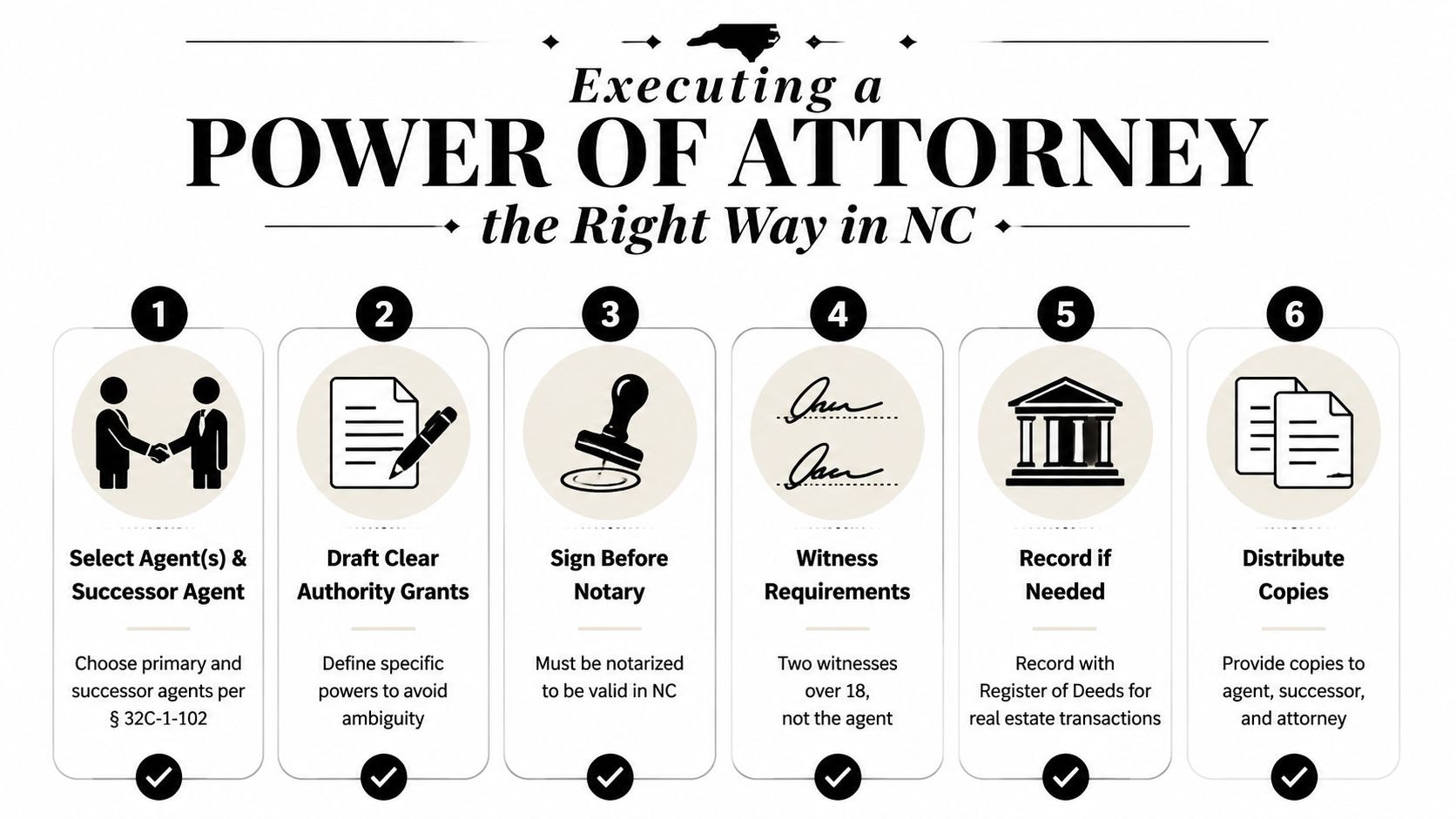
Choose the agent and successor agent. Select someone reliable, available, and willing to act. A successor can fill the role if the first agent can't serve, subject to the document's terms and the statutory framework in § 32C-1-102.
Define the powers. Identify whether the agent may handle banking, investments, business interests, taxes, property, or other matters. Sensitive powers, including gifting authority, should be addressed expressly rather than left to implication.
Sign and acknowledge the document. Under § 32C-1-105, the principal must sign and acknowledge the POA before a notary public. A signature without the required acknowledgment may not provide the formal assurance institutions expect.
Confirm the health-care paperwork separately. If the plan includes medical decisions, prepare the Chapter 32A health-care documents and follow their separate witness and notarization requirements. Financial and medical authority aren't interchangeable.
Record when real property is involved. Under § 47-28, the POA or a certified copy must be recorded with the Register of Deeds before the agent can convey real property. If the agent will sell, transfer, or mortgage a home, raise the recording issue before the closing process begins.
Distribute and store copies. Give copies to the agent and successor agent, keep the original secure, and ask the intended bank or title professional what documents it wants for review.
The acknowledgment also matters because an acknowledged signature is presumed genuine under the statute, supporting reliance by third parties that review the instrument. A person or institution that accepts an acknowledged POA in good faith and without actual knowledge of a defect receives statutory protection under Chapter 32C.
Before relying on the document, contact the bank, brokerage, or closing professional. Ask whether it will accept the POA and whether it requires an affidavit, certification, or legal review.
The following video provides another practical overview of the execution process.
Revoking or Changing a Power of Attorney in NC
A POA can stop working because the principal revokes it, the document reaches its stated end, or a statutory termination event occurs. Changing the agent or narrowing authority also requires deliberate drafting. Telling a family member that the POA is “no longer valid” may not be enough to protect the principal from continued reliance.
Revocation and Termination Triggers for NC POAs
| Trigger | NC Statute | Action Required |
|---|---|---|
| Written revocation of an unrecorded POA | § 32C-1-110 | Sign a later written revocation while the principal has capacity and notify affected parties |
| Revocation of a recorded POA | § 32C-1-110 | Record the revocation with the Register of Deeds and provide proof of service on the agent |
| Death of the principal | Chapter 32C termination rules | The agent's authority ends, and the estate's administration follows the applicable estate documents and law |
| Incapacity under a non-durable document | § 32C-1-104 and document language | Review the document's express termination language |
| Divorce involving a spouse-agent | Chapter 32C spouse-agent provisions | Review the POA and update the plan because authority may end unless the document says otherwise |
North Carolina gives the principal different revocation paths depending on recording. If the POA hasn't been recorded, a later written revocation or destruction of the document while the principal has capacity may revoke it. If it has been recorded, the revocation must also be recorded with proof that the agent was served.
A quiet divorce problem
Suppose a woman named her husband as her financial agent. They later divorce, but she never updates the document. The law may terminate the spouse-agent relationship unless the POA says otherwise, yet a bank or title office may still need clear notice and updated paperwork before accepting a replacement agent.
A careful revision may restate the entire POA, limit particular powers, replace the primary agent, or name a new successor. The safest approach is to identify every institution that received the old document, especially if real estate was involved, and provide the revocation or replacement document directly.
Common Power of Attorney Mistakes NC Residents Make
A POA can look complete and still fail the family's actual objective. The usual problem isn't a missing cover page. It's a mismatch between the document's language and the transaction the agent must perform.
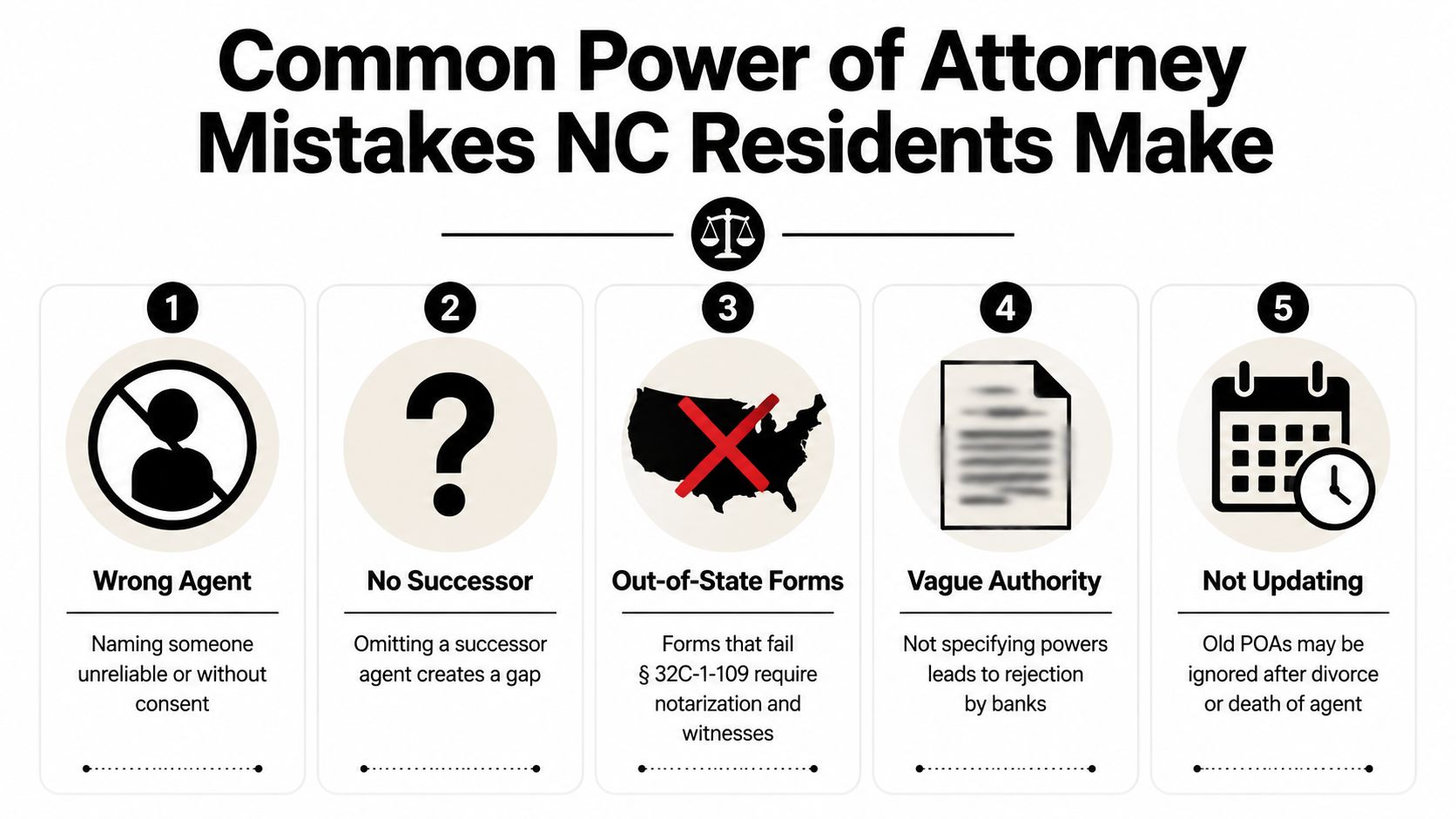
The document may fail at the moment of need
- Choosing an unsuitable agent: A relative who lives nearby isn't automatically the right agent. The person should be trustworthy, organized, and willing to communicate about the principal's money.
- Leaving out a successor: If the original agent dies, declines, or can't serve, the family may face a gap at the worst possible time.
- Using an out-of-state form without review: A form prepared for another jurisdiction may not satisfy North Carolina's acknowledgment requirements or may use unfamiliar statutory language.
- Writing vague authority grants: “Handle my affairs” may not clearly authorize a bank transaction, a gift, or a real-estate act. Chapter 32C identifies powers that require an express grant.
- Ignoring real-estate recording: An agent may arrive at a closing with a signed POA, only to learn that the document or certified copy needed recording before conveyance.
- Failing to update after life changes: Divorce, death of an agent, remarriage, relocation, and changed family relationships can make an old plan unsuitable.
North Carolina's default durability rule under § 32C-1-104 creates another common misunderstanding. Because a financial POA ordinarily continues through incapacity unless the document says otherwise, a principal must review the language that changes that default. A document can be durable and still be too narrow for the task at hand.
A durable POA also doesn't replace a will. It operates during the principal's life and ends at death. After death, the executor, administrator, or trustee acts under a different legal authority.
A signed document isn't the same thing as a transaction-ready document. The bank, brokerage, and closing attorney may each focus on different parts of the instrument.
How a POA Fits Into Your Broader Estate Plan
A power of attorney is the incapacity layer of an estate plan. It sits beside a will, trust, beneficiary designation, and health-care documents. It doesn't sit underneath them, and it doesn't replace them.
A North Carolina plan may be organized around different stages:
- Health-care decisions: A health-care POA and living will address medical preferences and decision-making. Families often confuse these documents, so reviewing a North Carolina living will alongside the Chapter 32A health-care POA can clarify their different roles.
- Financial incapacity: A durable financial POA gives a trusted agent authority to manage property and finances while the principal is alive.
- Distribution after death: A will identifies beneficiaries and appoints the person who will administer the estate. It doesn't give an agent authority during incapacity.
- Trust administration: A revocable trust may hold assets and provide a management structure, but only assets properly connected to the trust receive that treatment.
- Beneficiary designations: Retirement and insurance accounts may pass under their own beneficiary forms, so those designations should match the larger plan.
Why the POA stops at death
When the principal dies, the agent's authority under the POA ends. The person managing the estate then relies on the will, court appointment, trust terms, and asset-specific transfer rules.
That distinction prevents a painful mistake. An adult child may have authority to pay a parent's bills while the parent is alive, but the child can't use the same POA to distribute assets after death. Probate planning depends on the will, trust structure, ownership, and beneficiary designations, not on the POA alone.
An estate-planning attorney can coordinate the agent, successor agent, executor, and successor trustee so the incapacity plan and death plan don't conflict. The documents should work as a coordinated system rather than as isolated forms downloaded at different times.
Frequently Asked Questions and How to Get Started
Will a power of attorney signed in another state work in North Carolina?
It may. North Carolina's Chapter 32C includes rules addressing powers of attorney executed outside the state, including under § 32C-1-107. The practical question is whether the document was valid where signed and whether its language can be used for the North Carolina transaction.
A bank, brokerage firm, or closing attorney may still request supporting documents. Have the original, any certification, and the principal's identification information available for review before an urgent transaction.
Can an agent pay themselves for time spent?
An agent's compensation depends on the document, applicable law, and the circumstances of the service. The POA should address compensation and reimbursement clearly, especially when the agent is also a family member.
Keep records of expenses, payments, and decisions made for the principal. A written accounting trail helps distinguish legitimate administration from an unexplained transfer.
Does a POA survive divorce?
A spouse-agent relationship may end automatically after divorce unless the POA says otherwise. Review the document promptly after divorce and replace the agent if needed. Don't assume that an old form accurately reflects the principal's current wishes.
Do online POA forms satisfy North Carolina notarization rules?
An online form may contain useful language, but the completed document still must satisfy North Carolina's execution requirements. For a financial POA, § 32C-1-105 requires the principal to sign and acknowledge the document before a notary public.
The form also needs appropriate authority grants, durability language, agent provisions, and real-estate planning if applicable. A technically notarized document can still be poorly matched to the family's needs.
Three practical steps to begin
- List current agents: Write down the proposed primary agent, successor agent, and any person who should no longer serve.
- Gather account information: Identify banks, investment accounts, real estate, business interests, and institutions likely to review the POA.
- Schedule a consultation: Bring existing financial, health-care, will, trust, and beneficiary documents so an attorney can evaluate the complete plan.
The Law Office of Bryan Fagan can help North Carolina families draft or update financial, durable, and health-care powers of attorney while coordinating them with broader estate-planning documents. A consultation is an opportunity to identify gaps before incapacity or a real-estate closing turns them into an emergency.
If your parent needs a North Carolina power of attorney, contact the Law Office of Bryan Fagan to discuss agent selection, durability language, health-care authority, recording needs, and related estate-planning documents. Schedule a consultation before the next bank visit, medical crisis, or property transaction leaves your family trying to repair an incomplete plan.