A lot of people start looking into annulment after a short, painful realization. The marriage didn't just go badly. It feels like it should never have happened in the first place. If that's where you are, you're not alone, and you're not wrong to ask whether North Carolina law gives you a way to challenge the marriage itself instead of ending it through divorce.
That instinct makes sense emotionally. Legally, though, annulment in North Carolina is narrow, technical, and very different from wanting to undo a mistake. The court won't grant an annulment because the relationship moved too fast, the other person turned out to be dishonest in ordinary ways, or the marriage quickly became unhappy. North Carolina courts look for specific legal defects that existed when the marriage began.
For some people, a divorce or even a period of legal separation in North Carolina is the more realistic path. For others, annulment may be available, but only if the facts fit the statute and the proof is strong. The difference matters because an annulment changes more than marital status. It can also change how property, support, and related claims must be handled.
Is an Annulment the Right Path for You?
People often come in believing annulment is the cleaner option. They assume it's faster, simpler, and less damaging than divorce. In practice, that's often not true.
An annulment asks a North Carolina judge to declare that the marriage was legally invalid from the start. That is a much more specific claim than saying the marriage failed. If your concern is betrayal, incompatibility, financial conflict, or a relationship that unraveled almost immediately, those facts may support a divorce, but they usually won't support annulment.
Start with the real legal question
The first question isn't whether the marriage feels invalid. The first question is whether a recognized ground existed at the time of the ceremony. If the answer is no, the court is unlikely to grant an annulment no matter how compelling your personal story may be.
That's why the right path usually comes down to three issues:
- Legal eligibility matters first. You need a ground recognized under North Carolina law.
- Proof matters next. Courts expect evidence, not suspicion.
- Consequences matter too. Annulment can create property problems that many people don't see coming.
Practical rule: If your main goal is to divide a house, bank accounts, or other shared assets in a structured family-law process, divorce may offer a more predictable route than annulment.
Common misunderstanding
Many people think annulment is the option for short marriages. It isn't. A marriage can last a very short time and still be fully valid. A marriage can also be challenged even if it seemed valid to one spouse at the ceremony, if one of the narrow legal grounds existed then.
That distinction is the heart of annulment in North Carolina. If you're considering it, the safest approach is to evaluate the facts early and thoroughly, before you build a strategy around a remedy the court may never grant.
What an Annulment Legally Means in North Carolina
An annulment and a divorce do different legal jobs. A divorce ends a valid marriage. An annulment declares that the marriage was void or voidable from the beginning, meaning the law treats it as though it never legally existed once the court enters the decree.

A useful way to think about it is contract law. Divorce is like ending a valid contract. Annulment is like proving the contract was defective at the moment it was signed.
Why annulment is much less common
North Carolina courts don't use annulment as a broad fairness remedy. They use it only when the marriage itself was legally flawed at inception. That's one reason approximately 90% of couples seeking to end a legally invalid marriage choose divorce instead of annulment according to this North Carolina annulment overview.
That statistic surprises many people, but it should also reset expectations. Annulment is not the default option for a bad marriage. It is the exception.
Void and voidable are not the same
North Carolina law uses two related terms that people often confuse.
- Void marriage means the marriage is legally invalid by law.
- Voidable marriage means the marriage is treated as valid unless and until a court declares it invalid.
That distinction has consequences. In North Carolina, bigamy is the only marriage automatically considered void without further judicial action. Other defects may still support annulment, but they usually require a court case and proof.
The court is not deciding whether the marriage was a mistake. The court is deciding whether it was legally defective when it began.
What annulment does and does not do
An annulment changes marital status, but it doesn't solve every issue that comes with separation.
Here are the key effects in practical terms:
- Marriage status: The decree treats the marriage as never having legally existed.
- Spousal support: The court does not award alimony after an annulment because there is no valid marriage to dissolve.
- Property division: Family court does not divide a marital estate in the usual divorce sense.
- Children: Child-related issues can still be addressed if children were born.
That last point matters. An annulment doesn't erase parenting obligations. It changes the legal status of the marriage, not the need to address custody and support where children are involved.
The Specific Legal Grounds for Annulment in NC
A lot of people call my office after a very short marriage and assume that brevity alone makes annulment available. North Carolina law does not work that way. The court looks for a legal defect that existed when the marriage began. If that defect is not there, the case is usually a divorce case instead, subject to filing rules such as the North Carolina Divorce Residency Requirements.
That distinction matters for more than marital status. If a marriage is annulled, the usual equitable distribution process available in divorce is generally off the table. People are often surprised to learn that a fight over the house, bank accounts, vehicles, or money one spouse transferred to the other may have to be handled through separate civil claims instead. In some cases, proving grounds for annulment is only the first legal problem.
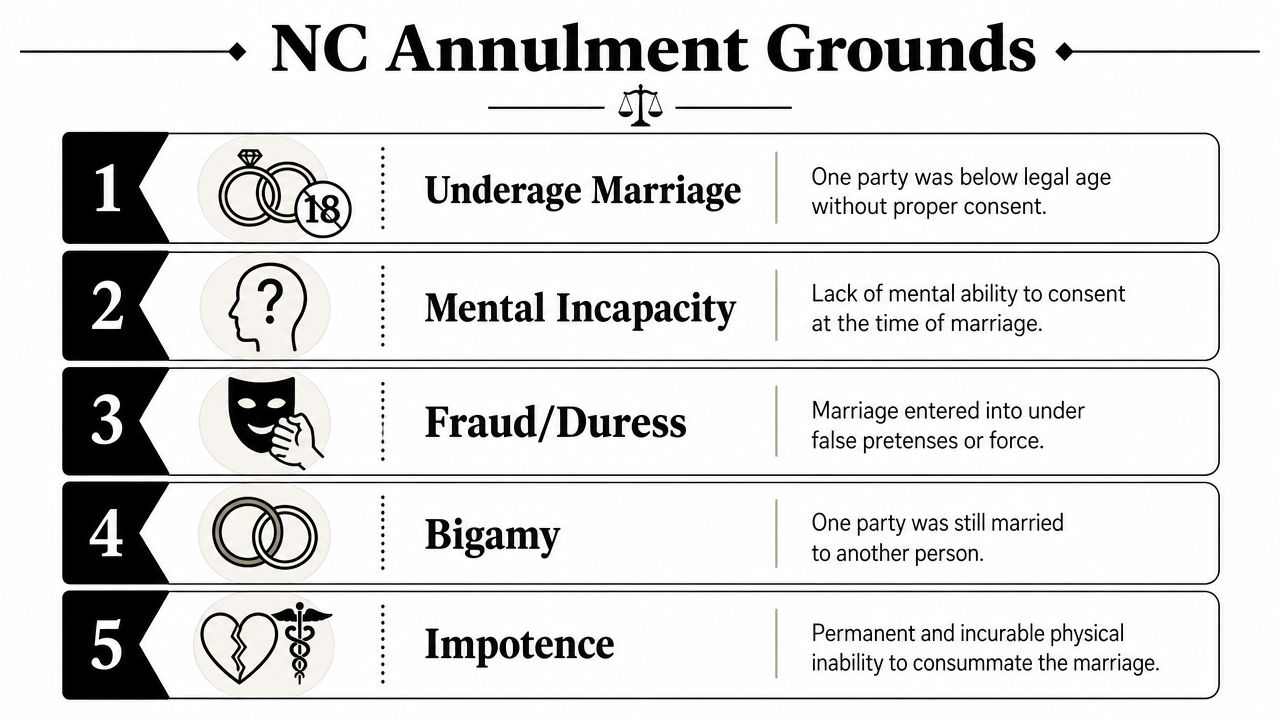
Bigamy
Bigamy is the clearest ground.
If one spouse was already legally married to another living person at the time of the ceremony, the later marriage is invalid. I regularly see confusion on this point when someone separated years ago, believed the prior marriage was effectively over, and remarried without getting an actual divorce judgment. Separation does not end a marriage in North Carolina. Only a divorce judgment does.
Incest and prohibited family relationships
North Carolina also prohibits marriages between people who are more closely related than first cousins. The statute also reaches double first cousins.
These cases are rare, but they do come up in extended-family situations where people did not fully understand the degree of relationship until later. Once the facts fit a prohibited relationship, the court does not have much flexibility.
Underage marriage
A marriage may be voidable if one party was under 16 and the legal requirements for marriage were not met at the time of the ceremony.
The focus stays on the age and legal capacity to marry when the license was issued and the ceremony took place. Later consent, a later reconciliation, or the simple passage of time does not automatically fix a defective marriage. Cases involving minors also tend to carry related factual disputes about parental involvement, pressure, and whether the marriage was legally authorized in the first place.
Mental incapacity
A marriage may be challenged if a party lacked the mental capacity to understand the nature of the marriage contract when the ceremony occurred.
This is narrower than many people expect. A diagnosis, standing alone, does not decide the case. The core question is whether the person could understand that they were entering a legal marriage and grasp the obligations that come with it. Medical records, witness testimony, and the timing of the impairment often matter more than labels.
Physical impotence
North Carolina recognizes incurable physical impotence existing at the time of marriage as a possible ground for annulment.
This is a narrow claim. Sexual disappointment, low desire, or later marital incompatibility is not enough. The allegation usually requires specific proof, and privacy concerns often make these cases more difficult than clients expect.
Fraud and duress
Fraud can support annulment, but only when the deception goes to the marriage itself in a legally meaningful way. A spouse being dishonest in a general sense is not enough.
Duress means the marriage was induced by force, threats, or coercion that overrode real consent. Those facts have to be proved carefully. Courts do not grant annulments merely because family pressure was intense or the decision was regretted later.
North Carolina law also recognizes a very specific fraud-based ground involving false representations of pregnancy. Under N.C. Gen. Stat. 51-3, a marriage may be voidable on that basis only when the statutory conditions are met, including prompt separation after the marriage, continued separation for the required period, and no child born within the time set by the statute. This is one of those areas where small factual details can determine the outcome.
People also confuse annulment questions with myths about informal relationships. If that issue is part of your situation, review how common law marriage in NC works.
Short marriages still create legal and financial problems. Annulment changes the status of the marriage, but it may leave property disputes to be handled in a different court posture, which is one reason a quick case can become more complicated than a standard divorce.
Navigating the Annulment Process and Costs
A client comes in believing an annulment will be faster, cheaper, and cleaner than divorce because the marriage lasted only a short time. Sometimes that is true. Sometimes the annulment itself is only the first fight, and the harder dispute comes later over a car, a bank account, furniture, or money one spouse says was never really "marital" property at all.
That is the part many people do not hear early enough. In North Carolina, an annulment case focuses on whether the marriage was legally invalid from the start. It does not give you the same property-division framework that exists in a divorce case. If your situation involves shared assets or debt, that trade-off needs to be weighed before anything is filed. For some people, reviewing the usual North Carolina divorce process helps clarify that difference.
Filing requirements and where the case begins
An annulment is filed in district court. The case is usually brought in a county where one of the parties resides, and the paperwork has to do more than say the marriage should not have happened. It must allege a recognized legal ground and facts that, if proven, would justify annulment under North Carolina law.
Costs vary with the facts. Clients should expect filing fees, service costs, and attorney's fees if they want representation. In my experience, the expense rises quickly when the other spouse contests the facts, cannot be located for service, or a separate property dispute is likely to follow outside the annulment case.
A short marriage does not always mean a simple case.
What the court process usually looks like
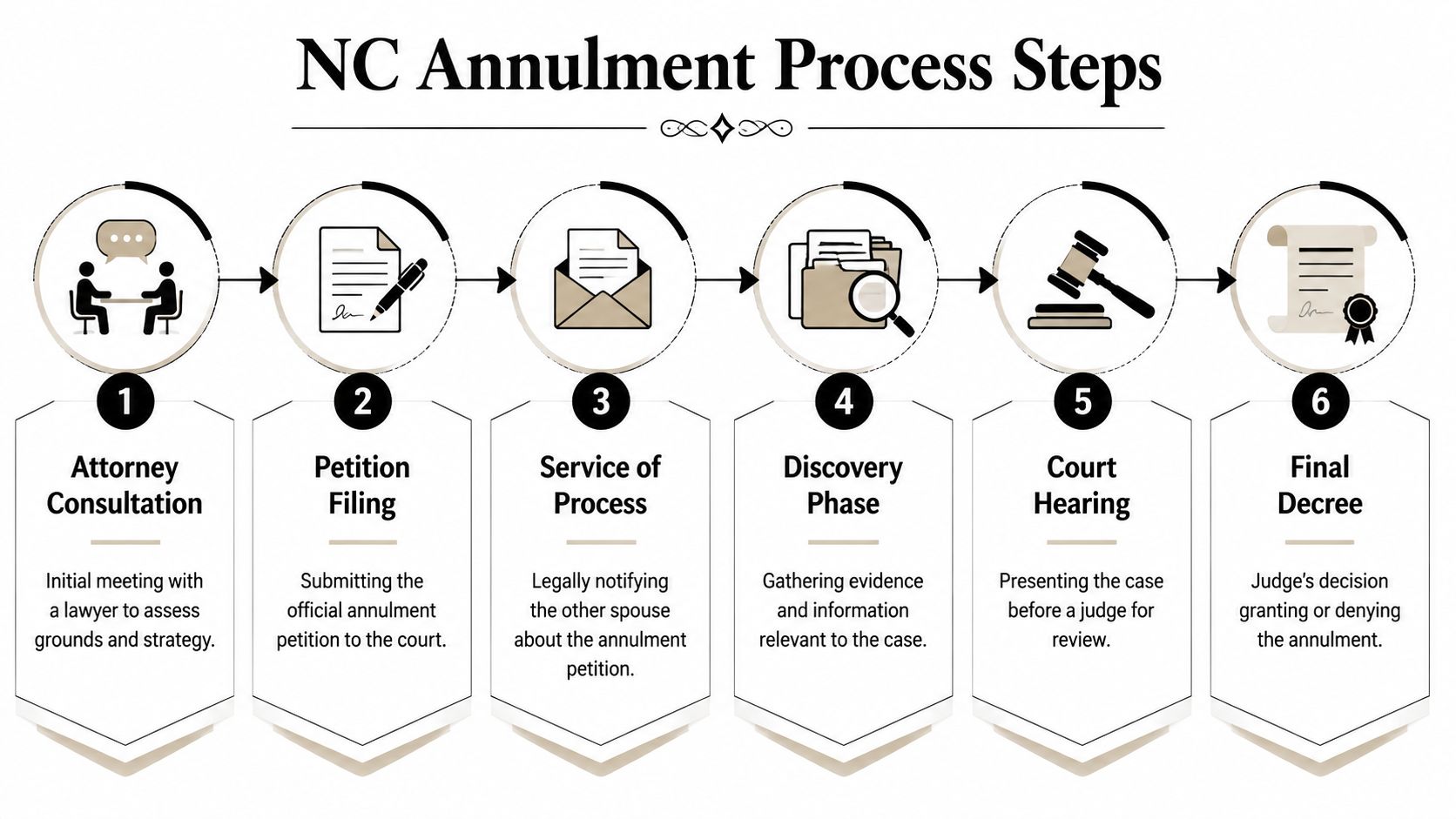
Most annulment cases follow a fairly direct sequence, but each step matters:
Initial case review
The facts have to fit a legally recognized ground for annulment. If they do not, the court can dismiss the claim.Drafting and filing the complaint
The complaint should state the ground clearly and include the supporting facts with enough detail to put the other side and the court on notice.Formal service of process
The other spouse must be served with the summons and complaint under the civil rules.Response by the other party
The responding spouse may admit the allegations, deny them, or raise defenses that turn the case into a factual dispute.Hearing or trial
The judge hears evidence and decides whether the legal standard for annulment has been met.
Before the hearing, many clients find it helpful to hear a general explanation of family-law procedure. This overview may help frame the process:
Evidence usually decides these cases
Annulment cases are won or lost on proof tied to the legal ground being claimed. Judges do not grant annulments because the marriage ended quickly or because one spouse later feels deceived in a general sense.
Examples of useful evidence include:
- Bigamy claims: Prior marriage records or other official documentation
- Impotence claims: Medical records or testimony
- Mental incapacity claims: Records and witness testimony tied to the time of the ceremony
- Fraud or duress claims: Messages, witness testimony, and other direct evidence showing what happened before the marriage
Practice point: The strongest cases usually have documents, records, or third-party witnesses that existed before the lawsuit was filed.
If the judge grants the annulment, that does not automatically settle every financial issue between the parties. That is where clients are often surprised. Without equitable distribution, ownership disputes may have to be sorted out through separate civil claims, which can take more time and money than a standard divorce property case. That risk should be part of the decision at the start, not an afterthought once the annulment is already underway.
Annulment vs Divorce Key Differences and Consequences
Many people assume annulment is a simpler version of divorce. In some cases, it's the opposite. The legal consequences are different enough that choosing the wrong path can create avoidable problems, especially where property is involved.
Annulment vs. Divorce in North Carolina at a Glance
| Issue | Annulment | Divorce |
|---|---|---|
| Legal effect | Marriage is treated as invalid from the beginning | Valid marriage is legally ended |
| Property division | No marital estate is divided through equitable distribution | Marital property can be divided in family court |
| Spousal support | No alimony based on a valid marriage ending | Alimony may be addressed when legally available |
| Children | Child-related issues can still be addressed | Child-related issues can still be addressed |
| Core proof issue | Must prove a specific legal defect existed at the start | Does not require proving the marriage was invalid |
The property issue most articles miss
Here is the trade-off that catches many people off guard. When a marriage is annulled, there is no "marital estate" to divide. Assets are subject to civil laws like "joint venture" or "tenancy in common," often requiring separate and more complex civil litigation than in a divorce to determine ownership, as explained in this discussion of North Carolina annulment eligibility and property consequences.
That means a person who chooses annulment because it sounds cleaner may lose access to the more familiar equitable distribution process used in divorce. If the two of you bought a home together, mixed funds, paid for renovations, or titled assets jointly, family court may not sort that out in the annulment decree.
A practical example
Consider a couple who marry, buy a house together, and separate after discovering a basis to seek annulment. In a divorce, the court can analyze marital and separate property under North Carolina equitable distribution rules. In an annulment, that structure may not exist.
Instead, one party may need to prove ownership interest through civil claims. That can be more technical, more fact-heavy, and less predictable.
If you're comparing broader options, North Carolina divorce may provide the more practical framework when support and property division are central concerns.
Some people pursue annulment to avoid divorce. They later discover that the property fight became harder, not easier.
What works and what usually doesn't
What works is choosing the legal route that matches your actual goals. If your top issue is proving the marriage was invalid from the start, annulment may fit. If your top issue is unwinding finances in an organized family-law forum, divorce is often the more functional tool.
What usually doesn't work is treating annulment like a symbolic remedy without thinking through the civil consequences.
Frequently Asked Questions About NC Annulments
A common call to my office starts like this: the marriage was brief, one spouse believes something was wrong from the start, and both assume annulment will be quick if the other side objects. That is not how these cases usually play out. Annulment is a court case built on specific legal grounds and proof.
Can my spouse stop the annulment by disagreeing?
A spouse can contest the case, and that happens often. Objection alone does not block an annulment, but it does mean the judge must decide whether the facts fit a recognized ground under North Carolina law.
The key legal question is whether a valid ground existed at the time of the marriage and whether you can prove it with credible evidence. If your spouse denies the facts, the case may turn on records, witness testimony, and your conduct after the problem became known.
Do I need a court order for every annulment case?
Not in every situation. Under North Carolina law, some marriages are void, while others are voidable. A bigamous marriage is void under N.C. Gen. Stat. § 51-3. By contrast, marriages involving other alleged defects usually require a court action to have the marriage declared void or annulled.
That distinction matters. If your case is voidable rather than void, you should expect to file suit and prove the claim rather than assume the marriage is automatically treated as if it never existed.
What if we kept living together after the problem came to light?
That can seriously weaken some annulment claims. Continued cohabitation may suggest that the marriage was accepted despite the alleged defect, especially in cases involving fraud or similar facts.
Judges look closely at timing. They also look at conduct. If you learned of the issue, stayed together, shared a household, and presented yourselves as married afterward, that can make the case harder to win.
Can I remarry after an annulment?
Yes, once your legal status is resolved. If a court enters a valid annulment decree, remarriage may be possible, but do not rely on assumptions or informal agreements.
This is one area where paperwork matters more than people expect. Remarrying before the prior marriage has been legally addressed can create another legal problem instead of ending the first one.
Is annulment always better than divorce if the marriage was short?
No. A short marriage does not automatically make annulment the smarter option. In many cases, divorce is still the cleaner legal path, especially if there are disputes about money, jointly titled assets, or support.
That is the part many online guides skip. An annulment may address marital status, but it does not give you the same familiar equitable distribution process that a divorce case can provide. If property was purchased, accounts were combined, or one party claims an ownership interest in assets held by the other, the fight may shift into separate civil litigation. For many clients, that trade-off deserves just as much attention as the annulment ground itself.
If your concern is not only whether the marriage was valid, but also how to sort out the financial fallout, annulment may create a harder path than divorce.
When You Need an Experienced NC Annulment Attorney
You may be certain the marriage should never have happened, yet still be unsure whether filing for annulment will solve the problem. That is usually the moment to get legal advice. In North Carolina, the hardest part is often not the label. It is choosing the process that protects you once questions about property, children, debts, or prior court filings start surfacing.
An experienced attorney should do more than decide whether a ground for annulment might exist. The job is to examine what happens after that claim is filed. If the marriage is declared void or voidable, you may not have the same equitable distribution framework available in a divorce case. A dispute over a house, bank account, vehicle, business interest, or money one party contributed can turn into a separate civil case. That added litigation is one of the most overlooked risks in annulment matters.
A useful case review usually focuses on four points:
- whether your facts fit a recognized North Carolina ground for annulment
- what documents, witnesses, or other proof will be needed
- whether annulment could push property issues into separate civil litigation
- whether custody, child support, or related claims need to be filed alongside the marital-status issue
Those are legal and practical decisions. They affect cost, timing, and advantage.

For that reason, it helps to work with counsel that handles both family law and civil litigation. The Law Office of Bryan Fagan represents North Carolina clients in both areas, which matters when an annulment case expands into a fight over ownership of property, support issues involving children, or related court claims that do not end with the marriage-status ruling.
You do not need to walk into a consultation with every answer. You do need a clear assessment of your options, the proof problems in your case, and the trade-offs between annulment and divorce before you commit to one path.