North Carolina doesn't allow you to create a common law marriage within the state, and there is no number of years of living together that turns an unmarried couple into a married one. If you live together in North Carolina without getting legally married, you don't gain spousal rights just because the relationship is long-term.
That answer is hard for many people to hear, especially after years of sharing a home, raising children, combining finances, or introducing each other as husband and wife. A couple may spend a decade together in Raleigh or Charlotte and assume the law will treat them like a married couple if they separate. In North Carolina, that assumption can create expensive problems.
The confusion gets worse because one part of the story is flatly simple and another part is more nuanced. North Carolina won't create a common law marriage, but it can still be required to honor one that was validly formed in another state. That distinction matters in divorce, property division, support, inheritance, and even basic decisions during a medical emergency.
Understanding Common Law Marriage in North Carolina
A common law marriage is a marriage recognized without a formal ceremony or marriage license, usually based on a couple's conduct and the law of the state where they lived. People often ask whether living together for a long time, sharing bills, or using the same last name creates that status in North Carolina. It doesn't.
A familiar situation goes like this. Two people move in together, buy furniture together, maybe open a joint account, and tell friends they're basically married. Years later, the relationship ends, and one person expects rights similar to divorce rights. In North Carolina, that expectation usually collides with the law.
Practical rule: In North Carolina, cohabitation alone doesn't turn into marriage, no matter how committed the relationship feels.
That matters because legal marriage is what triggers a long list of protections and obligations. Without it, an unmarried partner generally can't rely on the same rights involving property division, alimony, or spousal support. If the home is titled in one person's name, title often controls unless the couple created separate contractual protections.
Many clients come in asking the wrong first question. They ask, "How long do we have to live together?" The better question is, "What legal documents do we have, and what state did the relationship begin in?" For North Carolina residents, those details often decide whether the law sees a breakup as a contract issue, a property title issue, or a divorce.
Why North Carolina Law Does Not Create Common Law Marriages
The statute is direct
North Carolina law doesn't leave much room for debate. Under North Carolina General Statutes Chapter 51, specifically § 51-1, the state does not recognize common law marriage formed within North Carolina. To have a valid marriage here, a couple must obtain a license and have the marriage solemnized by an ordained minister or magistrate, as explained in this discussion of North Carolina common law marriage law.
That formal process is the line between being legally married and living together. Intent matters in relationships. In court, procedure matters too.
What North Carolina requires for a valid marriage
North Carolina generally requires these core steps:
- Marriage license: The couple must obtain a license before the marriage is performed.
- Authorized solemnization: An ordained minister, magistrate, or another legally recognized method of solemnization must be used.
- Mutual consent: Both people must agree to enter the marriage relationship.
If those steps didn't happen in North Carolina, the state won't treat the relationship as a marriage just because the couple acted married.
A lot of readers land here while sorting out a breakup and also trying to understand whether they are separated, divorced, or neither. If you're in that position, it's worth reviewing how legal separation works in North Carolina because separation rules and marriage rules often get confused.
What doesn't work
These facts usually do not create a marriage in North Carolina by themselves:
- Long-term cohabitation: Living together for years doesn't create marital status.
- Shared children: Parenting rights may exist, but spousal rights don't arise automatically.
- Public presentation: Calling each other spouses on social media or in everyday conversation doesn't replace a legal marriage.
- Shared finances: Joint bills or joint purchases may create financial evidence for other disputes, but they don't create a marriage.
If there was no valid marriage, the court won't turn a long relationship into one after the fact because it seems fair.
That result can feel harsh, but it gives people a reliable legal rule. It also means unmarried parents should separate issues carefully. Marriage status controls one set of rights. Parenting status controls another. Child support, for example, is calculated under a worksheet-based system discussed in North Carolina Child Support Guidelines Explained, and those obligations don't depend on whether the parents were married.
The Critical Exception Recognizing Valid Out-of-State Marriages
The biggest mistake I see in this area is the half-true statement that "North Carolina doesn't recognize common law marriage." That's incomplete. North Carolina doesn't create one, but it must recognize a valid common law marriage formed elsewhere.
When another state's law changes everything
If a couple validly formed a common law marriage in a state that allows it, North Carolina can be required to treat them as married after they move here. According to the National Conference of State Legislatures summary on common law marriage by state, 12 states currently recognize common law marriage in some form, and couples validly married in places such as Colorado, Iowa, or Texas may be treated as married in North Carolina for divorce and property division purposes.
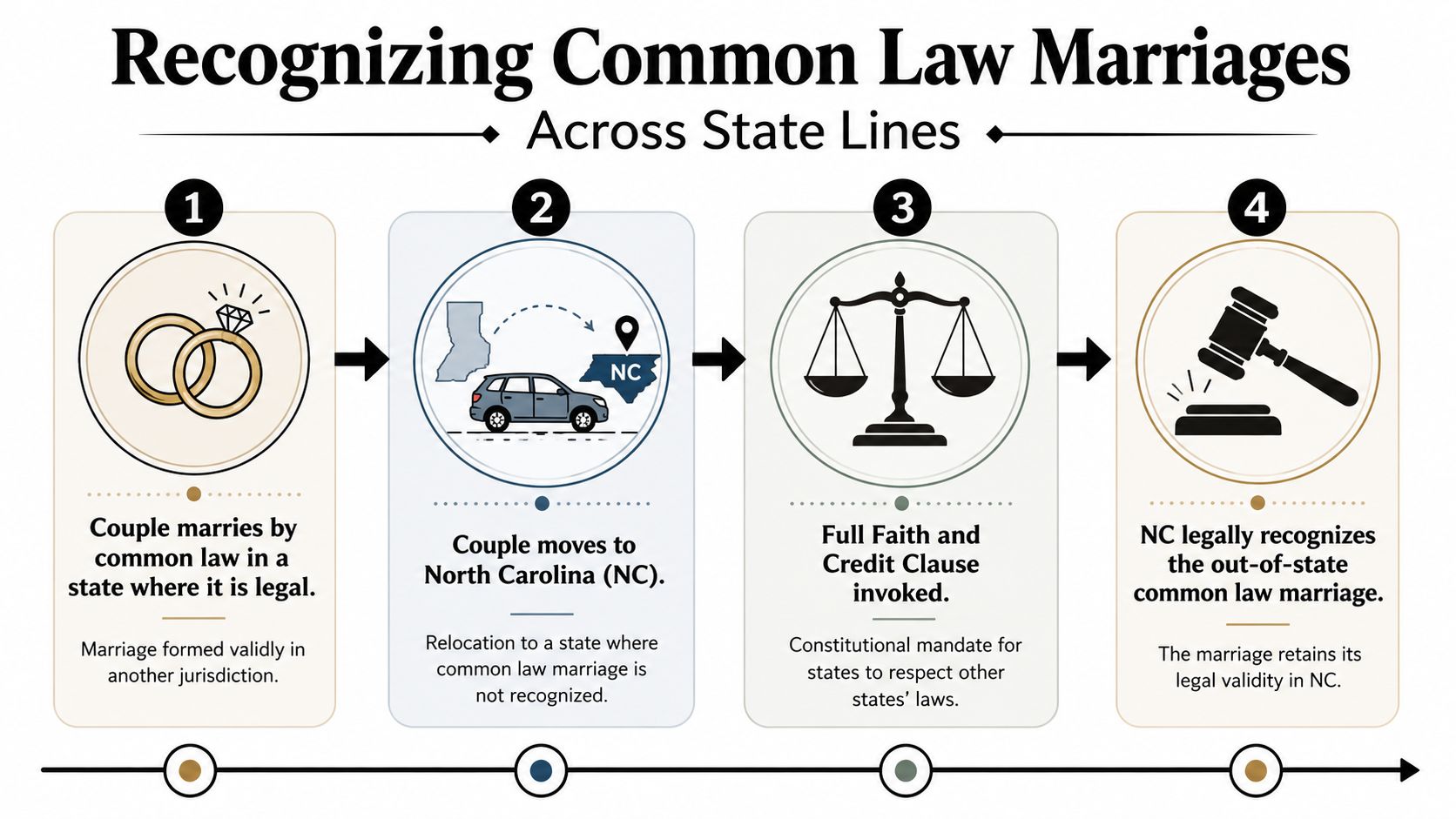
This happens because of the Full Faith and Credit Clause. In plain English, states generally have to respect legal relationships that were validly created under another state's law. So if Texas law made the couple married before they moved to Charlotte, North Carolina doesn't get to erase that marriage because North Carolina itself wouldn't have created it.
A practical example
Take this scenario. A couple lives in Texas, meets the legal requirements there, and becomes married under Texas common law. Later, they relocate to North Carolina and separate after several years.
At that point, one partner may think, "North Carolina doesn't do common law marriage, so we can just walk away." That can be a costly misunderstanding. If the marriage was validly formed in Texas, the couple may still need a divorce in North Carolina to end it. Without a divorce, they may remain legally married with unresolved issues involving property, support, and children.
How people prove the out-of-state marriage
The hard part in these cases often isn't the legal rule. It's proof. Courts usually look at the law of the other state and the facts showing the couple met that state's requirements.
Evidence may include:
- Tax filings: Returns filed as spouses, if applicable under the other state's law
- Property records: Deeds, titles, or other documents showing joint ownership patterns consistent with marriage
- Public conduct: Evidence the couple held themselves out as married
- Financial records: Accounts, insurance documents, or beneficiary choices that reflect a marital relationship
- Statements and testimony: What the couple said and did while living in the state that recognizes common law marriage
The key question isn't whether North Carolina would have created the marriage. The key question is whether another state already did.
That distinction is why relocation cases need careful legal review. A person can be unmarried in North Carolina after twenty years of cohabitation in Durham, yet fully married in North Carolina after moving from a state where the marriage was validly formed.
Rights at Stake A Comparison of Married and Unmarried Couples
The legal difference between married and unmarried couples in North Carolina isn't technical. It's practical. It affects who keeps property, who may seek support, who can make decisions in a crisis, and what happens when the relationship ends.
The comparison clients need to see
| Legal Right/Issue | Legally Married Couple | Unmarried Cohabiting Couple |
|---|---|---|
| Property division at separation | May have rights through divorce and equitable distribution if the marriage is legally recognized | No equitable distribution as a couple merely because they lived together |
| Alimony or spousal support | May seek alimony or post-separation support when the law allows | No spousal support rights based only on cohabitation |
| Inheritance if a partner dies without planning | May have spousal inheritance rights if legally married | No automatic spousal inheritance rights |
| Medical decision-making | A spouse may have a stronger legal position in emergencies | An unmarried partner may be excluded without proper documents |
| Need for divorce to end relationship | Yes, if the marriage is valid | No divorce if there was never a valid marriage |
For unmarried couples, this often means title and contracts do the heavy lifting. If only one name is on the deed, only one name on the bank account, or only one name on the vehicle title, that detail may decide the issue unless there is another enforceable agreement.
A related probate issue comes up after death. Many long-term partners assume surviving the relationship means automatically inheriting the home or accessing accounts. That's often wrong without planning. This overview of ways to avoid probate in North Carolina is relevant because unmarried couples usually need deliberate estate planning, not assumptions.
Cohabitation can end alimony even though it doesn't create marriage
North Carolina treats cohabitation very differently depending on the issue. It won't turn cohabitation into marriage, but cohabitation can still carry serious legal consequences in support cases.
Under North Carolina law, alimony terminates when a dependent spouse cohabits with a new romantic partner in a marriage-like relationship, as explained in this discussion of cohabitation and alimony under North Carolina law. In plain terms, a person can lose alimony by moving in with a new partner even without getting remarried.
That catches many people off guard. They assume, correctly, that moving in together doesn't create a new marriage in North Carolina. Then they assume, incorrectly, that the move has no legal effect. In an alimony case, it can have immediate consequences.
A hard reality for separating couples
Here is where the trade-off becomes obvious:
- Marriage creates rights and duties: Property claims, support claims, and the need for formal divorce.
- Cohabitation avoids some formal obligations: But it also leaves major gaps in protection.
- Post-divorce cohabitation can carry risk: A new live-in relationship may end alimony even though it doesn't create marital rights with the new partner.
Many people want the freedom of an unmarried relationship and the protections of marriage. North Carolina law usually makes them choose.
Legal Tools to Protect Unmarried Couples in North Carolina
Once people learn that common law marriage in NC won't protect them, the right response isn't panic. It's planning. North Carolina gives unmarried couples tools, but the couple has to use them on purpose.
Start with a cohabitation agreement
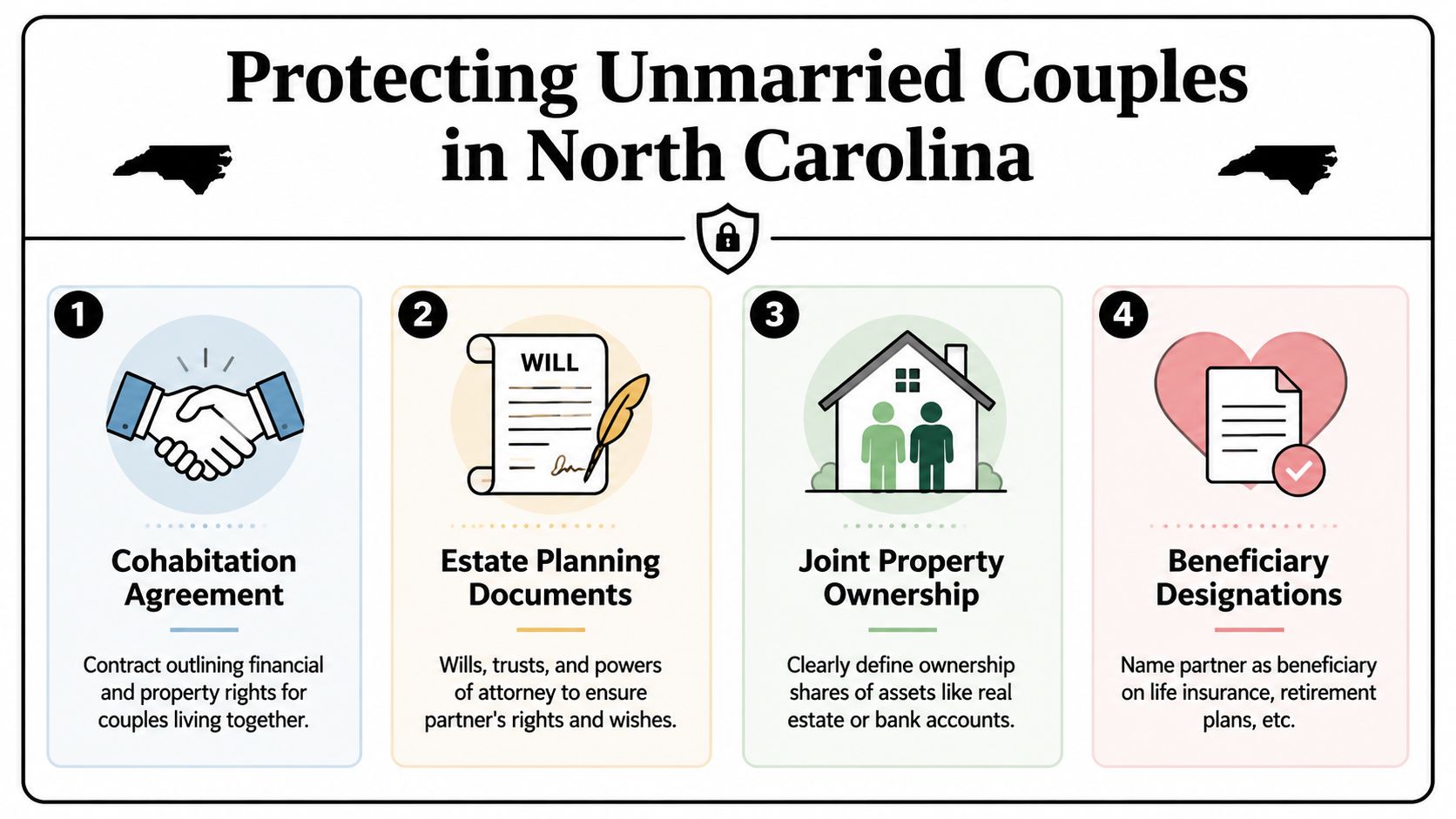
A cohabitation agreement is often the closest thing an unmarried couple has to a roadmap. It can address who owns what, who pays which expenses, how the couple will handle a breakup, and what happens to jointly acquired property.
That matters because North Carolina doesn't provide equitable distribution for unmarried partners. As noted in this explanation of common law marriage and cohabitation agreements in North Carolina, over 70% of North Carolina residents mistakenly believe long-term cohabitation creates marital rights, even though it doesn't.
A solid agreement can cover issues such as:
- Housing terms: Who owns the home, whether one partner will buy out the other, and how mortgage or rent contributions are treated
- Bank accounts and debts: Whether funds are joint, separate, or partly reimbursable
- Personal property: Furniture, vehicles, pets, and other items that often become flashpoints during a breakup
- Exit procedures: How much notice is required if one person moves out and how disputes will be handled
Use estate planning, not assumptions
If you want your partner to inherit, make medical decisions, or handle finances during incapacity, you need documents. Unmarried partners don't get automatic spousal standing.
Key tools often include:
- A will for inheritance instructions
- A trust if the estate plan calls for one
- A health care power of attorney so a partner can act in medical situations
- A financial power of attorney for property and banking matters
- Beneficiary designations on insurance and retirement accounts
If you're reviewing incapacity planning, a Durable Power of Attorney in North Carolina is one of the core documents to discuss.
This video gives a useful overview before you sit down to draft documents:
Title property correctly
Real estate and major accounts should match the couple's intentions. If one partner pays toward a home but isn't on the deed, that can become a serious dispute later. Joint ownership structures, deeds, and beneficiary choices can prevent arguments that otherwise have no clean fix.
For readers who want legal help creating those protections, the Law Office of Bryan Fagan North Carolina Divorce Lawyer page describes representation for absolute divorce and related claims under North Carolina law. In unmarried-couple matters, related planning often overlaps with family law and estate planning issues.
Waiting until a breakup or medical crisis is usually when people learn that an unwritten understanding isn't enforceable.
Common Questions and Your Next Steps
How many years do you have to live together for common law marriage in North Carolina
You don't. North Carolina doesn't create common law marriage based on the length of cohabitation.
If we call each other husband and wife, does that make us married
No. Using those terms socially doesn't create a valid North Carolina marriage.
Do we have marital rights if we have children together
Not automatically. Parents can have rights and obligations involving custody, child support, and parenting decisions, but those are different from spousal rights.
If we moved here from another state, do we need a divorce
Maybe. If you formed a valid common law marriage in a state that recognizes it, North Carolina may treat you as married and require a divorce to end the relationship.
Can my partner inherit from me if we're not married
Not automatically. Unmarried partners should use wills, trusts, beneficiary designations, and powers of attorney if they want legal protection.
If you're dealing with a breakup, planning a move to North Carolina, or trying to protect a long-term partner, don't rely on what friends think the law says. The right answer depends on where the relationship began, whether a valid marriage was formed elsewhere, how property is titled, and what documents are already in place.
A short legal consultation can save months of confusion. It can also prevent avoidable mistakes, such as failing to file for divorce when an out-of-state common law marriage exists, or assuming a shared life automatically creates shared legal rights.
North Carolina residents who need clarity on common law marriage, cohabitation agreements, divorce, support, or estate planning can schedule a consultation with the Law Office of Bryan Fagan. The firm works with individuals and families across North Carolina on family law and related planning issues, and a consultation can help you understand what rights you have now, what rights you don't, and what steps make sense for your situation.