You may be reading this after a night of threats, an argument that turned physical, or a moment when you realized the situation at home isn't going to calm down on its own. You may also be worried about your children, your housing, or whether calling the police will make things worse. Those reactions are common, and in North Carolina, there is a legal process designed to create immediate protection.
A 50B order is North Carolina's domestic violence protective order. It can address contact, access to a home, temporary custody, and other urgent safety issues. It can also intersect quickly with criminal charges and firearm restrictions, which is why getting accurate information matters.
A lot of people searching for help are also trying to solve a custody emergency at the same time. If that's where you are, it may help to read about emergency custody in North Carolina alongside the protective order process, because the facts that support one issue often affect the other.
Navigating a Domestic Violence Crisis in North Carolina
A common pattern looks like this. Two people separate, but one keeps showing up at the home, sending threatening messages, or using the children as a reason to force contact. The person asking for help often isn't thinking in legal terms. They're thinking, “How do I make this stop today?”
That's where a 50B order in NC can become an important tool. It's not just paperwork. It's a court order that can put rules in place fast, then give the court a chance to decide whether longer protection is necessary.
Practical rule: If you feel unsafe, act while the details are fresh. Specific facts matter in court, and people often remember more clearly in the first hours or days after an incident.
Many clients also arrive with the same understandable concern: “I don't know whether what happened counts.” North Carolina law doesn't expect you to diagnose your situation with legal precision before asking for help. But the court will require facts, dates, relationship details, and a clear description of what happened.
The hardest part for many people is that this process is emotional and technical at the same time. You may be managing fear, children, work, and housing while also trying to prepare for court. Clear advice and a calm plan can make that process more manageable.
What Is a 50B Order and Who Is Eligible to File
A 50B order is a civil court order under Chapter 50B of the North Carolina General Statutes. Courts use it to protect a person from domestic violence committed by someone who has a legally recognized personal relationship with them.
That relationship requirement decides many cases early.
In practice, people often focus first on the conduct, the threats, the assault, the stalking, the forced contact through the children. Those facts matter, but the judge also has to decide whether the relationship fits Chapter 50B. If it does not, the court may deny the request even if the behavior is frightening and serious. In those cases, the person seeking protection may need a different legal remedy.
A 50B case may apply if the other person is:
- A current or former spouse
- Someone you live with or used to live with
- The other parent of your child
- A current or former dating partner
- A qualifying family member covered by the statute
It usually does not apply if the person is:
- A neighbor
- A coworker
- A stranger
- A casual acquaintance with no qualifying relationship
That line can feel harsh, especially in cases involving harassment by someone outside the family or dating context. But from a legal strategy standpoint, it is better to identify that problem at the start than to file the wrong case and lose time.
Here is where related legal issues start to overlap. If the person accused of domestic violence is also the other parent, a 50B filing can affect temporary possession of the home, child exchanges, and later custody arguments. If police were called, the same facts may also lead to criminal charges. And if a 50B order is entered, firearm possession can become a serious legal issue for the defendant. Many people misunderstand that point. They assume a gun restriction applies only after a criminal conviction. That is not always true, and mistakes in this area can create new criminal exposure.
A few common examples help. If an ex-boyfriend waits outside your apartment, sends threats, and keeps contacting you after being told to stop, a 50B case may fit if the dating relationship can be shown clearly. If a former spouse uses custody exchanges as a chance to intimidate you, enters the home without permission, or threatens violence, Chapter 50B may give the court a way to address both safety and contact rules. If the person harassing you is a neighbor or coworker, the facts may support protection, but usually not through a 50B claim.
For a fuller explanation of Domestic Violence Protective Orders in North Carolina, review that guide. Many readers also look at North Carolina domestic violence protective order articles to see how these cases are handled in real situations.
Eligibility is not a technical side issue. In court, it is often one of the first questions the judge decides, and the answer shapes everything that follows.
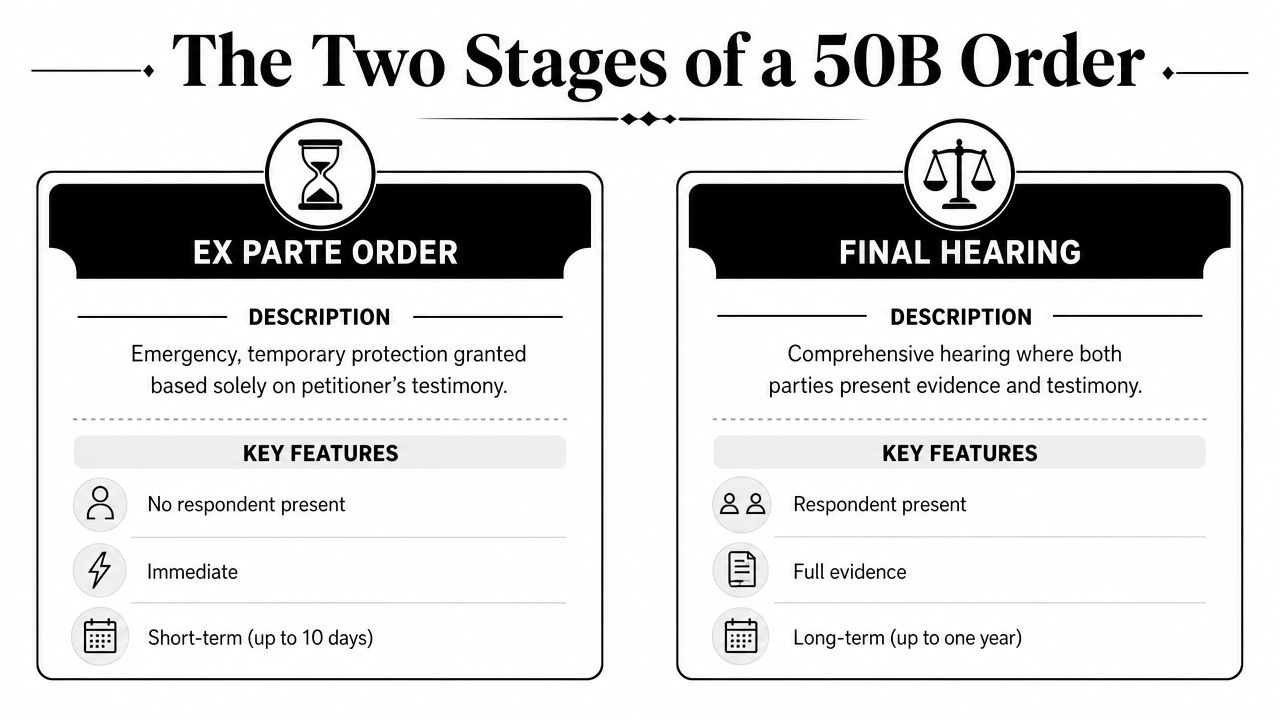
The Two Stages of a 50B Order Ex Parte vs Final Hearing
A 50B case often starts fast. A parent may leave the house with a child, report an assault, and be in court the same day asking for protection. At the same time, the other side may be facing a criminal investigation and immediate limits on contact with the child. That is why it helps to understand the two stages clearly. They serve different purposes, and mistakes at the first stage can affect custody, firearm issues, and the final outcome.
What an ex parte order does
An ex parte order is temporary emergency relief. The judge can hear from the person asking for protection without waiting for the respondent to be present.
The court uses this stage to address immediate danger. If the sworn facts show a current risk of injury, harassment, threats, stalking, forced entry, or similar conduct, the judge can enter short-term protections right away. Those terms may include no contact, temporary possession of the home, and temporary custody-related restrictions if children are at risk.
Specific facts matter. Judges need dates, recent incidents, and details that show why waiting would be unsafe. “He threatened to kill me outside the daycare on Tuesday and followed me home” is far stronger than “he scares me.”
One practical warning matters here. An ex parte order can trigger serious consequences before the final hearing. In some cases, it affects where a child stays in the short term. It can also create immediate problems for a respondent who has firearms. People often assume gun restrictions only follow a criminal conviction. In 50B cases, that assumption can be dangerous.
What happens at the final hearing
The final hearing is the full court hearing where both sides can testify, offer exhibits, and call witnesses. During this hearing, the judge decides whether to enter a domestic violence protective order that lasts longer.
According to the North Carolina Judicial Branch, the ex parte order remains in place until the hearing, and a final 50B order may be entered for up to one year, with renewal available before it expires. In practice, that means preparation starts immediately. There is usually very little time to gather text messages, photos, medical records, police reports, school records, or witness testimony.
This hearing also has strategic importance beyond the 50B file itself. What a party says under oath may later matter in a custody case. If criminal charges are pending, testimony can affect those proceedings too. I tell clients to treat the final hearing as a serious evidentiary hearing, not a simple follow-up to the emergency request.
| Feature | Emergency Ex Parte Order | Final 50B Protective Order (DVPO) |
|---|---|---|
| When it happens | At the emergency stage | After notice and a full hearing |
| Who is present | Usually only the petitioner | Both sides may appear |
| Purpose | Immediate short-term protection | Longer-term court-ordered protection |
| Duration | Temporary until the hearing | Up to one year |
| Can it continue longer | No, it is temporary relief | Yes, renewal may be requested before expiration |
What helps at each stage
At the ex parte stage, clear recent facts help. At the final hearing, proof helps. Those are not the same thing.
A temporary order does not guarantee a final one. The emergency filing may create needed breathing room, but the final hearing is where the judge closely examines credibility, consistency, and evidence. That is often where weak cases fall apart, and where strong cases are proven.
For readers who want more detail on the emergency side of the process, our page on ex parte orders in North Carolina explains how temporary relief works in related situations.
A temporary order can protect you quickly. The final hearing decides whether that protection stays in place.
Step-by-Step Guide to Filing for a 50B Protective Order
The filing process is usually more practical than people expect. You're not expected to draft a complex legal brief. You do need to provide clear facts and follow the court's procedure carefully.
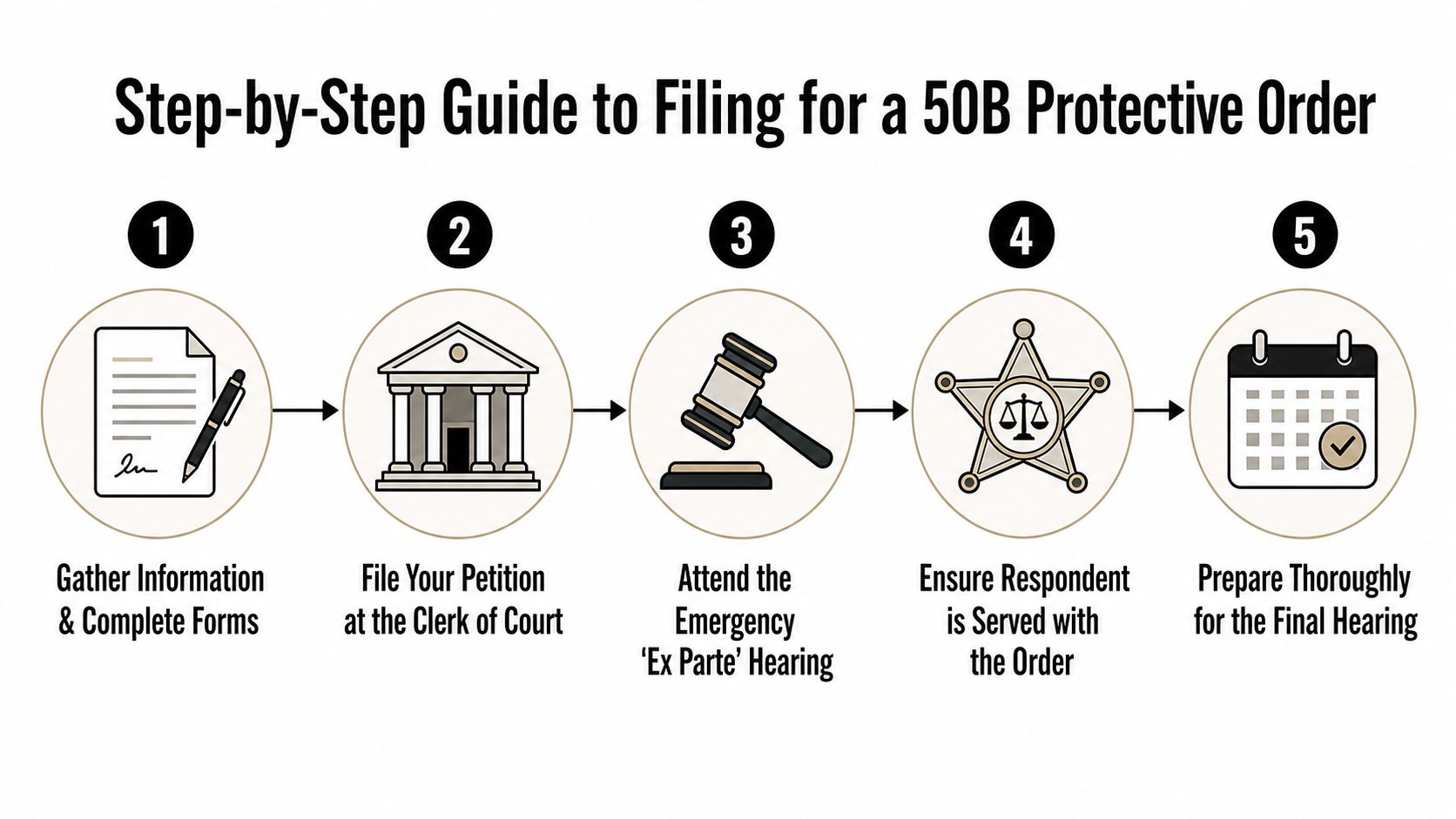
Step 1 Gather facts before you go
Write down the most recent incidents first. Include dates if you know them, locations, injuries, threats, damage, whether children were present, and whether police responded.
Bring what you already have. That may include texts, emails, photos, videos, medical paperwork, or screenshots. Don't panic if your file isn't perfect. A clear timeline is often the most useful starting point.
Step 2 Go to the courthouse and ask for the right forms
In most counties, you'll start with the Clerk of Court's office. Ask for the domestic violence protective order paperwork.
Be specific and truthful when you fill it out. Avoid exaggeration. Judges read a lot of petitions, and credibility matters. A plain, accurate description usually carries more weight than dramatic language.
Step 3 Request emergency relief if needed
If there is an immediate safety concern, the court may consider an ex parte request the same day. Under these circumstances, your recent facts become especially important.
If children are involved, explain how the domestic violence affects them directly. A parent who threatens the other parent during exchanges, exposes the children to violence, or uses the children to force contact raises issues the court may take seriously on an emergency basis.
Step 4 Make sure service happens
The respondent must be formally served with the filed papers and any order that is entered. In practice, that usually means the sheriff handles service.
This step is critical. A court order people talk about at home is not the same as a court order that has been properly issued and served.
Step 5 Prepare for the next legal issue, not just this one
A 50B case often sits next to separation, custody, support, or divorce. For some families, the next filing may be a custody action. For others, it may eventually include divorce paperwork. If that's part of your situation, How to File for Absolute Divorce in North Carolina explains the steps, residency rule, and filing requirements for an NC divorce.
A practical mistake is treating the 50B case as isolated when it may shape later family court decisions. Keep copies of everything you file. Keep a calendar of court dates. Save all new messages after filing.
Preparing for Your Day in Court Evidence and Testimony
The final hearing is where many people feel overwhelmed. The good news is that preparation is more important than polish. Judges don't expect a perfect speaker. They expect a believable witness with organized facts.
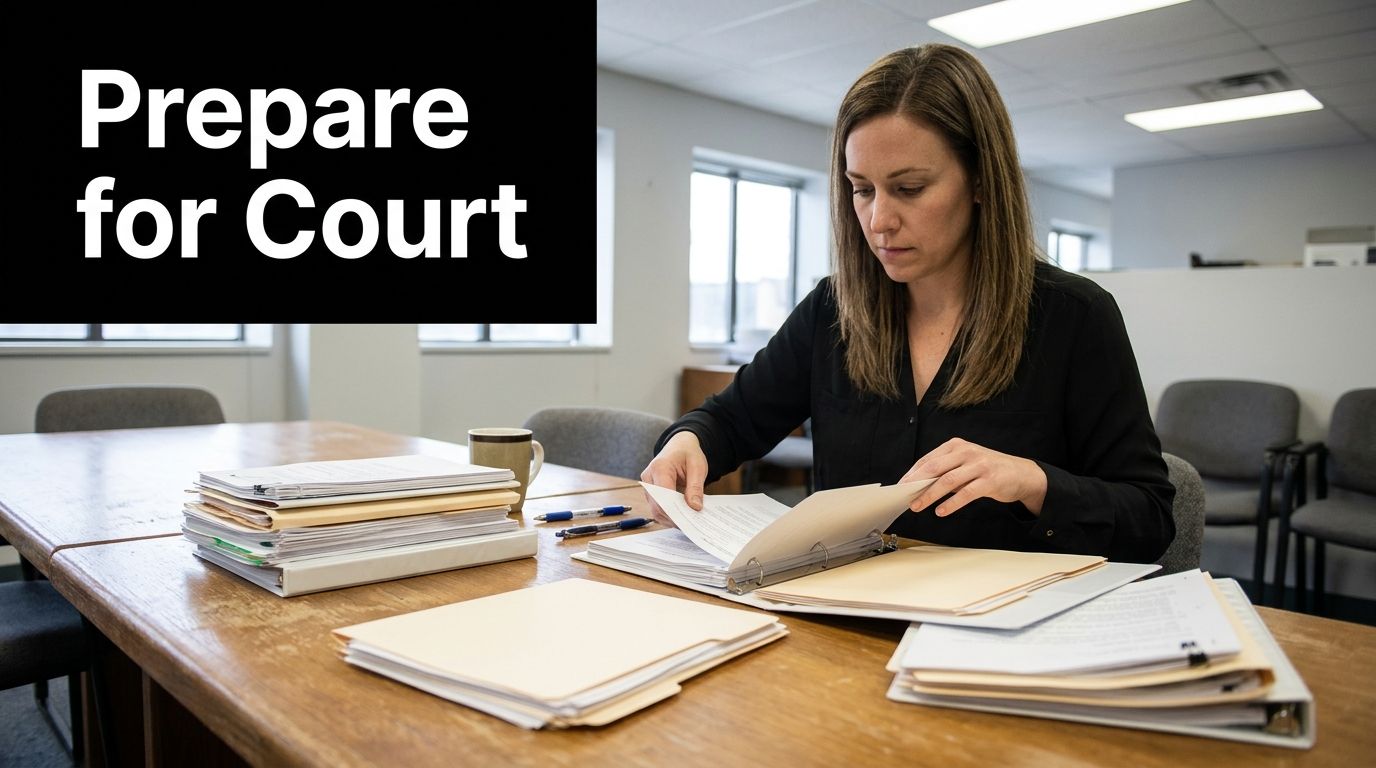
What evidence usually helps
In plain terms, evidence is anything that helps the judge understand what happened and why protection is needed. Strong examples often include:
- Photos: Injuries, torn clothing, damaged doors, broken phones, or destroyed property.
- Messages: Threatening texts, emails, voicemails, or social media messages.
- Witnesses: People who saw the incident, saw the aftermath, or heard the threats directly.
- Police involvement: Officers who responded, incident reports, or related criminal paperwork.
- Medical records: Treatment that connects to the incident.
- Calendar notes: A timeline you created soon after the events can help you testify clearly.
How to testify effectively
Speak in chronological order when you can. Start with the most recent or most serious event if that is easier, then explain the pattern around it.
Avoid arguing with the other side while you are on the stand. Answer the judge's questions directly. If you don't know or don't remember something, say that plainly. Trying to fill gaps with guesses can hurt your credibility.
The strongest testimony usually sounds simple. It is specific, consistent, and tied to things the judge can verify.
A practical example helps. Suppose a father shows up during a child exchange, shouts threats in front of the child, grabs the mother's arm, and later sends texts saying he'll come back that night. In court, the most effective presentation isn't a speech about how terrible he is. It is a sequence of proof: the exchange location, the child's presence, the physical contact, a witness, a photo of the bruise, and the follow-up texts.
For a basic overview of courtroom preparation, this video may help frame what organized testimony looks like in a protective-order setting:
What people often get wrong
Some petitioners bring a stack of papers with no order. Some respondents focus only on denying violence and ignore threshold legal issues that may matter. Others assume the judge has already read everything in detail.
Bring copies. Label your exhibits if possible. Know which messages matter most. If your case also touches custody, be ready to explain how the alleged conduct affected the children, not just the adults.
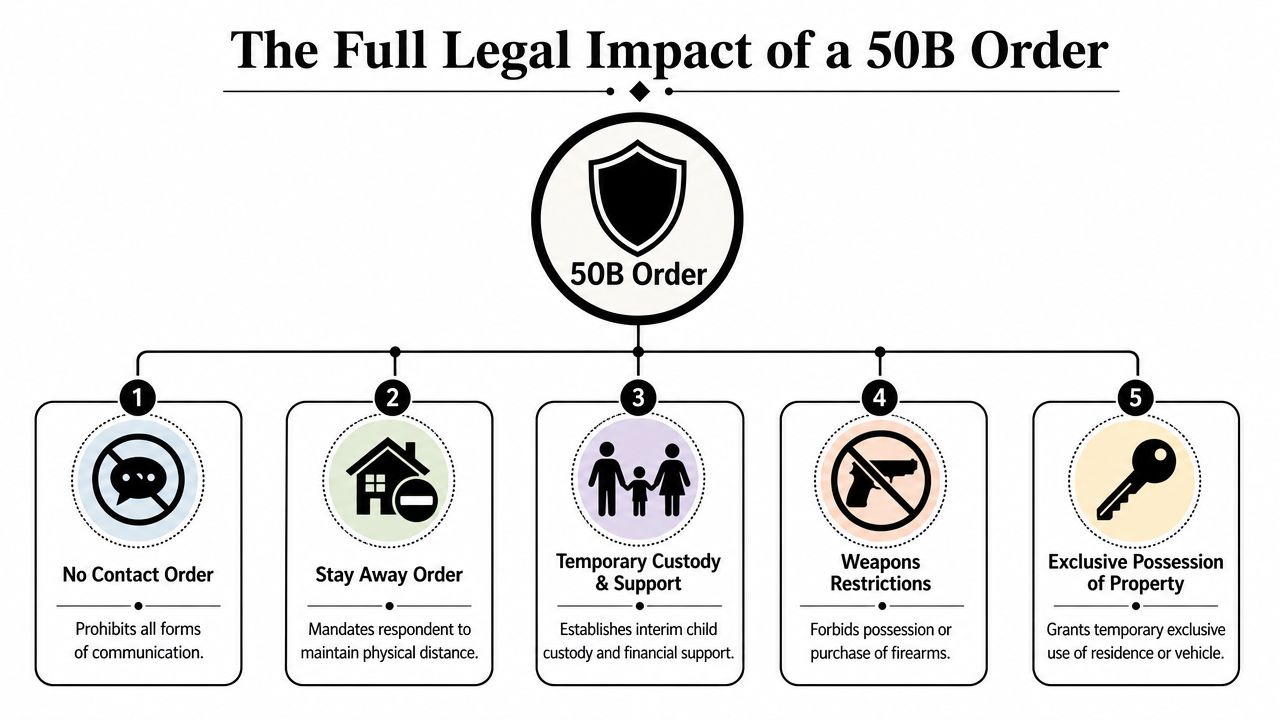
The Full Legal Impact of a 50B Order
A 50B order changes more than contact between two adults. In many cases, it quickly affects where someone lives, how child exchanges happen, whether a parent sees the children without restrictions, and whether criminal charges become more likely from the same set of facts.
A common example is a parent who expects the 50B case to stay separate from custody, then learns the judge can enter temporary child-related terms that shape the routine immediately. Another is a respondent who treats the case like a minor civil matter, then faces arrest after sending one text that violates the order. Those mistakes are avoidable, but only if you understand how these systems overlap.
Custody, possession of the home, and daily logistics can change immediately
A 50B order can include no-contact terms, stay-away provisions, temporary possession of a shared residence, and temporary custody or exchange terms involving children. For families in crisis, that relief can create needed structure fast.
It also creates a record. Judges in later custody litigation often see the same witnesses, the same messages, and the same allegations that first surfaced in the 50B case. That does not mean the protective order decides permanent custody by itself. It does mean the hearing can matter far beyond the short term.
This is one of the hardest trade-offs in practice. Emergency relief may be necessary for safety. It may also become part of the factual foundation for later custody arguments about violence, judgment, parental fitness, and the children's best interests.
Firearms are one of the most misunderstood parts of a 50B case
Many people assume gun restrictions only apply after a criminal conviction. In North Carolina, that assumption can create serious legal trouble.
A 50B order can require the surrender, transfer, or destruction of firearms and ammunition during the life of the order, and federal firearm restrictions may also apply, as discussed in this North Carolina 50B overview. If firearms are in the home, in a vehicle, in a safe, or stored with easy access, the respondent should get specific legal advice right away and follow the order exactly.
“I thought this was only a civil case” does not solve a firearm violation.
Petitioners should be just as direct on this issue. If the other party has guns, carries regularly, has made threats involving weapons, or has access to firearms through work or family members, say that clearly in court. Judges need concrete facts, not general fear.
Violations can lead to arrest and new criminal charges
A 50B order is a civil order, but violating it can produce criminal consequences very quickly. Under G.S. 50B-4.1, a violation can be charged as a Class A1 misdemeanor, and officers may make an arrest based on the alleged breach.
That point matters in real life because many violations happen through conduct people wrongly dismiss as harmless. A text saying “can we talk,” showing up at a child exchange outside the terms of the order, asking a relative to pass along a message, or going back to a prohibited location can all create new exposure. If there is already a related assault charge, communicating threats charge, or trespass charge, the 50B violation can complicate bond conditions, defense strategy, and plea discussions.
The overlap with criminal court is where I see costly mistakes. Statements made in the 50B case may affect the criminal case. At the same time, refusing to take the 50B seriously because “the criminal lawyer will handle it later” can make both matters worse.
Common real-world consequences
The legal effect of a 50B order often includes:
- Restricted contact: The respondent may be barred from calling, texting, emailing, messaging through apps, or using other people to make contact.
- Stay-away terms: The order may prohibit presence at a home, workplace, school, daycare, or another listed location.
- Temporary child-related terms: Custody, exchanges, and parenting time may change on short notice.
- Housing consequences: One party may receive temporary possession of the shared home.
- Firearm restrictions: Possession, access, transfer, and storage issues can become urgent immediately.
- Criminal exposure for violations: Police do not need to wait for a separate civil hearing before acting on an alleged violation.
The practical rule is simple. Read every line of the order and follow it precisely. Do not rely on informal permission from the other party, a family member, or even a well-meaning officer at the scene if the written order says otherwise. In a 50B case, small decisions often carry the biggest consequences.
Your Next Steps and Answers to Common 50B Questions
A 50B case often turns on details that seem small until you reach court. That is especially true when children, criminal charges, or disputed relationship status are involved.
Can a 50B order affect child custody right away
Yes. Temporary custody relief can be part of the emergency process in the right case. That catches many people off guard. Confusion is common here. A 2024 UNC School of Government study found that 63% of respondents incorrectly believed they only needed to prove non-violence, rather than addressing the specific no personal relationship standard under G.S. 50B-1 (North Carolina Chapter 50B statutory material). In other words, custody issues may move quickly, but the legal threshold still matters.
Will a 50B order show up as a criminal conviction
No. The protective order itself is a civil order, not a criminal conviction. But if someone violates it, that alleged violation can lead to criminal charges, which is a very different matter.
Can a 50B order be renewed or changed
It can be renewed, but timing matters and the request should be handled carefully. Whether a specific term can be modified depends on the posture of the case and the court's authority at that stage.
What should I do if I've been served with a 50B order
Read every term closely and follow it exactly. Don't assume the other party can waive the order informally by text or phone call. Don't try to fix the situation through direct contact. Get legal advice quickly, especially if the order affects your children, your home, or firearms.
If you live in North Carolina and need guidance about seeking or responding to a 50B order, custody concerns, or related criminal exposure, schedule a consultation with Law Office of Bryan Fagan. Clear legal advice at the beginning can help you protect your safety, your parental rights, and your next steps in court.