You're already dealing with enough. A missed exchange turns into a heated text thread, a blocked call leaves your child confused, and then the other parent says you're “overreacting” when all you want is the custody order followed. In North Carolina, that moment matters, because enforcement is real, but it only works when the order is clear, the violation can be proven, and the right motion is filed in the right court.
The hardest part is that many parents think every violation is the same. It isn't. Some problems are straightforward contempt cases. Others are really drafting problems, or they call for a modification petition instead of a punishment request. If you're trying to figure out how to enforce a custody order in NC, start with the order itself, then work outward from the facts you can prove.
When a Custody Order Is Violated in North Carolina
A mother waits at the usual exchange spot. The father does not show. Ten minutes pass, then 30, then the child's phone goes straight to voicemail. By evening, she gets a text saying the child will be returned “tomorrow,” even though the order says Sunday at 6 p.m. That kind of moment is upsetting, and it also raises a narrower legal question. Is this a true violation of a custody order, or a problem the court may see as unclear language, bad communication, or a request to change the schedule?
North Carolina courts treat custody orders as binding, and repeated disobedience can be enforced through contempt. Under the North Carolina Judicial Branch child custody guidance, a parent may file a Motion for Order to Show Cause or a Motion for Contempt, and a judge can impose remedies that include a verbal reprimand, a fine, jail time, or attorney's fees. The harder question is often the first one, whether the order is specific enough to enforce. If the wording is vague, the court may have trouble separating a real breach from a dispute about interpretation.
What counts as a real violation
A missed exchange, a blocked call, or a late return can support enforcement when the conduct violates a clear term in the order. Repeated interference with visitation can also matter, because North Carolina courts may view a pattern of interference as part of a broader custody problem, not just a one-time mistake. The key issue is whether the conduct was willful, not accidental.
Practical rule: if you cannot point to the exact sentence in the order that was violated, the court may see a disagreement instead of contempt.
Some parents assume they should call law enforcement first. That can make sense if there is an immediate safety concern. In an ordinary custody dispute, though, police usually will not rewrite a custody order at the curb, and they are not a substitute for a proper court filing. The better first move is to preserve the facts, read the order line by line, and decide whether the problem is enforcement, modification, or both.
A vague order creates a separate problem. If the order says parenting time is “reasonable” or leaves exchanges loosely defined, the court may have little to measure. That is where many parents get stuck, because enforcement depends on language the judge can apply. In that situation, a contempt motion may be a poor fit, and a modification request may do more to fix the dispute than a punishment request.
Legal Motions for Enforcing Custody Orders in NC
A custody order can be violated in ways that look small on paper and feel huge in daily life. A parent can miss exchanges, refuse calls, or keep the child beyond the scheduled return time, but the first question for the court is still whether the order is specific enough to enforce. If the language is too loose, contempt may not solve the problem, even when the frustration is real.
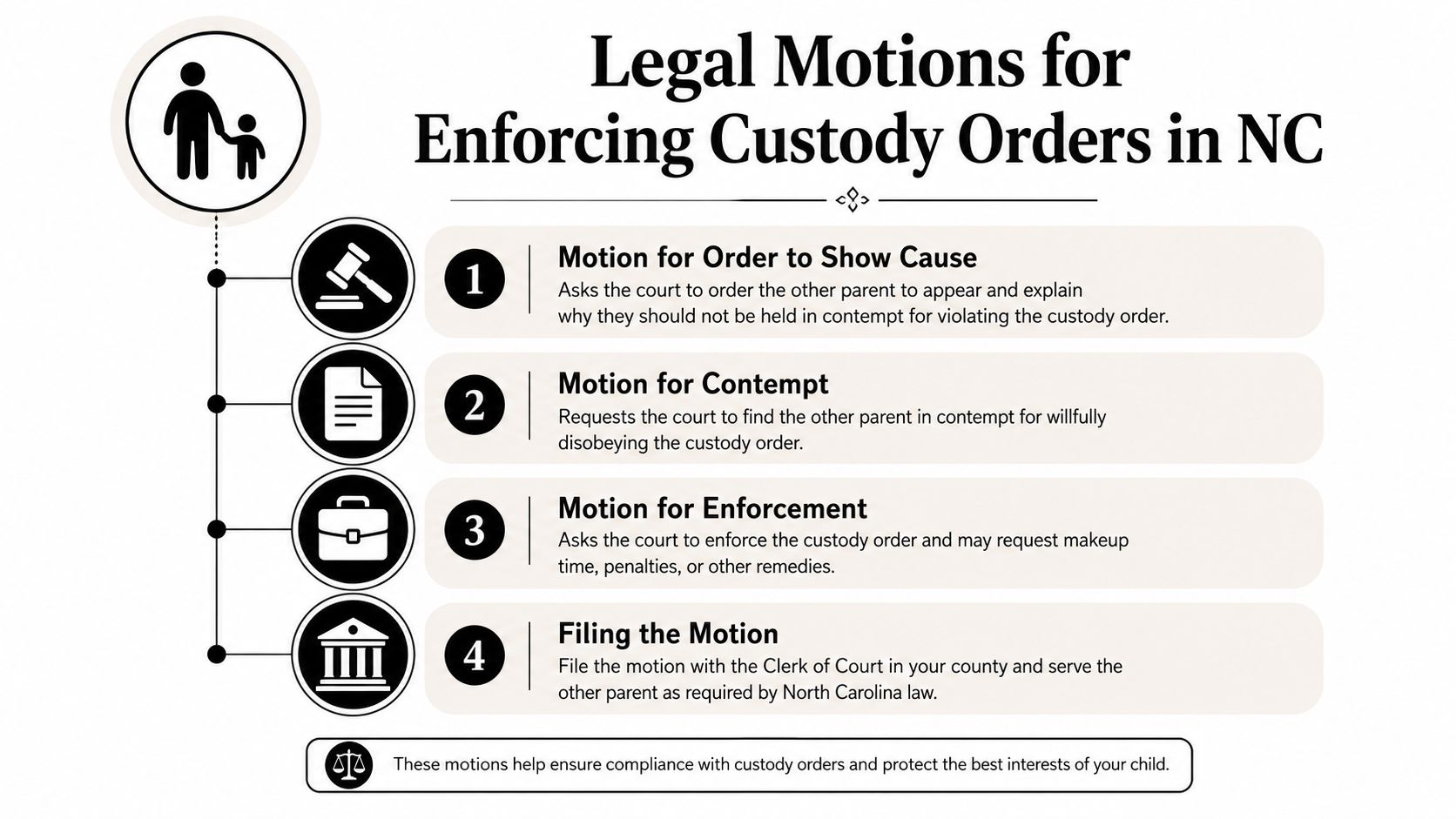
How contempt works in practice
North Carolina courts look for three things. The order must be clear, the other parent must have notice of it, and the violation must be willful. If the order leaves too much room for argument, or if the conduct was accidental rather than deliberate, contempt gets harder to prove.
A motion should read like a timeline, not a grievance. List each missed exchange, each denied phone call, and each late return on its own terms, with the date and the exact part of the order that was ignored. A filing that says the other parent was “noncompliant” without more detail usually gives the court very little to work with.
Civil contempt and criminal contempt do different jobs. Civil contempt is used to force compliance, often when a parent blocks visitation to pressure the other side into giving in. Criminal contempt is used to punish repeated defiance of a court order, especially when the same conduct continues after warnings. The practical choice depends on what you need the court to do, not on how angry the situation feels.
A concrete example helps. If one parent keeps the child past the exchange time to force agreement on extra weekend time, civil contempt may fit because the court can order compliance and try to restore the schedule. If the same parent keeps ignoring the order after repeated violations and notices from the court, criminal contempt may be the better fit because the issue is no longer a one-time failure, it is open defiance under Chapter 5A. The North Carolina Judicial Branch explains that the court can impose penalties such as a verbal reprimand, a fine, jail time, or attorney's fees if it finds a violation. North Carolina Judicial Branch child custody guidance
A contempt motion is not always the best answer. If the order is so vague that it does not say exactly when exchanges happen, where they happen, or what happens with missed time, the judge may not have a clean way to enforce it. In that situation, a modification petition may do more to fix the dispute than a punishment request, because it addresses the wording of the order itself. For a broader custody overview, Child Custody in North Carolina is a useful reference for how North Carolina courts approach the child's best interests.
One mistake I see often is filing a motion that sounds strong but proves little. The better case is specific, tied to the order, and focused on what the court can enforce. If the judge cannot tell what the other parent did, contempt becomes much harder to obtain.
Collecting and Presenting Evidence of Custody Violations
The difference between a persuasive enforcement case and a frustrating one is usually the paper trail. Judges do not need a dramatic story, they need a reliable record. A good violation log shows what happened, when it happened, and how you know it happened.
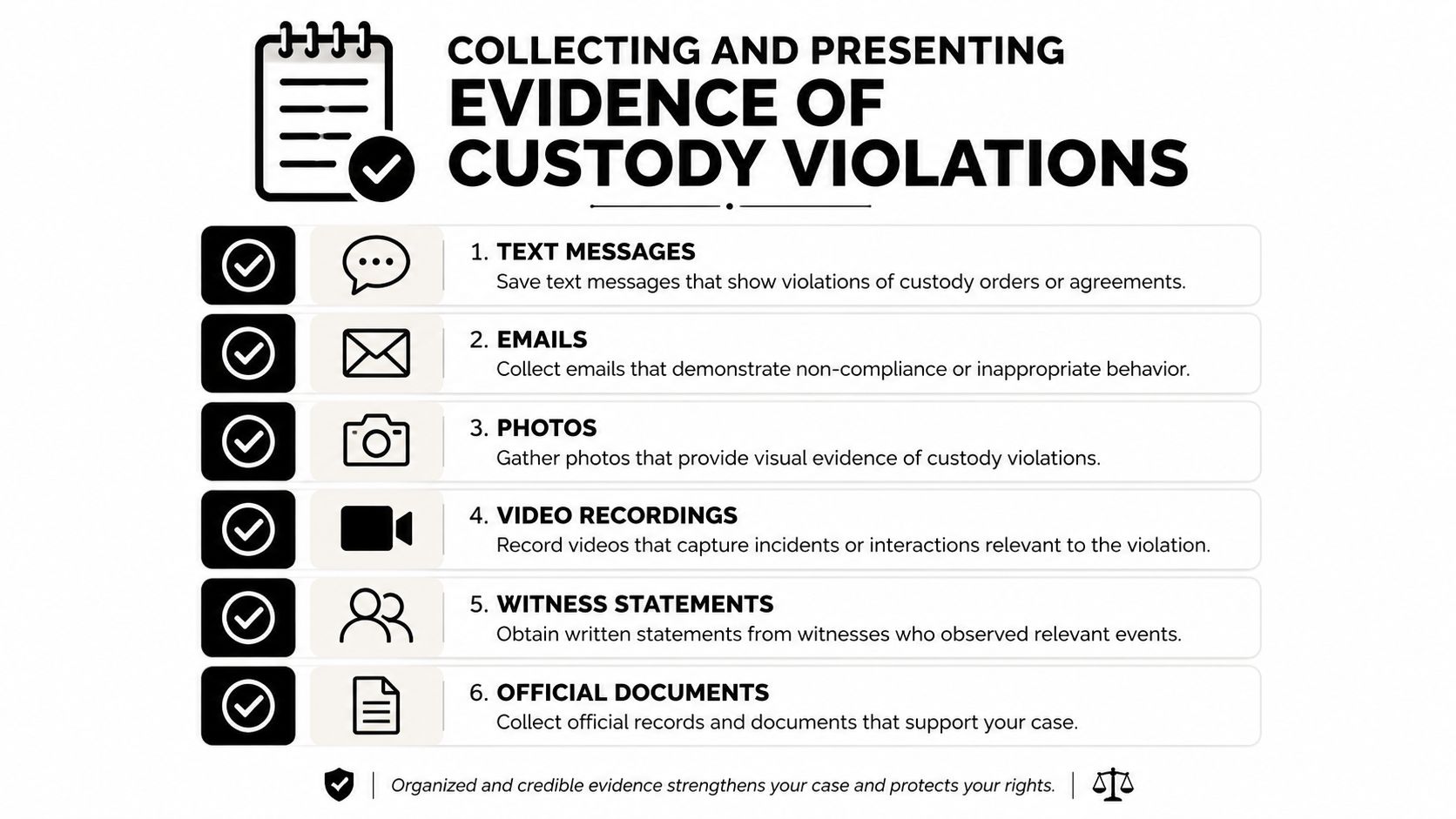
Build a violation log the court can follow
Start with the basics. Write down the date, time, location, scheduled exchange, what the order required, what happened, and how the other parent responded. Then attach proof. In North Carolina contempt cases, the most useful corroboration often includes texts, emails, call logs, school or daycare records, and witness declarations. That evidence helps the judge see a pattern instead of a single, disputed event. NC child custody enforcement remedies and penalties
The details matter more than the volume. One text saying “I'm keeping her until tomorrow” may be enough to matter if it matches the order. Ten pages of angry messages without dates and context can hurt the case because they bury the violation in emotion.
Common mistakes that weaken contempt
The most common problem is vagueness. A motion that says “he keeps interfering” doesn't help much if it never identifies the blocked phone calls or the late returns. Another mistake is relying only on memory. By the time the hearing comes around, a parent may remember the conflict clearly, but the judge needs proof, not a summary.
Keep screenshots in their original form when you can, and save the surrounding messages, not just the single line that feels strongest. Preserve school notes, daycare sign-in sheets, and records that show who picked the child up and when. If someone else saw the exchange or heard the blocked call, get a short declaration from that witness.
A practical example helps. If the order allows a Friday evening call and the other parent ignores it three Fridays in a row, log each date separately, note the time, and save the call history for those evenings. That sort of record makes willfulness much easier to argue because the pattern becomes visible.
For an external perspective on custody disputes that turn on the child's day-to-day stability, The North Carolina Custody Process and Mediation is helpful background, especially when enforcement starts edging into modification territory.
When the Custody Order Itself Is the Problem
Some custody disputes start with a parent who will not follow the order. Others start with an order that is too vague to enforce cleanly. If the decree says little about holiday exchanges, supervised visitation, or phone contact, the judge may have a hard time deciding whether a real violation occurred. That is the gap many parents overlook, and it can waste time if they rush into contempt before asking whether the order can be properly measured.
Vague wording creates the same argument again and again. One parent reads “after school” as 3:15 p.m., while the other treats it as whenever the child is ready. A holiday clause that leaves out pickup times invites conflict every year. A supervised visitation provision that does not identify who supervises, where the visit happens, or how long supervision lasts is difficult to enforce because the court cannot tell when the rule was broken.
Contempt is not always the right first move
If the order is unclear, a contempt case may fail even when the other parent's conduct feels unfair. In that situation, the question is whether the problem calls for punishment, clarification, or a change to the order itself. North Carolina treats permanent custody orders as modifiable when there has been a substantial change in circumstances affecting the child, so repeated disputes can point in two directions at once, contempt for past conduct and modification for the future structure. North Carolina modification guidance
A clean way to separate the two is simple. Contempt punishes a violation of a clear order. Modification changes the order because the existing one no longer fits the child's situation. If you need a closer look at that process, how to modify a custody agreement explains the kind of change the court is looking for.
Strategic point: if the schedule keeps breaking down because the language is fuzzy, filing the same contempt motion again and again may miss the real fix.
Make-up parenting time can help when the violation is limited and the rest of the order still works. Courts often award a day of make-up time for each day of denied parenting time, although the exact remedy depends on the facts and the judge's view of what is fair. Repeated interference is different. If the same vague clause keeps causing disputes, a clearer order may do more good than another round of contempt litigation.
The strongest clients are usually the ones who ask one hard question early. Is the problem the parent, or the paperwork. Answering that directly saves time, money, and emotional energy.
Enforcing Out-of-State Custody Orders in North Carolina
An out-of-state custody order does not become enforceable in North Carolina merely because the child is now living here. The order has to be registered in a North Carolina district court before a judge can enforce it like a local order or consider whether it should be changed. That registration step is the gateway, and missing it is one of the quickest ways to stall a case. Registration of out-of-state custody orders
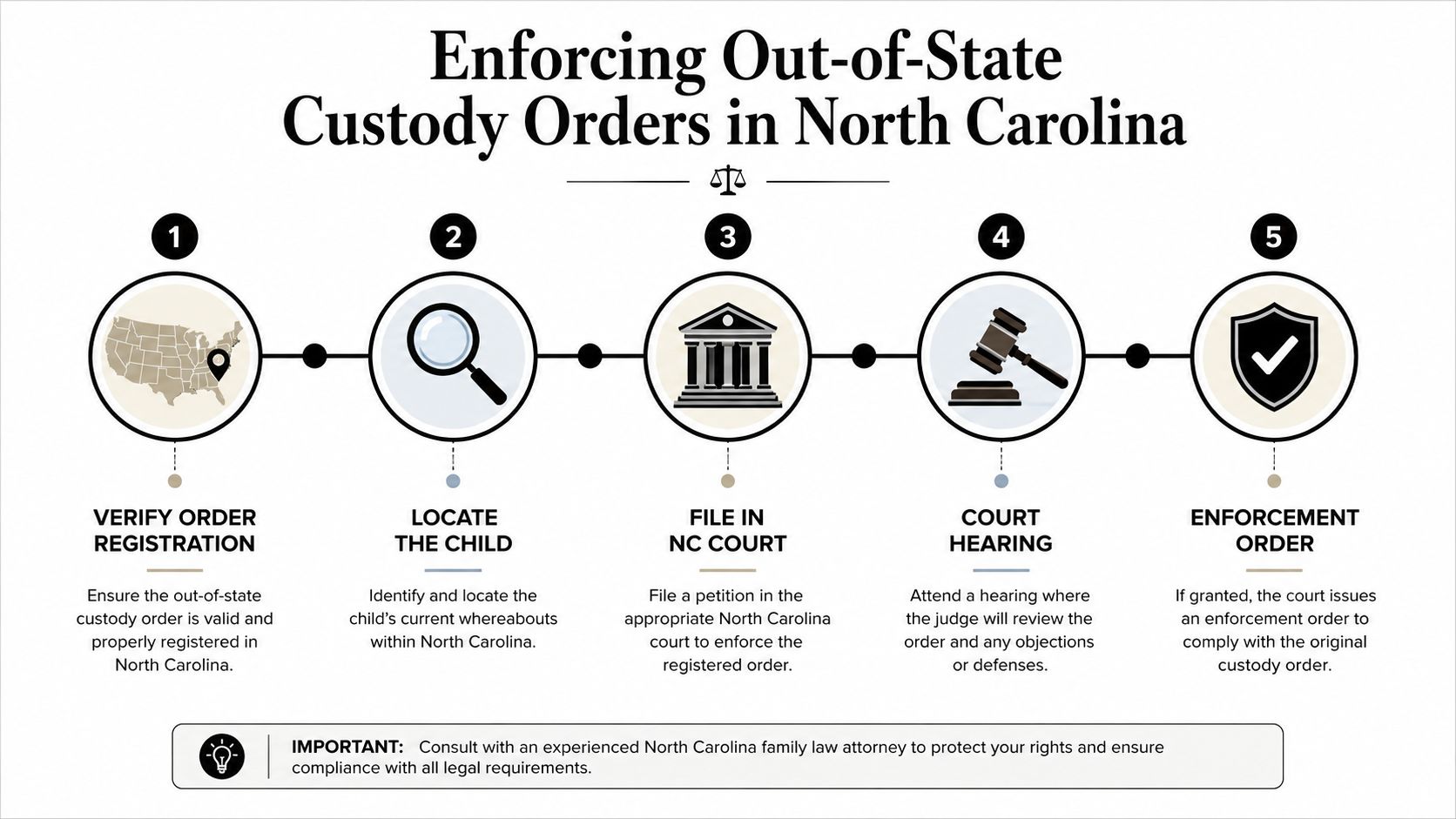
What the registration packet needs
The usual packet includes a petition, two copies of the foreign custody order, at least one certified copy, and proper service of the stamped registration notice on the other parent. Form AOC-CV-660 is part of the standard registration process, and these forms are available through the North Carolina Judicial Branch website or the clerk of court's office.
If the situation is urgent, the filer can seek expedited enforcement with Form AOC-CV-665. In a true safety emergency, Form AOC-CV-667 can be used for a warrant directing immediate physical custody of the child. Those remedies are serious, and the court will expect serious facts, not just frustration with a parent who will not cooperate.
The mistakes that slow cases down
The technical failures are usually predictable. A missing certification can derail the filing. So can filing in the wrong county. So can serving the registration notice the wrong way. Any of those mistakes can delay enforcement, which is the last thing a worried parent wants when time matters.
A parent dealing with an interstate case should also understand that North Carolina requires registration before enforcement or modification of an out-of-state order. That rule keeps the court from acting on a foreign judgment that has not been properly placed in the North Carolina file. If the order came from another state and the child now lives here, the process has to start with the paperwork, not with the argument at the courthouse window. For a broader look at interstate custody issues, custody if parents live in different states NC gives useful background.
If the child is in immediate danger, urgent relief may be appropriate, and the filing should spell out that danger in concrete terms. If the problem is ongoing disobedience rather than immediate harm, a standard registration and enforcement approach is usually the cleaner path. The right filing choice depends on whether the facts call for fast intervention or a more ordinary enforcement request.
Possible Outcomes and Sanctions for Custody Violations
A custody enforcement case is often about getting the schedule respected and the child out of the middle of the conflict. North Carolina courts respond differently depending on what happened. A first missed exchange does not usually call for the same result as a parent who keeps blocking visitation after repeated warnings. The court also looks at a point many parents miss, whether the order is specific enough to enforce in the first place.
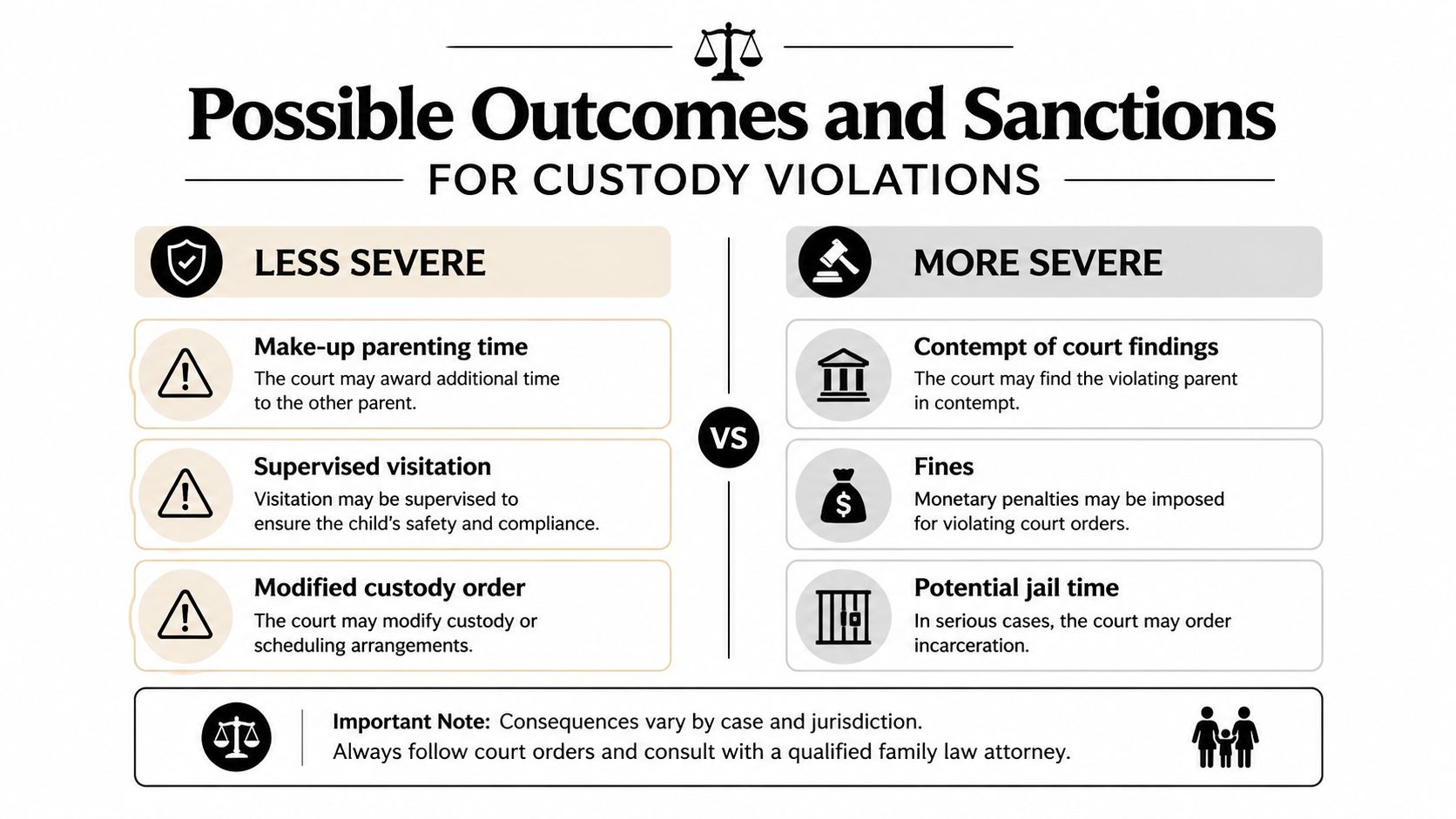
What courts can do
North Carolina courts have several remedies, and the response usually tracks the seriousness of the violation. A judge may order make-up parenting time when the problem is a missed visit or an isolated exchange dispute. That kind of relief is aimed at restoring lost time, not punishing a parent for a one-off mistake.
More persistent violations can lead to contempt. In North Carolina family law, contempt is the tool judges use when a parent has not followed a clear court order and the court needs a way to force compliance or punish willful disobedience. For a closer look at how contempt works in these cases, see contempt in North Carolina family law. The response can be different depending on whether the parent ignored the order once, kept doing it after notice, or refused to comply in a way that affected the child over time.
The North Carolina Judicial Branch child custody guidance explains that possible penalties can include a verbal reprimand, a fine, jail time, or attorney's fees. Those outcomes are not automatic, and judges usually choose the option that fits the conduct in front of them. A judge may start with a warning or corrective order when the violation is limited. Repeated or willful interference is more likely to bring stronger sanctions, especially when the order was clear and the parent knew exactly what was required.
When modification becomes part of the remedy
Repeated interference with visitation can also support a custody modification request. That matters when the core problem is not just one bad exchange, but a parenting plan that keeps breaking in the same place. If the order is too vague, too hard to follow, or written around a situation that no longer fits the child's routine, contempt alone may not fix the underlying problem.
Sometimes the best outcome is not punishment. If the loss is mostly missed parenting time, make-up time may be the most practical remedy. If the issue is a parent who keeps refusing to cooperate, contempt may be the better path. If the structure of the order keeps producing the same conflict, a modification petition may be the only option that changes the pattern for good.
The chart below gives a simple visual of how custody violations can lead to different sanctions. A chart illustrating potential legal consequences and sanctions for parents violating court-ordered child custody arrangements.
Parents usually want to know what will happen next. The honest answer is that the court looks at the violation pattern, how specific the order is, and whether the requested remedy helps the child. That is why the strongest enforcement strategy starts with the result you need, not just the frustration that brought you to court.
Getting Legal Help to Enforce Your Custody Order
Custody enforcement wears people down. You're already juggling parenting time, school schedules, bills, and the emotional fallout of someone ignoring a court order. A lot of parents wait too long because they worry about cost, conflict, or whether the case is “strong enough.” Those concerns are real, but so is the risk of letting a pattern continue.
The right legal help can narrow the issue fast. A lawyer who works regularly with North Carolina custody enforcement can review the order, sort out whether the language is enforceable, identify the best motion, and help build the proof the judge will expect. That matters because a contempt filing, a modification petition, and an emergency request each answer a different legal question.
The Law Office of Bryan Fagan works with North Carolina families on custody enforcement matters, including situations involving contempt, modification, and interstate orders. In a case like this, legal help is not just about filing paperwork, it's about choosing the right remedy and avoiding the procedural mistakes that slow everything down. If you're trying to protect time with your child and stop repeat violations, a consultation can help you decide whether your next step is enforcement, clarification, or modification.
North Carolina parents often feel pressure to handle this alone because they don't want to escalate things further. The problem is that silence rarely fixes a broken schedule. A focused legal strategy usually does more to reduce conflict than another round of back-and-forth texts.
If your custody order is being ignored, the next step should be a clear legal review of the order, the violations, and the best enforcement path under North Carolina law. Visit Law Office of Bryan Fagan to schedule a consultation and talk through your custody enforcement options with a North Carolina family law team that understands the local court process.