You open the mail, see a notice about custody mediation, and your stomach drops. You may already be juggling school pickup, bedtime, work, and tense texts with the other parent. Now the court is telling you to attend another process before you can even get in front of a judge.
That reaction is normal.
Many parents looking up child custody mediation in NC are worried about the same things. Do I have to go? Will I be forced to agree? Can the mediator decide where my child lives? What if the other parent is unreasonable? Those questions matter because mediation is not just a meeting. It can shape the parenting plan your family lives under for a long time.
A common example looks like this. One parent files for custody after a separation. The parents disagree about weekdays, holidays, and school decisions. Soon after, the court refers the case to mediation. The parent who expected a hearing first is surprised to learn that North Carolina usually requires this step before the case moves forward. That surprise often creates more anxiety than the session itself.
What helps most is understanding the process before you're sitting in the room. When you know what North Carolina requires, what the mediator can and can't do, and what parts of an agreement deserve careful review, you make better decisions.
Navigating Your First Step in a Custody Dispute
If you're at the beginning of a custody case, everything can feel urgent at once. You want stability for your child, but you're also trying not to say or sign the wrong thing. Mediation often enters the picture before parents have had time to fully process what litigation in North Carolina looks like.
For many families, the first shock is that mediation isn't optional in the usual contested case. The second shock is that it isn't a courtroom event at all. It's a structured settlement process focused on parenting issues, and that difference matters.
Consider a simple scenario. A mother wants the children to stay in their current school district. A father wants more overnights and a holiday schedule that reflects his work calendar. They don't need a judge to decide every detail if they can reach a workable parenting plan themselves. Mediation gives them a setting to try.
Practical rule: Mediation works best when you treat it as a planning session for your child's daily life, not a stage for proving who was right during the relationship.
Parents also get confused about what mediation is supposed to accomplish. It isn't therapy. It isn't punishment. It isn't a shortcut to automatic equal time. It's a chance to negotiate issues like exchanges, vacations, communication, and decision-making in a more controlled environment than trial.
That doesn't mean you should walk in casually. A mediated agreement can have serious legal consequences. The smartest approach is calm preparation. Know your goals, know your pressure points, and know what you need your parenting plan to address before you ever sit down with the mediator.
What Is Child Custody Mediation in North Carolina
A custody case in North Carolina often feels like it is headed straight for a judge. In many cases, there is an important stop first. The court sends parents to custody mediation so they have a structured chance to work out a parenting plan before asking a judge to decide the dispute.
In plain terms, child custody mediation is a court-connected settlement process for parents who disagree about custody or visitation involving minor children. Under N.C. Gen. Stat. § 50-13.1, the court generally refers contested custody and visitation cases to mediation unless a judge excuses the parties for good cause. If you want background on how courts approach these disputes more broadly, this overview of North Carolina child custody laws can help frame the legal issues that sit behind the mediation session.
That court referral matters for a practical reason. Mediation is not just a meeting on the calendar. It is part of the custody process itself, and what happens there can shape whether your case ends with your own agreement or continues to a hearing. You can see how it fits into the larger timeline in The North Carolina Custody Process and Mediation.
Why North Carolina requires mediation
North Carolina uses mediation because parents are usually in the best position to build the details of daily life for their children. A judge can decide where a child will live, when exchanges occur, or how holidays are divided. Parents, however, are the people who know the school start time, the soccer practice schedule, the childcare problem on teacher workdays, and the tension points that make exchanges harder than they look on paper.
That is why mediation often works like an architect's planning table. The mediator does not live in the house and does not choose the design. The mediator helps the people who will live with the plan sort through the layout before construction begins. In custody cases, that means discussing issues such as regular schedules, holidays, transportation, communication, and decision-making.
This also explains why the agreement you sign deserves careful attention. A parenting plan reached in mediation can become a court order. Once that happens, it is no longer just an informal understanding between parents. It carries legal force.
What the mediator does and does not do
A mediator is a neutral professional assigned through the court's custody mediation program. The mediator guides the discussion, keeps the conversation focused, and helps parents test whether a proposed schedule will work in real life.
The mediator does not give either parent legal advice. The mediator does not decide who is the better parent. The mediator does not impose a custody schedule if you and the other parent remain stuck.
That distinction clears up a common misunderstanding. Many parents walk in expecting someone in the room to settle the argument for them. Mediation does not work that way. The mediator manages the process. The parents decide whether to reach an agreement. If they cannot, the unresolved issues stay in the court case for a judge to address later.
A simple comparison helps:
| Role | What that person does |
|---|---|
| Mediator | Guides discussion and helps parents explore possible agreement |
| Attorney | Gives legal advice and protects your legal position |
| Judge | Decides unresolved custody issues if no agreement is reached |
The legal and strategic point is easy to miss when you are stressed. Mediation is designed to encourage settlement, but it is also a moment where unclear language, rushed concessions, or poorly planned schedules can follow you long after the session ends. A good result is not just getting a signature. A good result is reaching terms you can live with and, if entered as an order, enforce later.
The Step-by-Step NC Mediation Process Explained
You file for custody, and then a notice arrives telling you to attend mediation before the judge will hear the dispute. For many parents, that moment feels like the case has taken a detour. In North Carolina, it usually has not. Mediation is part of the court process in many custody and visitation disputes, and knowing the sequence helps you make better decisions before you ever sit down with the mediator.
Early in the case, the court refers a contested custody or visitation matter to mediation before or at the same time the matter is scheduled for hearing, as described by the North Carolina Child Custody and Visitation Mediation Program. That referral can also come up in some modification and contempt matters if custody or visitation issues are still disputed.
A quick visual can help:
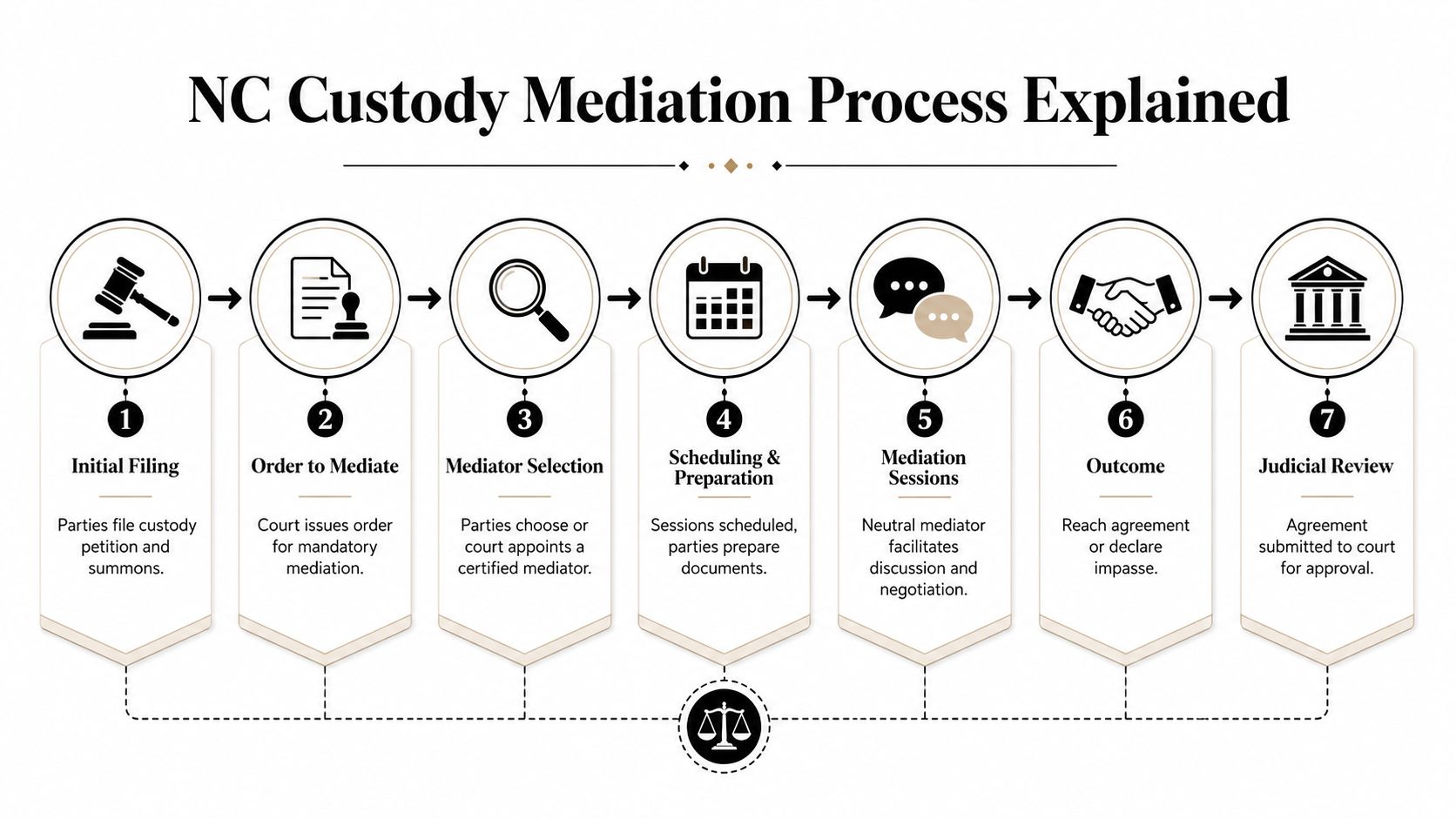
Step one and step two
North Carolina's court program generally requires two things before the custody case keeps advancing through litigation. Parents attend an orientation class, then they participate in a mediation session. The orientation gives you the map before the meeting starts. It explains the purpose of mediation, the ground rules, and the types of parenting issues that usually need to be addressed.
The mediation session is the working meeting itself. The mediator helps the parents talk through custody and visitation terms in a structured way. A useful comparison is a settlement conference with guardrails. There is a process, there are rules, and there is a goal. The goal is not merely to get through the appointment. The goal is to see whether a workable parenting arrangement can be reached and written clearly enough to hold up after everyone leaves the room.
That last point matters more than many parents expect. A rushed agreement can create school-year confusion, holiday disputes, or transportation fights months later. The session may last only a short time. The wording can affect your family for years.
Rules inside the session
Mediation is confidential. Under G.S. 50-13.1(e), communications made during mediation are generally confidential and inadmissible later in court. That protection gives parents room to discuss options, float compromises, and test schedules without treating every sentence like courtroom testimony.
Another procedural rule often catches parents off guard. Attorneys do not attend the mediation session itself in North Carolina. You can and should get legal advice before the session and after it ends, especially before signing language that may become part of a court order.
Here is the sequence many parents see in real life:
- A custody dispute is filed and the pleadings show that parenting issues are contested.
- The court refers the case to mediation through the local program.
- Each parent attends orientation and receives instructions about the process.
- The mediation session takes place with the court-appointed mediator.
- The session ends with either a full agreement, a partial agreement, or an impasse on the disputed issues.
A short video overview may also help some parents visualize the process before their session.
What happens at the end of the session
If the parents reach agreement on custody or visitation terms, the agreement is usually reduced to writing for court review. That document is not just a handshake on paper. If it is entered as an order, the wording can control exchange times, holiday schedules, decision-making, and future enforcement. A vague sentence that sounds cooperative in the room can become expensive to argue about later.
If the parents do not resolve the disputed issues, the case continues toward a hearing and a judge decides what remains unsettled. Sometimes the result is mixed. Parents may resolve a few points and leave others for court. Even then, mediation has shaped the case by narrowing the issues the judge must decide.
That is why the process should be viewed in two time frames at once. There is the immediate task of getting through orientation and the session. Then there is the longer legal consequence of whatever agreement is signed, submitted, or left unresolved.
How to Strategically Prepare for Your Mediation Session
The parents who get the most value from mediation usually don't improvise. They prepare. Since your attorney can't sit beside you in the session, the work you do beforehand becomes more important, not less.
Research discussed in this article on preparing for child custody mediation states that parents who prepare written position statements with legal counsel before mediation reach more durable agreements and reduce post-mediation litigation by 40% compared to unprepared parents. Whether your case settles or not, that point captures the larger truth. Preparation provides an advantage and clarity.
Here is a practical checklist to organize that preparation:
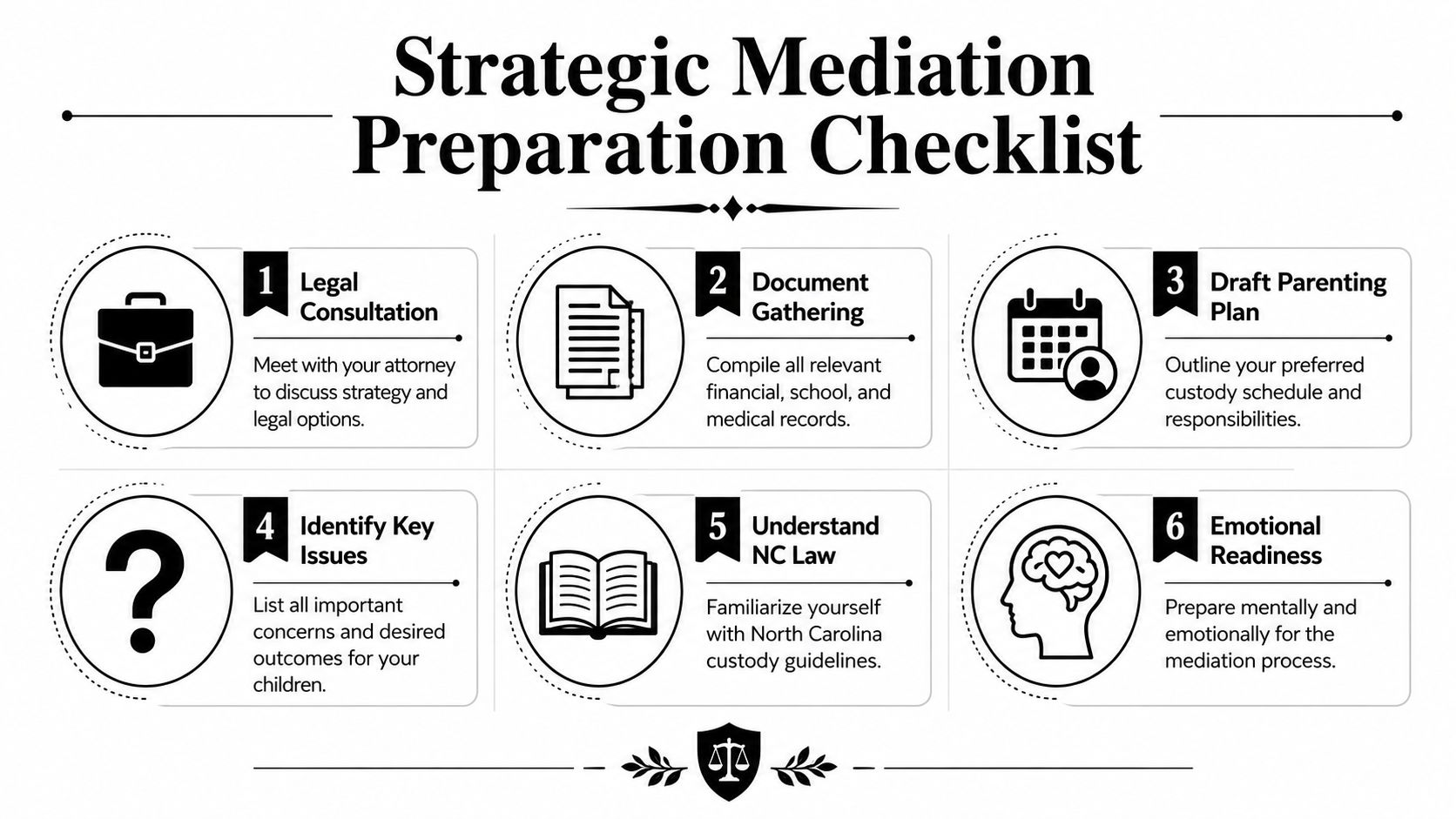
Build your proposal before you negotiate
Don't go in with a vague goal like "I just want fairness." That doesn't give you a usable roadmap. Instead, draft a real parenting proposal.
Include topics such as:
- Weekday routine: Where the child sleeps on school nights, who handles pickup, and how homework is managed.
- Weekend parenting time: Start and end times, transportation, and flexibility for activities.
- Holiday schedule: Thanksgiving, winter break, birthdays, Mother's Day, Father's Day, and summer vacation.
- Decision-making: How you want major school, medical, and extracurricular decisions handled.
- Communication rules: How parents will exchange information and how each parent will contact the child during the other parent's time.
A parent who says, "I need the children back by Sunday evening because school bags, medication, and uniforms have to be ready," is giving the mediator something workable. A parent who says, "I want respect," may be expressing a real feeling, but not a proposal.
Prepare with counsel even though counsel won't attend
Legal advice is essential. Before mediation, an attorney can help you test your proposal against likely court concerns, identify weak spots, and flag language that could create future disputes.
For example, "reasonable visitation" sounds flexible, but it's often a recipe for conflict because each parent may define "reasonable" differently. A detailed holiday rotation or exchange time may feel tedious, yet specificity usually prevents arguments later.
Bring a written outline of your priorities. If you're deciding for the first time in the room, you're already behind.
Some parents also benefit from using a written pre-mediation framework. That can mean a short document listing your proposed schedule, your absolute requirements, and the issues where you have room to compromise. If you're consulting a lawyer, this is one place to ask whether Law Office of Bryan Fagan or another North Carolina custody attorney can help review your goals before the session.
Gather records that keep the discussion grounded
A short list of documents can keep mediation focused on the child instead of accusations:
| Document | Why it helps |
|---|---|
| School calendar | Helps build realistic weekday and holiday schedules |
| Medical information | Clarifies appointments, medications, and provider access |
| Work schedule | Shows what parenting time is actually practical |
| Activity schedule | Prevents disputes over sports, lessons, and transportation |
The best-prepared parents don't arrive to "win the argument." They arrive to leave with a parenting plan that works on ordinary Tuesdays, not just in theory.
Understanding the Outcomes From Agreement to Impasse
Mediation usually ends in one of two directions. The parents either reach an agreement on some or all issues, or they don't. Both outcomes matter, and neither should catch you off guard.
If you reach an agreement
When parents agree, the terms are written into a Parenting Agreement that can be sent to the court for review and possible incorporation into an order. At that point, the details matter.
Read every line carefully before signing. Focus on the parts that create future conflict when they're vague. Exchange times, holiday start and end points, travel notice, school choice, electronic communication, and decision-making authority are common examples. A clause that feels harmless in the moment can become the center of a later dispute.
If you're concerned about how an agreement may be enforced or changed later, it helps to understand the basics of modifying a custody agreement in North Carolina. Modification issues often turn on the exact wording of the original arrangement.
If mediation ends in impasse
An impasse means no final agreement was reached in mediation. It doesn't mean you failed as a parent, and it doesn't mean the court will punish you for not settling.
The case then proceeds to a custody hearing, where a judge decides the unresolved issues. In practical terms, mediation may still help narrow the disagreement. Parents sometimes settle a few points and leave others for the court. Even partial progress can make later litigation more focused.
No agreement is better than a bad agreement that creates avoidable conflict for years.
A good rule is to stay thoughtful at the finish line. If the terms are solid and workable, settlement may make sense. If the terms are unclear, unsafe, or unrealistic, it may be better to let the court decide.
Common Pitfalls and When Mediation Is Not Required
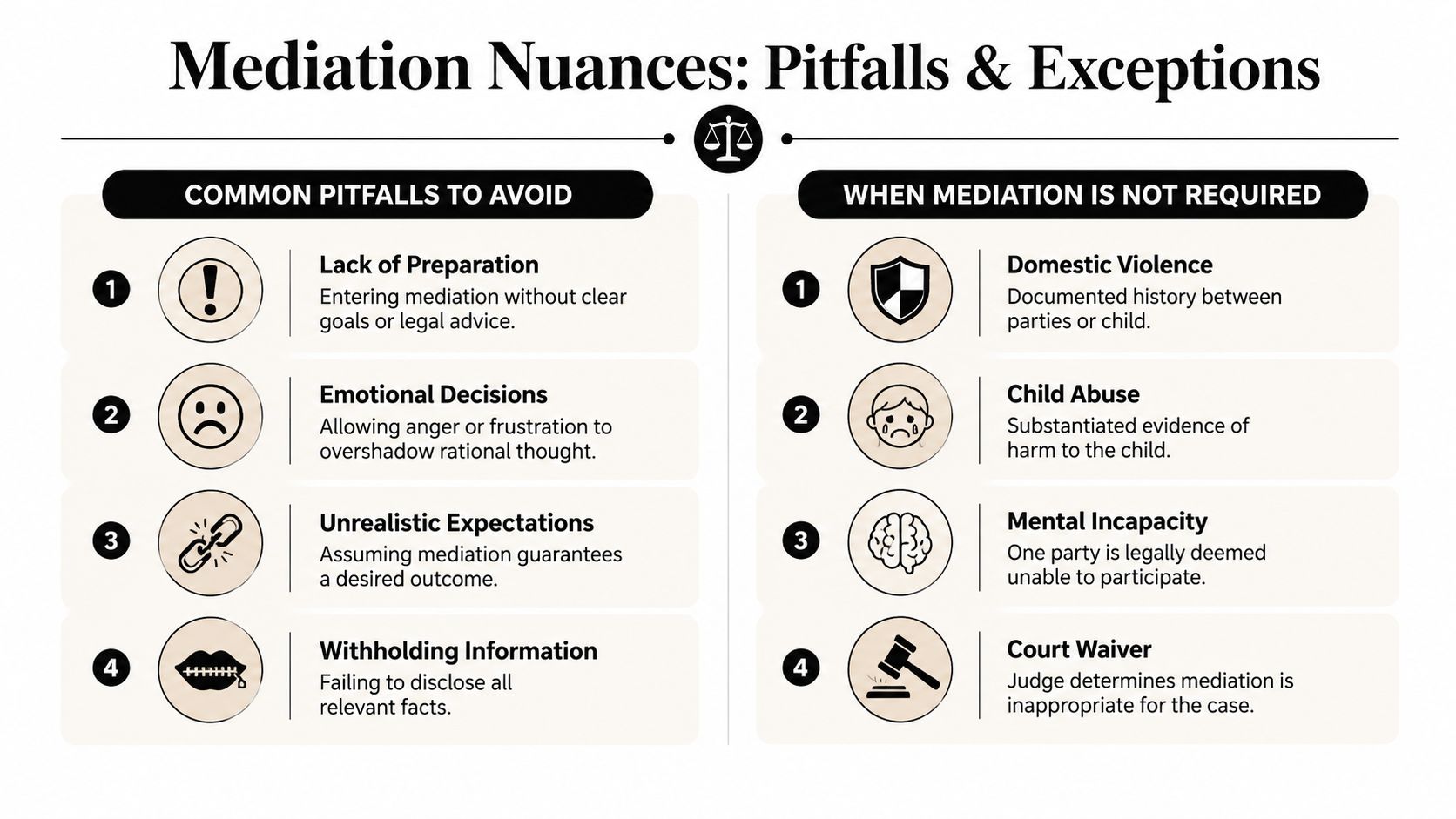
A parent walks into mediation expecting a simple split down the middle, leaves with language that sounds fair, and months later ends up arguing about pickups, holidays, and missed calls. That pattern is common because mediation is not a math exercise. It is a negotiated parenting plan that can shape daily life for years.
Research in Back to the Future An Empirical Study of Child Custody Outcomes found that mandatory mediation in North Carolina did not increase joint physical custody, and that mothers received sole physical custody more often in mandatory mediation than in lawyer-negotiated settlements or litigation. The practical lesson is straightforward. Do not enter mediation assuming the process will naturally produce equal parenting time. Enter it prepared to discuss a schedule that fits your child's needs, your work realities, and the facts of your case.
Pitfalls that hurt parents in mediation
The biggest mistakes usually happen before anyone sits down with the mediator.
Parents often arrive with positions, but no plan. Wanting "more time" is not enough. You need a workable calendar, holiday proposals, transportation details, school break options, and a backup plan for sick days or work conflicts. A custody agreement works like a set of operating instructions. If the instructions are thin, conflict fills the gaps.
Other common problems include:
- Treating mediation like a trial: The mediator is not there to decide who was the better spouse or who caused the breakup.
- Focusing on fairness between adults instead of stability for the child: Courts and mediators care most about what is workable and in the child's best interests.
- Agreeing to vague terms to keep the peace: Phrases like "reasonable visitation" or "liberal contact" often create more disputes than they solve.
- Ignoring long-term legal effects: Once an agreement is signed and entered by the court, changing it later is usually harder than people expect.
A simple example shows why wording matters. If one parent agrees to "alternate holidays" without listing exchange times, location, and what happens when school schedules shift, the holiday clause becomes a yearly argument. What looked cooperative on paper becomes fuel for repeat conflict.
When a judge may waive mediation
Some cases should not go through the standard mediation track. North Carolina courts may waive custody mediation for good cause.
That usually means the court sees a real reason why mediation would be unsafe, unfair, or impractical. Examples can include domestic violence, abuse, substance abuse, serious safety concerns, or a parent living more than 50 miles from the court. The distance issue matters because the rule is tied to the court's location, not just how far apart the parents live.
Here is the practical framework:
| Situation | Why it matters |
|---|---|
| Domestic violence or abuse allegations | Direct negotiation may put a parent at risk or distort the process |
| Substance abuse concerns | Safety and judgment issues may make mediation inappropriate |
| Parent lives more than 50 miles from the court | Distance may support a request to waive mediation |
If one of these concerns applies, raise it early and clearly through the proper court procedure. Waiting until the mediation date is near can create avoidable delay, and in safety-related cases, delay can create real risk.
Frequently Asked Questions About NC Custody Mediation
Is custody mediation mandatory in North Carolina
In most contested custody or visitation cases, yes. North Carolina requires mediation before the case moves to a final hearing unless the court grants a waiver for good cause.
Can my attorney come into the mediation session with me
No. In North Carolina's custody mediation program, attorneys are prohibited from attending the session itself. You can still get legal advice before mediation and have an attorney review any proposed agreement before you sign.
What if the other parent refuses to cooperate
The mediator can't force either parent to agree. If the session doesn't produce an agreement, the case generally proceeds to a custody hearing where a judge decides the unresolved issues. A difficult session doesn't end your case. It just means settlement didn't happen there.
Is what I say in mediation confidential
Generally, yes. Communications during mediation are protected by confidentiality rules and are generally inadmissible later in court, with limited exceptions such as threats of harm.
Is the agreement final once we sign it
An agreement can become very important very quickly, especially once it is reviewed and incorporated into a court order. That's why parents should read the terms carefully and, when possible, have counsel review the document before signing. The language you accept can affect future enforcement and modification issues.
Protect Your Rights with a North Carolina Custody Lawyer
Mediation gives parents a chance to shape a parenting plan themselves, but the legal consequences are real. What you agree to can affect your schedule, your decision-making role, and your child's routine for a long time. That's why careful preparation matters as much as the session itself.
If you're facing custody mediation in North Carolina, treat it as a legal event with long-term impact. Gather records. Draft a realistic proposal. Think through holidays, school logistics, transportation, and communication rules before the meeting begins. If there are safety issues or grounds to seek a waiver, raise them early.
Parents often feel calmer once they have a clear strategy. A consultation with a North Carolina custody attorney can help you understand your options, evaluate proposed terms, and decide when to compromise and when to hold firm. No lawyer can promise a specific outcome, but informed preparation puts you in a stronger position to protect both your rights and your child's best interests.
If you're dealing with a custody dispute, mediation notice, or questions about a parenting agreement, Law Office of Bryan Fagan can discuss your North Carolina case and help you prepare for the next step. Schedule a consultation to review your situation, understand your options, and develop a practical strategy for your child custody matter.