If you're sleeping in separate rooms, checking bank accounts in the middle of the night, and wondering whether you're “legally separated” yet, you're already in the part of the process that matters. In North Carolina, the biggest mistake people make is assuming separation is some formal court status that a judge has to approve. It isn't. Separation starts when you live in different homes and at least one of you intends for the split to be permanent, and that date can drive everything that comes next, from support to the earliest day you can ask for divorce.
That's why legal separation vs divorce NC isn't really a question about labels. It's a question about timing, control, and what you need to protect right now. If you want structure without ending the marriage yet, separation is usually the first move. If you want the court to end the marriage, you have to wait out North Carolina's divorce rules and file at the right time under the right facts.
| Factor | Legal Separation in NC | Divorce in NC |
|---|---|---|
| Legal status | Spouses remain legally married | Marriage is legally ended |
| Court filing required to start | No | Yes |
| When it begins | When spouses live in different homes and one intends the separation to be permanent | Only after the court enters the divorce |
| Timing gate | Immediate once the factual standard is met | At least one year and one day of separation, plus six months' North Carolina residency |
| Effect on property and support | Terms can be set by agreement while marital rights still exist | Equitable distribution is finalized through the court process |
| Reversibility | The relationship can potentially resume | The marriage is over |
| Enforcement of agreement | Unincorporated agreement is enforced as contract, not contempt | Court orders can carry contempt power |
What Legal Separation Means in North Carolina
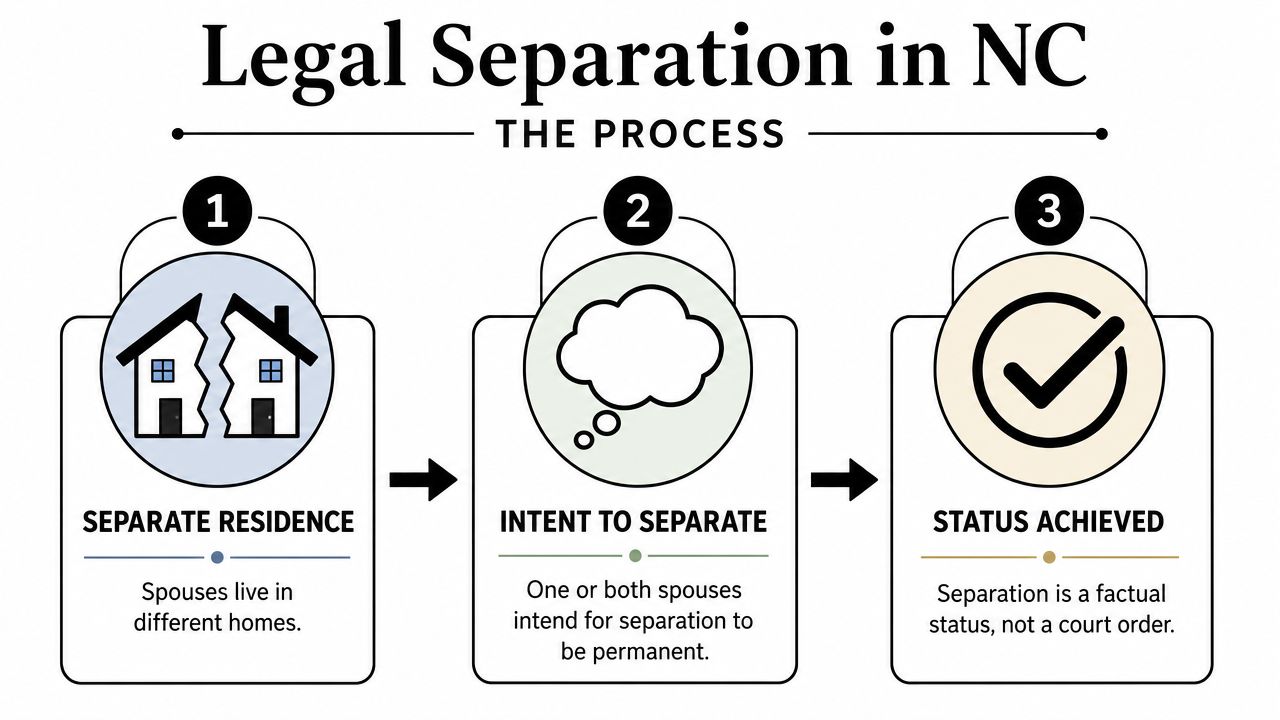
The mistake I hear most often is simple. “We haven't filed anything, so we can't be separated yet.” That is wrong in North Carolina. Legal separation is a factual status, not a court order, not a certificate, and not something a clerk has to approve. If you live in different homes and at least one spouse intends the separation to be permanent, the separation has started under North Carolina law. For a plain-English breakdown of that rule, see what legal separation in NC really means. A written separation agreement is not required to create separated status, though it is often smart to have one.
How the separation date really works
The date matters because North Carolina ties major rights to that moment. If a spouse moves out on Friday and the other spouse knows the split is permanent, Friday can become the anchor date for the rest of the case. I tell clients to write it down, save texts or emails that confirm the move, and keep records that show the homes became separate.
You do not need a judge to grant separation. You do need facts that support it. If both spouses are still living under the same roof and only sleeping apart, that usually is not the same thing as living in different homes. The law looks for a real change in residence, not just tension in the hallway.
Why a separation agreement still matters
A written agreement is optional for separation status, but in practice, it is often the most important document in the case. A well-drafted agreement can sort out property, support, and custody while the marriage remains intact, which is why couples often use Separation Agreements in North Carolina to steady the situation before divorce is even possible.
Practical rule: the day you separate is usually the day your legal strategy starts, not the day the court gets involved.
Plain English summary. The day you separate, you are still married, but you are no longer living as a married household. What changes immediately is the factual status and the clock. What does not change until divorce is granted is the legal ending of the marriage itself.
Side-by-Side Comparison of Separation and Divorce in NC
People get stuck because they treat separation and divorce like two versions of the same paper process. They're not. Separation is the way North Carolina recognizes that spouses are living apart while still married. Divorce is the court's final act that ends the marriage on a specific date and frees both people to remarry.
| Legal Separation vs Divorce in North Carolina | Legal Separation in NC | Divorce in NC |
|---|---|---|
| Marital status | Still married | Marriage ended |
| Court action to begin status | None required | Court filing and judgment required |
| Timing | Begins as soon as the factual standard is met | Only after one year and one day of separation, plus residency |
| Reversibility | Possible if the couple reconciles | Not reversible in the ordinary sense |
| Property planning | Terms can be set in a separation agreement | Equitable distribution is finalized through the court process |
| Support and custody | Can be addressed by agreement or court order | Can still be addressed, but marriage itself is over |
| Enforcement of agreement | Contract enforcement unless incorporated into a court order | Court-backed enforcement applies to orders and judgments |
The three surprises for most North Carolina residents are simple. First, separation keeps you legally married. Second, divorce ends the marriage on a court date, which is why the filing has to wait until the statutory clock runs. Third, the enforcement power behind a separation agreement depends on how it's written and whether it's incorporated into a court order. North Carolina bar guidance explains that a breach of an unincorporated separation agreement is handled as a breach-of-contract claim, with remedies like money damages, injunction, and specific performance, while contempt is off the table unless the agreement is incorporated into a court order or decree (North Carolina bar guidance on separation agreement enforcement).
That enforcement point is not academic. If one spouse keeps missing support payments, a contract claim and a contempt motion are not the same weapon. The first can work, but it's a slower, more limited path. The second carries the force of court enforcement.
If you want maximum leverage, don't just ask whether you're separated. Ask whether your agreement will be a contract, a court order, or both.
One more practical distinction. Divorce gives finality, but it does not magically fix the mistakes made during separation. If the wrong accounts were left exposed, the wrong parenting schedule was followed, or debts were left floating, divorce doesn't erase those problems. It just locks in the end of the marriage.
Filing and Residency Requirements for Divorce in North Carolina
North Carolina divorce has two filing gates, and both have to be cleared before a court will grant an absolute divorce. The spouses must live separate and apart for at least one year and one day, and the spouse filing must also have lived in North Carolina for at least six months before filing. If you file before both requirements are met, the case is defective from the start.
What the court is looking for
The separation period has to run continuously. The spouses need to live in different homes and treat the separation as permanent during that period. A brief reconciliation can create trouble if it makes the separation look broken, then restarted. That is why I tell people to track the date carefully and keep proof of when the separation began.
Residency is just as important. A spouse who moved to North Carolina for work and has only been here a few months cannot file yet, even if the marriage is clearly over. Military families stationed here need to watch the same rule. North Carolina still wants a real state connection before the divorce case can move forward.
The filing details people miss
The county choice matters, and service matters just as much. The complaint has to be filed in the proper court, and the other spouse has to be served correctly. If the complaint is filed one day too soon, that is not a harmless error. It can stall the case, add expense, and force a new filing later.
If you want the process laid out step by step, see how to file for divorce in North Carolina. A clean filing is easier to manage than trying to fix a rushed one after the fact.
Bottom line: count the separation period carefully, confirm residency, then file.
If you are even one day short, wait. One more day is cheaper than fighting off a procedural objection, and divorce already gives people enough to deal with without handing the other side an easy opening.
Effects on Property, Support, Custody, and Benefits
The separation versus divorce choice becomes real life. Separation does not mean your financial and parenting issues vanish. It means you have to manage them while the marriage still exists. Divorce ends the marriage, but the legal and financial work often started much earlier.
Property and support
North Carolina treats equitable distribution as the court process for dividing marital property fairly, and that process is finalized through the divorce case. During separation, the property picture is still being managed, which is why a separation agreement can be so useful. It lets spouses decide who pays what, who stays where, and how to handle debts before the court is asked to divide anything permanently. For the court side of that topic, see the firm's guide on equitable distribution in North Carolina.
Support works differently from property division. Spouses can negotiate support during separation, and a court can later address support issues if needed. The key is enforcement. An unincorporated agreement lives as a contract. If you want contempt power, you need incorporation into a court order or decree, which changes the enforcement profile in a real, practical way.
Custody, insurance, taxes, and retirement
Children do not wait for divorce papers. Parents can and should make custody and child support arrangements during separation, because those obligations arise in the middle of the family breakdown, not after the final judgment. A parent who moves out without addressing school schedules, exchanges, or monthly support is asking for conflict.
Health insurance often becomes one of the most urgent issues. A spouse may retain coverage during separation depending on the plan and the agreement, but divorce typically ends coverage through a spouse's employer. That is when people start asking about temporary continuation coverage and whether they should have acted earlier.
Retirement and tax issues also need attention. Retirement accounts often require a separate post-judgment process, such as a QDRO, before money can be divided and transferred correctly. Tax filing status changes with marital status, so separation and divorce can lead to different filing choices depending on timing and income.
The point is simple. Separation gives you room to organize. Divorce gives you finality. If you wait until the divorce date to think about benefits, insurance, or retirement, you're already late.
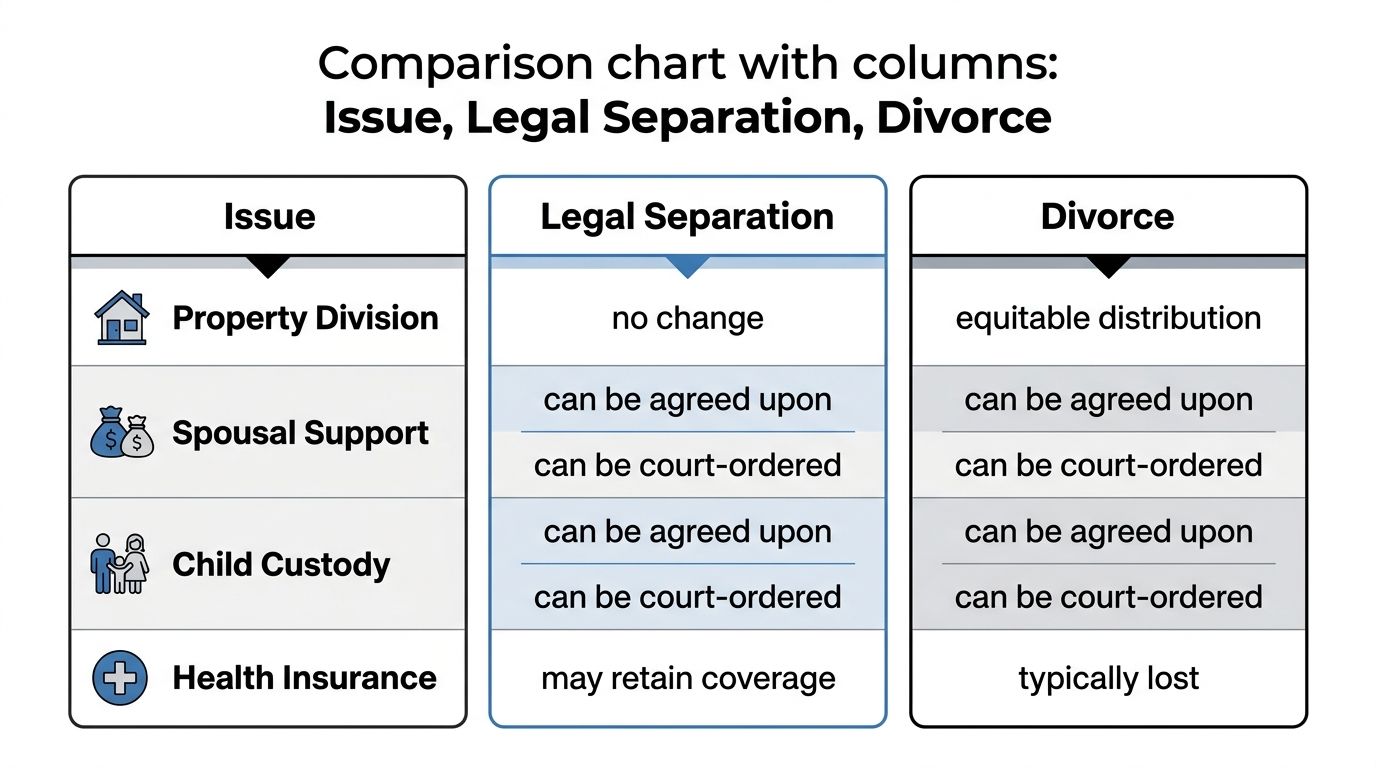
Here's a straightforward way to think about it. Separation is where you build the operating rules for living apart. Divorce is where the court closes the marriage file. If you don't build the rules first, the final judgment often arrives with more damage already done.
Real-World Scenarios Where Each Option Fits Best
A separation agreement makes the most sense when the spouses want structure but not an immediate end to the marriage. I see that often with couples whose religious beliefs make divorce a last resort, but who still need firm rules about the house, support, and the children. They're not pretending the marriage is healthy. They're choosing to reduce chaos while they remain legally married.
A pure divorce filing fits the spouse who has already completed the waiting period and wants the court to finish the job. If the couple has been separated for fourteen months, the legal question is no longer whether they can divorce. The question is whether they've protected property, custody, and support before the final filing. That is where sloppy planning comes back to bite people.
A high-asset business owner needs a more aggressive interim plan. If both spouses still have ownership interests, the risk is not just emotional. It's operational. A well-drafted separation agreement can act as a control layer while the divorce timing runs, especially when the business, debt, or access to accounts could be disrupted by one impulsive move.
Military families and spouses with insurance concerns need to think one step ahead. A parent worried about a newborn's coverage should not wait for the divorce judgment to figure out how the child will stay insured. That decision belongs in the separation planning stage, because timing can change everything about access and affordability.
The right path depends less on the label and more on what needs to be protected this month.
A quick way to sort your situation. If you need rules now and can live with being married for a while longer, separation is the better tool. If the year has already run and you're ready for finality, divorce is the cleaner move. If there's a business, a child, or a coverage issue in the mix, the safest option is usually to get the agreement built before the divorce clock runs out.
Strategic Pros and Cons of Each Path in NC
The primary advantage of separation in North Carolina is timing. It lets you live apart, keep the marriage intact for now, and buy space to make better decisions without forcing the final legal break too soon. That matters if you need time to settle down emotionally, test whether reconciliation is realistic, or work through the practical questions before a divorce filing ever makes sense.
It also gives you a chance to make a plan instead of reacting. A spouse who is still figuring out finances, child schedules, or health coverage usually does better with a separation strategy first, because the separation period is where the day-to-day rules get set.
The downside is the lack of finality. Separation does not end the marriage, so if you want certainty, you do not get it yet. You can also spend months living in a half-finished legal situation if you never follow through with a written plan or a later divorce filing.
Divorce gives you the clean break. It ends the marriage, clears the path to remarry, and closes the door on the uncertainty that hangs over separated spouses. If the relationship is already over and the waiting period is satisfied, divorce is the cleaner choice.
The trade-off is that finality comes with a price. Once you move to divorce, you are no longer just deciding whether to stay apart. You are deciding to end the marriage on paper, and that can feel heavier than people expect. It also means you should have already made the practical decisions, because waiting until the divorce is filed is often too late to fix sloppy planning.
The better strategy usually depends on readiness, not labels. If you are still unsure, separation gives you breathing room. If you already know the marriage is done and the legal timing is available, stop stretching it out. Pick the path that matches where you really are, not the one that feels easier in the moment.
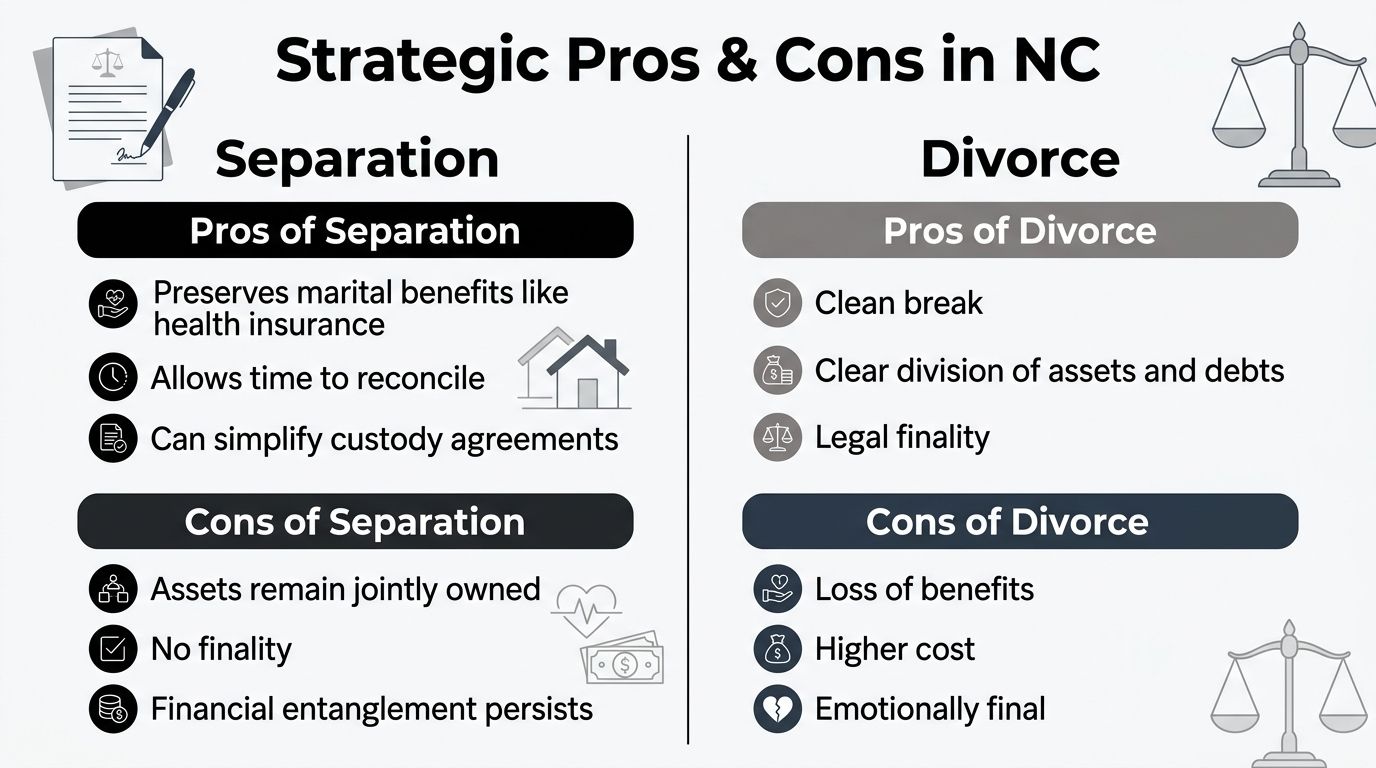
My view is simple. Separation is for people who need time and structure. Divorce is for people who want the marriage over and are ready to finish the job. The mistake is drifting in between, with no agreement and no plan.
Common Questions About Legal Separation and Divorce in NC
Can you date during separation in North Carolina?
You can live separately and date, but don't treat that like a harmless side issue. Dating can create emotional conflict and can affect negotiations, especially if children or support are involved. If you're already separated, keep your conduct clean and your records cleaner.
How long does an uncontested divorce take after the separation year?
Once the separation and residency requirements are met, an uncontested divorce is usually about getting the paperwork filed correctly and serving the other spouse properly. The statute gives you the filing window, but the case still depends on clean procedure and complete paperwork.
Is a separation agreement legally binding without court approval?
Yes, a properly signed separation agreement can be binding as a contract even without court approval. But the enforcement tools are different from contempt unless the agreement is incorporated into a court order or decree, which is why drafting matters so much.
Does legal separation protect you from the other spouse's debts?
Not automatically. Separation can help you define responsibility, but it does not magically erase debt exposure. If your name is on the account or the obligation was created during the marriage, you need the agreement to spell out the financial plan very clearly.
Schedule a Consultation With the Law Office of Bryan Fagan
If you're deciding between separation and divorce in North Carolina, don't guess your way through it. A consultation should focus on your separation date, residency, property exposure, debt, custody, and the support issues already in motion, because those facts drive the strategy. The Law Office of Bryan Fagan handles family law matters including divorce, equitable distribution, child custody, child support, spousal support, and separation agreements, so you can get a plan that fits the facts instead of a generic script.
You do not need to carry the whole thing alone. If you're in North Carolina and you want a direct read on your options, schedule a consultation and get clear advice on protecting your rights, your assets, and your long-term stability.
A CTA for Law Office of Bryan Fagan.