A lot of people reach this point the same way. They’ve been living apart for months, the practical parts of separation are already happening, and now they want to make it official. The problem is that North Carolina’s divorce process looks simple from a distance, but the details matter.
One spouse may think, “We’ve been separated for a year, so I just file and it’s done.” Sometimes that is close to true. In many other cases, that assumption causes expensive mistakes. The biggest one is confusing absolute divorce with the separate legal claims involving property, alimony, child custody, and child support.
North Carolina also has its own timeline. The state recorded 75,657 marriages in 2022, and the divorce rate was 2.7 per 1,000 residents in 2023, down from 5.1 per 1,000 in 2000 according to this North Carolina divorce rate overview. Those numbers don’t change what an individual family is dealing with, but they do reflect a system with firm procedural rules, especially the mandatory separation period.
If you’re searching for how to file for divorce in north carolina, the right starting point is this: first confirm you’re legally eligible to file, then prepare the correct documents, then make sure you don’t waive claims you still need to resolve. The paperwork ends the marriage. It does not automatically protect your house, retirement, support rights, or parenting arrangements.
Your Guide to Navigating Divorce in North Carolina
A common situation looks like this. A spouse moved into an apartment last year, the children are following an informal schedule, bills are being split as best as possible, and everyone is emotionally worn out. By the time the one-year mark arrives, that spouse isn’t asking whether the marriage is over. They’re asking how to get through court without making a mess of the next chapter.
That’s a reasonable question. North Carolina’s divorce process is structured, and for a simple case, it can be manageable. But “simple” has a very specific meaning in family law. It usually means the filing is limited to ending the marriage itself, without unresolved disputes that need separate claims.
Many people are surprised by how narrow an absolute divorce really is. It is the legal dissolution of the marriage bond. That matters, but it is only one part of a broader family law case.
What most people need to know first
Before filing, focus on three questions:
- Are you eligible now: Timing matters in North Carolina. Filing too early can get the case delayed or dismissed.
- Is your case simple: If there’s disagreement about property, support, or children, the divorce filing is only part of the work.
Self-represented parties often run into trouble protecting related claims.
Practical rule: If your marriage involves a house, retirement accounts, debt, support issues, or minor children, don’t assume the court will sort those out just because you filed for divorce.
Why the distinction matters
Clients often use “divorce” to mean everything at once. Lawyers in North Carolina usually separate that idea into parts. One case may involve ending the marriage, dividing marital property, determining spousal support, setting custody, and establishing child support. Those pieces can overlap, but they are not interchangeable.
That difference is why two people can both say they’re “getting divorced” while one has a straightforward administrative filing and the other is dealing with multiple contested claims.
Are You Eligible to File for Divorce in North Carolina
North Carolina has two threshold requirements that must be met before you file for absolute divorce. They are strict, and they are not technicalities.
Under North Carolina law, spouses must complete one year and one day of separation before filing, and at least one spouse must have been a North Carolina resident for six months before filing. The filing fee is typically $225, although a waiver may be available for financial hardship, as noted in this North Carolina divorce checklist.
The residency requirement
At least one spouse must have lived in North Carolina for the required six-month period before the case is filed.
That sounds simple, but people often overthink it when the other spouse has moved away. The key issue is whether one spouse satisfies the residency rule. If so, the case can usually still be filed in the appropriate North Carolina county.
The separation requirement
The more common problem is the separation rule.
In North Carolina, “separated” does not just mean emotionally distant or sleeping in different rooms. For an absolute divorce, spouses must live separate and apart, in separate residences, for the full required period. At least one spouse must also intend the separation to be permanent.
If you want a fuller explanation of how separation works under state law, this discussion of legal separation in NC is a useful starting point.
What counts as a costly mistake
A very common example is a brief reconciliation. A couple separates, lives apart for months, then tries again for a short time. Maybe one spouse moves back in for a few weeks around the holidays or while dealing with a child-related issue. If they resume living together, the separation clock can restart.
That catches people off guard because they think the original separation date still controls. It often doesn’t.
Separation in North Carolina is about more than intent. It is also about actual living arrangements.
A quick eligibility check
Use this short checklist before you spend time drafting paperwork:
| Question | What to confirm |
|---|---|
| Residency | Has one spouse lived in North Carolina for the required six months before filing? |
| Separate homes | Have you actually lived in different residences for the full required period? |
| Intent | Did at least one spouse intend the separation to be permanent? |
| County | Are you filing in the proper county based on residence? |
| Fee or waiver | Will you pay the filing fee, or do you need to request a waiver? |
What works and what does not
- What works: keeping a clear separation date, staying in separate residences, and making sure your complaint accurately states the residency and separation facts.
- What doesn’t: guessing at dates, using the date of an argument instead of the date of physical separation, or filing because “it has basically been a year.”
If you are even slightly unsure about the date your legal separation began, slow down and verify it before filing.
The Step-by-Step Guide to Filing Your Divorce Papers
Once eligibility is clear, the next part is mechanical but important. The next part helps simple cases remain uncomplicated and prevents avoidable errors.
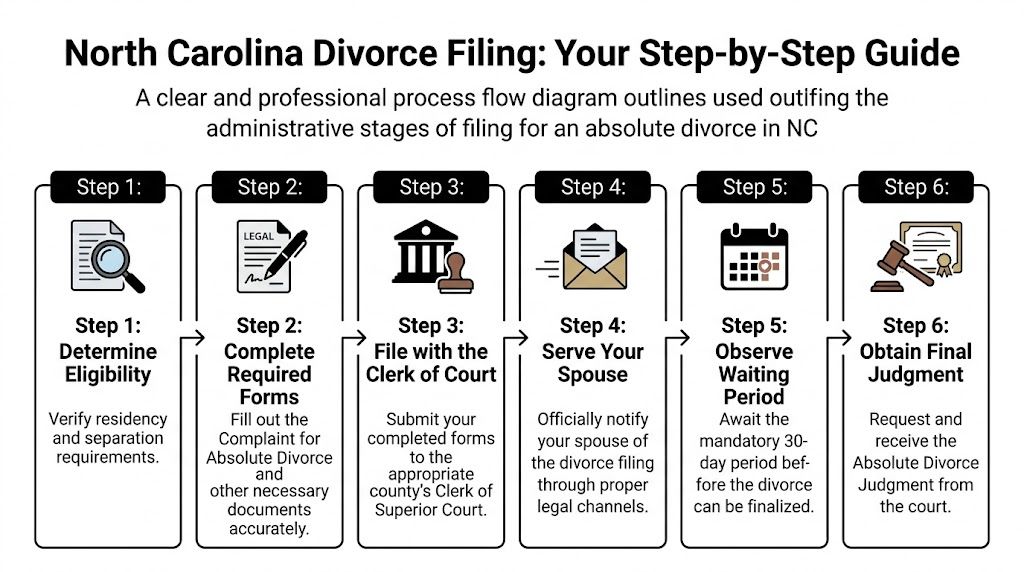
A North Carolina absolute divorce filing usually starts with a packet of core documents. The required documents include a verified Complaint for Absolute Divorce, a Civil Summons (AOC-CV-100), a Domestic Civil Action Cover Sheet (AOC-CV-750), and a Servicemembers Civil Relief Act Affidavit (AOC-G-250), as described in this guide to the steps in the divorce process.
To help visualize the sequence, this filing overview is useful:
Start with the complaint
The complaint is the document that tells the court what you are asking for and why you are entitled to it.
People often get tripped up because there is no standard fill-in-the-blank complaint for absolute divorce. The complaint has to include the necessary facts, including the marriage, residency, and separation allegations. It also needs to be verified.
That last word matters. “Verified” means the complaint is sworn to as true, usually before a notary. If that is done incorrectly, the filing can be rejected or delayed.
The standard forms that usually accompany the complaint
The rest of the packet is more standardized.
- Civil Summons: This formally notifies the other spouse that a lawsuit has been filed.
- Domestic Civil Action Cover Sheet: This gives the clerk basic case classification information.
- Servicemembers Civil Relief Act Affidavit: This addresses whether the other spouse is in military service, which affects default procedures.
If you are filing only for the dissolution of the marriage, review whether your matter fits a simple filing. A basic overview of absolute divorce in North Carolina can help frame that question.
Where to get the forms and where to file
Parties seeking divorce obtain the current forms through the North Carolina court system’s public resources and then file with the Clerk of Superior Court in the proper county.
The county matters. Filing in the wrong place can create delay that serves no one.
Filing with the clerk
When the paperwork is complete, you file it with the clerk’s office and pay the filing fee unless you’ve been approved for a waiver.
Bring organized copies. A disorganized filing leads to avoidable confusion.
What usually helps:
- A complete packet: Don’t show up with only the complaint and plan to “add the rest later.”
- Signed and verified papers: Check notarization before filing, not after.
- Legible copies: Courts and sheriffs can only work with what they can read.
- A prepared judgment form: In many counties, having your proposed judgment ready later in the process saves time.
Service is not optional
After filing, the other spouse must be properly served.
This is one of the clearest examples of what works versus what doesn’t. You cannot hand the papers to your spouse yourself and call it legal service. Service has to follow North Carolina procedure.
Common valid methods include service by sheriff and service by certified mail. In some cases, service may also be completed by a qualified disinterested adult. Which method is best depends on the facts.
Choosing the right service method
A practical comparison helps:
| Service method | When it tends to work well | Common issue |
|---|---|---|
| Sheriff service | Good when the spouse’s address is reliable and local cooperation is limited | Delay if the spouse is hard to locate |
| Certified mail | Useful when the spouse is expected to accept mail and the address is dependable | Problems if delivery is refused or not properly completed |
| Qualified third-party service | Can help in some circumstances where personal delivery is feasible | Mistakes if the server does not meet legal requirements |
After service, time starts running
Once service is complete, the responding spouse has a period to answer.
That waiting period is not dead time. Use it to review whether anything else needs to be filed, especially if unresolved financial or parenting issues exist. A rushed absolute divorce can create long-term problems if larger claims have not been preserved.
A short video explanation may also help if you prefer a visual overview of the process.
What usually makes a simple case stay simple
Pro se simple divorces can succeed when the forms are complete and the case is uncomplicated. The trouble starts when people assume every divorce is simple.
A few examples:
- Simple case: no dispute, no unresolved property claim, no support issue tied to the filing, service completed properly.
- Not simple: disagreement about the house, retirement funds, custody, alimony, or whether the separation date is accurate.
- Also not simple: one spouse is avoiding service, military-status questions exist, or prior claims weren’t filed when they should have been.
A clean filing is not just paperwork. It is timing, service, verification, and knowing what your divorce case does not automatically cover.
What Happens After the Divorce Papers are Filed
Once the clerk has accepted the case and the other spouse has been served, the process becomes less about drafting and more about timing.

North Carolina procedure generally gives the defendant 30 days after service before the matter moves toward final scheduling in a simple absolute divorce case. In an uncomplicated case, the post-service timeline may be relatively short, but that depends on proper paperwork, proper service, and local court handling.
The three common paths after service
Most cases go one of three ways.
Your spouse files an answer
If the defendant responds, the case can still move forward. In a simple absolute divorce, the answer may not create much conflict. In other situations, it may signal that broader claims are disputed or that a counterclaim may follow.
Your spouse does nothing
If no response is filed within the allowed period, the plaintiff may be able to proceed by default, assuming the rest of the procedural requirements are met.
People often misunderstand default. It does not mean you skip the rules. It means the case may proceed without an answer if service and other requirements were done correctly.
Your spouse responds and raises other claims
Property, support, and custody issues transform cases from administrative matters into broader domestic litigation. Property, support, and custody issues can turn a narrow divorce filing into a much more involved matter.
The hearing is usually straightforward in a true simple divorce
For a straightforward absolute divorce, the final hearing is often brief. The court wants to confirm that the legal requirements have been satisfied and that the proposed judgment is in order.
That does not mean preparation is optional. A hearing can be delayed because the judgment is incomplete, the dates are inconsistent, or service cannot be proven cleanly.
If a clerk, judge, or opposing party can spot a date problem in under a minute, it is better for you to catch it before the hearing is ever set.
What to have ready near the end
A practical checklist helps here:
- Proof of service: Make sure the court file reflects valid service.
- Your proposed judgment: Many delays happen because the final order is missing or incomplete.
- Correct separation and residency allegations: The dates in your documents should line up.
- Any local scheduling forms: Some counties have local practices that affect calendar placement.
For readers focused on how to file for divorce in north carolina, this post-filing phase is where patience matters. Filing starts the case. Proper follow-through finishes it.
Addressing Property Support and Children in Your NC Divorce
This is the issue that causes the most damage in North Carolina divorce cases.
An absolute divorce ends the marriage. That is all it does unless other claims are properly raised and preserved. It does not automatically divide property. It does not automatically award alimony. It does not automatically enter a custody order or child support order.

That distinction is where many self-represented filers make a serious mistake. According to this overview of obtaining divorce in North Carolina, pro se filers face 30-40% higher dismissal risks due to procedural errors. In complex cases involving property or children, which may take over 18 months, attorney involvement can improve outcomes by 40% by strategically bundling claims before the absolute divorce is finalized.
Absolute divorce versus everything else
Here is a straightforward explanation:
| Issue | Does absolute divorce alone resolve it? |
|---|---|
| Ending the marriage | Yes |
| Dividing marital property | No |
| Alimony or post-separation support | No |
| Child custody | No |
| Child support | No |
That table is simple, but the consequences are not.
A cautionary example
Take a common scenario. One spouse files for absolute divorce because the separation year has passed. There is a house, a retirement account, shared debt, and disagreement about who should keep what. The filing moves forward, the judgment is entered, and only afterward does that spouse try to ask the court to divide the marital estate.
That can be too late.
The reason is not that the property issue lacked merit. The problem is that rights can be lost if claims are not asserted before the absolute divorce is finalized. People often think, “We can deal with the money later.” In North Carolina, that assumption can be dangerous.
Important distinction: Ending the marriage is one claim. Protecting your share of property or support rights requires separate legal action if those issues are not already resolved.
Equitable distribution is not the same as “everything gets split down the middle”
North Carolina uses equitable distribution for marital property. In plain English, that means the court aims for a fair division of marital assets and debts.
Fair does not always feel neat. The analysis can involve the home, vehicles, bank accounts, retirement funds, business interests, credit card balances, and other obligations or assets acquired during the marriage.
If the estate is modest and the spouses agree, settlement may be possible without extensive litigation. If the estate is large, disputed, or poorly documented, the case becomes much more technical.
Support claims need their own attention
Spousal support issues are separate from the absolute divorce claim. So are child-related issues.
That matters because family life rarely pauses just because paperwork is pending. One spouse may need support to maintain housing. Parents may need a clear custody schedule. Children may need a workable structure that can be followed.
In many households, these are the most urgent issues. Yet they are the issues people wrongly assume come bundled with a standard divorce filing.
What works in real life
For cases involving more than just the legal end of the marriage, a better approach is usually to evaluate all claims together rather than treating absolute divorce as the whole case.
That often means asking questions like these early:
- Property first: What assets and debts are marital, and are records available now?
- Support exposure: Is either spouse financially dependent or paying most of the bills?
- Children’s routine: Do the parents already have a stable schedule, or is conflict escalating?
- Timing risk: Will an immediate divorce filing protect interests, or cut them off if other claims are not included?
Why “uncontested” can be misleading
People say their divorce is uncontested because both spouses agree they want to end the marriage. That is not the full test.
A matter is only uncomplicated if the related issues are also resolved, waived knowingly, or not in dispute. If the parties still disagree about the house, custody, support, or debt, the case is not simple just because both want the divorce.
That is why filing alone is often the easiest part.
Frequently Asked Questions About Filing for Divorce in NC
Can I file for divorce if we still live in the same house
Usually, no for purposes of absolute divorce. North Carolina requires spouses to live separate and apart in separate residences during the required separation period. Different bedrooms under one roof generally create problems for an absolute divorce filing.
What if I don’t know where my spouse is
You still have to complete service properly. The exact method depends on the facts and on what efforts have already been made to locate the other spouse. This is one of those moments when procedural advice matters, because defective service can stall the case even when the divorce itself is otherwise straightforward.
Do I have to go to court for a simple divorce
Not always in the way people imagine. In some simple cases, the hearing is brief and administrative. In others, local practice affects how the final judgment is presented. Even when the hearing is short, the paperwork still has to be correct.
Can I ask for my former name back
Yes, many people address name restoration as part of the divorce process or through related court procedures. It needs to be handled correctly in the paperwork. If restoring a former name is important to you, raise that issue early rather than assuming it will happen automatically.
If we agree on everything, do I still need a lawyer
Not everyone needs full representation for a simple filing. But agreement alone doesn’t eliminate legal risk. The biggest hidden issue is whether the agreement covers property, support, and child-related matters in a way that protects you. Many spouses agree in principle and still leave critical details unresolved.
You Don't Have to Navigate This Alone Schedule a Consultation
North Carolina divorce law is manageable when the case is simple and the filing is done correctly. It becomes much harder when someone files too early, serves incorrectly, misstates the separation facts, or assumes the divorce judgment will somehow resolve property and parenting issues on its own.
That last problem deserves repeating in plain language. Absolute divorce ends the marriage. It does not automatically protect your finances or your rights as a parent.
For some people, the right path is a narrow filing that cleanly dissolves the marriage. For others, the smarter move is to pause, review the larger picture, and make sure equitable distribution, support, or child-related claims are addressed before the divorce is finalized.
A consultation is often where that difference becomes clear. It lets you answer questions like:
- Is my separation date legally solid
- Should I file only for absolute divorce, or include other claims
- Have I already waived something without realizing it
- What should I do if my spouse has moved, won’t cooperate, or controls the finances
- What county and filing approach make the most sense in my situation
If you need legal guidance specific to your circumstances, speaking with a North Carolina divorce lawyer can help you avoid mista…com/north-carolina-divorce-lawyer/) can help you avoid mistakes that are easy to make and hard to undo.
No article can replace advice based on your documents, your timeline, and your family. If you’re ready to move forward, get clear answers before filing. That is usually the point where stress starts to turn into a plan.
If you're considering divorce or separation in North Carolina, Law Office of Bryan Fagan can help you evaluate your options, protect important claims, and move through the process with a clear strategy. Schedule a consultation to discuss your situation, your goals, and the next steps under North Carolina law.