A small estate affidavit in North Carolina allows collection of up to $20,000 in personal property, or $30,000 for a surviving spouse who is the sole heir, without full probate. It can be used only after 30 days from the date of death, and it covers personal property only, not real estate.
If you're handling a parent's or spouse's modest estate, the process may look simple from the outside. A bank account needs to be closed, a vehicle needs to be transferred, and family members want the matter resolved without the expense and administration of a traditional estate proceeding. North Carolina does provide a shortcut, but it's a limited statutory procedure, not a general waiver of probate.
The most important questions are whether the property qualifies, whether the correct heirs have been identified, whether debts and liens affect the calculation, and whether the required follow-up filing is completed after assets are collected. The sections below explain how the small estate affidavit in NC works under North Carolina law and when another procedure is safer.
What a Small Estate Affidavit Does in North Carolina
Consider an adult child in Raleigh whose father recently died. The father left a checking account, a paid-off Buick, and a small credit union certificate of deposit. His only will left everything outright to the child. The family may not need a traditional personal representative and full estate administration, but the child still needs legal authority to collect property held in the father's name.
Under N.C. Gen. Stat. § 28A-25-1, a small estate affidavit is a sworn statement that allows a qualified successor to collect certain personal property without opening a full probate estate. For most estates, the personal property subject to the procedure must not exceed $20,000 after liens and encumbrances. A surviving spouse who is the sole heir may qualify under the higher $30,000 ceiling, reduced by any spousal allowance already paid. Collection can't occur until 30 days have passed from the date of death. These limits and requirements are described in the North Carolina statute governing collection by affidavit.
The affidavit generally applies to assets such as:
- Bank accounts: Funds held solely in the decedent's name may qualify.
- Vehicles: A car titled solely to the decedent is personal property.
- Modest investments: Brokerage holdings without a beneficiary or survivorship feature may qualify.
- Debt instruments: Certain checks, notes, or other instruments evidencing debt may be collected.
Real estate is different. A North Carolina home or parcel of land isn't transferred through this personal-property affidavit. North Carolina courts describe the procedure as an affidavit for collection of personal property, not a general title-transfer process for every asset in the estate. The North Carolina Judicial Branch estate guidance makes that distinction clear.
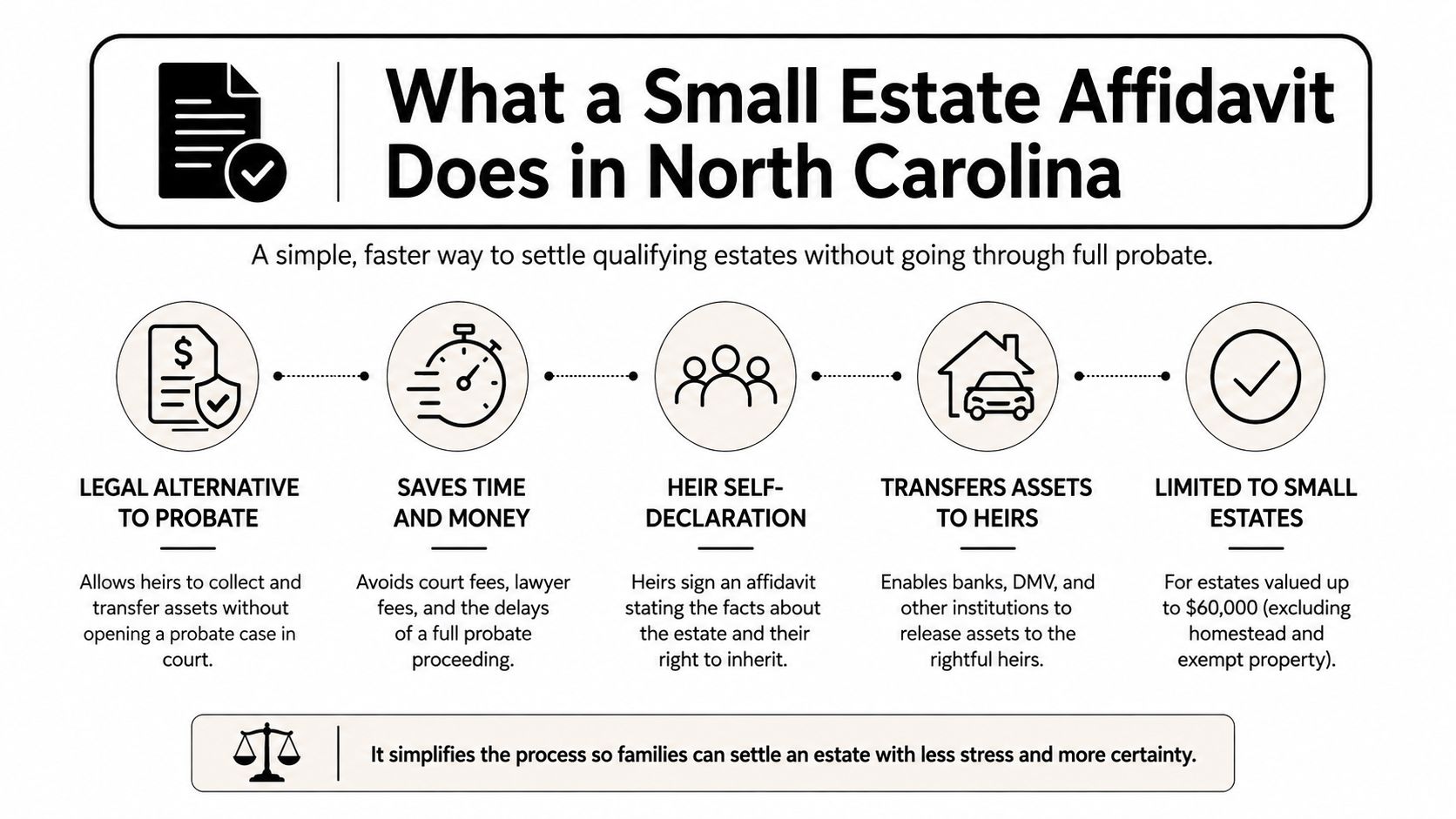
The procedure can be a practical shortcut when the estate consists of a few identifiable accounts or a vehicle and the family agrees about distribution. It won't replace probate when the estate exceeds the applicable threshold, heirs are disputed, creditor issues require court authority, or real property needs administration. Families comparing this procedure with other planning and probate options may also find it useful to review how North Carolina residents can avoid probate.
Who Qualifies and How the Thresholds Work
Eligibility depends on the probate personal property, not the decedent's total wealth. Under G.S. 28A-25-1, an intestate estate may use collection by affidavit after the waiting period when the decedent's personal property, less liens and encumbrances, doesn't exceed $20,000. The higher $30,000 ceiling is narrow. It applies when the affiant is the surviving spouse and sole heir, with the statutory reduction for any spousal allowance already paid. The statute also requires that no personal representative has been appointed anywhere.
The affiant must be legally entitled to the property. That may mean a successor named in a valid will, an heir under North Carolina intestacy law when there is no will, or a qualifying surviving spouse. When there is no will, identifying every heir matters. North Carolina's rules for distribution among a spouse and children can be reviewed in this explanation of NC intestate succession and spouse and children shares.
The valuation question also requires care. Use the personal property's fair market value as of the date of death, then account for qualifying liens and encumbrances. Don't use the original purchase price, an optimistic future sale price, or the gross value of assets that pass outside probate.
Assets that change the calculation
Joint accounts with a right of survivorship, payable-on-death accounts, transfer-on-death designations, and life insurance proceeds generally pass outside the affidavit process. They aren't collected as probate assets through the small estate affidavit, although the family should still confirm the account language and beneficiary records before excluding them.
| Asset Type | Counts Toward Cap? | Why |
|---|---|---|
| Sole-name bank account | Yes | It is personal property subject to estate collection. |
| Vehicle titled solely to the decedent | Yes | It is personal property, subject to the value and lien analysis. |
| Car with a lien | Yes, less the lien | The statute measures value after liens and encumbrances. |
| Joint account with survivorship | Usually no | It passes by survivorship rather than through the estate. |
| POD or TOD account | Usually no | The beneficiary designation controls the transfer. |
| Life insurance with a beneficiary | Usually no | The proceeds pass under the policy designation. |
| Real estate | No | The affidavit is limited to personal property. |
For example, suppose the estate has $18,000 in a sole-name bank account, a $5,000 car with a $4,000 lien, and a $25,000 POD retirement account. The retirement account generally isn't part of the affidavit calculation because it has a beneficiary designation. The vehicle contributes its value after the lien, leaving $1,000 of net value, so the affidavit-eligible personal property is $19,000, assuming no other qualifying assets or complications.
That calculation may fit the ordinary $20,000 ceiling, but a surviving spouse's status, prior allowance, creditor claims, and the accuracy of the asset records can change the result.
Documents You Need Before You Start
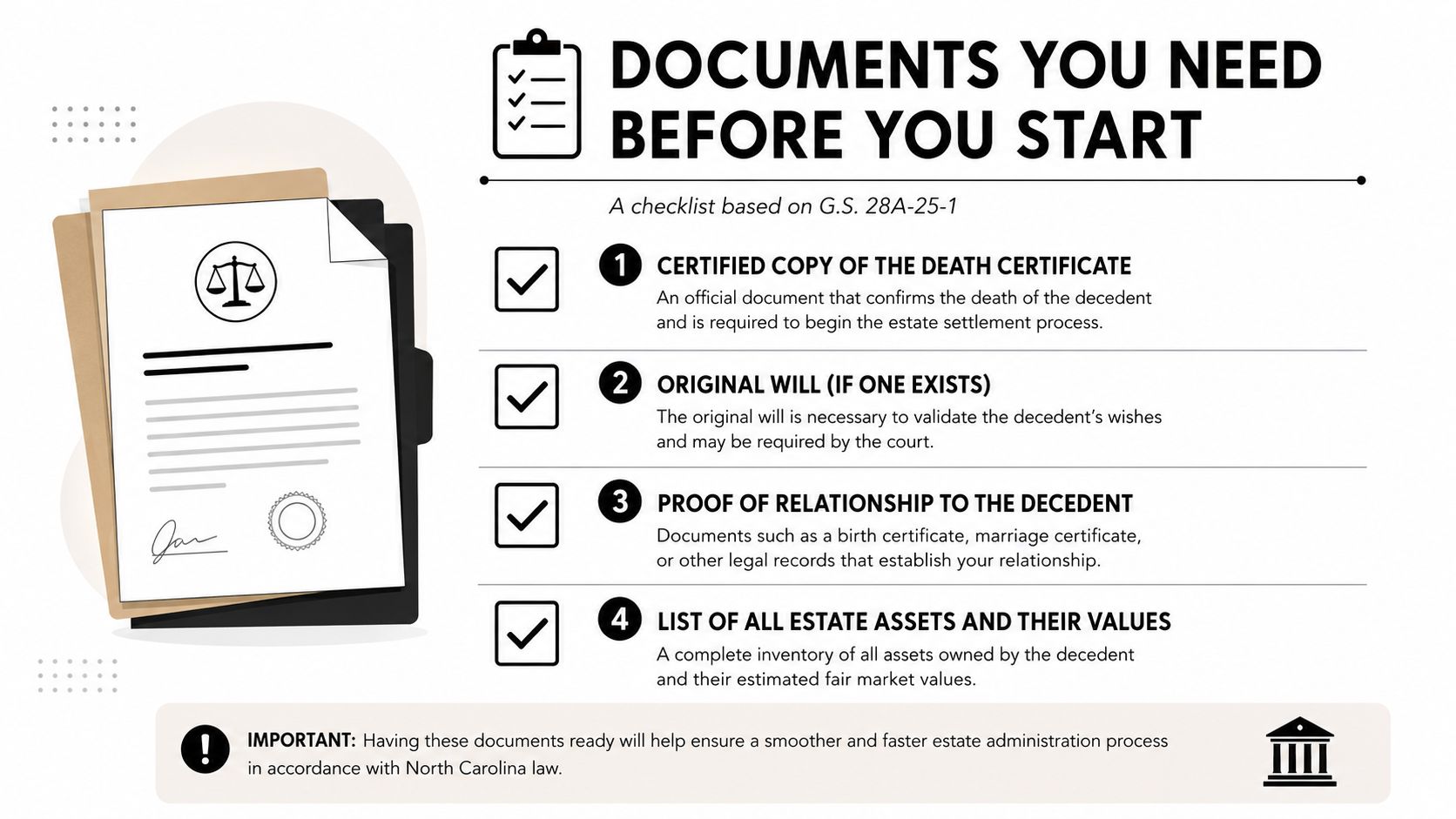
The affidavit is only as reliable as the information behind it. Before completing the statutory form, assemble a file that allows the clerk and each asset holder to see who died, who is entitled to inherit, what property is being collected, and how the value was determined.
Working checklist for the affiant
Gather these core documents:
- Certified death certificate: This confirms the date of death and supplies the document banks and other institutions usually require.
- Original will, if one exists: The will identifies successors and may change who is entitled to the property.
- Complete asset list: List personal property owned solely by the decedent, with fair market values and any liens or encumbrances.
- Heir and beneficiary information: Identify every person entitled under the will or North Carolina intestacy law.
- Relationship or successor proof: Keep records showing why the affiant is entitled to act, such as family records or documents identifying the named successor.
- Statutory affidavit form: Use the applicable North Carolina form and complete it consistently with the supporting documents.
The North Carolina court affidavit form is filed with the clerk in the county connected to the estate. It requires accurate identifying information and a truthful description of the property.
Supporting records aren't always listed as separate statutory requirements, but they can prevent avoidable delays. Include recent account statements, payoff letters for vehicle or other liens, vehicle titles, and reliable Social Security number verification where appropriate. Don't send sensitive records unnecessarily, but have them available when the clerk or institution asks for confirmation.
Suppose a small Forsyth County estate includes a Truist savings account and a Honda Accord titled solely to the decedent. The working packet should include the certified death certificate, the original will if there is one, the account statement, the vehicle title, a valuation for the Honda, any lien payoff information, and identifying information for all heirs. The bank statement and title help the institution match the affidavit to the assets it holds.
Legal paperwork involving a deceased person can also intersect with other family claims. For example, Don't Lose Your Rights: Filing Claims Before NC Divorce Is Final addresses why equitable distribution and alimony claims must be filed before an absolute divorce is granted. That subject is separate from estate collection, but the timing issue illustrates why unresolved legal rights shouldn't be assumed away.
Completing, Notarizing, and Filing the Affidavit
The practical filing process has several stages, and each one matters. Start by confirming that no personal representative has been appointed anywhere and that the 30-day waiting period has passed. Then identify the county of filing, generally the decedent's county of domicile at death. If the decedent was a nonresident, the location of the personal property may control, so unusual residency facts deserve attention.
Complete the form carefully
The affidavit should identify the decedent, date of death, county connection, affiant, heirs or successors, and property to be collected. Describe each asset specifically rather than writing a vague phrase such as “all accounts.” Attach the death certificate, asset schedule, will if applicable, and information identifying the people entitled to distribution.
The affiant must sign under oath before a notary public. A signature placed on the form in advance, without the required oath and notarization, can create a filing problem. Review every name, account description, vehicle identification detail, and value before signing.
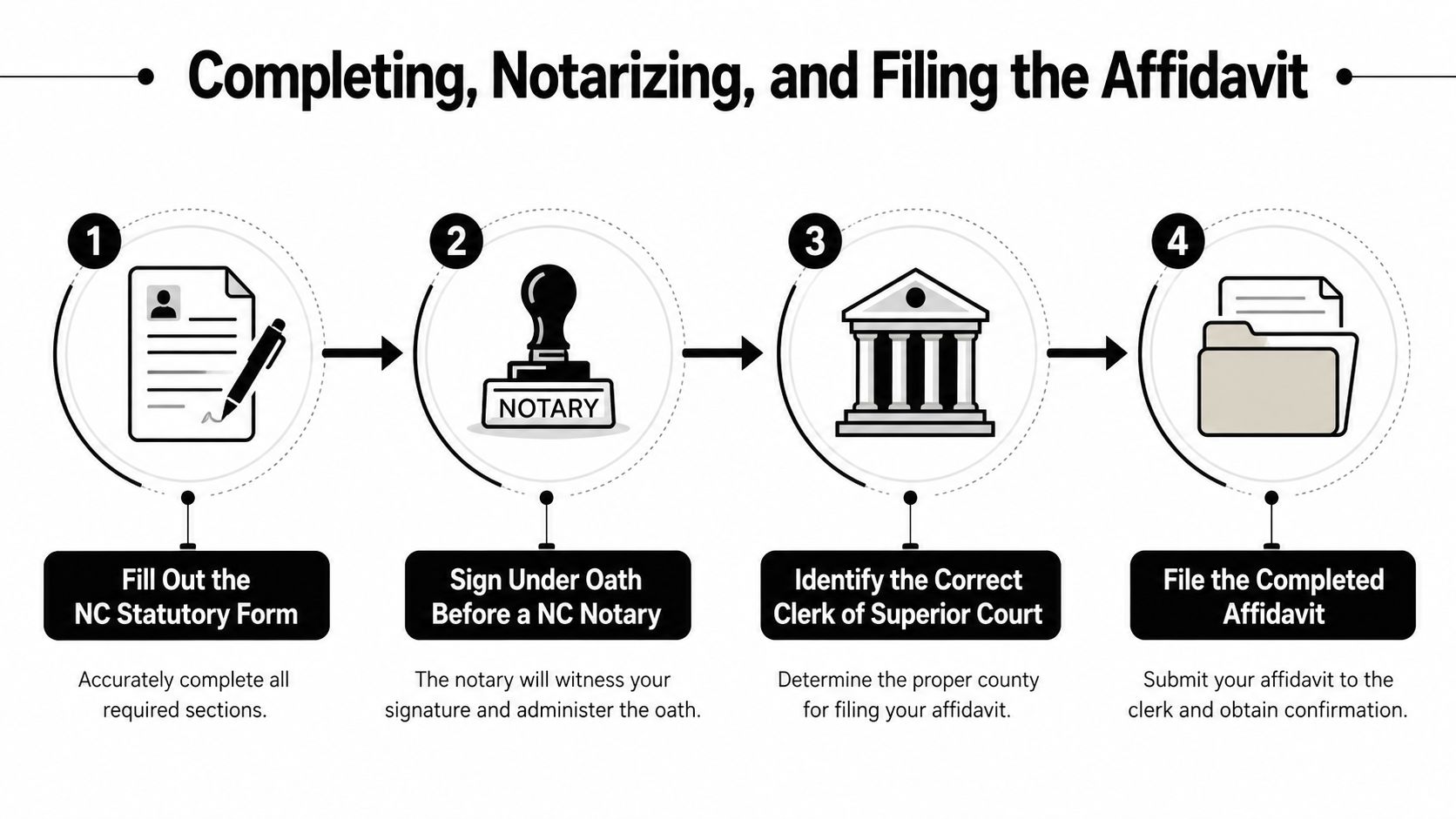
File the original affidavit with the clerk of superior court in the proper county. The clerk files and indexes it in the estate records and mails copies to the people identified as entitled to the property. Keep a complete copy of everything filed, including proof of filing and any clerk correspondence.
Present the certified copy to the asset holder
Filing with the clerk isn't the final practical step. After the clerk processes the affidavit, obtain the certified copy and present it to the bank, brokerage, or other institution holding the asset.
For example, an heir might present a certified affidavit to a Wachovia branch, now operating within Wells Fargo's organization, to request release of a $14,000 checking account. The institution may ask for its own internal forms, identification, additional estate documentation, or a review period beyond what the statute requires. The affidavit creates the legal basis for collection, but it doesn't guarantee that a particular employee or institution will process the request immediately.
Banks may route the matter to an estate department rather than handling it at a local branch. Ask for a written list of required documents, provide copies rather than originals when possible, and keep a record of each submission. In practice, the court filing is often more predictable than the presentation stage, where persistence and careful documentation make a difference.
After You File the Post-Collection Affidavit
North Carolina's process doesn't end when the bank releases the money. Under G.S. 28A-25-3, the affiant must later report what property was collected and how it was distributed. The statute requires a follow-up affidavit, and an independent North Carolina guide explains that it is generally due within 90 days, unless the clerk extends the time for good cause. Review the statutory post-collection requirement before relying on a particular deadline in your case.
Suppose an adult child collects a $15,000 checking account and is one of two co-heirs. The child distributes half to a sibling and keeps half as her own share. She should document the collection and payments, retain proof of distribution, and file the closing affidavit with the same clerk who handled the original filing.
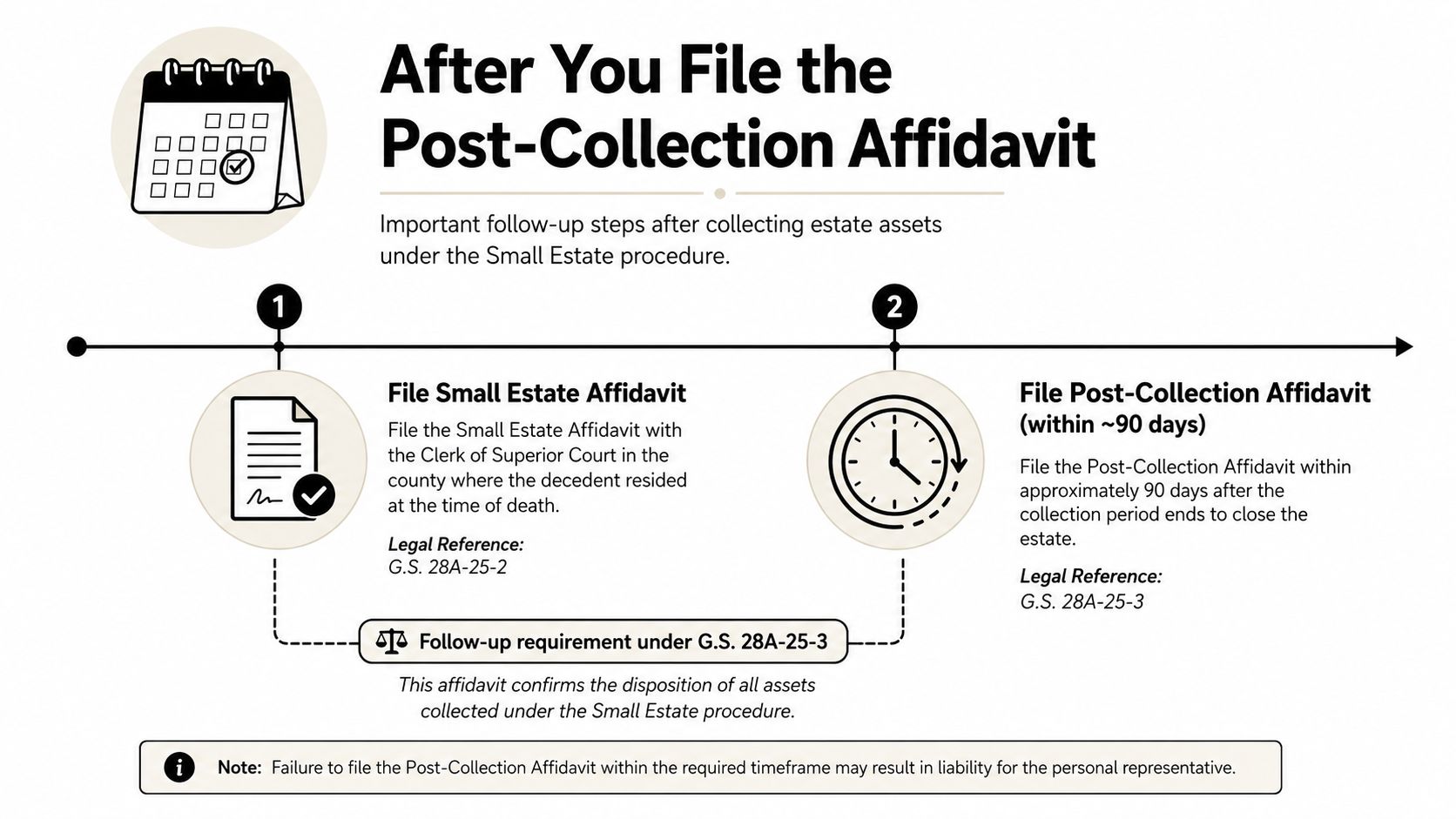
This follow-up filing is not optional paperwork. It tells the clerk what happened to the property and helps demonstrate that the affiant distributed assets to the people legally entitled to receive them.
Practical rule: Don't treat the certified collection affidavit as the closing document. Keep a distribution ledger, save receipts or transfer records, and calendar the follow-up filing as soon as the initial affidavit is accepted.
Skipping the report can leave the affiant personally exposed to later-discovered heirs or creditors. The clerk may also decline to accept future filings from that affiant. If the family discovers an omitted heir, an unpaid debt, or a mistaken distribution, seek legal advice before moving money again.
Common Mistakes That Derail NC Small Estate Cases
Most problems arise from treating the affidavit as a form rather than as a statutory process. The following errors can delay collection or make the shortcut inappropriate.
- Wrong county: File where the decedent was domiciled at death, or address the applicable location rule for a nonresident estate. A filing in the wrong place can undermine the collection effort.
- Filing too early: The family must wait 30 days from the date of death before collection by affidavit. Filing before the waiting period expires can result in rejection or delay.
- Omitting an heir: The affidavit requires identification of the people entitled to the property. Half-siblings, descendants of a predeceased child, and an overlooked surviving spouse can change the distribution and the eligibility analysis.
- Trying to transfer a home: A personal-property affidavit doesn't transfer title to North Carolina real estate. A deed, estate proceeding, or other legally appropriate title process may be necessary.
- Counting the wrong assets: Joint accounts with survivorship rights and POD or TOD accounts may pass outside the estate. Conversely, a sole-name account or vehicle may count even when the family assumes it transfers automatically.
- Ignoring liens: The statute measures qualifying personal property after liens and encumbrances. A vehicle's gross value isn't the same as its net value for this purpose.
- Collecting despite a creditor problem: The affiant isn't a court-appointed personal representative with full authority to investigate and resolve estate debts. A known creditor claim or uncertain debt picture may call for a different procedure.
- Assuming the first filing closes the matter: The post-collection affidavit remains part of the process. Failing to report collection and distribution can create personal liability and administrative problems.
The safest approach is to pause when the facts don't fit neatly. A family disagreement, unclear beneficiary designation, or missing asset record is a warning that the affidavit may be faster to file but harder to correct later.
When to Choose Formal Probate Instead and Talk to an Attorney
The affidavit is useful when the estate is small, the assets are personal property, the heirs are known, and the debts are manageable. It becomes a poor fit when the family needs authority that the affidavit doesn't provide. Formal probate gives a court-appointed personal representative a broader role in collecting assets, addressing claims, and distributing the estate under court supervision.
North Carolina also provides summary administration under G.S. 28A-23-1 in circumstances that may bridge the gap between a collection affidavit and a conventional administration. Whether it fits depends on the will, heirs, assets, debts, and the clerk's requirements. A careful comparison is more useful than assuming the least formal procedure is always the least risky.
| Factor | Small Estate Affidavit | Formal Probate |
|---|---|---|
| Court involvement | Clerk filing and certification are required. | The court oversees appointment and administration. |
| Authority | Limited authority to collect qualifying personal property. | Broader authority for the personal representative. |
| Asset eligibility | Personal property within the applicable statutory ceiling. | Wider estate administration, including issues outside the affidavit shortcut. |
| Creditor issues | Doesn't provide the same authority to investigate or bar claims. | Designed for structured creditor administration. |
| Family complexity | Works best when heirs agree and are readily identified. | Better suited to disputes, missing heirs, or contested rights. |
| Real estate | Doesn't transfer real property. | May provide the administration needed for title and sale issues. |
| Reporting | Includes the initial filing and post-collection reporting. | Includes inventories, accountings, notices, and closing requirements as applicable. |
Formal probate is usually the safer path when personal property exceeds $20,000, or the narrow $30,000 surviving-spouse ceiling, when real estate requires attention, or when creditor claims need to be handled through a court process. It may also be necessary when a creditor demands administrator authority, heirs cannot be located, or the will is likely to be challenged. The North Carolina probate process provides additional context for the broader administration route.
Situations that justify a consultation
Talk with a North Carolina estate attorney before filing if the estate involves a blended family, out-of-state assets, a business interest, potential Medicaid recovery claims, an anticipated will contest, or confusion about beneficiary designations and jointly held property. The same caution applies when the decedent had unpaid debts, multiple accounts, unclear vehicle ownership, or property that may have been transferred shortly before death.
A consultation doesn't mean formal probate is unavoidable. It gives the family a chance to confirm the asset classification, identify the correct heirs, evaluate creditor exposure, and choose between the affidavit, summary administration, or formal probate. That review is especially valuable because an incorrectly completed affidavit can create personal responsibility after the family believes the estate is already finished.
The Law Office of Bryan Fagan offers North Carolina-focused guidance on wills, trusts, probate, and estate administration, including reviewing whether a small estate affidavit fits your family's assets and heirs. Schedule a consultation by visiting Law Office of Bryan Fagan to discuss the county filing, personal-property calculation, post-collection filing, and any issues that may require formal probate.