You got stopped in North Carolina, the officer said alcohol was involved, and now the citation in your hand says DWI. If you searched for dui vs dwi nc, you're probably trying to answer a simpler question than the law gives you: whether this is “just a ticket,” whether your license is already in danger, and what matters most before court.
In North Carolina, the label on the citation is only the starting point. What controls the case is the statute, the proof of impairment, the testing results, and the sentencing factors the judge can use if there's a conviction.
| Question | North Carolina rule | Practical meaning |
|---|---|---|
| Is DUI a separate offense? | No, North Carolina uses DWI as the official charge under G.S. 20-138.1 | The acronym on the paper doesn't decide the case |
| What conduct is covered? | Driving while impaired by alcohol, drugs, or both | The case can involve more than drinking |
| What number matters for alcohol? | 0.08 for most drivers, 0.04 for commercial drivers | BAC can trigger a per se charge |
| What changes punishment? | Sentencing levels, aggravating factors, and prior history | Outcomes vary a lot from case to case |
That table is the short version. The longer version matters because North Carolina DWI law doesn't work like the simple DUI label people use in everyday conversation.
What the DUI vs DWI Question Really Means in North Carolina
A driver gets pulled over in Wake County after a few drinks, the officer reads the paperwork, and the citation says DWI. The first reaction is often confusion, because people from other states hear DUI and DWI as if they're different crimes. In North Carolina, the word choice is mostly a conversation problem, not a legal one.
The state's official offense is Driving While Impaired. That matters because the prosecutor is not tied to whatever shorthand an officer used on the roadside paperwork. The District Attorney charges the offense under North Carolina law, not the label a driver expected to see. The statute is the anchor, not the acronym. See the state's own DWI statute in G.S. 20-138.1 for the controlling language and offense structure, and compare that with a plain-English overview of impaired driving in North Carolina from the Law Office of Bryan Fagan.
The label on the ticket is not the whole case
If the citation says DUI, DWI, or some officer shorthand, the next question is still the same, what conduct is the State trying to prove? North Carolina's framework is broader than an alcohol-only label. It covers alcohol, drugs, and combined impairment in one offense, which is why a client's defense usually turns on the facts, not the letters printed on the citation.
Practical rule: if the stop, testing, or impairment evidence is weak, the exact acronym on the ticket won't save the case, and it won't sink it either.
Out-of-state drivers get tripped up here more than local drivers do. A person from Virginia, South Carolina, or Tennessee may use the term DUI automatically, then assume North Carolina has the same structure. It doesn't. North Carolina uses DWI as the offense name, and that official terminology controls court paperwork, DMV records, and how lawyers talk about the case.
The key point is simple. The acronym is not where the fight happens. The fight happens over the stop, the testing, the evidence of impairment, and, if necessary, the sentencing level.
How North Carolina Defines DWI Under G.S. 20-138.1
North Carolina's impaired-driving statute is built around one core rule, it is unlawful to drive on a highway, street, or public vehicular area while under the influence of an impairing substance, or with an alcohol concentration at or above the legal limit. That single statute is the reason North Carolina doesn't separate the offense into a DUI track and a DWI track the way some other states do.
The legal language in G.S. 20-138.1 matters because it gives prosecutors two ways to prove the case. One path is impairment of mental or physical faculties. The other is the per se alcohol concentration threshold. A driver can be charged under either theory, and prosecutors often allege both when the facts support it. The statute also includes separate treatment for commercial drivers and for certain controlled substances. You can read the statutory text directly in G.S. 20-138.1.
Two different theories, one offense name
The first theory is classic impairment. The State tries to show the driver's faculties were appreciably impaired by alcohol, drugs, or a mix of substances. The second theory is numerical, if the BAC is at or above the applicable legal threshold, the State can proceed without having to prove the driver looked obviously intoxicated in the field.
That's why defense lawyers use the word DWI. Judges do too. DMV paperwork does too. The legal system is built around that statutory offense name, not around the everyday DUI shorthand that drivers often use after an arrest.
A common misconception is that a driver has to “blow over” to be in trouble. That isn't true. North Carolina law reaches drugs, prescription medication, and mixed-substance impairment even when there's no alcohol number driving the case. The next sections show why that distinction matters in real court strategy, especially for people who thought they were dealing with a simple alcohol stop.
A DWI charge in North Carolina is really a proof problem. The State has to fit the facts into the statute, and the defense looks for every place that proof breaks down.
BAC Thresholds and Impairment Categories in NC
North Carolina's alcohol thresholds are straightforward on paper, but the courtroom application isn't. For most drivers, 0.08 is the per se limit under the DWI statute. For commercial drivers, the statutory threshold is 0.04. Those numbers matter because they change what the State has to prove and how the case gets framed at trial.
The practical split is this. A lower BAC can still support a charge if the officer, the field tests, and the surrounding evidence point to actual impairment. A higher BAC can support a charge even if the officer didn't document dramatic driving behavior. That's why the same case can feel very different depending on the test result, the observations, and the rest of the record.
What the number does and does not do
BAC evidence is powerful, but it isn't the whole story. A breath or blood result can strengthen the State's case, yet North Carolina law still leaves room to challenge whether the test was reliable, whether the sample was handled correctly, and whether the officer followed the required procedures. In practice, the difference between a number and a conviction often comes down to whether the evidence was properly collected and admitted.
| NC BAC Thresholds by Driver Category | Statute | BAC Limit | Notes |
|---|---|---|---|
| Standard drivers | G.S. 20-138.1 | 0.08 | Common per se threshold for impaired driving |
| Commercial drivers | G.S. 20-138.2 | 0.04 | Lower threshold for CDL-related enforcement |
| Underage drivers | North Carolina underage alcohol rules | 0.02 | Separate underage alcohol limit used in NC enforcement |
The biggest courtroom mistake is assuming BAC is the only issue. It isn't. North Carolina prosecutors still use the broader impairment prong when the alcohol number is below the per se threshold, and they use it even more often when drugs or combined substances are involved.
DWI Sentencing Levels and Penalties in North Carolina
North Carolina sentencing is more detailed than the usual first-offense, second-offense model people expect. The state uses six misdemeanor punishment levels, from Level 5 up through Aggravated Level 1, with a separate felony pathway for habitual impaired driving. The controlling sentencing statute is G.S. 20-179, and a practical overview of the system is available through the North Carolina DWI sentencing levels explained resource.
The judge does not guess at punishment. The court weighs aggravating, grossly aggravating, and mitigating factors. That structure is why two drivers with similar BAC readings can face very different outcomes.
How the levels change the stakes
At the lowest end, Level 5 is the least severe misdemeanor level. At the highest misdemeanor end, Level 1 can include a fine up to $4,000 and imprisonment from 30 days to 24 months, while Level 5 allows a fine up to $200 and imprisonment from 24 hours to 60 days under G.S. 20-179. The difference is not cosmetic. It changes the amount of jail exposure, the practical influence in plea negotiations, and the license consequences that follow.
North Carolina also uses aggravating factors to move the sentence upward. Those factors can include a BAC of 0.15 or higher, prior impaired-driving convictions, a child passenger, reckless driving, or a revocation history tied to impaired driving. Once grossly aggravating factors are in the case, the punishment can move sharply higher. A habitual pattern of impaired driving can even open the felony pathway.
| North Carolina DWI Misdemeanor Sentencing Levels (G.S. 20-179) | Level | Max Fine | Min Jail | License Revocation | Trigger |
|---|---|---|---|---|---|
| Least severe misdemeanor range | Level 5 | $200 | 24 hours | Statutory revocation applies | Mitigating factors outweigh aggravation |
| More serious misdemeanor range | Level 1 | $4,000 | 30 days | Statutory revocation applies | Strong aggravation or gross factors |
| Highest misdemeanor range | Aggravated Level 1 | Higher than Level 1 | 30 days to 24 months | Statutory revocation applies | Multiple grossly aggravating factors |
The sentence isn't just about jail. It also affects probation terms, treatment requirements, and whether ignition interlock becomes part of the picture. A case that looks minor at the arrest stage can still turn into a heavily supervised court outcome.
License Suspension and Ignition Interlock Consequences
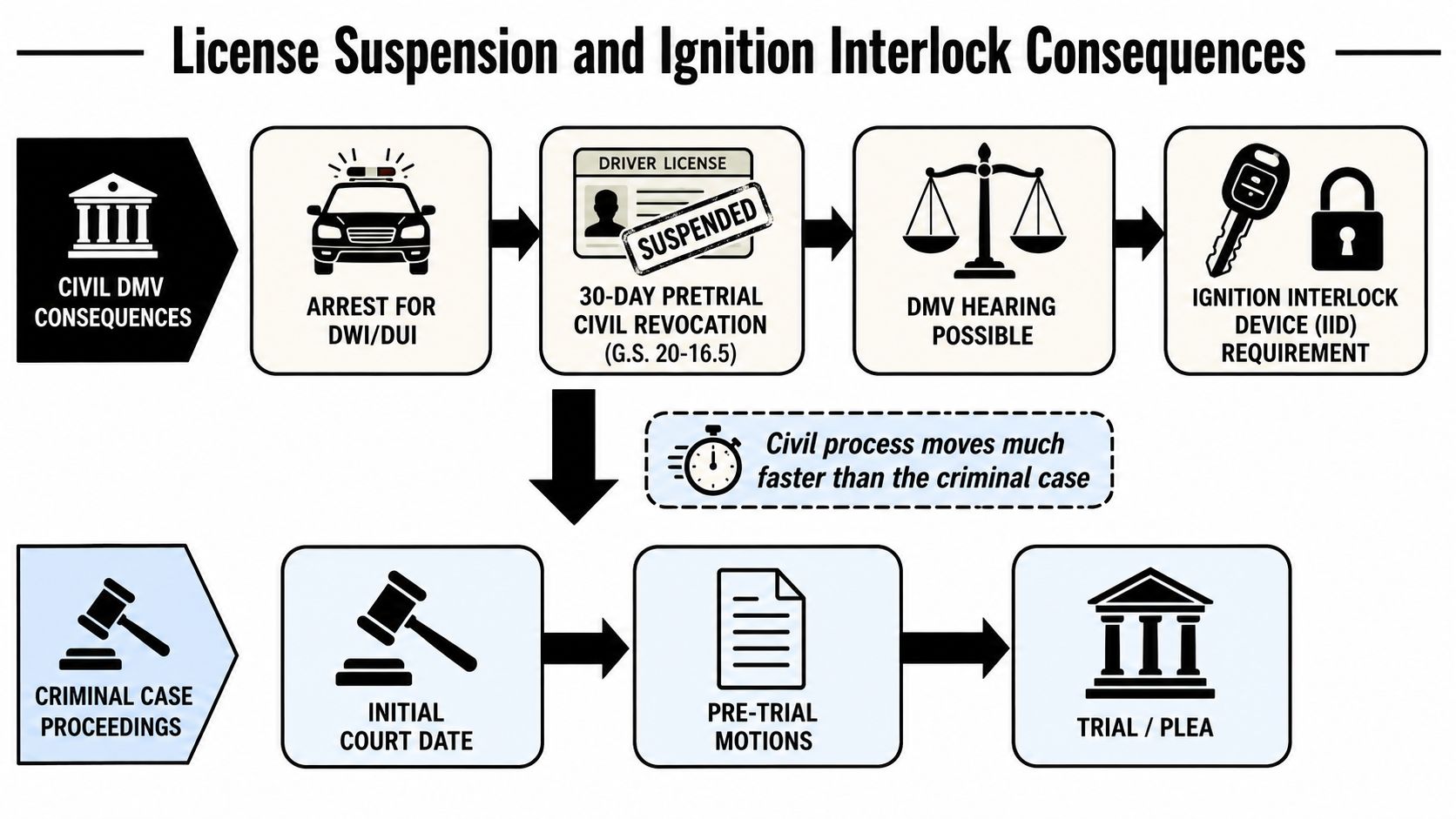
A DWI arrest can affect your license before the criminal case is resolved. That's the part many people miss. North Carolina has separate DMV consequences and criminal court consequences, and the DMV side can move faster than the judge's calendar.
The state's limited-driving and revocation rules are laid out in G.S. 20-16.2, G.S. 20-16.5, and G.S. 20-179.3. A summary of the revocation and limited-driving privilege process is also available from the NC DWI license revocation and limited driving privilege page. The civil process and the criminal process do not wait for each other.
Why the DMV timeline matters first
If there's a chemical refusal, the civil revocation can be triggered through the DMV process. If there's a qualifying BAC result or other evidence of impairment, the license consequences can start immediately as well. A preconviction hearing is available in limited circumstances, but the deadlines are short, and missing them can cost you driving time before the case ever reaches trial.
The criminal court may take months. The DMV consequences can start almost immediately, which is why the first few days matter so much.
Ignition interlock is its own issue. Under G.S. 20-179.3, certain convictions require installation of an ignition interlock device, including many Level 3, Level 4, and Level 5 cases, some Level 2 cases, and all the more serious sentencing categories described by statute. The device obligation can outlast the criminal sentence, so finishing probation doesn't automatically end the driving restriction.
Some readers also ask how this kind of legal deadline compares with other North Carolina filing rules. A separate example is the North Carolina Divorce Residency Requirements, which use a six-month residency rule, showing how seriously North Carolina treats timing in very different legal settings. DWI deadlines are even more unforgiving because they affect your ability to drive right away.
Drugs, Prescriptions, and Combined Substance DWI Cases
North Carolina DWI law is not limited to alcohol. G.S. 20-138.1(a)(2) and (a)(3) extend the offense to impairment from other substances and combined-substance use, which is why a lot of DWI tickets still say DWI even when alcohol is not the whole story. That broader structure is one reason the DUI versus DWI search question leaves out the most important real-world cases.
Drug-related DWI cases usually do not turn on a BAC number. Officers and prosecutors often rely on a Drug Recognition Evaluator opinion, blood testing, and the totality of the observations. That puts more pressure on the quality of the field process, the lab handling, and the officer's training.
Prescription use is not an automatic shield
A valid prescription does not end the inquiry. If the medication impaired driving, the State can still pursue the case under North Carolina's DWI statute. The legal question is not just whether the substance was lawful. It is whether the driver was impaired in a way the statute prohibits.
Combined-substance cases are especially common because alcohol below 0.08 can still matter when paired with THC, stimulants, opioids, or benzodiazepines. Prosecutors often treat these files as impairment cases, not alcohol-number cases, because the combination can support the broader theory of impairment even when no single substance tells the whole story.
Defense issues in these cases are technical. Chain of custody on the blood sample matters. DRE training and certification matter. Lab accreditation matters. So does whether the officer followed implied consent procedures under G.S. 20-16.2. When any of those pieces break, the State's version of the case gets weaker.
Bottom line: if the case involves medication or more than one substance, the defense has to test the procedure as hard as the State tests the blood.
Common Defenses and Long-Term Impact of a DWI
A man gets stopped at night after a lane drift, but the body-cam video shows the car was steady before the officer made the stop. The defense starts there, because if the stop lacked reasonable suspicion, the rest of the evidence can become vulnerable. From there, the lawyer looks at how the field sobriety tests were administered, whether the breath machine was properly calibrated, and whether the officer's drug-impairment opinion is really backed by the record.
A DWI defense in North Carolina usually starts with the basics. Was the stop lawful under G.S. 20-138.1. Were the field tests performed correctly. Was the breath test machine maintained under 10A NCAC 41B .0320. In drug cases, did the officer have a sound basis for the opinion that impairment came from a controlled substance rather than fatigue, injury, or another cause.
The consequences often outlast the case
A conviction can trigger insurance problems, employment problems, and licensing issues that keep showing up after the court date is over. It can also follow you into other states. North Carolina DWI history is treated seriously by interstate licensing systems, and nearby states like South Carolina, Virginia, and Tennessee may treat an NC impaired-driving offense as a prior when their own laws apply.
The long tail matters in places people don't expect. Background screening, professional licensing reporting, and child-related employment rules can all become more difficult after a conviction. Even if a charge is reduced, the record can still create questions that take time to explain.
A careful defense posture is not just about avoiding jail. It is about deciding whether the State's proof is strong enough to justify a plea, whether a suppression issue could change the equation, and whether the long-term costs make a trial the better path.
Next Steps After a DWI Charge in North Carolina
The first 72 hours matter. Start by finding the citation, the breath or blood paperwork, and any release documents the officer gave you. Then protect the deadline that can preserve driving privileges, because North Carolina's DMV process moves quickly after a DWI arrest and refusal-related issues under G.S. 20-16.2 can create immediate consequences.
A practical first-week checklist
- Request the DMV hearing on time: If your case involves a refusal, act within the statutory deadline so you do not lose the chance to challenge the revocation.
- Stay off social media: Posts about drinking, the stop, or the arrest can be used later.
- Save every document: Keep the citation, test paperwork, and any text messages or ride receipts that may help reconstruct the timeline.
- Don't give an insurance statement too early: A recorded statement can box you into facts before counsel reviews the file.
- Choose counsel with local court experience: A North Carolina DWI lawyer who regularly handles cases in the charging county will know the judge, the prosecutor's practices, and the local filing rhythm.
If you're comparing lawyers, ask direct questions about district court experience, how often they litigate suppression issues, and whether they handle ignition interlock and limited driving privilege issues as part of the case. A limited offender may also have pretrial diversion options under G.S. 15A-1341(a4), but those depend on the facts and the county practice.
The best next step is a consultation before the deadlines start closing. The earlier the file is reviewed, the more options usually remain.
The Law Office of Bryan Fagan helps North Carolina residents sort out DWI charges, license issues, and the practical fallout that follows an arrest. If you need a plan for court, DMV deadlines, and the evidence in your case, visit Law Office of Bryan Fagan to schedule a consultation and get clear next steps from a North Carolina defense team that handles these cases every day.
FAQ
Is DUI the same as DWI in North Carolina
Yes. North Carolina uses DWI as the official offense name, and DUI is not a separate criminal charge here.
Can you be charged with DWI in NC if your BAC is below 0.08
Yes. North Carolina can still charge DWI if the State claims the driver was impaired by alcohol, drugs, or both, even without a per se BAC case.
Does a prescription drug defense automatically beat a DWI charge
No. A lawful prescription does not matter if the medication impaired driving.
Will I lose my license right away after a DWI arrest
You can. DMV and criminal consequences run on separate tracks, and some license consequences start before the case is resolved.
What should I do first after a DWI arrest in NC
Save the paperwork, protect your DMV deadlines, and speak with a North Carolina DWI lawyer before giving statements or making assumptions about the case.