You leave a North Carolina courthouse or roadside stop with a frightening question: Can you legally drive to work tomorrow? The answer may depend on whether your license is under an immediate civil revocation, whether a criminal DWI case is pending, whether a conviction has occurred, and whether a court has issued a Limited Driving Privilege.
A license revocation removes your ordinary authority to drive. A Limited Driving Privilege is different. It's a court-issued authorization allowing only the driving activities, destinations, vehicles, and times stated in the order. The two consequences can arise from the same DWI event, but they serve different legal purposes.
A limited privilege isn't normal driving. It's restricted permission to drive under a specific court order.
This guide explains the North Carolina DWI license revocation and limited driving privilege process in chronological order. The rules come from North Carolina statutes and court materials, including North Carolina General Statute 20-16.5. Examples are intended to clarify the process, not predict eligibility or results in any individual case.
License consequences at a glance
| Issue | Civil Revocation | Criminal Revocation or Privilege |
|---|---|---|
| Legal setting | Administrative consequence connected to the arrest and qualifying testing or refusal circumstances | Criminal case, conviction, sentencing, restoration, or court-issued driving authorization |
| Immediate effect | Often begins with an immediate loss of driving rights | May arise from the criminal case or from conditions imposed after conviction |
| Decision-maker | Magistrate, DMV process, or court handling the civil revocation | Criminal court and applicable licensing authorities |
| Driving option | A qualifying person may seek a pretrial privilege | Eligibility depends on sentencing level, license history, assessment, interlock rules, and other statutory conditions |
| Main warning | Don't assume the criminal case controls the civil revocation | Don't treat a privilege as unrestricted reinstatement |
If you're trying to understand the broader charge and court process, the firm's overview of DWI in North Carolina provides related information. For the immediate license question, preserve every notice, court date, and document before deciding whether to drive.
Civil and Criminal DWI Revocations Explained
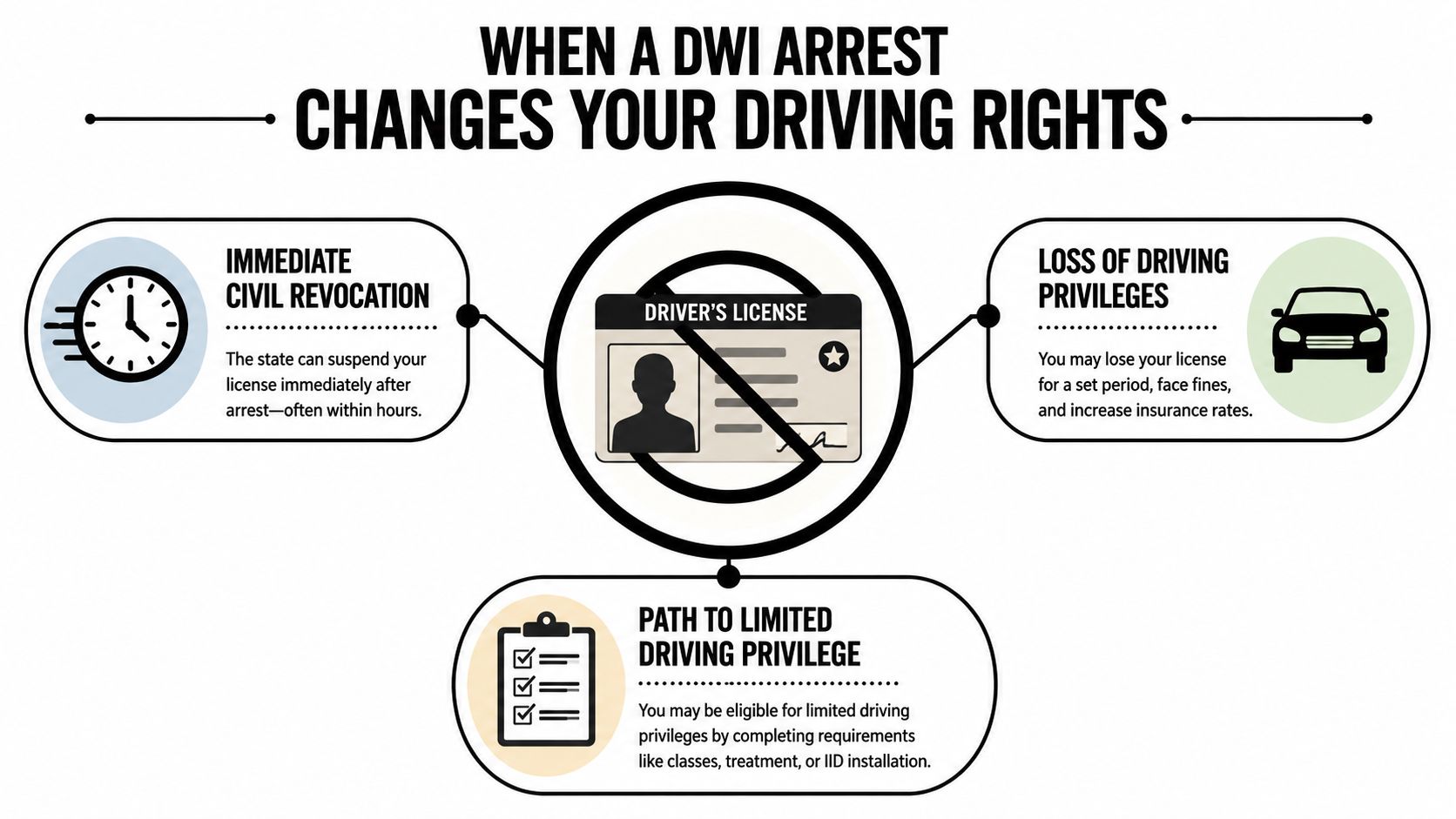
North Carolina's DWI system can place two separate legal tracks beside each other. The first is the civil revocation, which can begin immediately after an impaired-driving arrest when statutory conditions are met. The second is the criminal DWI prosecution, which moves through court and may create additional consequences if there's a conviction.
Under G.S. 20-16.5, many qualifying arrests involve an immediate 30-day civil license revocation. Qualifying circumstances can include a breath or blood alcohol result of 0.08 or higher, a refusal, or other circumstances identified by the statute. The civil revocation isn't a finding that the person has been convicted. It's an administrative driving consequence connected to the arrest and specified testing or refusal facts.
The criminal case has a different purpose. Prosecutors must pursue the DWI charge in court, and the person may have defenses, negotiations, motions, or trial rights. A person might challenge the civil revocation while separately defending the criminal charge. Resolving one track doesn't automatically resolve the other.
Why the distinction matters
Consider a driver whose license is revoked after an arrest. The driver may believe that winning or dismissing the DWI charge automatically restores driving rights. That assumption can be unsafe because the civil revocation, criminal case, DMV records, and any later court order may operate on different timelines.
A Limited Driving Privilege also doesn't erase the charge, cancel the revocation, or establish that the criminal case will end favorably. It creates a narrow exception to the active loss of ordinary driving authority.
A court order permitting limited travel doesn't convert a revoked license into a fully valid license.
The practical question is therefore not, “Is my license suspended?” Ask instead:
- What caused the loss: Was it a civil revocation tied to the arrest, a conviction-related consequence, or another licensing issue?
- Who controls the next step: Is the relevant decision before a magistrate, district court judge, criminal court, or DMV?
- What document governs driving: Do you have an effective privilege order, or only a pending request?
- What remains unresolved: Are there other impaired-driving charges, assessment requirements, insurance issues, or interlock conditions?
That classification prevents a common mistake, treating the arrest, civil revocation, criminal prosecution, and restoration process as one interchangeable event.
Eligibility Rules and Critical Filing Deadlines
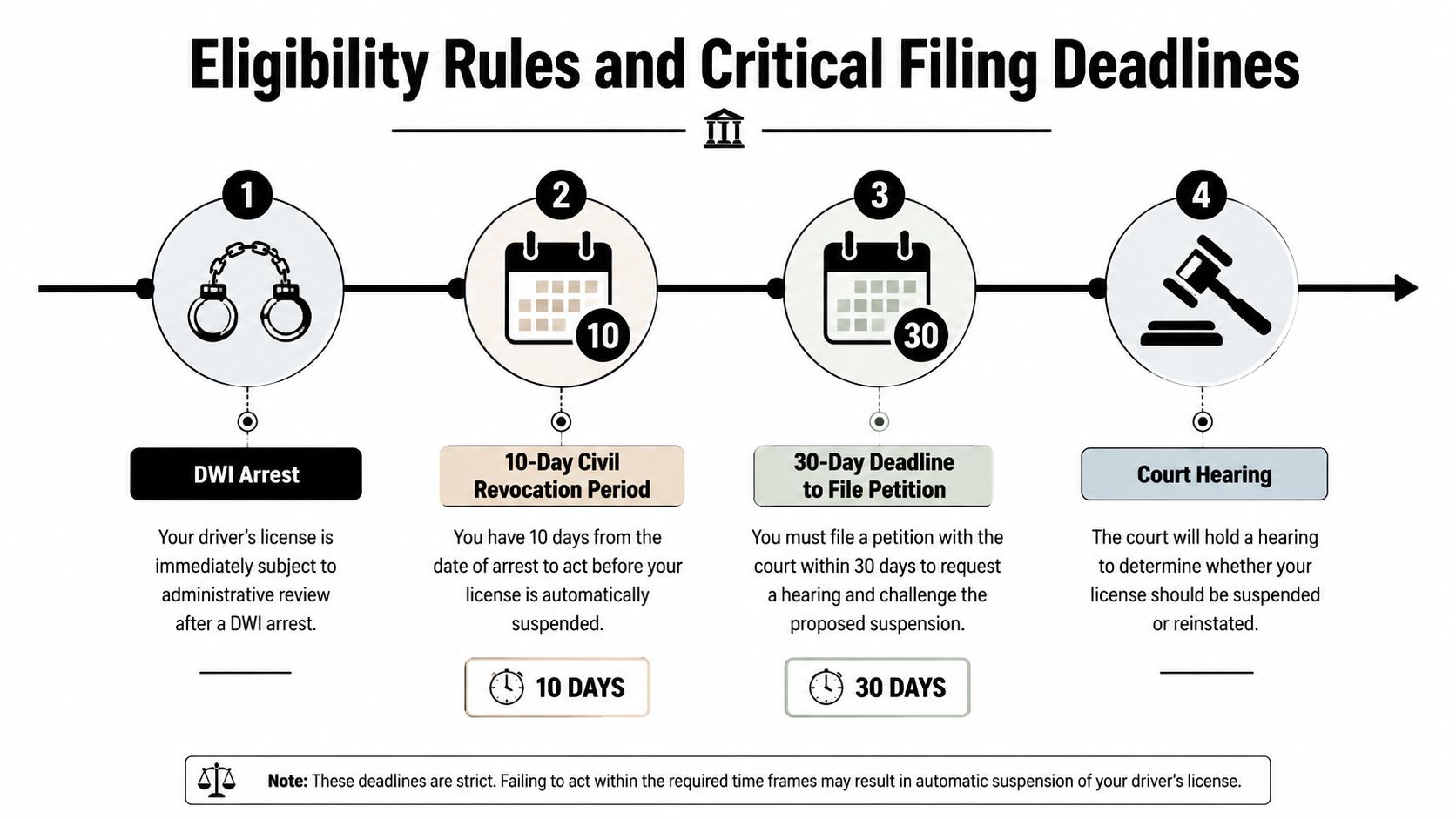
The first task is to identify the revocation shown on your paperwork. North Carolina's statutory structure uses waiting periods and eligibility findings before a court may issue a pretrial Limited Driving Privilege. The privilege isn't automatic merely because work or family transportation is difficult.
Follow the legal sequence
For many civil revocations lasting 30 days, the statute sets an eligibility point after the person has waited at least 10 days. If the revocation is for 45 days, the applicable waiting point is at least 30 days. The exact period depends on the revocation described in the notice and the statutory category involved. See the North Carolina statute governing civil revocation and limited privileges before relying on a calendar calculation.
A person generally must also satisfy conditions such as holding a valid license, or one expired for less than a year, having no unresolved pending impaired-driving charges that create a statutory barrier, and completing a substance-abuse assessment with any recommended treatment. Meeting those conditions establishes a possible path for consideration, not a guaranteed order.
Use this sequence:
- Read the notice carefully. Confirm the start date, revocation length, stated reason, and hearing information.
- Calendar the earliest eligibility point. The waiting period is not the same as the date you're automatically allowed to drive.
- Preserve hearing deadlines. A request to challenge the civil revocation or seek relief must follow the applicable procedure and local court practice.
- Complete required assessment steps. Keep proof of the assessment and any recommended education or treatment enrollment.
- Obtain the signed order. Don't drive merely because you've filed paperwork or believe you qualify.
- Read every restriction. The order controls approved purposes, times, destinations, vehicles, and conditions.
The conviction stage follows a separate analysis. For many DWI convictions, eligibility is tied to lower sentencing levels, a valid license at the time of the offense, the absence of a disqualifying prior DWI pattern, and a filed substance-abuse assessment. A conviction involving an alcohol concentration of 0.15 or higher can delay the privilege at least 45 days and require ignition interlock, as discussed in North Carolina DWI first-offense guidance.
The distinction between filing a request and receiving effective authorization is essential. A person may be eligible to ask the court for relief, yet still lack legal permission to drive until the court issues an effective order.
For a separate North Carolina legal deadline involving divorce, Don't Lose Your Rights: Filing Claims Before NC Divorce Is Final explains why equitable distribution and alimony claims must be filed before an absolute divorce is granted. That issue is unrelated to DWI licensing, but it illustrates the broader importance of preserving legal claims before a deadline expires.
Building the Limited Driving Privilege Application
Once the timing appears favorable, preparation becomes the central issue. A court needs enough accurate information to determine whether the statutory prerequisites are met and what driving terms are appropriate. A complete packet still doesn't guarantee that a judge will issue the privilege.
Gather the record first
Start with the documents that identify your legal status. These commonly include the civil revocation notice, driving record, citation or charging information, current license information, and any court paperwork showing pending or resolved impaired-driving matters.
Your license history matters because the court may need to determine whether the license was valid at the time of the offense or had been expired for less than a year. Other unresolved DWI charges can also change the analysis. Don't rely on memory if the driving record or court file can answer the question more accurately.
Document the reason for driving
A request should explain the transportation need with practical detail. Depending on the case, that may involve:
- Employment: Employer information, work location, schedule, and the route or time range needed for work.
- Education: School or training information and the driving schedule required to attend.
- Treatment: Assessment paperwork and proof of enrollment in recommended treatment or education.
- Household needs: The household-maintenance activities that require transportation.
- Insurance: Current proof of financial responsibility in the form accepted for the case.
- Interlock information: Vehicle details, installation records, service documentation, and any conditions relevant to monitored driving.
The court order may identify approved destinations, time windows, and vehicles. If the application uses vague or inaccurate information, the resulting order may fail to address the transportation problem or may create confusion during a traffic stop.
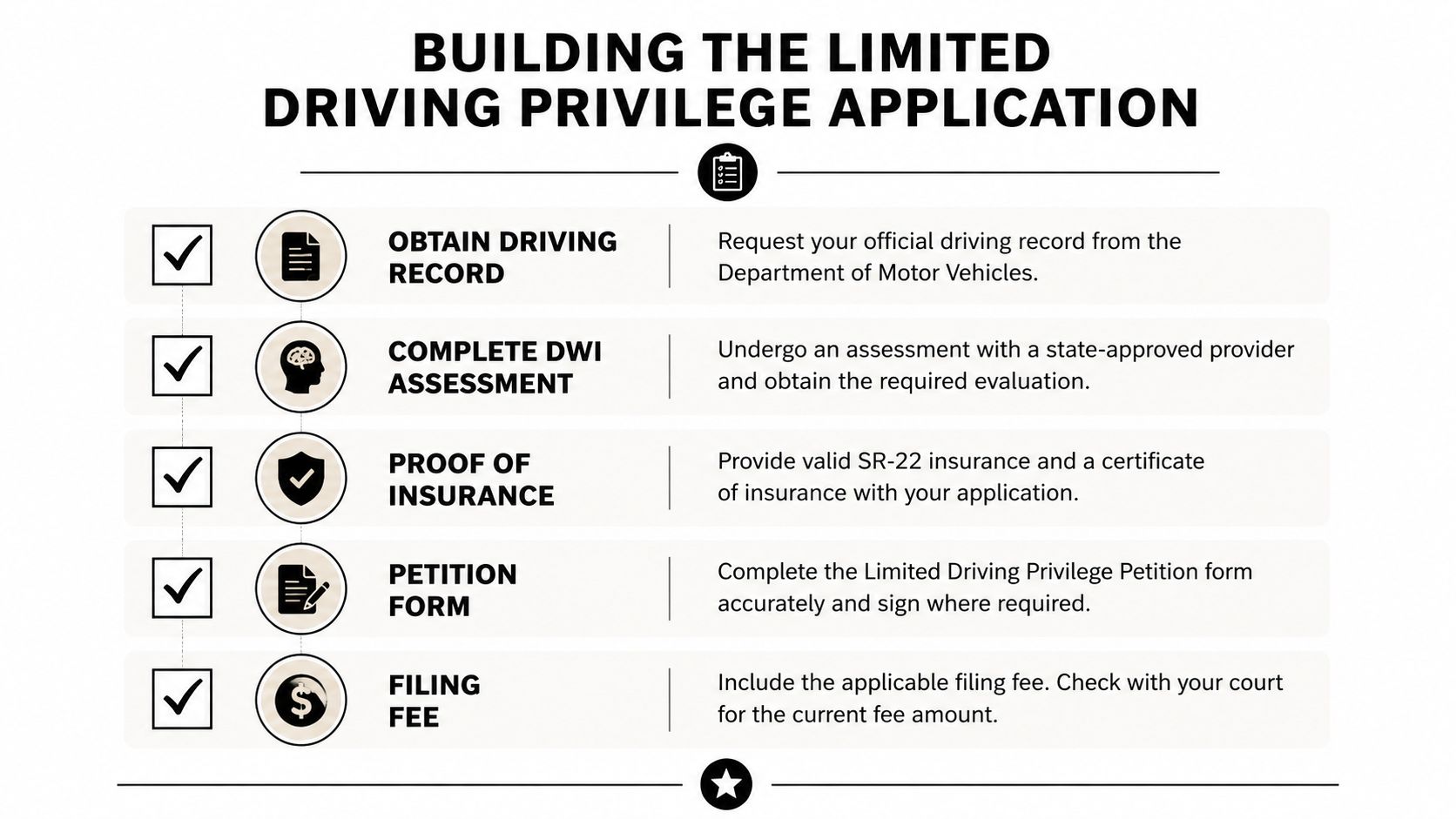
Forms and filing practices can vary by judicial district and case posture. Before filing, compare your packet with the current court form, confirm whether certified records are needed, and check whether the court requires particular proof of insurance, assessment, treatment, or vehicle information.
The safest preparation creates a file another person can review quickly. Put the notice, record, assessment, insurance proof, proposed driving schedule, and interlock documents together, then ask a North Carolina attorney to identify missing or inconsistent information.
What a North Carolina Privilege Actually Allows
A Limited Driving Privilege can solve a transportation problem without restoring ordinary driving rights. North Carolina law and court materials identify purposes such as work, household maintenance, education, court-ordered treatment, community service, and emergency care. The order may limit when, where, and why the person drives.
Suppose a driver receives permission to travel to work and court-ordered treatment. That authorization doesn't necessarily permit a stop at a store, a personal visit, or an unscheduled trip. The driver must read the order carefully and ask for clarification before taking a trip that doesn't clearly fit its terms.
Time windows can control the trip
Court materials describe household-driving windows such as 6:00 a.m. to 8:00 p.m., Monday through Friday, while emergency medical driving may be allowed at any time under the applicable order and statutory conditions. Those examples show why “I'm allowed to drive for household needs” isn't enough. The time restriction may be just as important as the purpose restriction. See the North Carolina limited driving privilege statute for the statutory framework.
A different driver may need transportation for school, worship, treatment, or community service. Another may have only a narrow work route. The court can define the approved purpose and travel boundaries based on the legal category and facts presented.
The vehicle and alcohol conditions matter
An approved destination doesn't eliminate other conditions. A privilege can require a specific vehicle, proof of insurance, treatment compliance, and ignition interlock. A driver should keep the order available and avoid assuming that a family member's vehicle or a different route is covered.
For a high-risk conviction, the privilege may not become effective until at least 45 days after conviction and may require a functioning ignition interlock system. The North Carolina Department of Health and Human Services alcohol and the law materials describe alcohol-concentration restrictions that can apply on restoration, including 0.04 on first restoration and 0.00 on second or subsequent restoration.
The practical rule is simple: plan only the trips the order clearly authorizes. If the wording is unclear, don't test the boundary on the road.
Ignition Interlock and High-Risk DWI Conditions
A driver may receive a limited privilege and still be unable to drive an ordinary vehicle freely. When ignition interlock applies, the device becomes a condition of legal driving, alongside the order's approved purposes, hours, and routes.
North Carolina court materials address interlock requirements for license restoration and limited privileges following a DWI conviction. For a conviction involving an alcohol concentration of 0.15 or more, the court interlock form states that the privilege cannot become effective until at least 45 days after final conviction. It also requires a functioning device configured to prevent driving with an alcohol concentration greater than 0.00. Review the current North Carolina courts' ignition-interlock privilege form because the exact wording of the order controls the conditions in a particular case.
North Carolina guidance also identifies a universal 0.02 alcohol-concentration restriction for people required to have interlock as a condition of restored licensing. The court form for the specified high-alcohol conviction describes a stricter device setting. These rules apply at different stages, so the relevant document and case posture matter. A driver should not assume that one threshold governs every civil restoration, pretrial privilege, or conviction-based privilege.
Refusal consequences follow a separate path
A refusal-based civil revocation creates a different timeline from a conviction-based restriction. State materials describe an immediate 30-day loss followed by an additional minimum 12-month revocation in qualifying refusal cases. In certain refusal situations, a limited privilege may be available only after six months. The UNC School of Government discussion of ignition-interlock and limited privilege changes explains why refusal cases need separate review.
Before driving, verify four details:
- Covered vehicle: Confirm that the device is installed in the vehicle authorized by the order.
- Compliance duties: Follow the installer's service, calibration, and reporting requirements.
- Order terms: Check the effective date, destinations, hours, and alcohol restrictions.
- Required records: Keep installation, service, and compliance documents available.
Interlock affects both the vehicle and the driver's legal permission to use it. A privilege that appears available on paper may remain narrow once the device, waiting period, purpose limits, and alcohol conditions are read together.

Common Defenses, Pitfalls, and Attorney Guidance
The most damaging mistake is often procedural rather than dramatic. A driver may miss a hearing opportunity, drive before an order becomes effective, or assume that a filed petition creates permission to drive. Those errors can create additional legal trouble even when the person had a potentially valid request.
Separate the arguments
A civil revocation hearing may provide a way to challenge the legal basis for the revocation. That process is separate from defending the criminal DWI charge, where the attorney must examine the stop, testing, statements, charging documents, and other evidence. Seeking a Limited Driving Privilege isn't the same as conceding the criminal case, and challenging the civil revocation doesn't automatically resolve the criminal case.
Review the consequences connected to the possible sentencing level through North Carolina DWI sentencing levels explained. Prior impaired-driving history, refusal allegations, unresolved charges, and a higher revocation period can change the legal path.
Avoid preventable errors
- Driving before effectiveness: Don't drive because you filed a request, completed an assessment, or expect approval. Wait for an effective court order.
- Missing the date: Confirm every hearing and filing deadline from the actual notice and court record.
- Ignoring restrictions: A work-related privilege may not cover personal travel, side trips, or weekends.
- Overlooking insurance: Keep the required proof of financial responsibility current throughout the privilege period.
- Using the wrong vehicle: An interlock order may apply only to a properly equipped vehicle.
- Submitting inconsistent information: Employment schedules, treatment dates, destinations, and license records should match.
Prompt legal review is especially important when the case involves refusal, a 45-day revocation, a longer revocation, prior DWI history, interlock requirements, unresolved charges, or uncertainty about current district forms. The Law Office of Bryan Fagan provides North Carolina criminal defense representation and can review the driving record, notices, court posture, and potential privilege issues without promising a particular result.
For a separate matter, a North Carolina Divorce Lawyer may address absolute divorce and related claims under North Carolina law. That service is distinct from DWI representation.
North Carolina DWI License Questions Answered
Is a civil revocation the same as a criminal DWI conviction?
No. A civil revocation can begin after a qualifying arrest under G.S. 20-16.5, while the DWI charge proceeds through the criminal court system. Challenging one process doesn't automatically decide the other.
Does a Limited Driving Privilege let me drive normally?
No. It authorizes only the purposes, times, destinations, vehicles, and conditions stated in the order. Work, education, treatment, household maintenance, community service, and emergency care may be included, but the order controls.
Why might I need ignition interlock?
Interlock may be required for restored driving or a post-conviction privilege. A conviction involving an alcohol concentration of 0.15 or higher can involve a delayed effective date and a functioning device, with the applicable court order controlling the details.
When should I contact a North Carolina DWI attorney?
Contact counsel promptly if you're unsure whether the issue is civil or criminal, face a refusal allegation, have prior DWI history, have unresolved charges, need a privilege, or don't understand an effective date or restriction. Bring your revocation notice, citation, driving record, assessment documents, insurance proof, and any interlock paperwork to the consultation.
The Law Office of Bryan Fagan can review your North Carolina revocation notice, criminal case status, eligibility concerns, and proposed driving needs, then explain the options that may apply without guaranteeing an outcome. Visit Law Office of Bryan Fagan to schedule a consultation about your DWI license revocation and Limited Driving Privilege.