You've been stopped in Raleigh after a few drinks. The citation says Driving While Impaired, and the court paperwork mentions “Level Three” without explaining what that means. You may be wondering whether jail is unavoidable, how much the fine could be, whether your license is at risk, and why another person's DWI seemed to end very differently.
North Carolina doesn't use one fixed punishment for every DWI conviction. Under G.S. 20-179, the judge places the case into one of six punishment levels, based on grossly aggravating, aggravating, and mitigating factors. The assigned level controls the statutory punishment range, but it doesn't decide every detail by itself. The judge still evaluates the facts, the evidence, the defendant's record, and the circumstances surrounding the offense.
How North Carolina Decides Your DWI Penalty
The first point to understand is that “DWI” describes the charge, not the final punishment. A person charged under North Carolina's impaired-driving law may face a significantly different sentence from another person charged with the same offense because the cases contain different sentencing factors.
Suppose a driver has no prior impaired-driving convictions, didn't cause a crash, and has evidence supporting safe driving and treatment efforts. That case may be considered for a lower punishment level. A different driver may face a much higher level because the person drove while already revoked for an impaired-driving offense, caused serious harm, or accumulated multiple grossly aggravating factors.
The process generally works in this order:
- The court determines which statutory factors apply.
- The judge weighs grossly aggravating, aggravating, and mitigating factors.
- The case is assigned to one of the six levels.
- The judge selects a punishment within that level's authorized range.
- The court sets probation, confinement, treatment, monitoring, and other conditions when applicable.
The six levels are the backbone of North Carolina DWI sentencing. They range from Aggravated Level One, the most severe standard DWI tier, to Level Five, the lowest tier. Even the lowest level remains a criminal conviction with consequences beyond the fine.
| Level | Maximum Fine | Maximum Imprisonment |
|---|---|---|
| Aggravated Level One | Up to $10,000 | 12 to 36 months |
| Level One | Up to $4,000 | 30 days to 24 months |
| Level Two | Up to $2,000 | 7 days to 12 months |
| Level Three | Up to $1,000 | 72 hours to 6 months |
| Level Four | Up to $500 | 48 hours to 120 days |
| Level Five | Up to $200 | 24 hours to 60 days |
These are statutory ranges, not guaranteed sentences. A suspended sentence can still include probation, treatment, community service, monitoring, or a confinement condition. For a broader discussion of impaired-driving law in the state, readers can review North Carolina DWI law and defense information.
Practical rule: The level assigned to your case is often the most important number on the sentencing paperwork, but the facts used to reach that level deserve the same careful review.
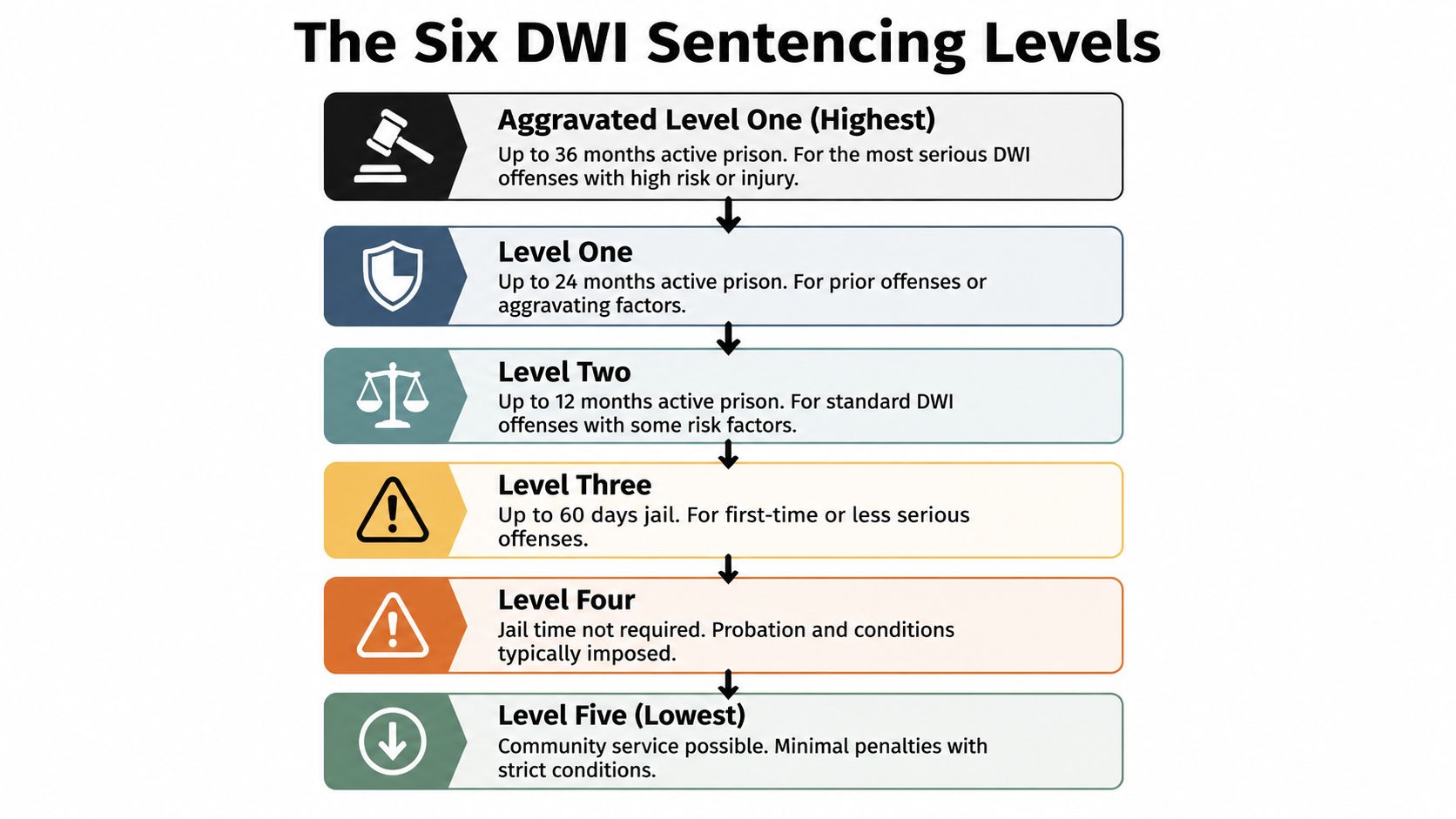
The Six DWI Sentencing Levels From Highest to Lowest
North Carolina's chart is a ladder. The judge chooses the level first, then decides where the sentence belongs within the range. A lower level may allow more flexibility, while higher levels can require active jail time or special probation conditions.
Aggravated Level One
This is the highest standard DWI level. It applies when three or more grossly aggravating factors are present. The statute allows a fine of up to $10,000 and imprisonment ranging from 12 to 36 months.
A representative scenario would involve a defendant facing several serious statutory findings, such as qualifying prior impaired-driving history combined with another grossly aggravating circumstance. At this level, the court's ability to suspend the entire punishment is sharply limited, and the sentence can include mandatory active time and intensive monitoring requirements.
Level One
Level One allows up to a $4,000 fine and 30 days to 24 months of imprisonment. It is less severe than Aggravated Level One but still exposes the defendant to substantial confinement.
For example, a defendant with serious grossly aggravating facts, but not enough to reach the top tier, may be placed at Level One. The judge then determines the sentence within that range rather than automatically imposing the maximum.
Level Two
Level Two carries up to a $2,000 fine and 7 days to 12 months of imprisonment. A case involving a grossly aggravating factor may fall into this range, depending on the statutory findings.
A defendant could face Level Two where the court finds a serious factor that requires more than ordinary misdemeanor treatment, but the overall circumstances don't justify Level One or Aggravated Level One.
Level Three
Level Three allows up to a $1,000 fine and 72 hours to 6 months of imprisonment. This is often the level people see when aggravating facts outweigh mitigating facts, but no grossly aggravating factor controls the sentence.
A Level Three sentence may be suspended in an appropriate case, but suspension doesn't erase the minimum punishment or other court conditions. The defendant may still have to complete probation-related obligations, treatment, community service, or confinement.
Level Four
Level Four carries up to a $500 fine and 48 hours to 120 days of imprisonment. A case where aggravating and mitigating factors are relatively balanced may fall here.
A driver with limited record concerns, no serious crash facts, and some evidence of mitigation might receive a sentence toward the lower end, subject to the judge's findings.
Level Five
Level Five is the lowest standard tier. It allows up to a $200 fine and 24 hours to 60 days of imprisonment. A suspended sentence may be available, with court-imposed conditions such as probation, assessment, treatment, or community service.
The chart gives the judge a range. It doesn't turn every Level Five case into the same outcome, and it doesn't make a higher-level sentence automatic merely because the State alleges an aggravating fact.
Grossly Aggravating Aggravating and Mitigating Factors Explained
North Carolina separates sentencing facts into three broad categories. Grossly aggravating factors carry the greatest sentencing weight, aggravating factors increase the seriousness of the case, and mitigating factors support a lower punishment level.
Grossly aggravating factors
These facts can move a case into the upper part of the sentencing structure. Examples may include a qualifying prior DWI conviction within the statutory lookback period, driving while the license was revoked for an impaired-driving offense, causing serious injury, or transporting a young child or vulnerable passenger.
The court doesn't count every unpleasant fact as grossly aggravating. The fact must fit the statutory definition, and the State must prove the relevant sentencing factor under the applicable legal standard. A prior conviction also needs to be identified and authenticated rather than assumed from an allegation in a report.
Aggravating factors
Aggravating factors make the offense more serious without necessarily placing the case in the grossly aggravating category. Examples can include a high alcohol concentration, especially reckless driving, passing a stopped school bus, or other conduct that increased the danger to the public.
A high BAC can matter, but it doesn't answer every sentencing question. The court still considers the full driving conduct, record, crash facts, treatment history, and competing mitigating evidence.
Mitigating factors
Mitigating factors give the defense a way to show that the case deserves less severe treatment. Potential examples include a safe driving record, safe operation apart from the impairment allegation, voluntary substance-abuse assessment or treatment, and evidence that a collision wasn't caused by the defendant.
Mitigation isn't a substitute for challenging weak evidence. It's another part of the defense strategy. Counsel may present treatment records, proof of compliance, character evidence, employment responsibilities, or other admissible information that helps the judge understand the person and the circumstances beyond the arrest report.
For comparison, a family-law resource such as Alimony in North Carolina: Dependent and Supporting Spouses addresses how North Carolina determines alimony through dependent and supporting spouse status. That analysis is separate from DWI sentencing, but both areas show why legal outcomes depend on defined facts rather than labels alone.

How Prior Convictions and Aggravating Facts Change the Outcome
Two defendants can receive very different sentencing exposure from what appears to be the same DWI charge. The difference usually comes from the facts the judge is legally permitted to consider.

A first-offense example
Consider a 32-year-old charged after a stop involving a 0.09 BAC, no crash, and no prior record. Those facts don't guarantee a result, and the charge still requires a careful review of the stop, testing, and officer observations. But the absence of a crash and prior DWI history may leave more room to argue for mitigation and a lower sentencing level.
If the case results in a conviction, the judge may consider a suspended sentence, probation, assessment, treatment, and other conditions permitted by the assigned level. A person facing a first North Carolina DWI should not assume the case is routine. The evidence still determines whether the charge can be defended, negotiated, or resolved in another way. More information about this situation is available through North Carolina first-offense DWI guidance.
A prior conviction must also be legally relevant. The court may examine the date, nature, and proof of the conviction, along with whether it falls within the applicable lookback period. An out-of-state conviction may require additional analysis to determine whether it qualifies under North Carolina law.
A repeat-offense example
Now consider a 45-year-old with two prior DWIs, a 0.18 BAC, and a minor crash that injured another person. Those facts create a very different risk profile. Prior offenses, the alcohol concentration, and the crash may each affect the sentencing analysis, although the precise level depends on what the State proves and how the statutory factors apply.
A case with multiple grossly aggravating factors may reach Aggravated Level One, which carries a fine of up to $10,000 and 12 to 36 months of imprisonment under the North Carolina sentencing framework. That doesn't mean every defendant with similar allegations automatically receives the top tier. It means the defense must investigate each alleged factor instead of treating the prosecutor's description as the final answer.
The central question is not how many drinks someone reports or what number appears on a test. It's whether the evidence proves the elements of the charge and the sentencing factors that could raise the punishment level.
When a DWI Becomes a Felony Under North Carolina Law
Most North Carolina DWI cases proceed through the six-level sentencing system under G.S. 20-179. Habitual impaired driving is different. It's a separate felony offense under N.C.G.S. § 20-138.5, and it can create a prison case rather than an ordinary misdemeanor sentencing hearing.
A person becomes subject to habitual DWI prosecution after three or more impaired-driving offenses within 10 years, according to the available North Carolina legal summary on habitual impaired driving. A new charge can then be raised to a Class F felony. The habitual statute creates its own sentencing framework, instead of just adding a higher punishment level to the ordinary misdemeanor chart.
The practical distinction matters:
- Ordinary DWI: The court uses Aggravated Level One through Level Five under G.S. 20-179.
- Habitual impaired driving: The State must prove the repeat-offense requirements under N.C.G.S. § 20-138.5.
- Felony procedure: The case involves felony charging, felony discovery, felony court procedure, and substantially greater prison exposure.
- Minimum exposure: The available summary states that even the lowest punishment level for habitual DWI carries at least 12 months in prison.
The prior offenses need careful examination. Defense counsel should verify the identity of the defendant, the dates, the convictions, the offense classifications, and whether out-of-state convictions qualify for the habitual count. A charging document may list prior offenses, but the listing itself isn't proof.
A habitual DWI allegation also changes immediate strategy. Bond conditions, prior-record litigation, discovery requests, evidentiary motions, and negotiations require prompt attention because the consequences can extend far beyond the maximum fine associated with a standard Level Five or Level Three case.
License Revocation Ignition Interlocks and Life After Sentencing
A DWI sentence doesn't end when the judge announces the fine or jail term. Driving privileges, insurance, ignition-interlock requirements, and treatment obligations can affect daily life for a long time afterward.
The exact license consequences depend on the conviction history, the facts of the case, DMV action, and whether the defendant qualifies for a limited driving privilege. A person may also face separate administrative consequences connected to chemical-test issues. Those questions should be reviewed quickly because DMV deadlines can operate separately from the criminal court schedule.
An ignition interlock is a device that requires a breath sample before a vehicle starts. When required, the defendant must arrange installation, maintain the device, comply with reporting requirements, and avoid violations. The financial burden includes installation and maintenance expenses, but the amount varies by provider and circumstance, so it shouldn't be assumed from the criminal fine.
Insurance can become another substantial concern. A driver may need an SR-22 filing or face higher premiums after a conviction, depending on the DMV and insurer requirements. A limited driving privilege may allow restricted travel for approved purposes, but it doesn't restore unrestricted driving.
A low criminal sentencing level doesn't necessarily mean the practical consequences are low. The DMV, insurer, employer, and licensing board may each respond differently.
Before driving after court, confirm the status of the license, the terms of any privilege, and every ignition-interlock condition. Driving outside the authorized terms can create new legal exposure and may jeopardize the privilege itself.
Practical Next Steps and How a Lawyer Can Influence the Level
The strongest sentencing strategy often begins before the sentencing hearing. A lawyer should examine why the officer stopped the vehicle, what happened during the investigation, how field sobriety testing was conducted, and whether breath or blood evidence was collected and handled properly.
Start with the evidence
Request and review discovery, including reports, recordings, chemical-test documentation, and relevant witness information. The defense may identify issues involving the traffic stop, probable cause, field sobriety tests, breath-test reliability, blood analysis, or the State's proof of prior convictions.
A challenge to the State's evidence can affect more than the question of guilt. If the State can't prove a sentencing factor, that factor may not be available to increase the punishment level. Counsel should also investigate whether the alleged prior convictions qualify and whether the State can prove them.
Build mitigation early
Treatment and responsible conduct can support mitigation, but timing and documentation matter. A defendant may consider an assessment, follow recommended treatment, preserve completion records, and gather reliable evidence of safe driving, employment, family responsibilities, and character where those facts are legally relevant.
That preparation doesn't guarantee a lower level. It gives the judge a documented basis for considering the defense position instead of relying only on the arrest narrative.
Make decisions based on the actual case
A guilty plea may resolve a case, but a plea should follow a review of the evidence, the likely sentencing factors, and the consequences of each available option. A trial may be appropriate in some cases, while a negotiated resolution may make sense in others. No lawyer can ethically promise dismissal, a particular level, or avoidance of jail without knowing the complete record.
The Law Office of Bryan Fagan handles North Carolina criminal defense matters, including situations where the alleged DWI level, prior convictions, and sentencing factors need close review. A consultation can help identify the issues that require immediate attention and clarify the choices available under North Carolina law.
Common Questions About NC DWI Sentencing Levels
Is a first DWI in North Carolina usually a felony?
Usually, a first DWI proceeds as a misdemeanor under the six-level system. A separate habitual impaired-driving allegation can make a new charge a Class F felony when the statutory repeat-offense requirements are met.
How does the seven-year lookback affect prior DWIs?
A prior DWI may matter only if it meets the statutory requirements, including the relevant timing rules. The conviction date, offense date, and proof of the prior should be verified rather than assumed.
Does Level Five require an ignition interlock?
Not every person with a Level Five conviction faces identical DMV consequences. Interlock requirements depend on the license history, conviction circumstances, and applicable DMV rules, so obtain case-specific advice before driving.
Can a defendant avoid jail at a higher level?
Sometimes a sentence may be suspended or structured with probation conditions, but higher levels can include mandatory active confinement or special probation requirements. The answer depends on the assigned level and proven factors.
The Law Office of Bryan Fagan can review the stop, testing evidence, prior convictions, sentencing factors, license issues, and potential defenses in your North Carolina DWI case. Visit Law Office of Bryan Fagan to schedule a consultation and discuss a strategy based on your specific facts.