You're a dentist in Raleigh, an attorney in Charlotte, or a CPA in Wilmington. Your practice may have modest equipment, ordinary furniture, and a bank balance that doesn't seem to explain why the business produces substantial income. During divorce, your spouse's attorney asks for a valuation, and you hear a term that can change the entire property-division discussion: goodwill.
The confusion is understandable. A balance sheet shows tangible property, but it may not capture client relationships, referral patterns, systems, reputation, or the ability of a practice to keep operating. North Carolina's law changed significantly with the Supreme Court's decision in Sneed v. Johnston, decided on August 14, 2026. Personal goodwill in a professional practice is no longer marital property subject to equitable distribution, while enterprise goodwill may still matter.
This guide explains professional practice goodwill valuation in an NC divorce, how the law developed, how experts separate enterprise value from personal value, and how the analysis can affect property division, support, negotiation, and evidence.
Why Goodwill Can Decide Your NC Divorce Outcome
Consider a hypothetical North Carolina dentist who built a busy practice during the marriage. The office owns equipment, computers, furniture, and supplies. It also has accounts receivable and work in progress. Those items can be identified and valued with relative clarity.
But patients may also return because they recognize the practice name, trust its staff, use its established systems, and receive care through a location that has served the community for years. Some patients may follow the dentist personally rather than remain with the practice if ownership changes. Those two sources of value look similar on a profit-and-loss statement, but they have different legal significance after Sneed v. Johnston.
Before discussing goodwill, many spouses make the same mistake: they assume the business is worth the value of its equipment, cash, and other items listed on the books. That approach can undervalue an established practice. It can also overvalue a professional whose income depends almost entirely on personal skill and relationships. The court's task is to identify what value exists, what created it, and whether that value belongs to the marital estate.
The balance sheet is only part of the picture
North Carolina's foundational decision, Poore v. Poore, states that a court valuing a professional practice should consider fixed assets, accounts receivable, work in progress, goodwill, and liabilities. The decision also rejected a single mandatory formula for goodwill. Instead, the trial court must make specific findings about the practice's value and the evidence supporting those findings.
That rule matters in high-asset divorces involving doctors, lawyers, accountants, dentists, and other licensed professionals. Goodwill may represent a meaningful part of the marital estate, but its value can't be assumed from a label or copied from a generic formula.
Practical rule: A practice's book value and its divorce value answer different questions. The first describes recorded assets. The second examines the value of the operating practice and the liabilities attached to it.
The 2026 shift changes the question
The Supreme Court's ruling in Sneed v. Johnston held that personal goodwill is not marital property subject to equitable distribution. That means a valuation must distinguish value attached to the professional from value that could remain with the business after a transfer.
The distinction can affect settlement outcomes. A spouse seeking a share of practice value may focus on staff, systems, recurring clients, contracts, and institutional referrals. The professional owner may focus on personal reputation, individual relationships, and future labor. Neither side should assume the answer from the practice's gross revenue alone. The evidence must show why the practice has value and what portion can exist independently of the owner.
Understanding Professional Practice Goodwill in Plain English
A professional practice can look modest on paper yet command significant value in a divorce. A dental office, law firm, medical practice, or accounting firm may own equipment, computers, furnishings, supplies, vehicles, and other fixed assets. It may also have accounts receivable, which means money owed for completed services, and work in progress, meaning services that have begun but are unfinished. Liabilities reduce the value left after those items are considered.
Goodwill is the additional value created by an operating practice beyond its identifiable assets. A neighborhood dental office illustrates the difference. Its chairs and imaging equipment have value, but those items do not explain why patients continue scheduling appointments, referral sources keep sending people, or a buyer might pay for an established operation rather than start with an empty office.
North Carolina case law treats a practice as a bundle of components. No single formula automatically determines goodwill. The valuation must fit the facts and rest on competent evidence, including evidence showing which value belongs to the business and which value depends on the individual professional.
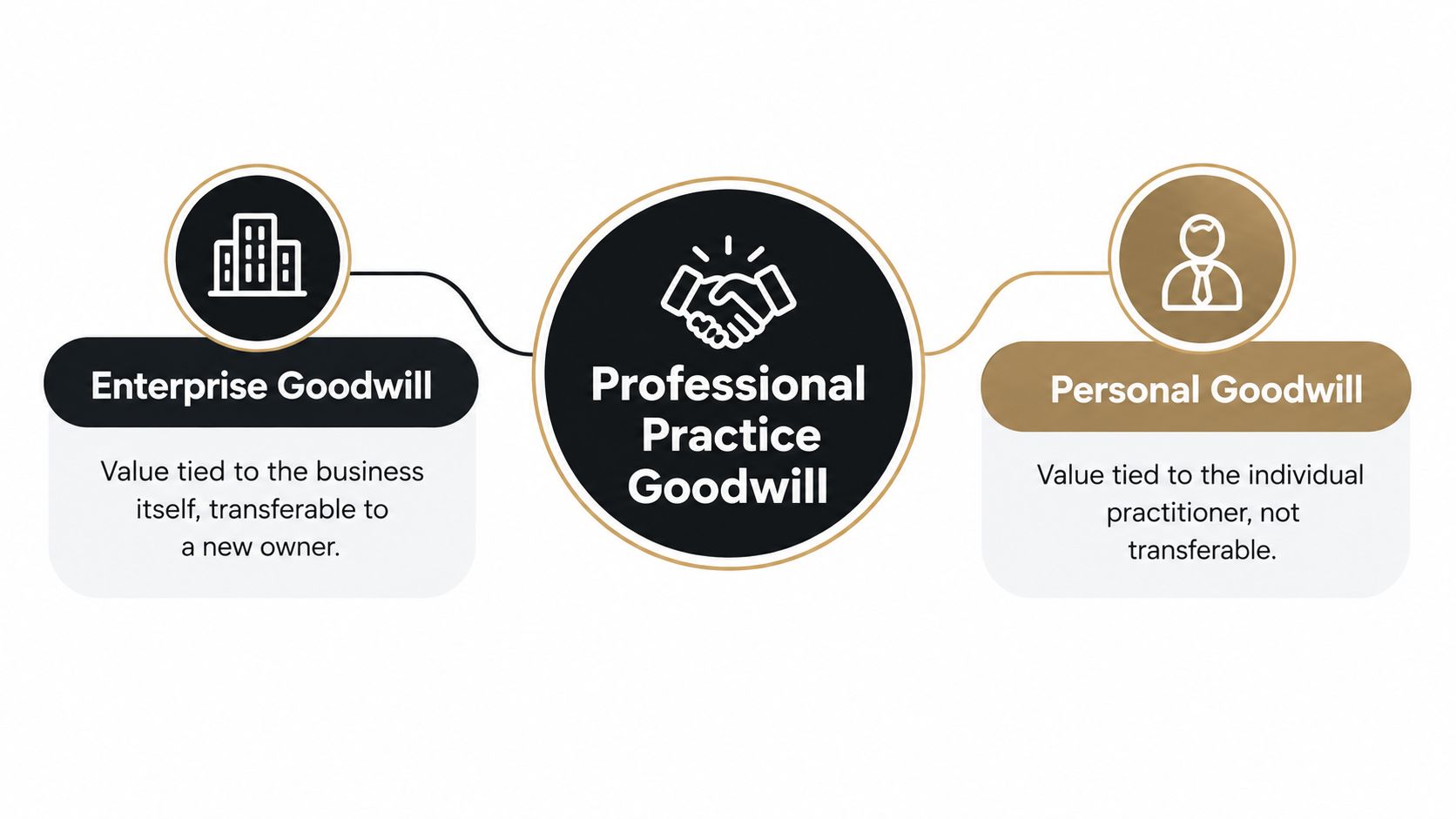
Enterprise goodwill belongs to the business
Enterprise goodwill is value connected to the practice as an operating business. It may include:
- Established systems: Staff procedures, scheduling, billing, and operational know-how may continue under new ownership.
- Business identity: A recognizable name, brand, location, or community presence may attract clients without depending on one professional.
- Transferable relationships: Institutional referrals, recurring customers, contracts, or payer relationships may remain with the practice.
- Workforce and infrastructure: Employees and other professionals may preserve earning capacity after the owner leaves.
A medical practice with several providers, trained staff, consistent procedures, and organization-based referral relationships may have enterprise goodwill. A buyer could acquire an operating platform, not merely equipment.
Personal goodwill follows the professional
Personal goodwill is tied to the individual owner. It may arise from personal reputation, specialized skill, professional judgment, personality, individual referral relationships, and client trust in that specific person.
The practical question is what would happen if the professional stopped working there. If clients would follow the owner, referrals would leave, or no replacement could preserve the same relationships, that portion raises a personal-goodwill issue.
Two practices can have similar equipment and financial records while having very different goodwill profiles. One may function through its staff, name, systems, and transferable relationships. The other may depend almost entirely on one lawyer, physician, accountant, or dentist. After Sneed v. Johnston, that distinction can affect what value is considered marital property in a North Carolina divorce. The analysis must separate business value from value that would leave with the professional.
How North Carolina Law Treats Goodwill After Sneed v Johnston
A professional owner may believe the practice is worth its full goodwill amount. A spouse may believe that goodwill created during the marriage belongs in the marital estate. Under North Carolina law, both positions can be incomplete. The court must identify what creates the value and whether that value can continue without the individual professional.
North Carolina's analysis began with Poore v. Poore, a Court of Appeals decision from 1985. The court held that valuing a professional practice may require examination of fixed assets, accounts receivable, work in progress, goodwill, and liabilities. It also rejected a single required goodwill formula. Trial courts must make specific findings that connect the practice's value to competent evidence.
The North Carolina valuation materials from the UNC School of Government reflect this component-based approach. Book value alone may miss intangible value arising from clients, reputation, systems, and earning capacity. Those components must be examined separately rather than combined into an unexplained goodwill figure.
Sneed separates personal value from enterprise value
On August 14, 2026, the North Carolina Supreme Court decided Sneed v. Johnston. The court held that personal goodwill of a professional practice is not marital property subject to equitable distribution. That holding changes the valuation question for practices whose value depends heavily on the owner's skill, reputation, relationships, or continued labor.
The source of goodwill now carries direct consequences for classification. Tangible assets, receivables, work in progress, liabilities, and transferable enterprise goodwill may still contribute to the marital estate. Value attributable purely to the professional's personal reputation and individual relationships is excluded under Sneed.
A practice can therefore contain both kinds of goodwill. Enterprise goodwill works like value attached to an operating platform, such as trained staff, established procedures, a recognizable practice identity, and relationships that could remain after an ownership change. Personal goodwill follows the professional and may disappear when that person stops practicing.
What Sneed means for a divorce case
A professional owner should not assume that every goodwill amount is excluded. A spouse should not assume that every intangible benefit developed during the marriage is divisible. The court must classify each portion according to its source and the evidence supporting that classification.
The valuation report should address client retention, referral ownership, employee contributions, operating systems, transferability, and dependence on the owner's future labor. Evidence connecting value to the enterprise supports including that portion in the marital estate. Evidence showing that value exists only through the individual professional supports exclusion under Sneed. This separation can change negotiation positions, settlement value, and the evidence each side needs.
Equitable distribution also involves timing. Before an absolute divorce is granted, a spouse should obtain North Carolina-specific legal advice about preserving property claims. The goodwill dispute does not replace filing requirements, deadlines, discovery, or classification of all property as marital, separate, or divisible.
Comparing Valuation Methods for Professional Practices
North Carolina law doesn't require one goodwill formula. Under Poore, the court should consider a sound method supported by competent expert testimony and make findings that fit the particular practice. The right method depends on the business, the available records, the nature of its earnings, and the question being answered.
Three approaches, three different lenses
The income approach asks what the practice's future earning capacity is worth today. A method such as capitalization of excess earnings separates a reasonable return on tangible assets from earnings that may reflect goodwill. It can be useful for a profitable medical, dental, accounting, or legal practice. Its limitation is sensitivity to assumptions about compensation, normalization adjustments, risk, and whether earnings depend on the owner personally.
The market approach compares the practice with comparable sales or other market evidence. It can provide a useful reality check when meaningful comparisons exist. Its weakness is that professional practices often differ in geography, payer mix, referral sources, staffing, owner dependence, and transferability. A superficially similar transaction may not be comparable.
The asset-based approach values identifiable assets and subtracts liabilities. It works naturally when tangible assets drive value or when the practice has limited goodwill. It may understate an established service practice if client relationships, systems, and ongoing operations produce value beyond the balance sheet.
| Valuation Methods at a Glance | Best For | Key Strength | Key Limitation |
|---|---|---|---|
| Income approach | Practices with reliable earnings | Connects value to earning capacity | Results depend on assumptions and owner dependence |
| Market approach | Practices with credible comparable sales | Uses observable market evidence | Comparable practices may not be truly comparable |
| Asset-based approach | Asset-heavy or low-goodwill practices | Clearly identifies assets and liabilities | May miss transferable operating value |
Choosing a method is not the final answer
The method can influence the initial value, but Sneed adds a second layer. Even after an expert estimates total goodwill, the report must address how much is enterprise goodwill and how much is personal goodwill. An income approach that captures earnings doesn't automatically prove that all resulting value belongs to the business.
For example, a Charlotte law firm may generate strong earnings because of a recognizable firm name, associate attorneys, established intake procedures, and institutional referral relationships. Another solo practice may generate similar earnings because clients hire one lawyer for that lawyer's judgment and personal reputation. The numbers may look alike, but the transferability analysis may differ substantially.
A useful discussion of broader business valuation issues appears in Business Valuation for Divorce in North Carolina. The attorney and appraiser should work from the same factual record, identify the valuation date, explain assumptions, and avoid presenting a formula as though it decides the legal classification by itself.
Proving Value With Experts and Evidence in NC Courts
A spouse may face a valuation report that assigns a large number to a professional practice. The number alone does not resolve the dispute. A persuasive report explains how the practice operates, which records were reviewed, what method was used, how assumptions were tested, and which portion of the value is transferable enterprise goodwill rather than personal goodwill. North Carolina trial courts need specific findings supported by evidence, so the factual record can shape both the classification analysis and settlement strategy after Sneed.
Build the factual record first
Start with records showing how the practice earns money and what could continue if ownership changed. Depending on the practice, the file may include:
- Tax returns and financial statements: These show historical revenue, expenses, compensation, distributions, debt, and unusual items that require explanation.
- Accounts receivable and work-in-progress schedules: These identify services performed, amounts owed, and unfinished matters existing on the valuation date.
- Payer mix analysis: In a medical or dental practice, insurance, Medicare, private-pay, and other sources may show whether revenue depends on the enterprise or a particular provider.
- Referral pattern documentation: Referral records can indicate whether new business comes from institutional relationships, staff systems, advertising, or the owner's personal network.
- Organizational records: Employment agreements, contracts, leases, policies, marketing materials, and ownership documents may show what a buyer could acquire and operate.
- Expert valuation report: A qualified appraiser should explain total practice value and the allocation between enterprise and personal goodwill.
North Carolina law supports analyzing the practice as a bundle of components rather than relying on one balance-sheet figure. That approach reinforces the need for a complete factual record.
Ask questions that test transferability
Preparation and cross-examination should test whether the reported value could survive a change in ownership:
- Who generates the revenue, the owner, employees, or several professionals?
- Do clients identify with the business name or with the individual practitioner?
- Would clients remain after a sale or ownership change?
- Are referral sources personal, institutional, or documented through business relationships?
- Could another qualified professional perform the work without a material loss of client confidence?
- Which adjustments were made to compensation, expenses, or unusual revenue?
- Why is the selected capitalization rate or comparable transaction appropriate?
- Which parts of the conclusion represent enterprise goodwill, and which depend on the owner's continued labor?
These questions do not dictate the result. They expose unsupported assumptions and require the expert to connect each conclusion to identifiable facts. A plain-language explanation of what expert witness testimony means in North Carolina can help a spouse understand how expert opinions are presented and evaluated.
Evidence matters most when it answers the transfer question: what could a buyer acquire and continue operating without the professional spouse?
Preserve records and maintain ordinary business practices after separation. A professional owner should avoid unusual compensation changes, unexplained expenses, or transfers that could weaken credibility. The other spouse should use lawful discovery and distinguish suspicion from proof. Courts evaluate evidence, not speculation.
How Goodwill Affects Property Division Support and Taxes
The classification of goodwill can change the practical settlement conversation. If the practice contains enterprise goodwill, that value may be included in the marital estate along with other divisible components. If value is personal goodwill, Sneed excludes it from equitable distribution, but the professional's actual income and earning capacity may still matter in a support analysis.
That difference prevents a common form of double counting. A court shouldn't treat future personal earning capacity as a present marital asset for property division and then treat the same income as available for support without distinguishing the legal purposes. Property division asks what assets and interests can be distributed. Support asks about financial need, ability to pay, and relevant income or earning capacity.
Settlement choices can replace a forced sale
Suppose a Raleigh medical practice has equipment, receivables, staff, systems, and a patient base that can continue under new ownership, while much of the owner's reputation remains personal. The spouses might negotiate for the professional to retain the practice while the other spouse receives retirement accounts, real property, cash, or a structured payment representing the divisible value.
A Charlotte law firm may present a different problem if the firm's clients hire the owner personally and the firm has limited systems or transferable relationships. The parties may focus less on dividing a large goodwill figure and more on support, liquid assets, debt allocation, and the professional's continuing income. These are illustrations, not predictions. The facts and evidence control.
The North Carolina framework for dividing marital property is discussed in equitable distribution in North Carolina. A settlement can use offsets, installment payments, or other lawful structures, but the documents should identify what is being transferred, how value was determined, and how future disputes will be handled.
Taxes and timing require individual advice
Transfers of business interests, real estate, retirement assets, and cash can carry different tax consequences. Support payments may also receive different treatment depending on the type of payment, the governing agreement, and applicable federal law. A family law attorney, valuation professional, and tax adviser should coordinate before a settlement is signed.
The divorce timeline matters just as much. How to File for Absolute Divorce in North Carolina addresses the steps, residency rule, and filing requirements for an NC divorce. A spouse should obtain advice about equitable distribution and alimony claims before absolute divorce is granted, because waiting can jeopardize important rights.
Frequently Asked Questions and Next Steps for NC Residents
Does goodwill apply to a solo professional?
Yes, a solo practice can have goodwill, but the analysis must identify its source. A practice may contain enterprise value from systems, a business identity, staff, location, or transferable relationships. Value tied only to the individual professional's reputation, relationships, skill, and future work is personal goodwill under Sneed.
Does Sneed automatically resolve a pending divorce?
Not necessarily. The effect may depend on the procedural posture, valuation evidence, claims already filed, and issues preserved in the case. A North Carolina attorney should review the pleadings, orders, valuation date, and available expert analysis.
Can goodwill affect alimony?
It can affect the analysis indirectly. Personal goodwill isn't marital property for equitable distribution, but income and earning capacity may remain relevant to support. Counsel should keep property classification and support calculations distinct.
What should I do first?
Preserve financial records, avoid unusual business changes, identify all property claims, and obtain advice before the divorce is finalized. A qualified valuation expert may be necessary when the practice's value depends on intangible assets.
If you're facing divorce as a North Carolina professional owner or spouse, schedule a consultation before goodwill becomes an unsupported number in negotiations. The facts surrounding clients, staff, systems, referrals, and future income can shape both valuation strategy and settlement decisions.
The Law Office of Bryan Fagan provides North Carolina family law representation involving divorce, equitable distribution, and complex property issues, including professional-practice valuation concerns. Visit Law Office of Bryan Fagan to discuss your practice, goodwill evidence, filing timing, and available legal options in a confidential consultation.