You've applied for a job in Raleigh, found a promising apartment in Charlotte, or started planning a new chapter after an old North Carolina case. Then a background check shows a charge you thought had disappeared, or a conviction that still follows you years later. You may be asking the question many North Carolina residents ask: Can I clear my record, and do I need to file something to make that happen?
North Carolina expunction law can provide meaningful relief, but it isn't a single process. Dismissed charges may follow an automatic expunction track, while convictions usually require a carefully prepared petition under a statute that specifically authorizes relief. The answer depends on the disposition, offense classification, dates, sentence completion, prior record relief, and the filing date.
This guide explains expunction NC law in plain English, with particular attention to the changes affecting petitions filed on or after July 9, 2025. It also separates the two systems that are often blended together, so you can better understand whether you're waiting for an automatic record-clearing process or need to ask the court for relief.
Introduction to Expunction in North Carolina
An expunction is a legal process that removes or limits access to an eligible criminal record under North Carolina law. In everyday terms, it can help put an eligible arrest, charge, or conviction out of the ordinary public record. But expunction isn't available because a record is old, employment has become difficult, or clearing it would seem fair.
The North Carolina School of Government explains that when no statute authorizes expunction for a conviction, a person generally has no right to one. That principle makes the first question very specific: Which North Carolina statute, if any, applies to this exact record? The School of Government's general discussion of expunctions describes why statutory authority controls the analysis.
Consider two people in similar situations. One was charged with a misdemeanor, but the charge was dismissed. The other pleaded guilty to a nonviolent misdemeanor and completed probation. Both may see the case on a background report, but they may be on entirely different legal tracks. The first person may qualify for a dismissal-related process. The second may need to satisfy a waiting period and file a conviction petition.
North Carolina's expunction system has changed substantially over time. Earlier relief was narrower and focused mainly on certain drug offenses, youthful misdemeanors, dismissals, and acquittals. Broader reforms, including the modern framework under G.S. 15A-145.5, created more structured routes for some nonviolent misdemeanor and felony convictions.
The scale of the system also shows why individual records can be difficult to manage. The North Carolina Administrative Office of the Courts reported 46,458 expunctions in fiscal year 2023-2024, following 78,473 in fiscal year 2022-2023 and 421,925 in fiscal year 2021-2022. Those figures reflect major year-to-year swings associated with policy changes and processing levels, but they don't mean every eligible person receives relief. Advocacy reporting estimates that about 25% of North Carolina adults have a criminal record, while more than 90% of people eligible for relief never receive an expunction (North Carolina legislative reporting).
A record may be eligible for relief without clearing itself. The legal pathway and the administrative process both matter.
What Expunction Means Under North Carolina Law
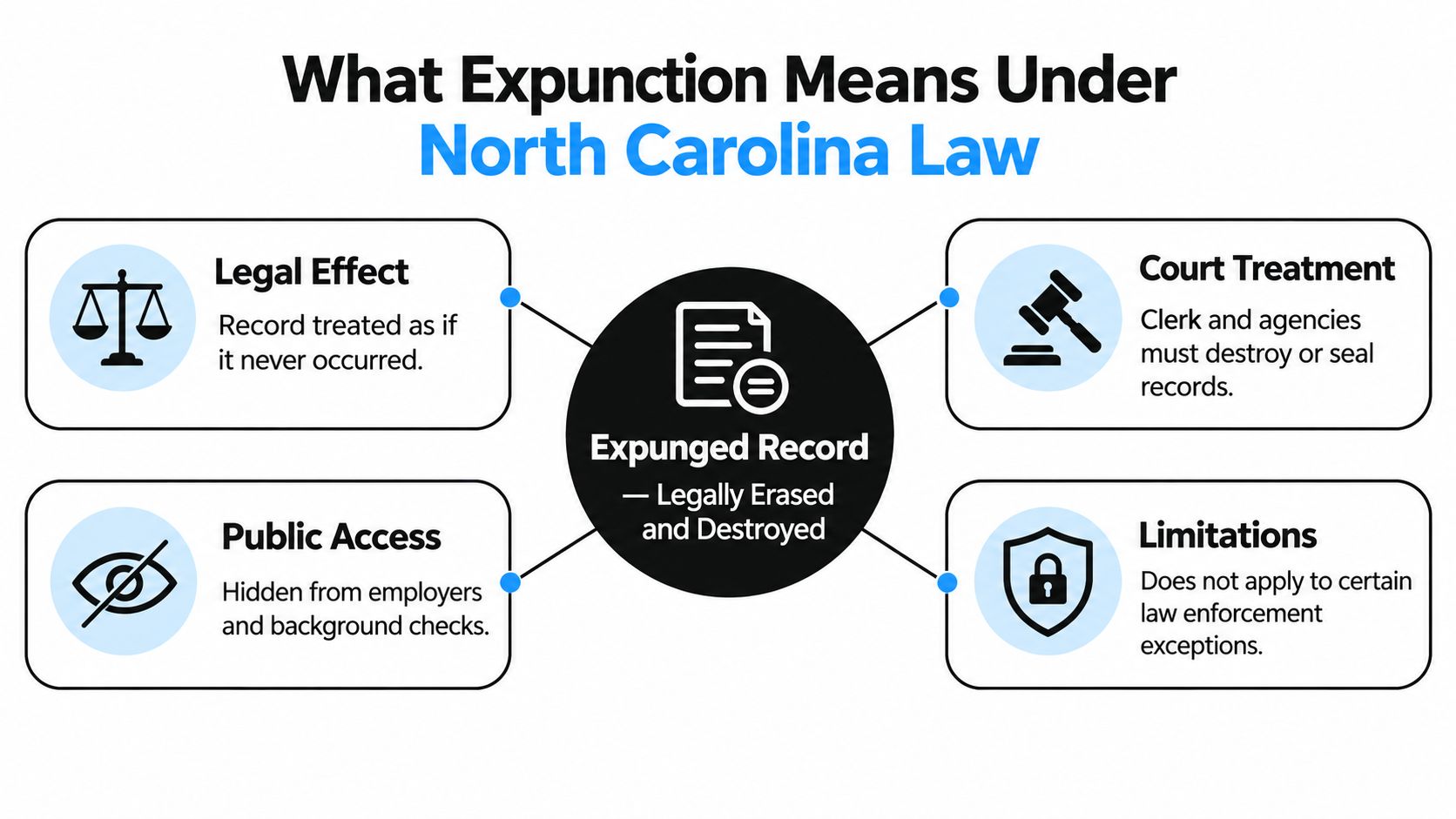
North Carolina law uses expunction to change how an eligible record is treated by courts, agencies, and the public. A useful analogy is a file cabinet. A conviction or charge may begin in a file that government agencies and authorized record systems can access. An expunction order tells the appropriate agencies to remove, destroy, or otherwise handle the record as the statute requires.
That analogy has limits. Expunction isn't a magic eraser that guarantees every copy disappears instantly from every database. It's a legal remedy that operates through North Carolina's court and agency systems. The practical result depends on the type of record, the statute used, the order entered, and the agencies responsible for processing it.
The legal effect
After a qualifying expunction, the record is generally treated under the applicable law as though it didn't occur for many ordinary public-facing purposes. Clerks and agencies receive directions concerning the destruction, sealing, or handling of records. Employers and background-check companies may no longer see the record through ordinary public record searches once the process has been completed.
That doesn't mean every legal consequence disappears. Certain law enforcement, judicial, licensing, or sentencing-related exceptions may still apply. The exact effect depends on the statute, so a person shouldn't assume that an expunction permits every possible denial or disclosure in every setting.
Why the statute matters
North Carolina doesn't give courts a broad power to erase any record whenever a judge believes relief would be equitable. The offense, disposition, age of the person at the time of the offense, timing, and prior expunction history must fit an authorizing law.
This is also why related legal concepts shouldn't be confused. An expunction differs from a pardon, a certificate of relief, and ordinary non-disclosure. Each remedy has its own requirements and consequences. If you're also researching how North Carolina classifies lower-level offenses, the difference between an infraction and a misdemeanor in North Carolina can provide useful background, but classification alone won't determine expunction eligibility.
North Carolina's expunction statutes address criminal records, not every type of legal dispute. For example, the North Carolina Child Support Guidelines Explained discusses how NC calculates child support using the Worksheet system, which is a separate family-law issue.
Who Qualifies for Expunction in North Carolina
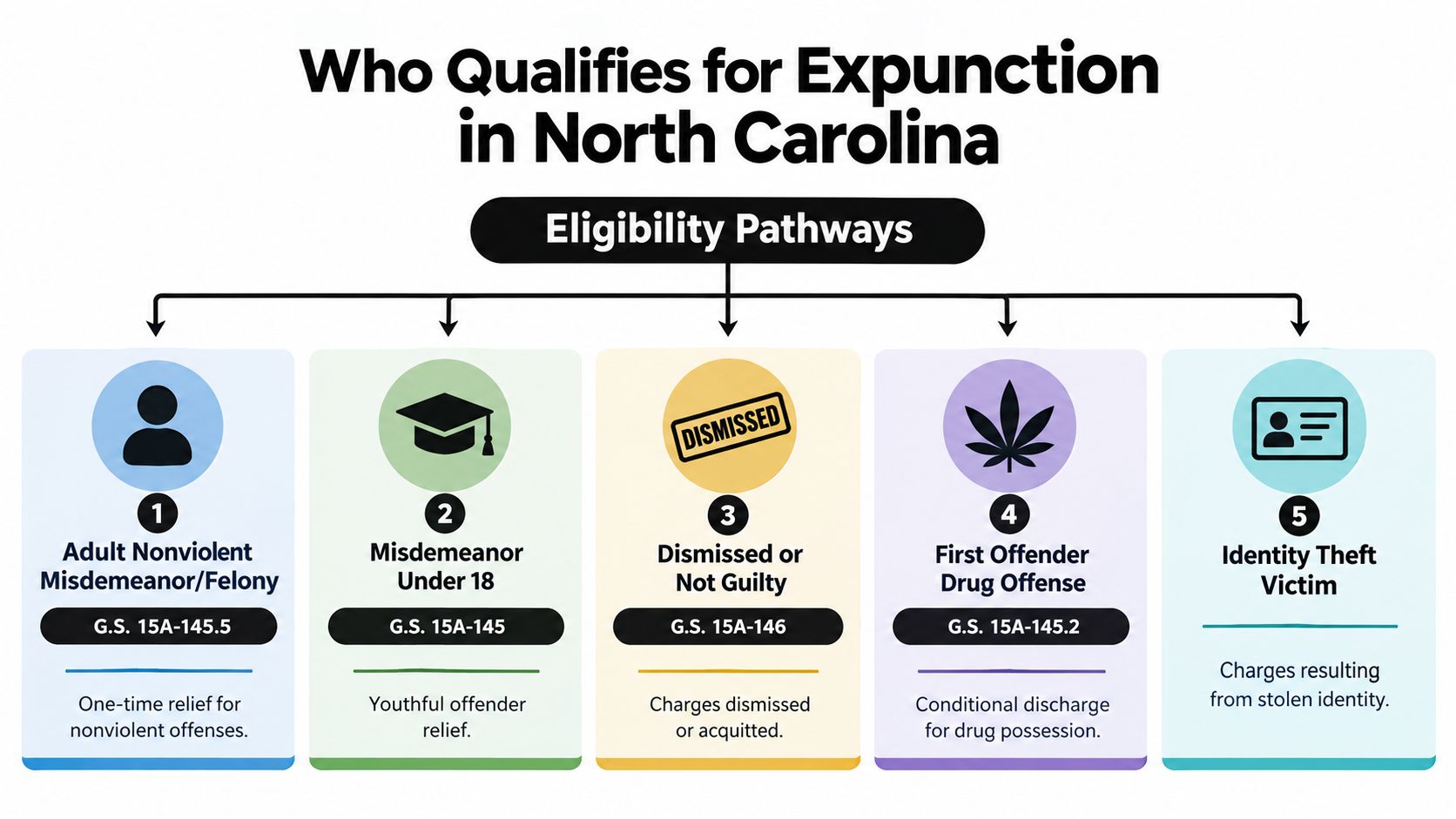
Eligibility depends on the record's legal category. Start with the disposition, then review the offense class, the person's age when the conduct occurred, the sentence, and any prior expunctions. A record that looks minor on a background report may still fall outside the statute.
Adult nonviolent convictions
G.S. 15A-145.5 provides a central adult pathway for certain nonviolent misdemeanors and felonies. The statute contains important exclusions. These include Class A through G felonies, A1 misdemeanors, offenses with assault as an essential element, and impaired driving offenses.
The statute also treats different conviction combinations differently. One nonviolent misdemeanor is analyzed separately from multiple nonviolent misdemeanors. One nonviolent felony is treated differently from two or three nonviolent felonies. A person with several convictions shouldn't assume that every offense can be grouped into one favorable category.
For example, one eligible nonviolent misdemeanor may fit the single-conviction pathway, while two eligible misdemeanors may trigger a different waiting period. A person with one nonviolent felony must be reviewed under the felony provisions, and two or three nonviolent felonies may involve a substantially longer statutory period. The presence of an excluded conviction may also affect the petition.
Youthful and special-purpose pathways
North Carolina has separate statutes for some misdemeanor records involving people who were under a specified age when the offense occurred. Other statutes address dismissed charges, acquittals, certain first-offender drug matters, and cases connected to identity theft.
These categories shouldn't be treated as interchangeable. A person whose charge was dismissed may have a faster route than someone convicted of the same offense. A first-offender drug statute may require facts that aren't present in a general nonviolent-conviction petition. Someone whose identity was stolen may need to establish that the criminal record resulted from that identity theft.
Dismissals and acquittals
G.S. 15A-146 addresses important dismissal and not-guilty situations. North Carolina court guidance explains that some statutes allow a person to file almost immediately after a case ends, while conviction-based statutes may require years of waiting or completion of supervision (North Carolina Courts expunction guidance).
That distinction is important. A dismissal isn't the same as a conviction, and a petition for a dismissal isn't the same as a petition under G.S. 15A-145.5. The dates and disposition language on the court record control.
Prior relief can also change the result. The North Carolina Justice Center's 2025 summary explains that some G.S. 15A-145.5 petitions are disqualified only when a prior expunction was granted after December 1, 2021 (North Carolina Justice Center expunction summary). That means intake should include the client's complete history of prior expunctions, not just convictions.
Waiting Periods Timelines and Costs for Expunction NC
Timing is where many otherwise promising cases fail. Under G.S. 15A-145.5, the waiting period is tied to both the conviction and the completion of qualifying sentence obligations. A conviction may look old, but the clock can be affected if probation, post-release supervision, or another active sentence ended later.
For the core adult pathway, the statutory periods are:
| Expunction Pathway | Waiting Period and Key Trigger |
|---|---|
| One nonviolent misdemeanor | 3 years for petitions filed on or after July 9, 2025, measured under the statutory conviction and sentence-completion rules |
| Multiple nonviolent misdemeanors | 7 years, with the required period measured after the relevant conviction and sentence-completion dates |
| One nonviolent felony | 10 years, subject to the statute's timing and eligibility requirements |
| Two or three nonviolent felonies | 20 years, subject to the statute's timing and eligibility requirements |
| Dismissed or acquitted charge | May be eligible without the conviction waiting periods, depending on the applicable statute and disposition |
The 2025 change is especially important. For petitions filed on or after July 9, 2025, S.L. 2025-71 reduced the waiting period for one nonviolent misdemeanor conviction from 5 years to 3 years. It didn't broadly shorten every expunction period. Multiple misdemeanors and felony pathways continue to require their own statutory analysis (UNC School of Government 2026 expunction update).
Filing date versus conviction date
The filing date now matters for a single nonviolent misdemeanor. A person who was previously told to wait five years may need a fresh review if the petition would be filed on or after the effective date of the change. But the later completion of probation or post-release supervision may still affect eligibility under the statutory language and the way the petition form frames the required findings.
Some petitions also carry a 120-day filing window. A court may excuse a late filing for good cause, but relying on that possibility creates avoidable procedural risk, particularly when records span multiple counties.
Automatic dismissals follow a different clock
The automatic track is separate from conviction petitions. North Carolina courts reported 1,418,282 expunctions in fiscal year 2024-2025, and the automatic dismissal process applies only when all charges were disposed on or after December 1, 2021. The automatic expunction occurs 180 to 210 days after final disposition, according to the UNC School of Government's 2025 expunction guide.
This is why a person with a dismissal may ask, “Why hasn't it disappeared yet?” The answer may involve the final disposition date, whether every charge qualifies, or administrative processing. Convictions generally remain on the petition track.
Processing also requires administrative capacity. North Carolina's annual reporting laws require breakdowns of expunction types and documentation of funds used to support processing, showing that record clearing depends on coordinated court and agency work, not only a person's eligibility.
For sentencing terminology that may appear in a record, the North Carolina structured sentencing overview can help explain how criminal punishment is organized, although it doesn't replace an expunction eligibility review.
How to File for Expunction in North Carolina Step by Step
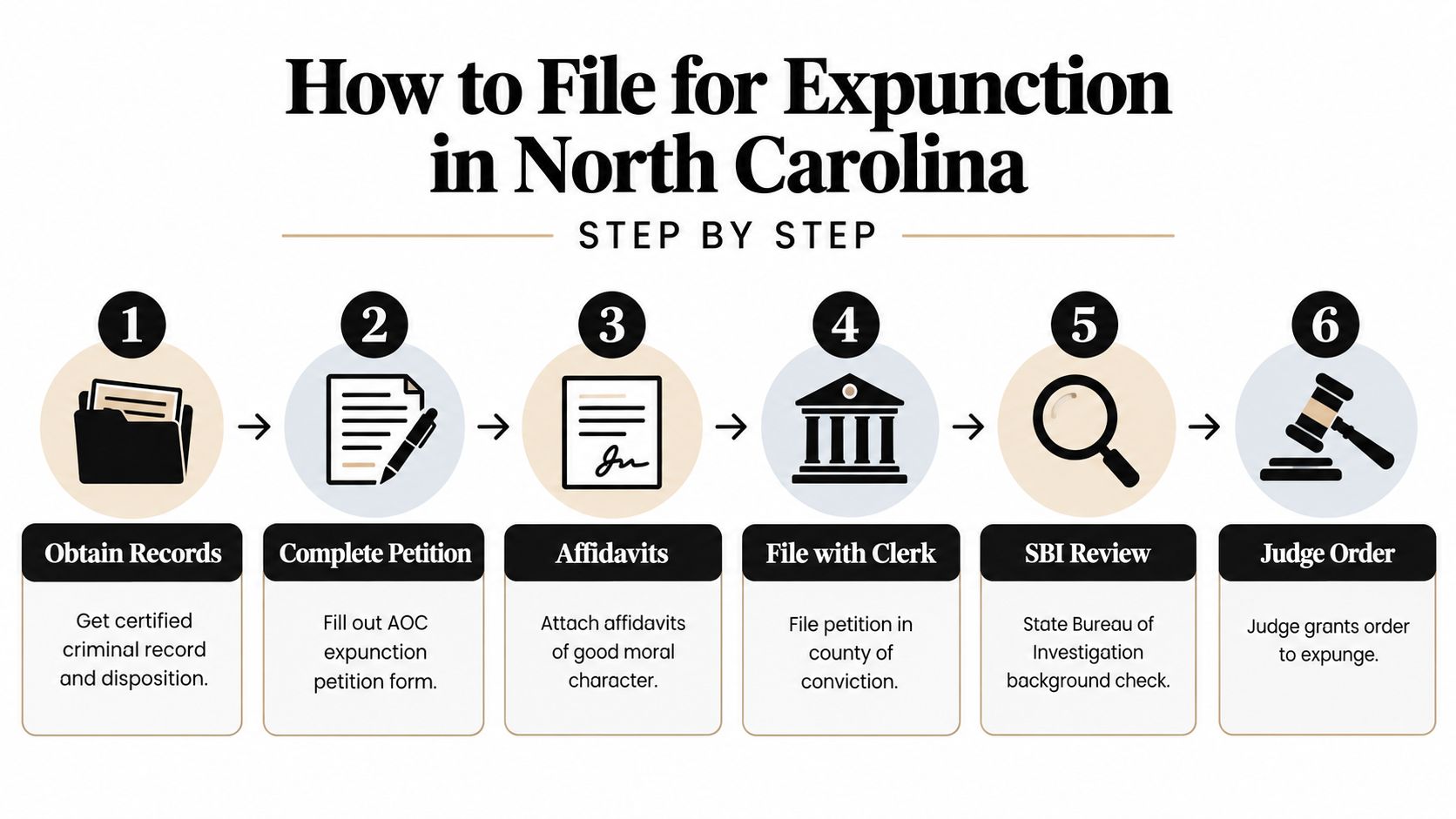
A conviction-based expunction normally requires more than completing a form. The safest approach is to build the record first, select the correct statute second, and file only after checking every date and required attachment.
Gather the underlying records
Obtain the criminal record and the disposition from the county involved. Certified documents can reveal details that a commercial background report omits, including the precise offense name, classification, final disposition, sentence, and date supervision ended.
If the person has cases in multiple counties, organize each file separately. Mixing docket numbers or assuming that one county's record describes another can create errors in the petition.
Match the form to the statute
North Carolina Administrative Office of the Courts forms are designed for particular relief pathways. The form must correspond to the disposition and statute. A dismissal petition isn't interchangeable with a petition for a nonviolent conviction.
A practical file checklist may include:
- Certified court records: Obtain the documents showing the charge, disposition, and sentence.
- Date verification: Confirm conviction dates and the dates active sentences, probation, or post-release supervision ended.
- Prior relief review: Search for prior expunction orders and determine when they were granted.
- Required affidavits: Prepare any statements or affidavits the applicable form requires.
- County confirmation: Identify the proper clerk's office for filing.
File, serve, and respond
The petition is generally filed with the clerk in the county connected to the conviction or disposition. Required parties, including the district attorney where applicable, must receive notice or service under the governing procedure. The State Bureau of Investigation and court personnel may conduct the reviews required by the statute.
Some cases proceed without a hearing. Others require a judge to review the evidence or address an objection. Don't assume that filing ends the process. Keep copies of everything filed, monitor notices from the clerk, and respond promptly to any request for clarification.
A common error is treating a background-check printout as the legal record. Another is entering the date a person stopped reporting to probation instead of the official completion date. Careful preparation usually matters more than filing quickly.
The automatic dismissal process is different. If the case qualifies, the person may not need to file a petition, but the record still may take time to move through the automatic system.
For a visual overview of the process, watch this North Carolina expunction resource:
Common Pitfalls Benefits and Limits of Expunction
The biggest mistake is assuming that every old or dismissed case clears automatically. Automatic relief applies to a defined group of dismissals, while conviction relief generally requires a petition under a specific statute. A dismissal outside the automatic conditions may still require action, and a conviction won't become eligible merely because enough time has passed.
The 2025 waiting-period change creates another trap. The 3-year period applies to one nonviolent misdemeanor petition filed on or after July 9, 2025. It doesn't automatically help someone with multiple misdemeanors, a felony history, an excluded offense, or a sentence-completion date that changes the calculation.
Watch for these problems:
- Wrong statutory pathway: Using a dismissal form for a conviction, or choosing a general conviction pathway when a special statute applies, can delay the case.
- Incorrect supervision date: The relevant date may be the official end of probation or post-release supervision, not the date you remember finishing obligations.
- Overlooked prior relief: A prior expunction granted after December 1, 2021, may affect eligibility under G.S. 15A-145.5.
- Excluded offense: Class A through G felonies, A1 misdemeanors, assault-based offenses, and impaired driving offenses require careful review because they're excluded from the central nonviolent pathway.
- Instant-result expectations: Even automatic dismissal relief must move through court and agency processing.
Expunction may improve how an eligible record appears during employment, housing, education, or licensing reviews. It also may help a person move forward without repeatedly explaining an old case. But it doesn't guarantee approval, eliminate every law-enforcement exception, or erase records held outside North Carolina's statutory process.
North Carolina's own reporting reflects a persistent gap between people who may qualify and people who actually receive relief. Eligibility is the starting point, not the finish line.
If your record involves a marijuana-related charge, you may also need to understand how the underlying offense was classified and disposed of. The North Carolina marijuana laws overview is separate from an expunction determination, but it may help provide context before reviewing the court file.
Take the Next Step Toward Clearing Your Record
A careful expunction review follows a short sequence:
- Identify the disposition, such as dismissal, acquittal, or conviction.
- Match the record to a North Carolina statute.
- Check the offense class and exclusions.
- Calculate the waiting period from the correct dates.
- Review prior expunctions and every related county record.
- Prepare the correct form and supporting documents.
Frequently asked questions
Will an employer still see an expunged record?
An expunction is intended to remove or restrict the record from ordinary public access, but some legal exceptions and database-processing issues can matter. If a background report still shows the case after the order, preserve the order and investigate the source of the information.
Do out-of-state convictions qualify under North Carolina law?
North Carolina expunction statutes are specific to the records and circumstances they authorize. An out-of-state conviction may not fit a North Carolina conviction-expunction statute, so it requires an individual legal review rather than an assumption that North Carolina can erase it.
What happens if a petition is denied?
A denial isn't necessarily the end of every possible legal option, but the next step depends on why the court denied relief. Review the order, identify whether the problem was eligibility, timing, documentation, or procedure, and obtain legal advice before filing again.
Can I file if I have records in multiple counties?
Possibly, but multi-county histories require careful coordination. Each docket, disposition, sentence-completion date, and prior expunction should be reviewed before selecting the filing strategy.
North Carolina residents often benefit from a consultation when the record includes multiple charges, more than one county, a prior expunction, uncertain offense classification, or a sentence date that is difficult to verify. A North Carolina criminal defense attorney can help distinguish automatic dismissal processing from petition-based conviction relief and identify issues that a standard background report won't show.
Schedule a consultation with the Law Office of Bryan Fagan to review your record, filing date, statutory pathway, and practical next steps. No attorney can guarantee an expunction, but a careful review can replace guesswork with a clearer plan.
The Law Office of Bryan Fagan provides North Carolina-focused legal consultations, including review of criminal records and expunction options based on the governing statute and case history. Visit the Law Office of Bryan Fagan to discuss your record and schedule a consultation about clearing eligible charges or convictions.