You may be here because your spouse has the car, the account login, the business records, or the only key to the storage unit, and your property case in North Carolina feels stuck. Meanwhile, bills keep arriving. The mortgage doesn't pause because equitable distribution takes time, and debt can grow while both sides wait for a final hearing.
That's where an interim distribution motion in NC equitable distribution can matter. In the right case, it gives the court a way to make a temporary allocation of certain property or debt before the final equitable distribution trial. It is not a shortcut to “winning” the whole property case. It is a tool for stability, access, and damage control while the larger dispute is still pending.
Why Interim Distribution Matters During Your NC Divorce
A common North Carolina divorce problem looks like this. One spouse moved out after separation. The other stayed in the home, has control of household records, and keeps using an account both parties once relied on. The spouse who moved out still has expenses, still needs transportation, and still may be tied to marital debt. Final property division is coming, but not quickly enough to solve today's pressure.

Why temporary relief can change the case
Interim distribution exists for moments like that. It can help when a marital asset needs to be used now, when a debt needs immediate attention, or when one spouse has practical control over property that affects both parties' financial stability.
That matters because waiting for the final trial can create avoidable harm. If nobody can access the funds needed to keep an asset intact, the asset itself may lose value. If one spouse has all the use of an item that both parties claim, the other spouse may be left without basic functioning during the case.
Practical rule: Temporary relief is about keeping life and property manageable during the lawsuit, not about locking in the final result.
Real-world examples clients often recognize
Interim distribution often makes sense in situations like these:
- A vehicle dispute: One spouse has the only reliable car, but both parties need transportation for work and parenting exchanges.
- A debt problem: A joint debt is growing, and one party asks the court to temporarily assign responsibility so the account doesn't spiral.
- A business or income-producing asset issue: One spouse controls income or records from an asset the parties both say is marital.
- A household property conflict: Important personal or household items remain inside the home, and the parties can't resolve access on their own.
Clients often worry that asking for interim distribution will trigger a final ruling before they're ready. That's usually where confusion starts. In North Carolina, interim relief is temporary. It addresses the present problem while preserving the right to argue later about what the property is, what it's worth, and how it should ultimately be divided.
If your situation feels urgent, but not yet final, this is the part of equitable distribution procedure worth understanding carefully.
Understanding Interim Distribution Under North Carolina Law
North Carolina did not always have this tool. Interim distribution became part of North Carolina equitable distribution law in 1991, when N.C.G.S. § 50-20(i1) became effective on October 1, 1991 according to the UNC School of Government bench book discussion of interim distribution.
What the statute actually allows
In plain English, N.C.G.S. § 50-20(i1) lets a court act after an equitable distribution case has already been filed, but before the judge enters the final property judgment. During that period, the court may, unless there is good cause to deny the request, classify property as separate and divide part of the marital property, divisible property, or debt on a temporary basis, with any interim transfer later credited at final trial under North Carolina General Statutes section 50-20.
That timing point is critical. You can't use interim distribution before an equitable distribution claim exists. You also can't use it after the final property judgment.
A helpful place to understand the larger property framework is Equitable Distribution of Property in North Carolina, which explains that North Carolina uses equitable distribution rather than community property.
For readers who want more background on the broader property-division concept, what is equitable distribution in North Carolina is a useful starting point.
What interim distribution is not
The most important misconception to clear up is this. Interim distribution is not final equitable distribution. It is a preliminary order entered during the lawsuit.
The North Carolina Court of Appeals described interim distribution as available only while the case is pending and emphasized that the transfer is without prejudice to later arguments about classification, value, or final division in the North Carolina appellate discussion of interim distribution orders.
Without prejudice means you are not giving up your right to argue later that the property was misclassified, overvalued, undervalued, or should be divided differently in the final judgment.
Here's the practical takeaway. A judge might temporarily place an asset, use of an asset, or responsibility for a debt with one spouse now. Later, at final trial, that same judge can still hear evidence about whether the item was marital, separate, divisible, or subject to a different overall allocation.
A short explainer may help if you prefer video format:
A simple before-and-after comparison
| Issue | Interim distribution | Final equitable distribution |
|---|---|---|
| Timing | During the pending ED case | At the end of the property case |
| Purpose | Temporary access, use, or allocation | Complete property division |
| Effect | Preliminary and interlocutory | Final judgment on division |
| Later arguments allowed | Yes | Usually resolved in the judgment |
If you remember only one point from this section, remember this. The court can use interim distribution to solve a present problem without deciding every final property issue that will be tried later.
When to Seek Interim Distribution and When Courts May Deny It
A strong interim distribution request usually answers one question clearly. Why does this need court attention now instead of later?
Situations that often justify filing
Some cases present immediate pressure. Others don't. Judges often look closely at whether temporary action is needed to preserve fairness or prevent practical harm during the case.
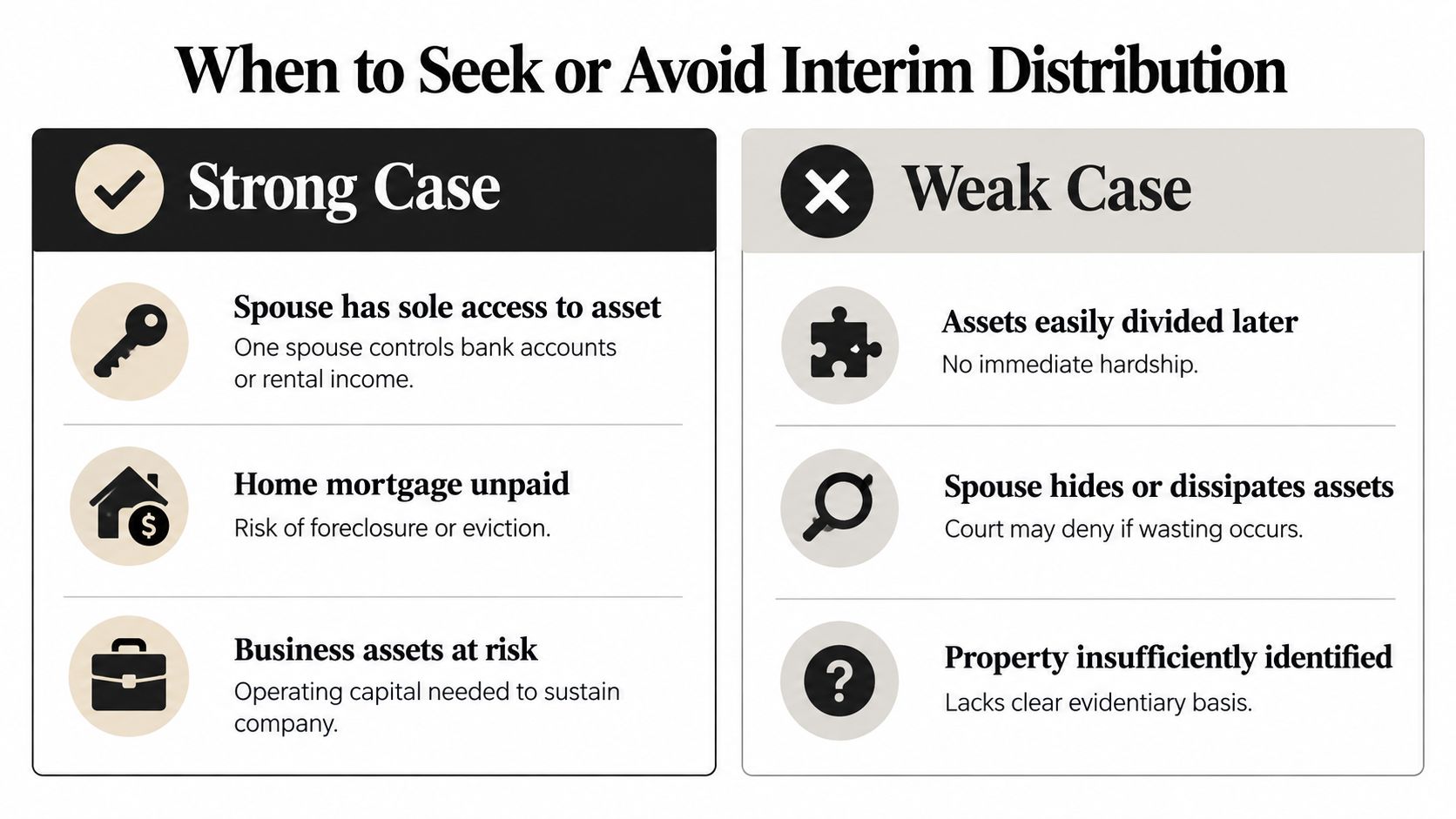
Stronger candidates often include:
- An asset one spouse exclusively controls: If your spouse has sole access to an account, records, rental income, or a necessary vehicle, temporary court action may be appropriate.
- A property-related payment problem: If the home, vehicle, or another significant asset faces trouble because no one is paying or both parties are pointing at each other, waiting may make the dispute worse.
- A debt that needs temporary assignment: If a debt is tied to daily living or property preservation, the court may need to address responsibility before trial.
- A clearly identifiable item: The more specific the request, the easier it is for a judge to evaluate it.
If your dispute also involves property acquired or changing after separation, it can help to understand divisible property in North Carolina equitable distribution because not every post-separation issue fits neatly into the same category.
Situations that often weaken the motion
A weaker motion usually suffers from vagueness, overreach, or lack of urgency.
Courts may deny relief when there is good cause not to enter an interim distribution order. North Carolina's statute expressly allows the court to act unless good cause is shown that interim distribution should not occur in the North Carolina codified version of section 50-20.
That can show up in different ways:
- The request is too broad: “Give me half of everything now” is not the kind of focused interim request judges usually want.
- The property isn't identified clearly: If the motion doesn't specify the account, debt, item, or use sought, the court may see more confusion than necessity.
- There's no immediate hardship: If the property can be dealt with later without meaningful disruption, a judge may prefer to reserve it for the final trial.
- The motion sounds like a final trial brief: If the filing reads as though you are asking the court to decide the whole case early, that can undercut credibility.
A good interim motion solves a present problem. A bad one tries to win the whole equitable distribution case in a temporary hearing.
A practical comparison
| Likely stronger request | Likely weaker request |
|---|---|
| Specific vehicle, account, debt, or item | General demand for broad property division |
| Immediate need tied to living or asset preservation | No clear urgency |
| Sworn facts and documents | Assumptions and accusations |
| Temporary framing | Final-result framing |
Many clients feel frustrated when they hear a motion is “not ripe” or “not specific enough.” Usually that means the court doesn't yet have a clean, focused reason to step in on a temporary basis.
How to File an Interim Distribution Motion in North Carolina
You separate, the car is in your spouse's driveway, the joint account is being drained to pay one household but not the other, and the final equitable distribution trial is nowhere close. That is the setting for an interim distribution motion. In North Carolina, the process works less like filing a generic request and more like asking the court for a short-term property rule while the larger case is still pending.
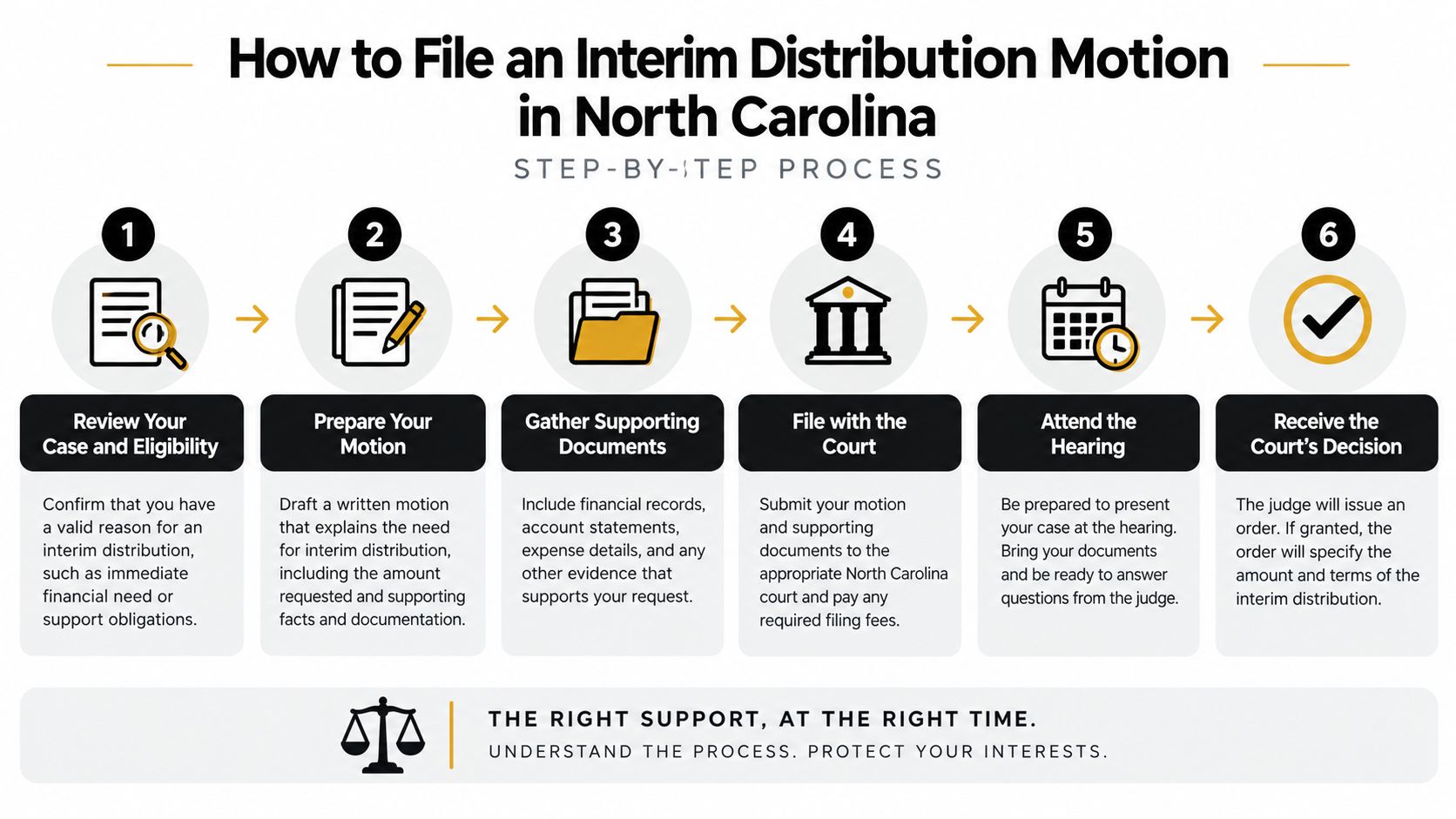
Confirm that equitable distribution is already on file
The court cannot enter interim distribution in a vacuum. There must already be a pending equitable distribution claim under N.C. Gen. Stat. § 50-20.
That filing requirement is where some people lose ground without realizing it. If the absolute divorce is entered before equitable distribution is properly claimed, the property claim can be waived. Don't Lose Your Rights: Filing Claims Before NC Divorce Is Final explains that deadline problem in plain terms.
Draft a motion that solves one present problem
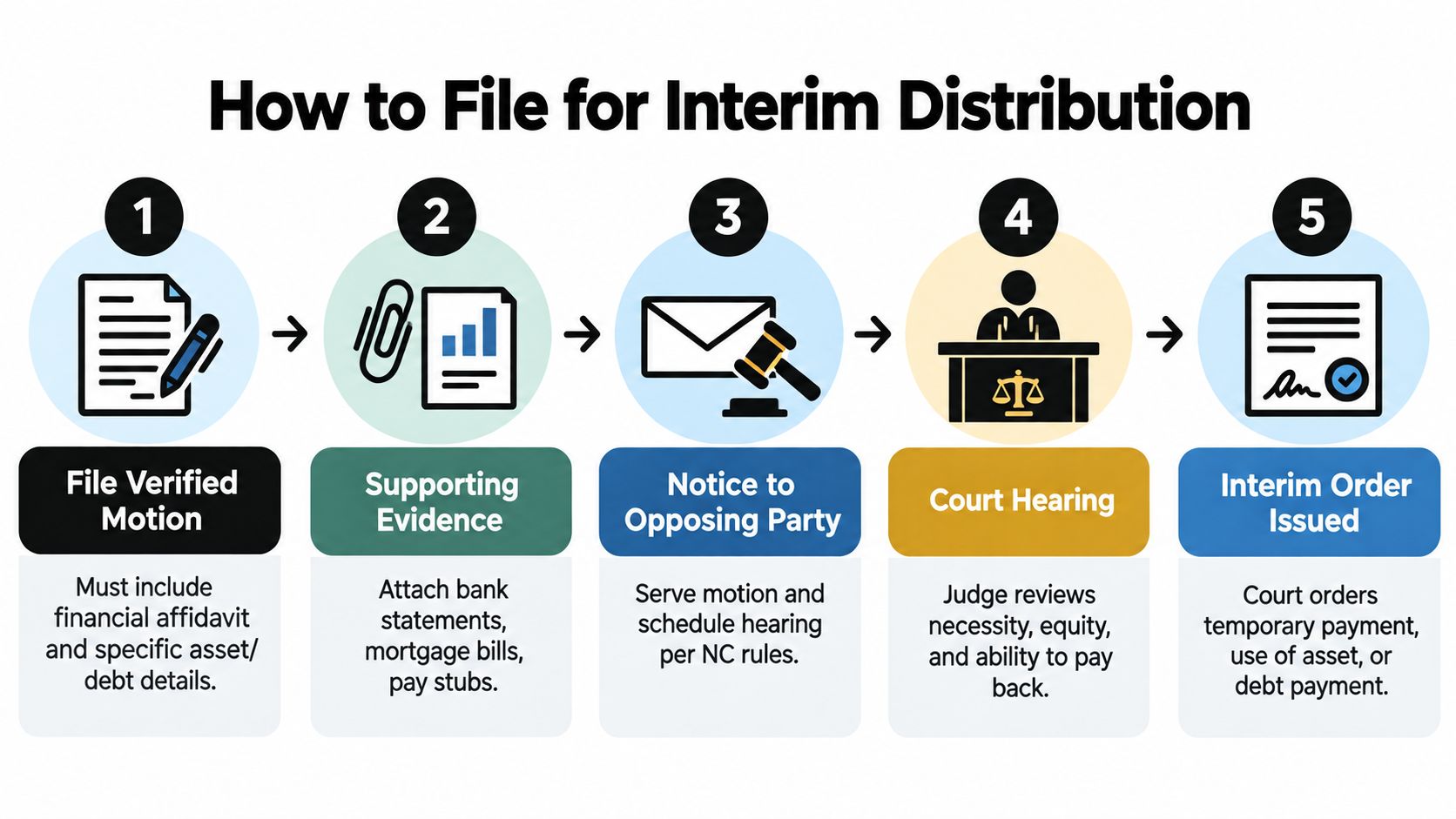
A strong interim motion is usually narrow. It tells the judge exactly what needs to happen now, why it needs to happen now, and what property is involved.
Use clear labels, not broad categories. Name the vehicle, the bank account, the credit card debt, the business tool, or the household item. If you want temporary possession, temporary use, temporary responsibility for a payment, or protection against transfer, say that directly. Judges handling family court calendars often have limited time. A motion that reads like a focused repair request is easier to hear than one that reads like an early final trial brief.
A North Carolina family law discussion from Pierce Law Group describes the basic practice sequence this way: file the equitable distribution claim, serve a motion identifying the specific property or debt at issue, support it with sworn facts, and obtain a hearing date through family court procedure in the North Carolina interim distribution hearing overview from Pierce Law Group.
The sworn-facts piece matters. Your motion is stronger if the court receives a verified pleading or affidavit that states who has the property, when separation occurred, what immediate problem exists, and why waiting until final trial would cause harm or unfairness.
Build the file before you calendar the hearing
This step often decides whether the motion feels organized or rushed.
Interim distribution works a bit like asking a judge to make a temporary traffic decision at a busy intersection. The judge does not need every fact from the marriage. The judge needs enough reliable proof to direct who uses, holds, pays, or preserves the property until final equitable distribution is tried.
Before you push for a hearing date, gather the papers that match the exact relief requested:
- Account and debt records: recent statements, payoff figures, payment histories, or transaction records tied to the disputed asset or obligation
- Ownership and control documents: titles, registrations, screenshots, photos, app access records, or messages showing who possesses or controls the item
- Proof of present need: missed-payment notices, insurance risks, work-related transportation need, or documents showing the item is needed for housing, employment, or basic stability
- A proposed order: some courts appreciate a short draft stating precisely what temporary relief you want entered
Get the hearing scheduled under local rules and serve it correctly
This part is practical, and it varies by county. Some North Carolina districts have detailed family court local rules about motion calendars, notice periods, exhibit exchange, and how to request a hearing date. Others rely more heavily on local custom and coordinator instructions.
That means you should check the local rules early, then confirm the court's actual scheduling practice. Do not assume filing the motion automatically places it on a calendar. In many counties, a party or lawyer must actively request the hearing date, prepare the notice of hearing, and make sure service is completed in the form the rules require.
The North Carolina Judicial Branch publishes county and district court directories and local rules pages that are often the starting point for figuring out where motions are calendared and what local procedure applies: North Carolina Judicial Branch local rules and court information.
Prepare for a limited hearing and keep track of the credit issue
An interim distribution hearing is usually a targeted hearing, not a full property trial. The court is deciding whether temporary possession, use, control, or payment responsibility should be assigned before the final equitable distribution judgment.
That temporary nature is important for two reasons. First, your presentation should stay tight. Second, the interim ruling does not disappear later. At final trial, the court typically accounts for what was distributed or assigned on an interim basis and credits or adjusts the final equitable distribution accordingly under N.C. Gen. Stat. § 50-20. In plain English, interim distribution is more like an advance allocation than a separate property case.
So keep a clean record after the order is entered. Save the signed order, proof of transfers, account balances as of the transfer date, payment records, and any documents showing whether the other side complied. Those details can matter when the judge later decides how to credit the interim order at the final equitable distribution hearing.
Evidence Exhibits and Mistakes That Can Hurt Your Motion
An interim distribution hearing is often won or lost on organization. Judges hear many urgent-sounding requests. The side that brings clear proof usually has the stronger footing.
What judges usually want to see
Strong evidence is specific, tied to the request, and easy to follow. Think less in terms of “everything that happened in the marriage” and more in terms of “what this judge needs to decide this temporary issue.”
Good exhibit packages often include:
- A sworn factual statement: Not argument, but facts. Who has the property, when separation occurred, what debt is due, and what immediate need exists.
- Records tied to the disputed item: Statements, invoices, title documents, payoff information, or account printouts.
- Proof of present risk or hardship: Notices showing a payment problem, correspondence showing denied access, or records showing one spouse's sole control.
- A proposed order or short written relief request: Some judges appreciate seeing exactly what temporary relief you are asking for.
If your case involves broad financial disputes, document production, or inconsistent financial information, NC divorce discovery and financial affidavits can help frame the larger evidence-gathering process around property issues.
How to present exhibits without losing the judge
A disorganized pile of documents can weaken even a valid request. Label each exhibit. Keep the hearing packet tight. Make sure your affidavit and attachments match the relief you are requesting.
One common problem is overloading the court with records that never connect back to the temporary issue. If the dispute is about one account or one debt, the hearing should feel focused on that account or debt.
Bring the judge from problem to proof to requested relief in a straight line.
Mistakes that create avoidable trouble
Some errors come up repeatedly in interim distribution matters.
- Treating temporary relief as final relief: Interim orders are preliminary. If your motion reads as though the court must decide the entire equitable distribution case now, you may lose credibility.
- Requesting vague property: “Personal items from the home” is often too unclear. A list is better. A detailed list with supporting facts is stronger.
- Skipping the legal timing requirement: If equitable distribution has not been filed, the motion is on shaky ground from the start.
- Failing to explain urgency: Judges need a reason to act now instead of later.
- Ignoring the possibility of later credit: Temporary transfers are part of a larger accounting. Your presentation should acknowledge that framework rather than resist it.
A short checklist before the hearing
| Ask yourself | Why it matters |
|---|---|
| Have I identified the exact item or debt? | The court needs a specific target for relief |
| Do I have sworn facts? | Argument alone usually isn't enough |
| Can I explain why now? | Urgency is central to interim relief |
| Are my exhibits labeled and relevant? | Clarity improves credibility |
Clients often think the strongest motion is the longest one. Usually it's the opposite. The strongest one is the one the judge can understand quickly and trust.
What Happens After the Order and How to Protect Your Interests
Once the judge enters an interim distribution order, the property case is not over. The order controls the temporary situation, but it does not close the final questions.
How the temporary order fits into the final trial
Under North Carolina law, any interim transfer is later accounted for in the final equitable distribution proceeding. In practical terms, the court can credit the interim transfer at final trial as part of the overall property division. That is built into the statute discussed earlier.
So if one spouse receives temporary possession, use, or responsibility now, that doesn't erase the need for a complete final accounting later. It becomes part of that accounting.
What you should do after the order
After entry of the order, protect yourself by keeping a clean record.
- Follow the order carefully: Noncompliance can create enforcement problems and damage your position later.
- Save payment records: If the order assigns a debt or expense temporarily, keep proof of every payment.
- Track the condition and use of property: If you receive an asset for temporary use, document maintenance, expenses, and significant changes.
- Prepare for final valuation and classification issues: Those disputes may still be ahead of you even if the interim issue is resolved.
Clients often ask whether the interim order locks in the property's value or legal classification. Usually, no. The underlying idea of interim distribution is that the court can make a temporary allocation without prejudice to later arguments at the final equitable distribution hearing.
FAQ about interim distribution motions in North Carolina
Can I file an interim distribution motion before filing equitable distribution
No. In North Carolina, interim distribution is available only after an equitable distribution claim has been filed and while that claim is still pending.
Does an interim distribution order decide who finally gets the property
No. The order is temporary and interlocutory. Final classification, valuation, and division issues remain open for the final equitable distribution trial.
Can a judge temporarily assign debt in an interim distribution case
Yes. North Carolina's statute allows temporary division of part of the marital property, divisible property, or debt, subject to the court's final accounting later.
How fast will the hearing be scheduled
That depends on the county and local family court procedures. Some local rules aim to set the hearing as soon as possible, with a target of within 30 days of the request, but scheduling practices vary.
Should I handle an interim distribution motion without a lawyer
Some people try, but these motions are highly fact-specific and require careful timing, evidence, and drafting. If the asset, debt, or temporary access issue matters to your stability, legal advice is often worth getting early.
North Carolina residents dealing with frozen assets, urgent debt issues, or access disputes during divorce usually need a plan that fits both the statute and the local court process. A focused consultation can help you decide whether interim distribution is the right tool, what proof you need, and how to protect your position at the final property hearing.
The Law Office of Bryan Fagan helps North Carolina clients evaluate equitable distribution strategy, prepare evidence for temporary hearings, and address property and debt issues that can't wait for final trial. If you need practical guidance on whether an interim distribution motion fits your case, visit Law Office of Bryan Fagan to schedule a consultation.