You may be dealing with a custody fight, a DUI charge, or a divorce that suddenly involves business records, mental health records, or competing stories about what really happened. Then your lawyer says the case may need an expert witness.
It is then that the legal process often starts to feel less familiar and more intimidating.
In North Carolina, expert witness testimony often becomes the bridge between raw facts and a decision a judge can make. A photograph, bank statement, toxicology result, or psychological evaluation doesn't always speak for itself. Someone with specialized training may need to explain what it means, what it doesn't mean, and how much weight the court should give it.
Understanding Expert Witness Testimony in Your NC Case
A client usually first hears the term during a stressful moment. In a custody dispute, it might come up when the other parent asks for a psychological evaluation. In a criminal case, it may arise after the State produces a lab report. In a civil case, it often appears when a doctor, accountant, appraiser, or engineer is needed to explain technical evidence.
That's where the practical answer to what is expert witness testimony matters. An expert witness gives an opinion under oath based on specialized knowledge that goes beyond what an average juror or judge is expected to know. The point isn't to repeat facts everyone can already understand. The point is to help the court make sense of complicated facts.
Why Expert Testimony Matters in Real Cases
If a parent is accused of misusing prescription medication, a judge may need more than accusations and screenshots. A qualified professional may need to explain drug metabolism, testing limits, and whether a result indicates anything meaningful about parenting ability.
If a spouse claims the family business is worth far less than it appears, the court may need a forensic accountant to evaluate records and explain the numbers in plain English.
If you're facing a criminal charge, an expert may challenge how evidence was collected, interpreted, or linked to you.
Practical rule: An expert doesn't win a case by title alone. The expert helps only if the opinion is tied closely to the facts the court must decide.
Expert testimony is common because modern cases are technical. According to the National Institute of Justice summary on the use of expert witnesses in U.S. civil cases, expert witnesses are used in over 60% of civil trials.
What Clients Often Misunderstand
Clients often assume an expert is just a hired advocate. That's not how the court is supposed to view the role. A useful expert must stay within a real field of expertise and offer an opinion grounded in reliable work.
A second common misconception is that expert testimony only matters in jury trials. In North Carolina family court, the trier of fact is often the judge. That can make expert testimony even more targeted, because the judge wants focused help on a specific issue rather than broad courtroom theater.
Expert Witness vs Lay Witness What Is the Difference
The cleanest way to understand the difference is this. A lay witness tells the court what they personally saw, heard, or did. An expert witness tells the court what those facts mean within a specialized field.
Take a car wreck example. A lay witness can say, “I saw the blue truck run the red light.” An accident reconstruction expert can analyze impact patterns, vehicle damage, and road evidence to offer an opinion about speed, force, or sequence.
In a North Carolina custody case, a teacher may testify that a child often arrived late, looked tired, or seemed anxious. That's lay testimony. A psychologist may evaluate family dynamics and give an opinion about a child's needs or parental functioning. That's expert testimony.
The Functional Difference
Lay witnesses are limited by firsthand observation. They usually can't give technical opinions just because they feel strongly about what they saw.
Experts are different. The court allows them to draw conclusions from training, education, experience, or specialized methods, but only within a defined field.
That last part matters. North Carolina courts don't let people become “general experts” on everything.
Lay Witness vs. Expert Witness in North Carolina Courts
| Attribute | Lay Witness | Expert Witness |
|---|---|---|
| Primary role | Describe firsthand facts | Offer an opinion based on specialized knowledge |
| Basis of testimony | Personal observation | Education, training, experience, skill, or technical analysis |
| Can give opinions | Usually only limited everyday opinions | Yes, within a qualified area of expertise |
| Example in custody case | Neighbor describes exchanges between parents | Psychologist evaluates parenting concerns |
| Example in criminal case | Officer describes what was observed at scene | Toxicologist explains test results |
| Example in civil case | Property owner describes what happened | Appraiser or engineer interprets technical evidence |
A witness who says, “I saw him stumble,” is not doing the same job as a toxicologist who explains whether a substance level supports impairment.
What Works and What Doesn't
What works is matching the witness to the exact issue in dispute. If the question is mental health, use a mental health professional. If the question is business valuation, use a financial expert.
What doesn't work is trying to stretch one witness too far. A person may be highly credible in one subject and completely unqualified in another. That distinction often decides whether testimony helps or gets limited by the court.
How Testimony Becomes Admissible in North Carolina Courts
North Carolina doesn't allow expert opinions just because someone has an impressive resume. The judge must decide whether the testimony is admissible.
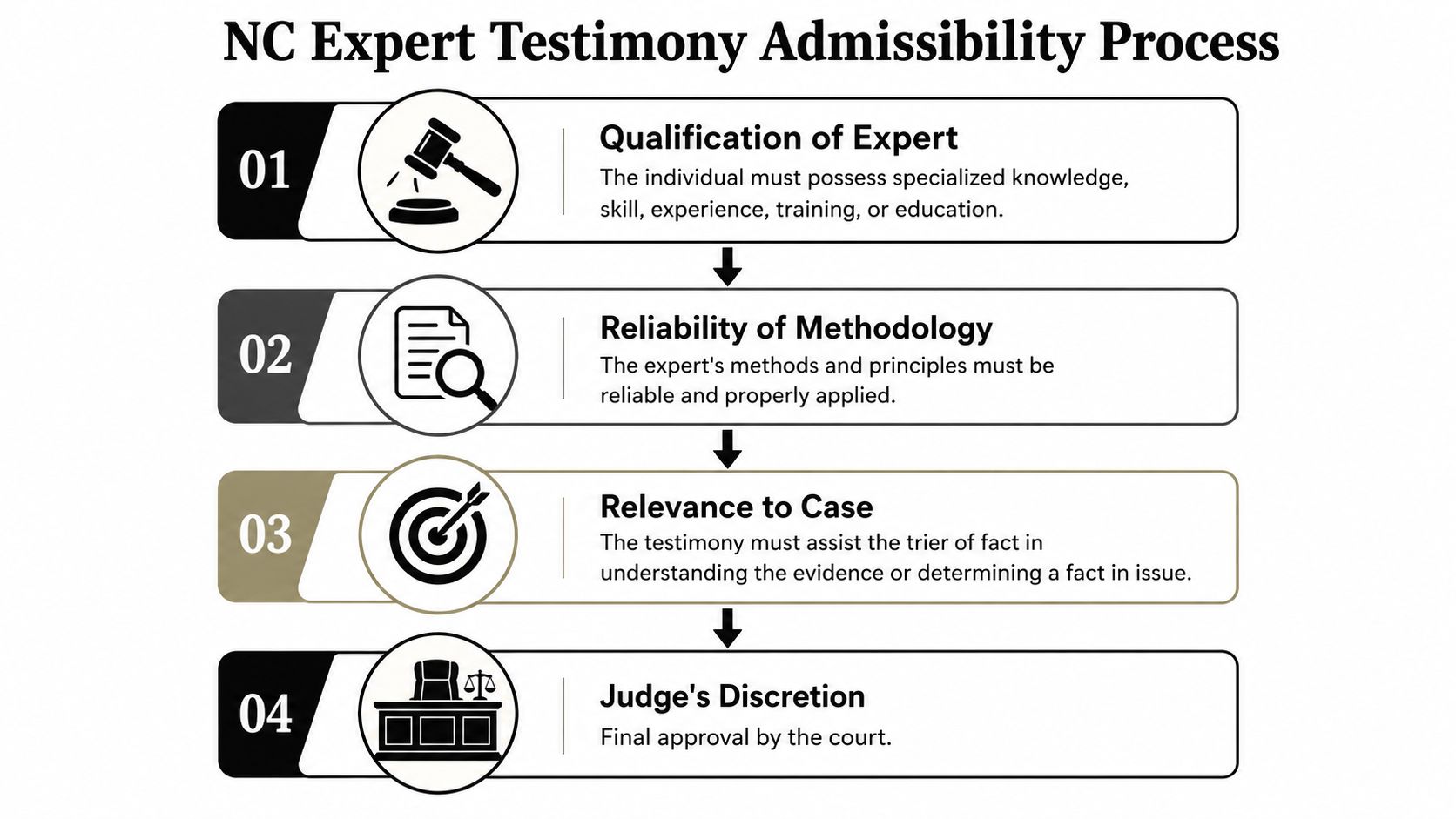
That decision usually comes down to a practical three-part checklist. Is the expert qualified? Is the method reliable? Will the opinion help resolve an issue in the case?
The Three Questions the Court Asks
Under North Carolina practice, Rule 702 serves as the key filter. North Carolina's rule closely follows the federal standard. Under Federal Rule of Evidence 702, expert testimony is admissible only if it is based on sufficient facts, derived from reliable principles and methods, and those methods have been reliably applied to the case. That standard exists to keep speculation out of the courtroom.
Here's what that means in plain English:
Qualification
The witness must have specialized knowledge, skill, training, education, or experience tied to the issue at hand.Reliability
The opinion must come from a dependable process. The court wants more than a guess, a hunch, or a conclusion built for litigation.Helpfulness
The testimony must help the judge or jury understand evidence or decide a fact that matters.
How This Plays Out in Real NC Cases
Suppose a parent in a custody case wants to introduce a counselor's opinion. The court may ask whether the counselor evaluated the right records, used accepted methods, and stayed within the proper scope of expertise.
Or consider a criminal case involving impaired driving. A defense lawyer may challenge whether a State expert can reliably connect a test result to actual impairment in the specific circumstances. Issues like that often shape litigation in cases involving charges such as drunk driving in North Carolina.
In divorce litigation, admissibility issues can arise around tracing separate property, valuing a closely held company, or explaining income available for support. Even in a more straightforward filing, such as How to File for Absolute Divorce in North Carolina, the procedural steps are separate from proving contested financial or parenting issues. That's where expert testimony may become necessary.
Why Clients Should Care About the Gatekeeping Role
The judge acts as a gatekeeper. That protects your case from unreliable opinions, but it also means your own expert must be prepared carefully.
The strongest expert opinions are narrow, fact-specific, and easy for the court to follow.
What usually hurts admissibility is overreach. An expert who strays outside the discipline, ignores contrary records, or offers broad conclusions without a clear method becomes vulnerable fast.
How Experts Are Used in NC Family Criminal and Civil Cases
A custody hearing, a felony trial, and a business dispute can all involve expert testimony, but the job the expert is doing is different in each one. In North Carolina, that difference matters because the judge or jury is deciding different kinds of questions. A good expert does not just add credentials to a case. The expert helps the court answer a specific disputed issue.
Family Law
In family law, experts are often used to address parenting, mental health, substance abuse, income, or asset valuation. The focus stays on practical questions the court has to decide, especially in custody cases where the child's best interests control. Mental health professionals, custody evaluators, substance abuse assessors, and forensic accountants all show up for different reasons.
A common custody dispute starts with two very different stories. One parent says a child is struggling after exchanges. The other says the allegation is exaggerated or coached. The judge usually needs more than accusations. A qualified evaluator may review records, interview family members, and give an opinion that helps the court assess parenting concerns. Clients often get their first real sense of expert involvement during the custody evaluation process in NC.
Experts can help in support and property disputes too. In a high-income divorce, a forensic accountant may trace cash flow through a closely held business, review whether expenses are personal or business-related, and test whether reported income reflects what is available for support. That kind of work can be expensive, so it is not automatic. The question is whether the value of the issue justifies the cost of the expert.
Criminal Defense
In criminal cases, experts are often used to test the State's proof rather than present an alternative story. That is a major practical difference from family court.
A toxicologist may examine whether a lab result supports the prosecution's theory. A digital forensics expert may review phone extraction methods, chain of custody, or whether the data really says what the State claims. In cases involving mental condition, a psychiatrist or psychologist may address competency, capacity, diagnosis, or the limits of a prior evaluation.
Cost is often a real pressure point here. In retained cases, clients may need to decide whether an expert will materially improve the defense or instead confirm what cross-examination can already establish. In appointed cases, funding issues can shape strategy. Good criminal defense work involves choosing the expert carefully, defining the assignment narrowly, and avoiding reports that create more problems than they solve.
Civil Litigation
Civil cases usually use experts to prove causation, damages, value, or professional standards. The type of expert depends on the claim. A physician may connect an injury to an event. An appraiser may address real property value. An accountant may sort through conflicting financial records in a partnership or contract dispute.
In many civil cases, the expert who explains the records clearly and stays inside the facts will be more persuasive than the witness with the longest résumé.
The trade-off in civil litigation is usually between cost and proof. If damages are modest, a full expert report may not make financial sense. If the case involves a business valuation, future medical care, or a technical causation dispute, expert testimony may be the only practical way to meet the burden of proof. In North Carolina cases, that decision should be made early enough to gather records, test assumptions, and avoid rushing an opinion that will not hold up under cross-examination.
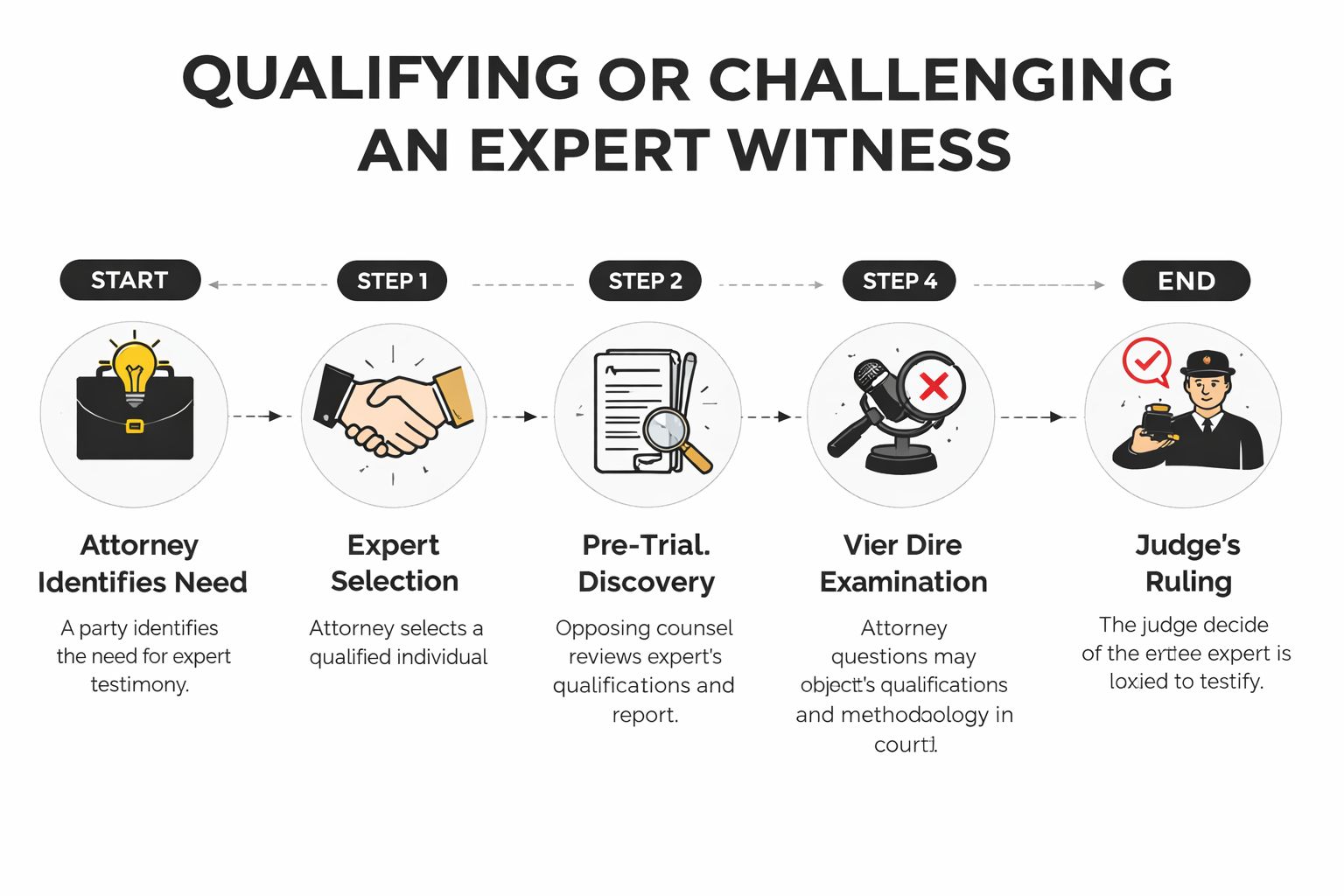
How Attorneys Qualify or Challenge an Expert Witness
Lawyers do not announce that someone is an expert and move on. The court expects a foundation. In North Carolina, that usually means the attorney must show why the witness is qualified and why the proposed opinion fits the issue before the court.
How an Attorney Qualifies an Expert
The process often begins with background questions. Education, licenses, training, work history, publications, and prior experience may all matter. But the key question is narrower than many clients expect. The court cares less about prestige in the abstract and more about fit.
If the issue is substance testing in a custody case, the lawyer needs to show why this witness can speak to toxicology. If the issue is business valuation, the lawyer needs to tie the witness's financial expertise to the records and valuation methods involved.
North Carolina recognizes that scope matters. Under the UNC School of Government discussion of Rule 702 and G.S. 8-58, a witness must have specialized knowledge that assists the court. In a custody case with substance abuse allegations, a toxicologist may qualify to explain drug metabolism, but not to offer a broad opinion about overall parental fitness.
How the Other Side Challenges an Expert
Opposing counsel usually attacks one of three areas:
- Qualifications: The witness lacks training or experience in the specific issue.
- Methodology: The opinion rests on weak facts, unreliable methods, or a poor application of those methods.
- Bias or overreach: The expert sounds more like an advocate than an objective professional.
A strong challenge doesn't have to prove the expert knows nothing. It only has to show the opinion goes beyond what the witness can reliably support.
Here is a useful overview of how the process tends to unfold:
Why Voir Dire Matters
Voir dire is the questioning process used to test the expert before the judge accepts the testimony. During this process, details matter. A lawyer may explore what records the expert reviewed, what assumptions were made, and whether important facts were ignored.
Courtroom reality: A polished witness can still be excluded if the method is weak. A modest witness can be persuasive if the opinion is disciplined and well supported.
Practical Guidance When an Expert Is on Your Team
A common problem in North Carolina cases starts like this. A parent in a custody dispute waits until the week before mediation to ask about a psychological evaluator. A business owner in a divorce waits until financial disclosures are already due before looking for a valuation expert. A criminal defendant first raises the need for a toxicologist after the State has finished testing and reporting. By that point, the issue often is not whether an expert would help. The issue is whether there is still enough time and budget to use one well.
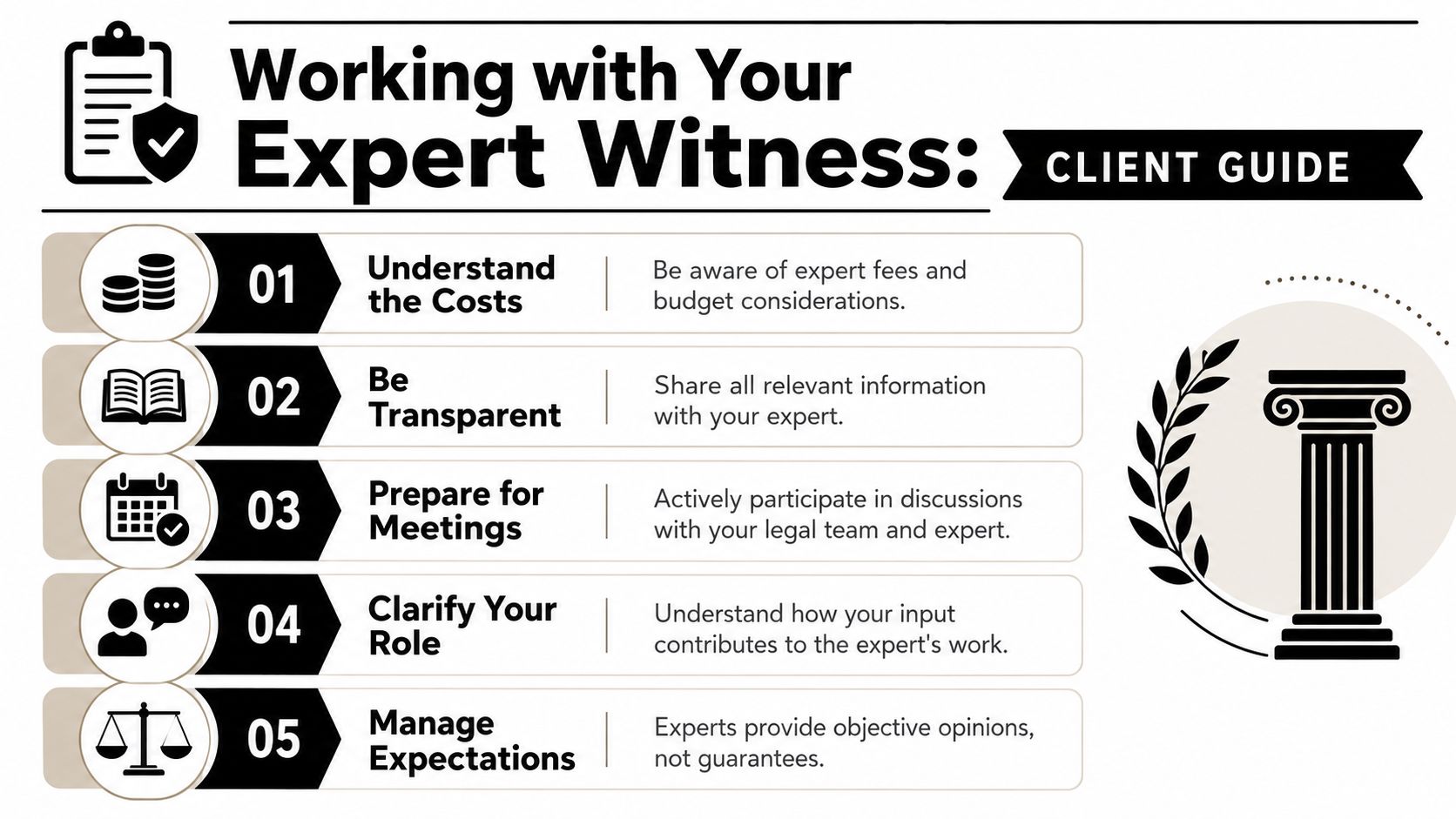
If your case needs an expert, help your lawyer build a complete factual record early. Experts do their best work when they have the full file, enough time to review it, and room to ask for follow-up documents before deadlines start driving the case.
Candor matters. Share the damaging text messages, the missing bank records, the prior treatment history, and the facts you wish were not in the case. In practice, those facts usually come out anyway. It is far better for your own expert to account for them than to have opposing counsel expose them first.
What You Should Do Early
Start gathering records as soon as expert involvement becomes likely. In family law matters, that may mean tax returns, business records, school records, therapy records, and account statements. In criminal cases, it may include lab reports, body camera footage, medical records, phone data, or prior evaluations. In civil litigation, it often means contracts, repair records, photographs, billing files, and industry documents.
Cost and timing deserve a straight answer. As a practical matter, North Carolina experts in financially or medically complex cases often require a meaningful upfront retainer, and the right expert may not be available on short notice. That is especially true for forensic accountants, business valuation professionals, mental health experts, and certain forensic specialists. Delay can limit your options and increase cost because the expert has less time to work carefully.
I see this frequently in divorce cases involving closely held companies. If a spouse waits until mediation week to ask for an opinion on company value, the expert is being asked to solve a scheduling problem, not just a valuation problem. In many cases, that is too late to produce work the court or the other side will treat seriously. If business ownership is part of the marital estate, planning early for a business valuation in a North Carolina divorce can prevent that squeeze.
How to Work With the Expert Effectively
- Provide complete records quickly: Partial files lead to tentative opinions, added cost, and avoidable revisions.
- Answer questions directly: If the expert asks about dates, treatment, finances, or prior incidents, accuracy matters more than polish.
- Understand the assignment: Ask what the expert is being asked to evaluate, what materials are still needed, and when a draft opinion may be realistic.
- Respect independence: A credible expert is not a spokesperson for your side. The expert needs room to reach an honest opinion, even if some parts are not ideal for your case.
- Budget for the full process: Fees may include review time, conferences with counsel, report preparation, deposition, and trial testimony. The cheapest retainer is not always the lowest total cost if the work has to be redone or defended poorly.
The practical benefit of a good expert is not limited to trial. In North Carolina family cases, a well-prepared valuation, custody evaluation, or vocational opinion can shape settlement discussions long before a judge hears testimony. In criminal defense, an independent review of forensic testing can expose limits in the State's proof or keep a weak case from sounding stronger than it is. In civil cases, expert analysis often narrows the dispute and changes how both sides value risk.
If you're looking at legal representation options, the Law Office of Bryan Fagan provides representation in North Carolina family law, criminal defense, and civil litigation matters where expert testimony may become part of the case strategy.
What Clients Should Not Expect
An expert does not guarantee a result. The expert also does not replace your own testimony or fix bad facts.
What a good expert can do is explain technical issues in a way a judge or jury can use. That can improve settlement posture, sharpen the core dispute, and give the court a sound basis for decision. In the right North Carolina case, that is money well spent.
North Carolina Expert Witness FAQs
Can an out-of-state expert testify in a North Carolina case
Sometimes, yes. The key issue usually isn't where the expert lives. It's whether the person is qualified in the relevant field and whether the opinion meets North Carolina admissibility standards.
What if I disagree with my own expert's opinion
Tell your attorney immediately. That doesn't always mean the expert is wrong, and it doesn't always mean the expert should testify. Sometimes the disagreement reveals missing records, misunderstood facts, or a need for a different type of expert.
Does every North Carolina custody case need an expert witness
No. Many custody cases are decided through parent testimony, school records, medical records, and other fact evidence. Experts are most useful when the judge needs help understanding mental health issues, substance use concerns, or other specialized topics.
Who pays for an expert witness in North Carolina
Usually, the party who hires the expert pays that expert's fees unless the court orders otherwise in a specific context. The practical question is less about labels and more about planning early so the cost doesn't disrupt your case strategy.
Can an expert witness be excluded before trial
Yes. If the expert is unqualified, used unreliable methods, or offers opinions that don't properly fit the issues in the case, the court can limit or exclude the testimony before trial.
If you're dealing with a divorce, custody dispute, criminal charge, or civil case in North Carolina and think expert testimony may affect the outcome, speaking with counsel early can save time, cost, and avoidable mistakes. The Law Office of Bryan Fagan works with North Carolina clients on family law, criminal defense, and civil litigation matters and can help you evaluate whether an expert is necessary, what kind of expert fits your case, and how to prepare for the challenges that follow. Schedule a consultation to discuss your options under North Carolina law.