
You may be here because you and your spouse have already been separated for a long time, and you assumed the property issues could wait until later. That assumption causes real damage in North Carolina.
A common version looks like this. One spouse moves out. The other stays in the home. Both believe the house, retirement accounts, and debts will be sorted out after the divorce. Then the absolute divorce is granted, and one spouse learns too late that the right to ask the court for equitable distribution is gone.
That is why the phrase absolute divorce cuts off equitable distribution claim in North Carolina matters so much. It is not just a technical rule. It can decide whether a spouse keeps the ability to seek a share of the marital home, retirement funds, vehicles, or debt allocation.
When the Divorce Ends Before the Property Claim Starts
Consider a North Carolina couple who separate. The husband moves out and assumes they will divide the house and his 401(k) later. The wife waits more than a year, then files for absolute divorce. He sees the complaint, thinks the divorce is just the legal ending of the marriage, and doesn't file anything asking for property division.
The judge signs the divorce judgment. Only then does he realize there is no pending equitable distribution claim.
At that point, the problem usually isn't that he lacked a property interest. The problem is timing. In North Carolina, the court can end the marriage through absolute divorce without deciding who gets the house, retirement funds, or other marital assets. Those issues are separate claims. If no one properly raises the property claim before the divorce judgment is entered, the right can disappear.
How this mistake happens
Often, the spouse who files first includes multiple claims in one complaint. The complaint may ask for absolute divorce and also ask for equitable distribution. If that happens, the property claim is preserved and can continue even after the marriage itself is dissolved.
The bigger danger comes when only the divorce claim is filed.
A defendant spouse may need to respond with an answer, a counterclaim, or another proper pleading that asserts equitable distribution before the absolute divorce is granted. If that doesn't happen, the court can enter the divorce judgment without ever reaching the property issues.
Practical rule: The divorce decree ends the marriage. It does not automatically divide property for you.
That catches people off guard because the judgment itself often says nothing about the home, retirement accounts, or jointly titled debt. Clients sometimes read the final divorce papers and assume those issues remain open. They often don't.
The takeaway clients need early
If you're dealing with an absolute divorce in North Carolina, don't assume you can “come back later” for the financial side of the case. In many situations, later is too late.
What works is simple, even if the paperwork isn't. Assert the property claim before the judge enters the absolute divorce judgment. What doesn't work is relying on verbal promises, informal understandings, or the hope that the court will sort it out after the divorce becomes final.
What North Carolina Law Says About the Cutoff Rule
North Carolina makes this rule statutory, not discretionary. Under N.C. Gen. Stat. § 50-11(e), an absolute divorce obtained in this state destroys the right to equitable distribution unless that right was asserted before the divorce judgment was entered, with narrow exceptions discussed below. The statute is available through North Carolina General Statutes section 50-11.
What equitable distribution means
Equitable distribution is the court-supervised division of property and debt between spouses under Chapter 50. In plain English, it is the legal process for identifying what belongs in the marital estate, deciding what is separate property, valuing the property, and then dividing it under the statutory framework.
If you want a plain-language overview of what equitable distribution is, start there. But the key point here is narrower. The court can only divide property if someone has properly asserted the claim in time.
Why the rule is strict
This cutoff rule exists because North Carolina treats absolute divorce as a point of legal finality. The General Assembly created a framework in which spouses live separate and apart before seeking an absolute divorce, and once that divorce judgment is entered, the law generally closes the door on later property claims that were never raised.
Courts don't have open-ended equitable authority to revive a missed equitable distribution claim after the judgment is signed. That is the part many people find hardest to accept. If a valid claim was never asserted before the divorce, the court usually cannot rescue it afterward because the result feels unfair.
North Carolina's rule is harsh in practice because a spouse may have a legitimate interest in marital property and still lose the claim entirely by missing the pre-divorce pleading deadline.
Where pleading fits into the process
A property claim has to be raised through proper pleadings in the divorce case or related action before the judgment of absolute divorce is entered. That is why process matters just as much as substance. People spend a lot of time arguing over who paid for the house or how much of a retirement account was earned during the marriage. Those are important issues, but they don't matter if the claim itself never survives the cutoff rule.
If you're still trying to understand the steps, residency rule, and filing requirements for the divorce side of the case, How to File for Absolute Divorce in North Carolina is a useful starting point. Just remember that learning how to obtain the divorce is only part of the job. Protecting the related property claim requires separate attention.
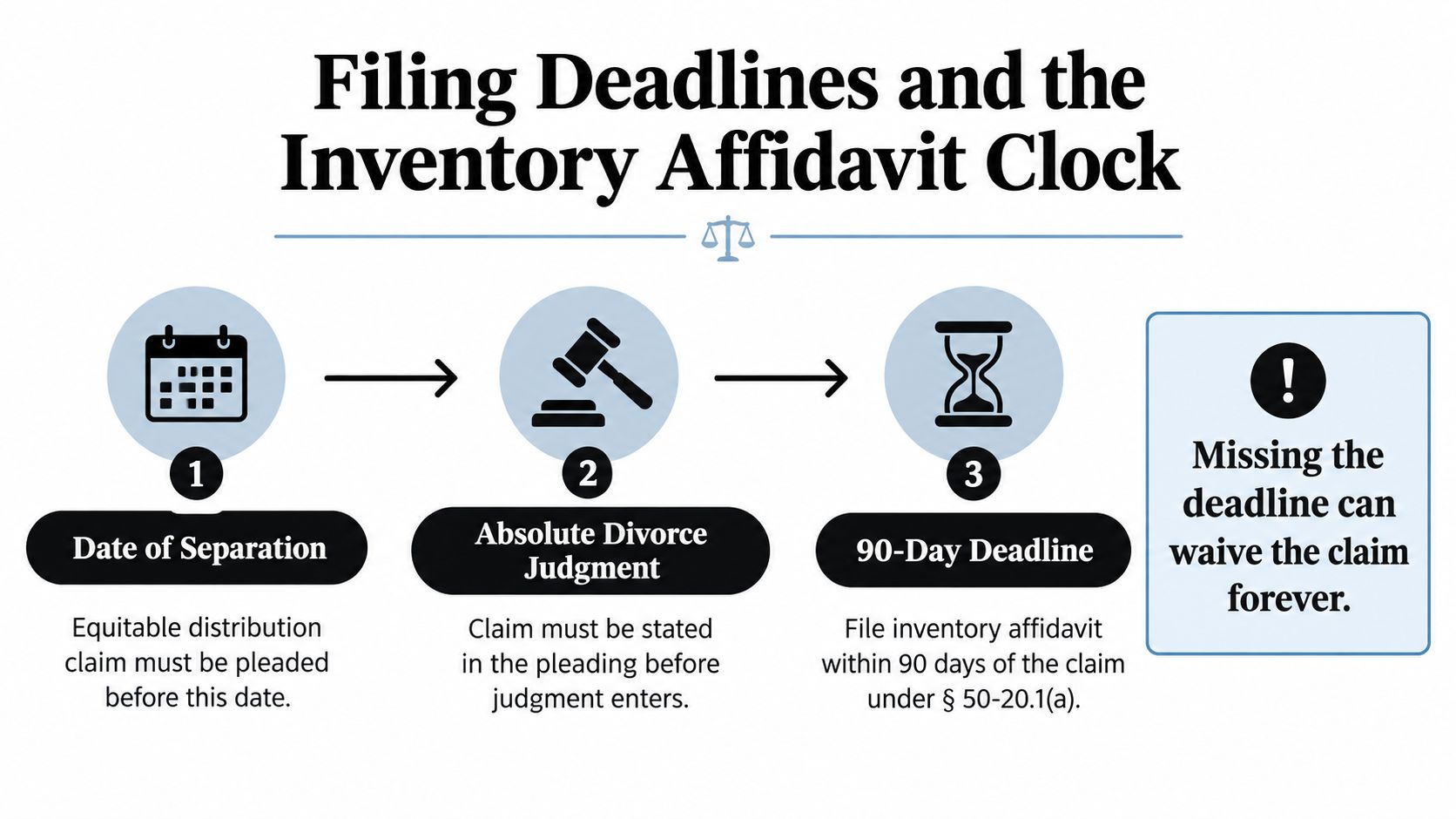
Filing Deadlines and the Inventory Affidavit Clock
A common problem looks like this: the divorce case is on track, settlement talks are drifting along, and one spouse assumes the property paperwork can wait until after the judge signs the divorce. That assumption creates trouble fast. In North Carolina, preserving the claim and proving the claim run on related clocks.
Once an equitable distribution claim is filed, the case shifts from pleading to disclosure. North Carolina procedure requires the party who first asserts equitable distribution to serve an inventory affidavit within 90 days after service of the claim under N.C. Gen. Stat. § 50-21. The other spouse then has 30 days to serve a responding inventory affidavit. Those dates matter because the cutoff rule and the affidavit deadline are part of the same process map. First, get the claim on file before the divorce cuts it off. Then, get the sworn inventory out on time so the case stays usable.
What the inventory affidavit actually has to do
This affidavit is not a placeholder. It is a sworn listing of assets and debts, with each item identified and classified, and with an estimated fair market value tied to the date of separation. That usually means marital property, separate property, divisible property, or a dispute about classification.
A bare claim keeps the door open. The inventory affidavit gives the court and the other side a workable list of what is being fought over.
In practice, that means details such as:
- House: whether it is claimed as marital, separate, or mixed, plus the estimated value and debt balance as of the relevant date
- Retirement account: what account exists, what portion was earned during the marriage, and whether supporting statements are available
- Vehicle or personal property: the value claimed, any lien, and whether either spouse says part of it is separate
Clients often underestimate how much work this takes. Accounts have changed names. Statements are missing. Refinances blur the paper trail. If document gathering starts after the 90-day clock is already running, the case becomes harder than it needed to be.
Why this deadline matters even when the claim was filed on time
Filing before entry of absolute divorce protects the right to seek equitable distribution. It does not excuse weak or late financial disclosure. Courts can address missed affidavit deadlines through motions, sanctions, extensions for good cause, or other case-management orders depending on the facts.
That is the trade-off I explain to clients. A fast filing may preserve the claim, but a rushed filing without prompt records collection can leave the case disorganized and expensive to clean up. The law gives some room for extensions in the right case. It does not reward waiting.
Deadline warning: Filing the equitable distribution claim before divorce is only step one. The 90-day inventory affidavit clock starts running after service of that claim.
The practical answer is to treat the property claim, service issues, and affidavit deadline as one coordinated timeline. That matters even more in the cases discussed next, where publication service or personal-jurisdiction problems can change whether a late property claim is still possible. The exception analysis is separate, but if your claim is already properly pending, the inventory affidavit deadline still has to be handled.
If you are still collecting statements, deeds, loan balances, and retirement records, it helps to understand how North Carolina divorce discovery and financial affidavits fit into the rest of the case.
What works in practice
Use a simple sequence:
- File the equitable distribution claim before the divorce judgment is entered.
- Start collecting records immediately, not after a hearing date is set.
- Prepare classifications and estimated values using the date of separation as the anchor point.
- Calendar the 90-day affidavit deadline and the 30-day response deadline at the same time.
Waiting for mediation, waiting for a settlement draft, or waiting until after the divorce judgment usually creates avoidable risk. In this part of the case, timing problems are often self-inflicted.
Exceptions That Can Preserve or Revive a Claim
Most discussions stop at the warning that absolute divorce cuts off equitable distribution. That is incomplete. North Carolina recognizes two narrow exceptions, and they matter because some readers still have a possible path forward.
Service by publication exception
One exception applies when the defendant spouse was served by publication, did not appear, and the statutory conditions are met. In that situation, North Carolina's statute creates a six-month post-judgment window for the defendant to file an equitable distribution action or motion in the cause after the divorce judgment. The statute appears in N.C. Gen. Stat. § 50-11 through FindLaw's North Carolina code version.
This is not a broad safety net. It is a tightly limited exception for a specific service scenario.
Personal jurisdiction exception
The second carve-out involves lack of personal jurisdiction over the absent spouse when the divorce was entered. In practical terms, if the court dissolved the marriage but did not have personal jurisdiction to adjudicate property rights against the absent spouse, the cutoff rule is not applied in the same way. That issue is technical, but it can preserve a later path to litigate equitable distribution once jurisdiction exists.
Online summaries often fail readers. They collapse every case into one rule and leave out the personal-jurisdiction problem entirely.
Two Statutory Exceptions to the Equitable Distribution Cutoff
| Exception | Trigger | Deadline to File | Procedural Step |
|---|---|---|---|
| Service by publication | Defendant was served by publication, did not appear, and the statutory requirements are met | Within six months after the divorce judgment | File an equitable distribution action or motion in the cause within that window |
| Lack of personal jurisdiction | Court entered divorce without personal jurisdiction over the absent spouse for property adjudication | Depends on when jurisdiction can properly be obtained | Assert the property claim once jurisdiction is established through the proper procedural vehicle |
How to think about these exceptions
These exceptions do not help the average person. But when they do apply, they are case-shaping.
Ask these questions early:
- How was service completed: Personal service, acceptance of service, or publication can change the analysis.
- Did the defendant appear: The publication exception is narrow.
- Did the court have personal jurisdiction over the absent spouse: A divorce can end the marriage without necessarily resolving financial claims against someone outside the court's reach.
If you think one of these exceptions may apply, don't assume. The issue turns on service, appearance, and jurisdiction details that have to be reviewed carefully.
A Real-World Equitable Distribution Example
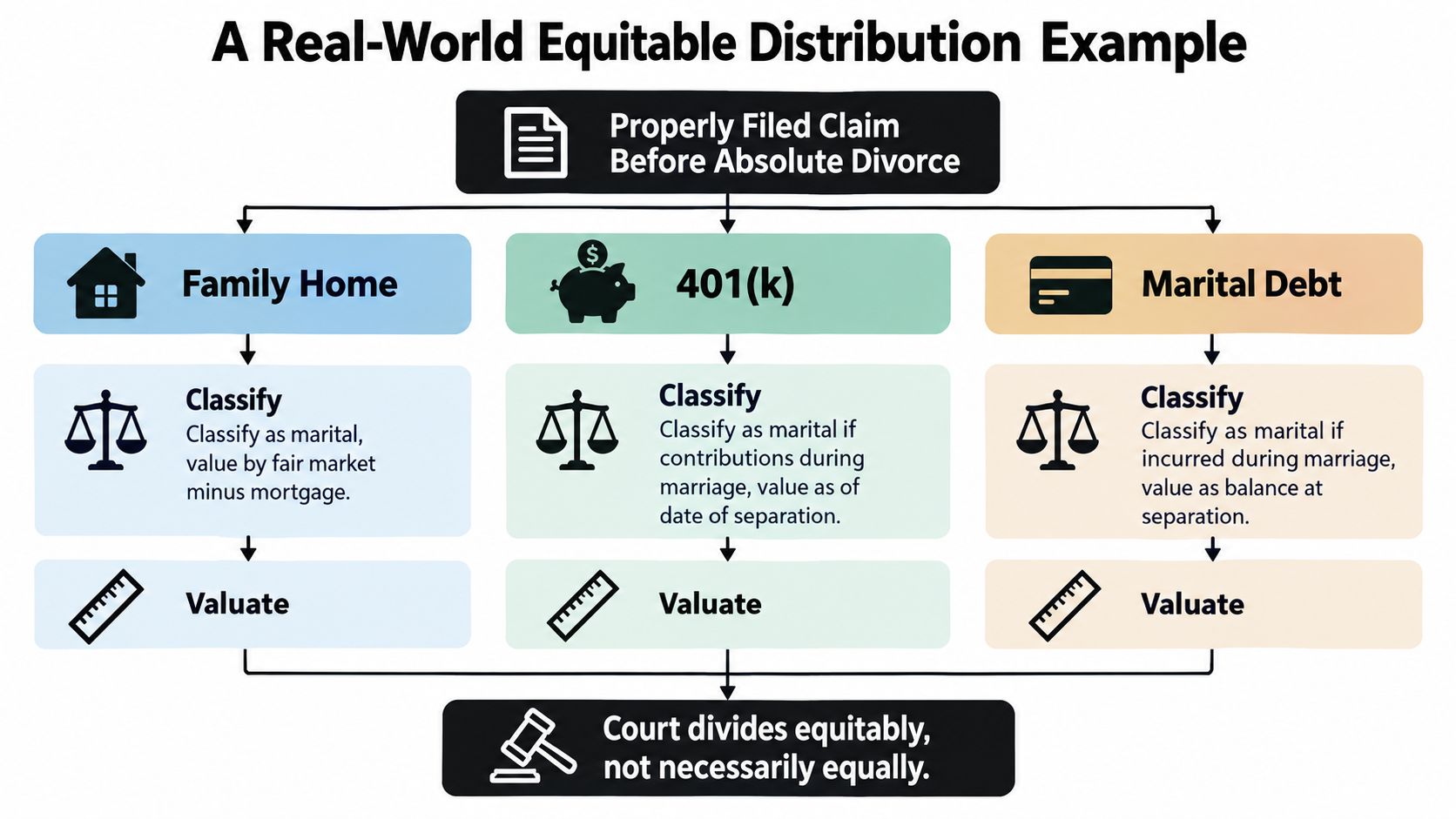
Once a claim is timely preserved, the case turns from deadline law to property law. At that stage, the court focuses on classification and valuation.
North Carolina's equitable distribution procedure requires the inventory affidavit to identify property claimed as marital and separate and to include the estimated date-of-separation fair market value of each item. The statutory procedure appears in Chapter 50 of the North Carolina General Statutes.
How the court looks at common assets
Take a typical marital estate with a family home, a 401(k), and a jointly titled vehicle.
- Family home: The court examines whether the house is marital, separate, or mixed. If the home was acquired during the marriage, that often points toward a marital classification, though title and source-of-funds issues can complicate the analysis.
- 401(k): Contributions accumulated during the marriage are often central to the marital analysis. Pre-marriage amounts may be argued as separate, depending on tracing and proof.
- Vehicle: A jointly titled car may be straightforward, but disputes still arise over debt, value, and whether one spouse paid down the note with separate funds.
Why valuation matters as much as classification
Clients often focus on ownership and forget valuation. The court needs both. A spouse can win the argument that an asset belongs in the marital estate and still struggle if the evidence of value is weak.
The date of separation becomes the anchor point for many valuation questions. That is why records from around separation matter so much. Statements, payoff balances, account records, and appraisals all help create a usable picture of the estate.
This short video gives a practical overview of the property-division process in a North Carolina divorce:
The threshold issue is preserving the claim
If the claim was filed in time, the court can sort through classification disputes and value evidence. If the claim was never preserved, none of that analysis begins.
That is why preserving the claim is the first job. Negotiation can happen later. Valuation disputes can happen later. The legal right to ask the court to divide the estate cannot wait until after the divorce judgment if the cutoff rule applies.
Common Misconceptions About Timing and Consent
Two mistaken ideas show up in consultation after consultation.
The one-year separation period protects my property rights
It doesn't. The one-year separation requirement for absolute divorce is a divorce eligibility rule. It is not a shield that keeps an unfiled property claim alive once the divorce judgment is entered.
That confusion is common enough that the North Carolina Judicial Branch divorce guidance separately addresses filing deadlines, pending claims, and related procedure. The practical lesson is simple. Separation time and property-claim preservation are connected, but they are not the same thing.
A spouse can be separated for a long time and still lose the equitable distribution claim by letting the absolute divorce go through first.
We have to wait until after divorce to divide property
That also isn't right.
North Carolina law generally bars entry of an equitable distribution judgment before the decree of absolute divorce, but there are important exceptions. A consent judgment can be entered during the pendency of the action, and if the parties have been separated for at least six months they may consent in a filed pleading or writing to try equitable distribution before the divorce decree is entered under Session Law 1993-209.
What clients should do with that information
This creates an important strategic choice.
- If you agree on terms: A separation agreement or consent judgment may lock down the property issues before the divorce is final.
- If you don't agree: Assert the claim in time so the court can decide it later.
- If one spouse is pushing for quick divorce papers: Treat that as a deadline problem, not just a relationship problem.
Consent can solve timing problems, but only when the agreement is properly documented before the divorce closes the claim.
The biggest mistake is passivity. Clients often think cooperation means postponing the paperwork. In North Carolina, cooperation is often better expressed by getting the paperwork done while the claim is still alive.
Practical Next Steps Before Your Divorce Is Final
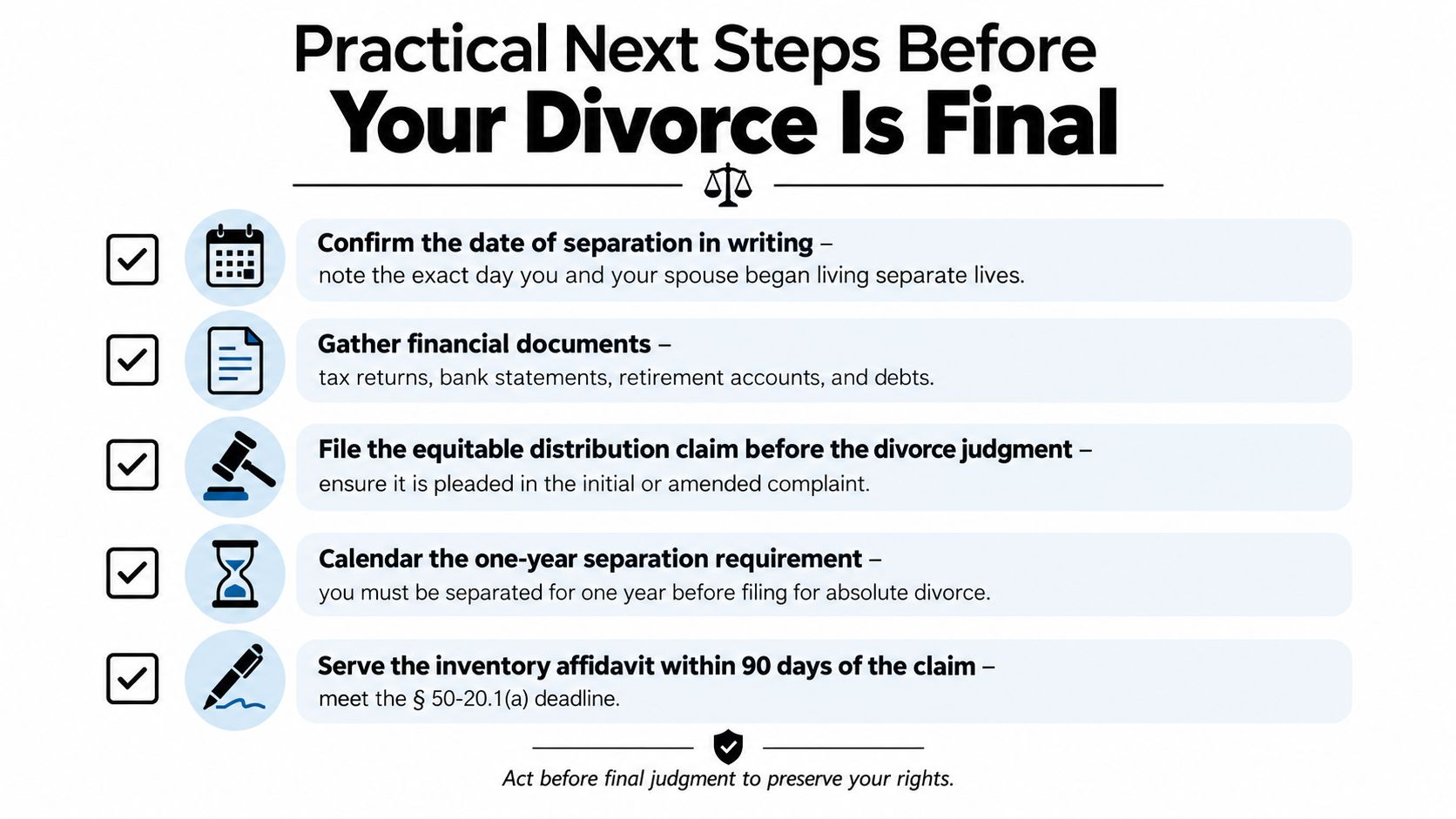
If you're separated or approaching the one-year mark, the safest move is to treat your divorce and your property claim as one coordinated project. Waiting to “deal with the assets later” is where avoidable losses happen.
A workable checklist
Start with the items that control every later deadline:
- Confirm the separation date: Write down the exact date you and your spouse began living separate and apart.
- Calendar the divorce eligibility date: Mark when the one-year separation period is complete.
- Decide whether equitable distribution needs to be filed: If property or debt remains unresolved, don't leave that decision hanging.
- Calendar the affidavit deadline at the same time: Once the claim is asserted, the inventory deadline follows fast.
- Gather records before filing if possible: Deeds, mortgage statements, retirement records, vehicle titles, loan balances, tax returns, and business records often become immediate needs.
Where people usually go wrong
The common failure points are predictable:
- A spouse lets the absolute divorce judgment enter before anyone has asserted equitable distribution.
- A defendant receives divorce papers and doesn't answer with the necessary property claim.
- A party files the claim but delays preparing the sworn property inventory.
- The parties rely on informal promises and never reduce them to an enforceable agreement.
Each of those mistakes can narrow options quickly.
When to involve counsel
If there is a home, retirement account, business interest, pension, significant debt, or a dispute about what belongs to whom, involve a North Carolina family law attorney before the divorce judgment is entered. That is especially true if service issues, publication, or out-of-state parties are involved.
For readers who want legal representation as one option, the North Carolina Divorce Lawyer page describes divorce-related representation involving absolute divorce and related claims under North Carolina law. Whether you hire that firm or another attorney, the key is timing. Counsel is most useful before the deadline problem becomes irreversible.
If you're already close to a hearing date, have just been served, or think an exception may apply, don't wait for a better moment. The calendar usually won't give you one.
Frequently Asked Questions
Does absolute divorce automatically divide property in North Carolina
No. The divorce ends the marriage. Property division requires a separate equitable distribution claim or a valid agreement addressing those issues.
Can I file for equitable distribution after the divorce is final
Usually no. North Carolina's cutoff rule generally destroys the claim if it was not asserted before the absolute divorce judgment, subject to narrow exceptions such as qualifying publication service situations or personal-jurisdiction problems.
What is the deadline for the inventory affidavit in North Carolina
The party first asserting the equitable distribution claim must serve the inventory affidavit within 90 days after service of the claim, and the responding party then has 30 days to respond under N.C. Gen. Stat. § 50-21.
Can spouses settle property issues before the divorce is final
Yes. In some circumstances, spouses may resolve property issues by agreement or consent judgment before the final divorce is entered, subject to the statutory framework.
What if my spouse served me by publication
That may matter. In a narrow set of cases, a defendant served by publication who did not appear may have a six-month window after the divorce judgment to file for equitable distribution if the statutory conditions are met.
If you're worried that an absolute divorce may cut off your property claim, Law Office of Bryan Fagan can help you evaluate the timeline, determine whether equitable distribution was properly preserved, and identify whether any narrow exception may still apply under North Carolina law. To discuss your separation date, pending divorce papers, and property issues before a deadline passes, visit Law Office of Bryan Fagan.