If your parent died on or after January 1, 2023, North Carolina usually won't pursue Medicaid estate recovery unless the gross probate estate is at least $50,000, the Medicaid claim is at least $10,000, and the expected net recovery to the state is at least $5,000. Just as important, North Carolina generally limits recovery to the probate estate, which means assets that pass outside probate often aren't part of the claim.
That's the part most families never hear first. They hear, “Medicaid can come after the house,” and panic starts immediately. In North Carolina, that statement is often incomplete. The better question is whether your parent's property is even in the estate the state can reach, and whether the estate is large enough for the state to bother pursuing it.
If you're sitting at the kitchen table staring at a deed, a bank statement, and a letter from the state, slow down. You need to know what's exposed under North Carolina law, what isn't, and what to do next.
Will North Carolina Actually Pursue Your Parent's Estate
You open your parent's mail after the funeral, see a Medicaid notice, and your mind goes straight to the house. Stop there. The first question is not whether North Carolina can file a claim. The first question is whether this estate is even large enough, and probate-based enough, for the state to spend time pursuing it.
For deaths on or after January 1, 2023, North Carolina generally uses a cost-effectiveness screen before pursuing estate recovery. The state's notice and policy materials describe three thresholds: a gross estate of at least $50,000, a Medicaid claim of at least $10,000, and an expected net recovery of at least $5,000, as stated in DHB-5054. If one of those numbers is missing, many families are not looking at a real collection case.
That is the part families need first, not last.
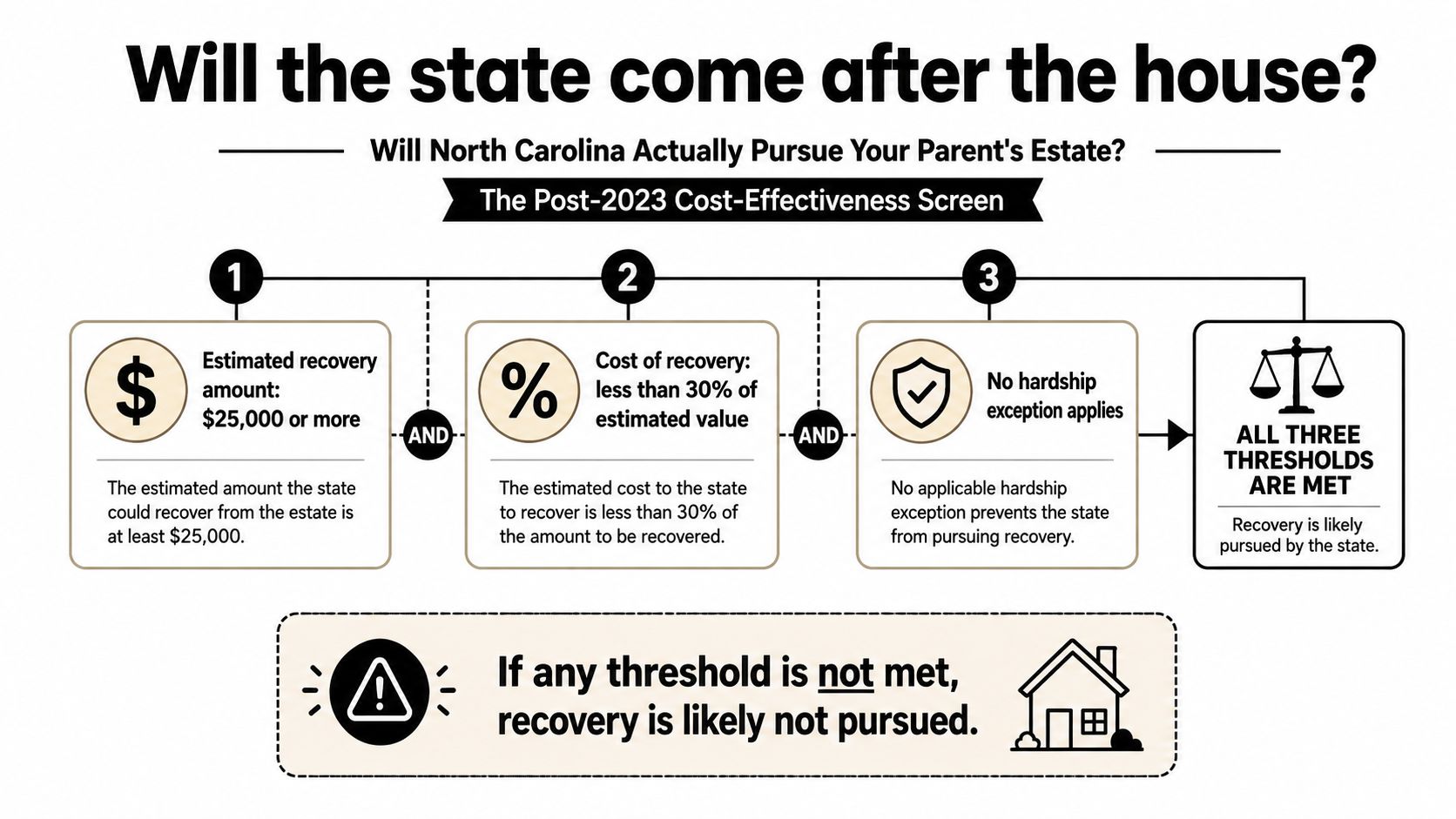
Start with the estate, not the fear. If your parent died owning a modest home in sole name, an older car, and one bank account, you still need to ask what the gross probate estate is and what the state could realistically net after costs, debts, and administration. A lot of North Carolina estates never reach the point where recovery makes economic sense for the state.
Here is the practical rule I give clients: do the probate math before you argue about exemptions. Families waste time worrying about every asset their parent ever owned. North Carolina usually cares about the estate it can reach through probate and whether the numbers justify action.
North Carolina is widely treated as a probate-only recovery state, not an expanded-estate state, under this explanation of how Medicaid estate recovery works in North Carolina. That distinction changes the answer in many cases. Assets that pass outside probate are often outside the state's usual recovery target. Joint tenancy with survivorship, payable-on-death accounts, and other nonprobate transfers can change the exposure analysis fast.
So if you are asking, “Will the state come after my parent's estate?” my answer is direct. Sometimes, yes. Often, no. If the probate estate is small, or the claim does not clear the state's screening numbers, or the valuable assets passed outside probate, the state may never pursue collection at all.
That is where your review should start. Size first. Probate exposure second. Everything else comes after that.
How Medicaid Estate Recovery Works in North Carolina
Your mother dies. You open a simple probate estate because the house and one bank account are still in her name. A few weeks later, a Medicaid notice shows up, and now the question is not theoretical anymore. It is whether the state will file a creditor claim in that estate and whether you need to fight it.
In North Carolina, estate recovery usually shows up through probate administration, not through a separate lawsuit filed out of nowhere. If an estate is opened, the personal representative handles the claim in the same file used to deal with other debts, notices, and distributions. If you need a refresher on the probate sequence, this overview of the North Carolina probate process helps place a Medicaid claim in the larger estate timeline.
The forms families often run into are DHB-5051 and DHB-5054. Those are part of the notice and review process used by the agency. What matters in practice is simple. The state reviews the recipient's Medicaid history, decides whether the services fall into a recoverable category, and then determines whether to assert a claim in the probate estate.
A Wake County style timeline
Take a common Wake County fact pattern. A father dies after receiving Medicaid-paid long-term care services. His daughter qualifies as personal representative and opens probate with the clerk of superior court because there are probate assets to administer.
From there, the estate recovery issue follows the estate file. The agency reviews the Medicaid record and, if it chooses to pursue recovery, presents its claim through the probate process. The personal representative then has to make a decision. Pay the claim if it is valid, object if the amount or service category is wrong, or raise any deferral, exemption, or hardship argument through the proper channels.
That is the part families need to understand early. This is not just a notice problem. It is a probate administration problem with deadlines.
What the family actually sees
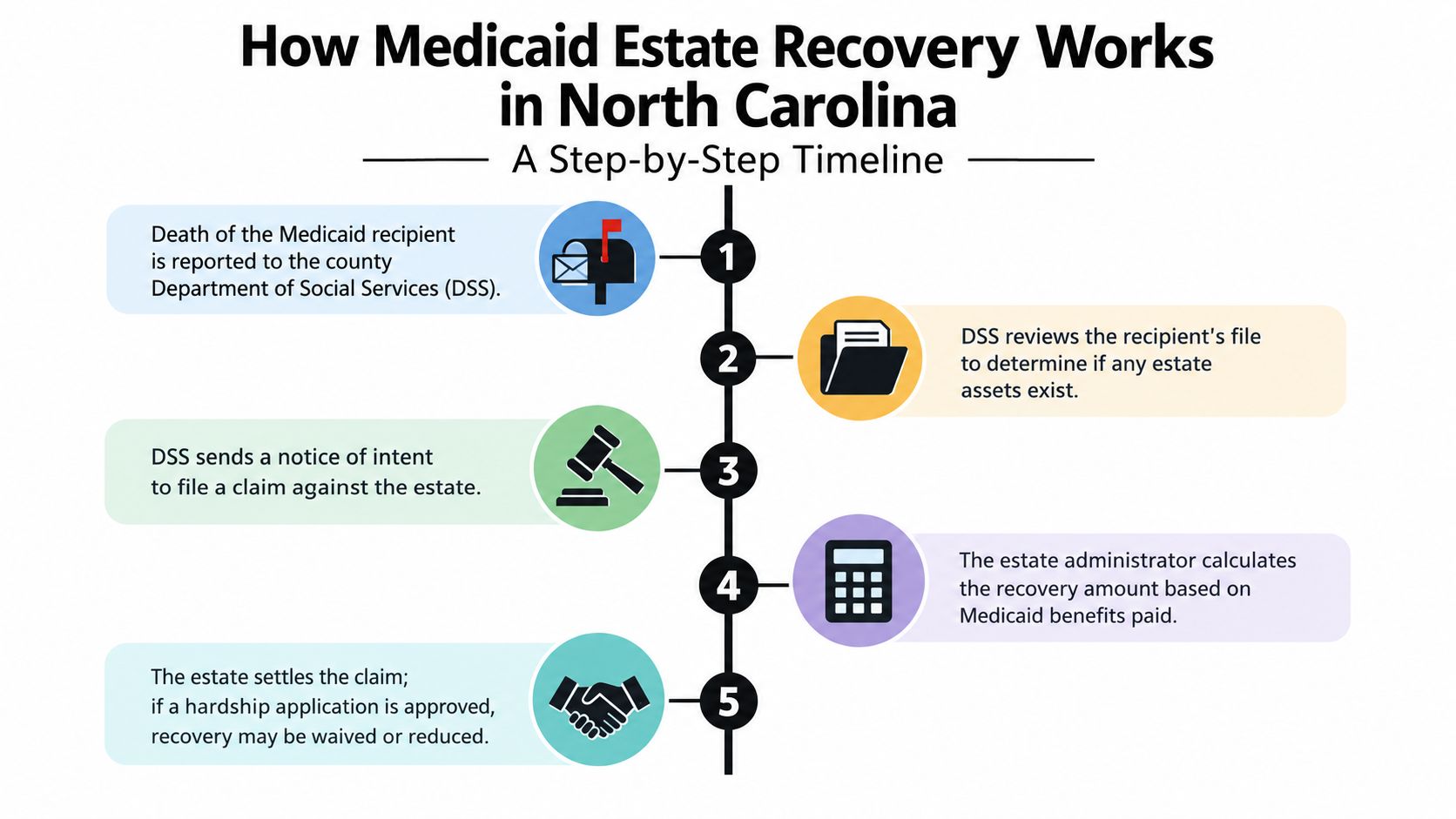
The paper trail usually looks like this:
- Death and estate opening: Someone opens probate if the deceased left assets in his or her sole name.
- Agency review: Medicaid payment history is reviewed for services that may support recovery.
- Notice and claim activity: The personal representative receives notice and may later receive a creditor claim in the estate.
- Estate response: The representative asks for backup, disputes the amount, raises a deferral or hardship issue, or pays the claim through the estate.
- Estate closing: The claim is resolved, reduced, deferred, denied, or never filed.
Later in the process, many families want a short overview before they start answering mail from the clerk, the agency, or both. This video can help frame the issue before you sort out the paperwork.
When clients say, “No one told us this was coming,” they usually mean no one explained that probate turns a private loss into a creditor process with paperwork and deadlines.
One date still matters. North Carolina's notice framework ties estate recovery to Medicaid applications or reapplications made after October 1, 1994, as noted in the state notice materials used in this process. If your family receives one of those notices, do not treat it like routine mail. Compare the claim to the probate inventory, confirm what assets are in the estate, and make the state prove the amount before the house gets listed or the account gets emptied.
What North Carolina Law Allows the State to Recover
The statute that matters most here is N.C.G.S. 108A-70.5. Read in plain English, it doesn't let the state recover “everything Medicaid ever spent.” It allows recovery for specific services and only from the estate the law permits the state to reach.
North Carolina limits its Medicaid Estate Recovery Plan to the probate estate for most recipients, and the state's claim can't exceed the amount of medical assistance paid on behalf of the recipient under N.C.G.S. 108A-70.5. That single statute answers two of the biggest client questions. What services count, and where can the state collect from?
Who is in the recovery group
The law generally reaches two groups:
- Recipients age 55 and older
- Certain institutionalized individuals of any age
That doesn't mean every dollar of Medicaid spending is recoverable. It means the state can pursue recovery for the categories the statute identifies.
What services are recoverable
Here is the cleanest way to think about it.
| What North Carolina Can Recover Under N.C.G.S. 108A-70.5 | What It Means | NC Example |
|---|---|---|
| Nursing facility services | Medicaid-paid nursing home care can be part of the claim | A Mecklenburg resident in a skilled nursing facility receives Medicaid coverage for that stay |
| ICF-IID and related institutional care | Certain institutional services for qualifying individuals are recoverable | An institutionalized adult with intensive support needs receives covered facility-based services |
| Home- and community-based services | Medicaid-funded care delivered outside a facility may be included | A Durham resident receives in-home support so she can remain at home |
| Personal care services | Hands-on daily assistance paid by Medicaid may fall within recovery | An older adult receives help with bathing, dressing, and mobility at home |
| Related hospital and prescription drug costs | Associated medical and drug costs tied to the covered category may also be claimed | A recipient over 55 has hospital treatment and prescriptions related to long-term care needs |
A lot of families get tripped up by the phrase “related hospital and prescription drug costs.” In practical terms, if the person was in the covered group and the paid services fall within the recoverable categories, those related costs may be included in the claim.
The probate piece also affects inheritance expectations. If you're trying to understand who inherits when there's no will, this overview of what intestate succession means in North Carolina helps, but it doesn't remove creditor claims. Heirs inherit what's left after valid estate obligations are handled.
Exemptions and Deferrals That Can Pause or End a Claim
You need to separate two very different ideas here. A deferral usually means the state waits. A waiver can reduce or end the claim.
That distinction matters because families hear, "the house is protected," and assume the problem is over. In many cases, it is only postponed.
North Carolina can defer estate recovery if the Medicaid recipient is survived by a spouse, a child under 21, or a blind or disabled child under the applicable standard. If one of those people exists, raise it early and prove it. Do not wait for the state to figure it out on its own.
Four protections that matter
| NC Medicaid Estate Recovery Exemptions and Deferrals at a Glance | Who Qualifies | Effect on Claim | Action Required |
|---|---|---|---|
| Surviving spouse deferral | A spouse survives the Medicaid recipient | Recovery is put on hold during that spouse's lifetime | Notify the agency and provide proof promptly |
| Child under 21 deferral | A surviving child is under 21 | Recovery is delayed while that child remains protected | Submit the child's information to the estate recovery unit |
| Blind or disabled child deferral | A surviving child is blind or disabled under the governing standard | Recovery is deferred, and in some cases blocked while that status applies | Provide medical or benefits records and make the request clearly |
| Undue hardship waiver | A family member can show hardship under agency rules | Claim may be waived or reduced | File a written waiver request with supporting evidence |
What this looks like in a real North Carolina family
A father dies after receiving Medicaid-covered long-term care services. His house is still titled in his name alone, so it lands in probate. His widow still lives there.
The state can assert its claim, but collection is generally deferred while the surviving spouse is alive. That does not mean the claim vanished. It means the file may come back later, often after the second death if the property is still exposed.
Now change one fact. The surviving child is disabled and meets the legal standard. That can stop recovery while that protection applies. For many families, that is the difference between keeping the home and having to fight over it in the estate.
Important: These protections are not automatic. If the personal representative stays quiet, misses the notice, or fails to send records, the estate can slide into a payable claim when a valid deferral or waiver was available.
The hardship waiver deserves special attention because it is the one families misunderstand most. The state is not asking whether paying the claim feels unfair. The question is whether collection would create serious hardship under the program rules.
If the home is the only place a surviving family member can live, or sale of the property would cause real financial deprivation, press the issue and document it well. Give the agency bank records, proof of income, proof of disability, housing records, and anything else that shows the actual harm. Vague statements do not help.
Here is my advice. If your family may qualify for a spouse, minor-child, disabled-child, or hardship protection, handle that before probate drifts ahead on autopilot. The strongest exemption can still be lost by poor follow-through.
Estate Planning Moves That Limit Exposure in NC
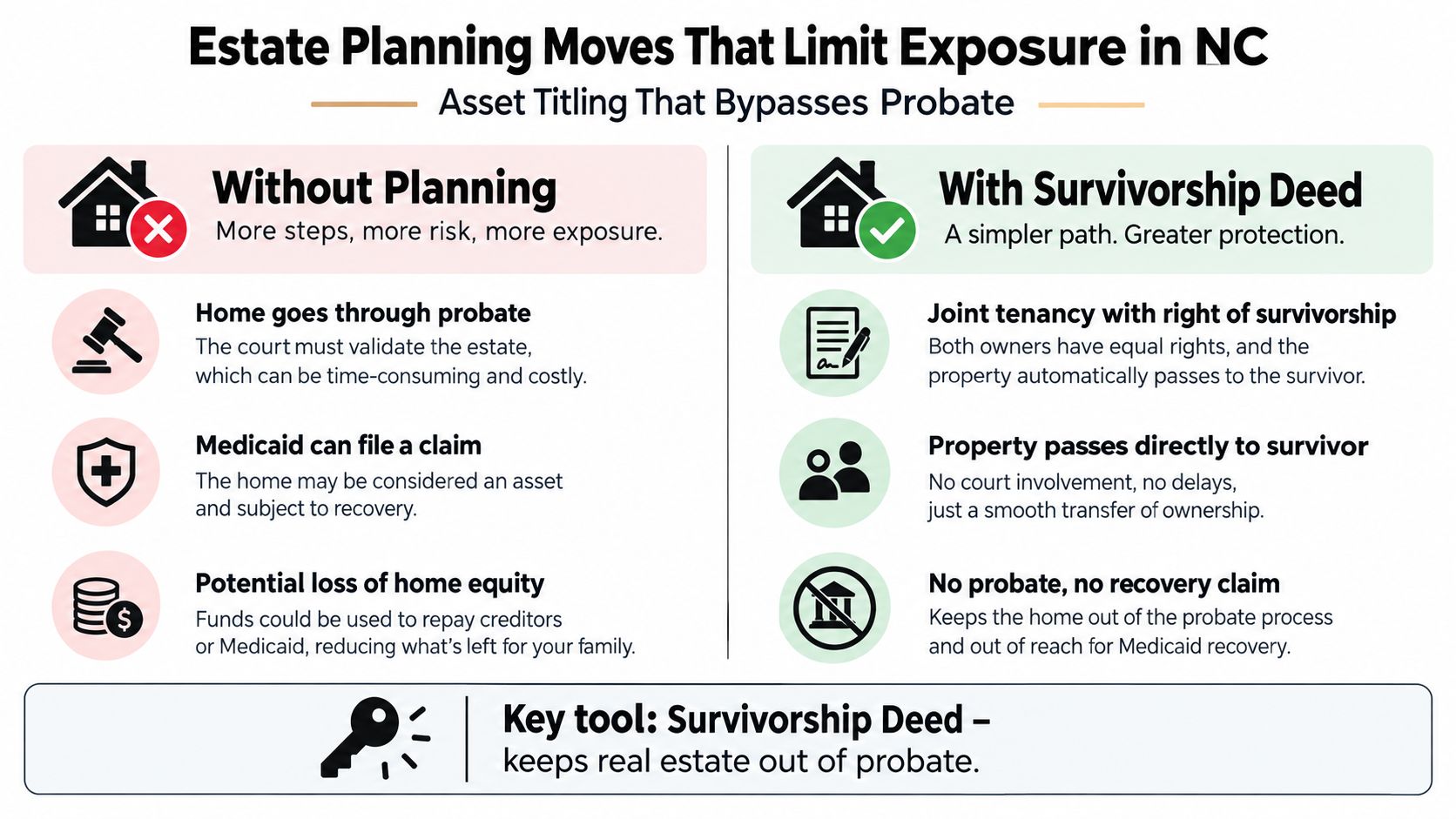
If North Carolina usually recovers only through probate, then the planning question becomes obvious. Which assets are going to probate, and which aren't?
That's why deed language, beneficiary forms, and trust funding matter so much. The law doesn't reward vague intentions. It follows title.
The tools that actually change exposure
- Joint tenancy with right of survivorship: If real estate is titled correctly, the property usually passes automatically to the surviving co-owner instead of through probate. That can keep the house outside a typical North Carolina recovery claim. The warning is timing. Transfers close to a Medicaid application can trigger transfer-penalty problems.
- Transfer on Death deed: North Carolina allows Transfer on Death deeds under Chapter 47A. They must be properly executed and recorded before death. If the deed is done correctly, the property passes outside probate.
- Beneficiary-designated accounts: Bank and brokerage accounts with valid beneficiary designations often bypass probate. Families miss this all the time because they assume the will controls everything. It doesn't.
- Ladybird deed planning: Where available and properly used in planning conversations, enhanced life estate style planning is often discussed because it may keep remainder interests outside probate while preserving control during life. This is technical work, and sloppy drafting causes problems.
- Revocable living trusts: In a probate-only state, a fully funded revocable trust can keep assets out of probate. But people get this wrong constantly. An unfunded trust is just a binder on a shelf.
The caveats people ignore
A deed to children is not a magic fix. It can create eligibility issues, tax issues, and family-control problems. If one child gets sued, divorced, or dies first, your “simple solution” can become a mess.
Revocable trusts also need a reality check. In North Carolina, the trust helps mainly because assets titled in the trust may avoid probate. It doesn't create some separate force field during the parent's lifetime. If you're weighing long-term asset protection structures, this discussion of an irrevocable trust in North Carolina is a useful companion topic.
In some families, estate planning overlaps with dependent children and guardianship concerns. Questions about Child Custody in North Carolina involve how courts apply the best interests standard, which is a separate issue, but it often comes up when a caregiver grandparent is planning for both housing and child stability.
The best estate recovery planning usually isn't flashy. It's careful retitling, updated beneficiary forms, and making sure the paperwork matches the family's actual plan.
Common Myths North Carolina Families Bring to a Consultation
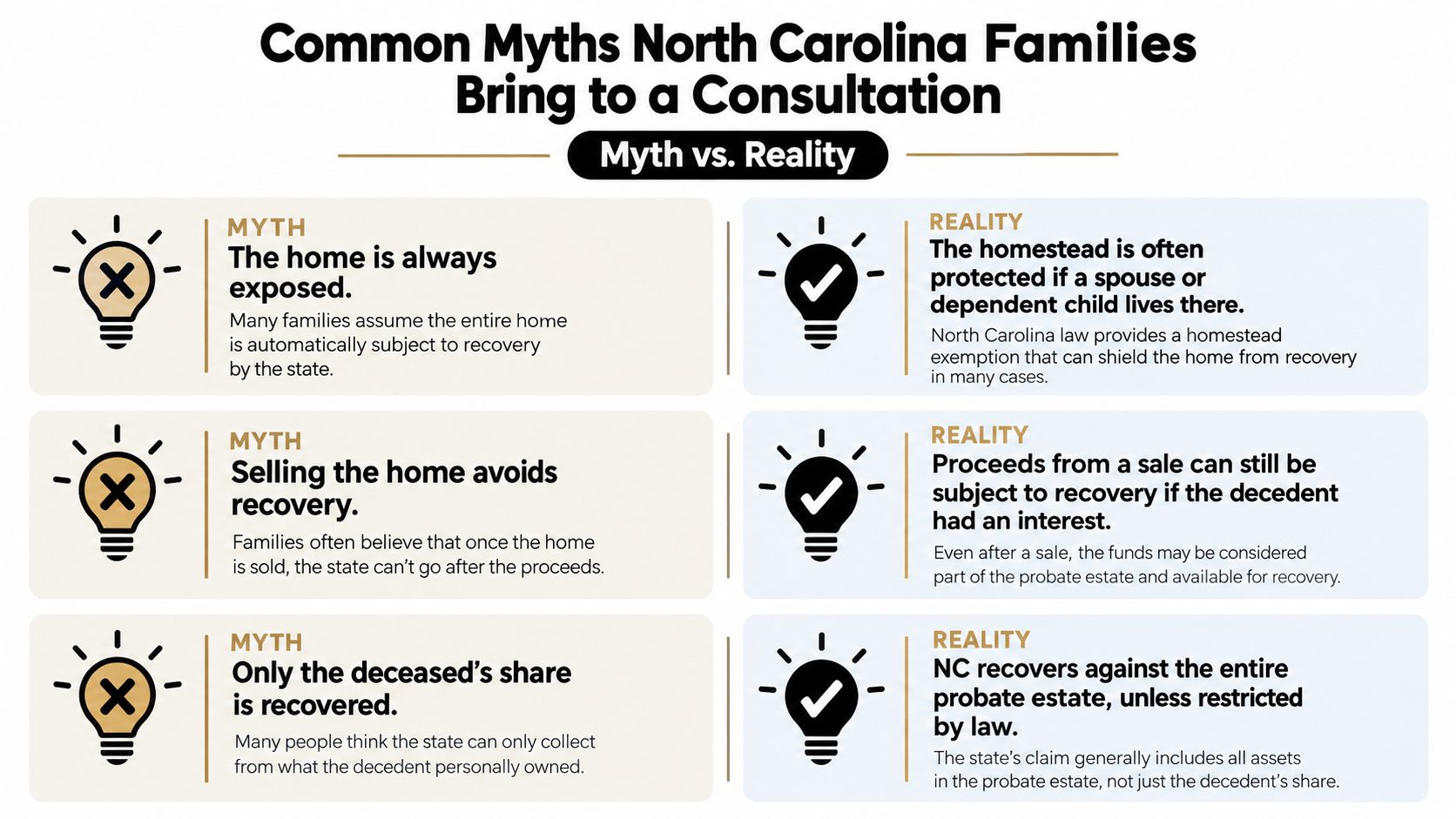
You walk into my office worried the state is about to take your parent's house. That fear is common. It is also usually based on half-true rules mixed with worst-case stories from someone's cousin.
Start with the question families should ask first. Is this estate even large enough, and probate-based enough, for North Carolina to bother pursuing recovery? If the answer is no, the rest of the panic often falls away.
Myth one and the legal reality
Myth: If Mom owns a house, the state will take it.
Reality: Title and probate status matter more than the fact that there is a house. In North Carolina, estate recovery usually reaches the probate estate, not every asset the family associates with “the estate.” The practical screen matters too. A smaller estate, or one with too little recoverable value after costs, may never become a collection target. This overview of North Carolina estate recovery thresholds and probate-only reach explains why that first exposure question matters more than families expect.
Myth two and the legal reality
Myth: Just deed the house to the kids and the problem is solved.
Reality: That is one of the fastest ways to create a new problem. A last-minute deed can trigger transfer penalties, create capital-gains consequences, expose the house to a child's creditors or divorce, and leave the parent without control. If you are going to change title, do it as part of an actual plan, not as a panic move after a nursing home admission.
Myth three and the legal reality
Myth: Medicaid will definitely file a claim.
Reality: North Carolina does not pursue every case. State policy applies cost-effectiveness screens, and recovery only makes sense if there is enough probate value to justify the effort. I tell families to stop guessing and check three things first. What assets were titled solely in the parent's name at death, whether a probate estate will even be opened, and whether the likely net recovery is large enough to get the state's attention.
Myth four and the legal reality
Myth: If Medicaid paid, the family has no options.
Reality: Families still have options after death. The claim amount can be reviewed. The estate may include assets the state cannot reach. Deferrals, exemptions, and hardship arguments may apply depending on who survived the Medicaid recipient and who still lives in the home. N.C. Gen. Stat. § 108A-70.5 and the related state recovery rules matter here because the answer turns on the family facts, not on rumor.
The blunt advice is this. Do not assume the house is doomed, and do not assume a quick deed fixes everything. In North Carolina, the first real answer comes from probate exposure, asset titling, and whether the estate is big enough for recovery to be worth pursuing at all.
How to Contest a Claim or Request a Hardship Waiver
Once a claim is filed, families usually need to choose between two tracks. Challenge the claim itself, or accept the legal basis and pursue relief through hardship or deferral. Don't blur those together. They require different proof.
When to object to the claim
Object when the numbers or legal basis don't look right. That includes situations where the claim appears to include nonrecoverable services, the probate estate is being described incorrectly, or the state's filings don't line up with the actual estate assets.
Your lawyer will usually want to review:
- The death certificate
- The DHB notice or claim paperwork
- Medicaid award or eligibility letters
- The will, if there is one
- The estate inventory and probate filings
- Recent appraisals or property tax records
- Proof of a surviving spouse's or child's income and assets
- Account statements showing how title was held at death
If you're in Wake, Mecklenburg, or Buncombe County, the basic document list is the same. County practice may differ at the margins, but the core analysis doesn't.
When to request hardship relief
The hardship route is different. You're not saying, “The state is legally wrong.” You're saying, “Even if the claim is legally allowed, recovery would create genuine hardship and shouldn't go forward as filed.”
That argument works best when the facts are concrete. A survivor still living in the home. No realistic replacement housing. Serious financial vulnerability. Property burdened by debts that make a forced sale destructive rather than productive.
Get probate and planning counsel aligned
Families lose ground here. The probate lawyer, the Medicaid-planning lawyer, and the personal representative need to be working from the same facts. If one person says the asset was probate property and another says it passed outside probate, you've created your own fight.
Law Office of Bryan Fagan handles estate planning and probate guidance for North Carolina families, which makes this the kind of issue that often needs coordinated review rather than a one-off phone call.
Bring the deed, the beneficiary forms, and the agency notice to the first meeting. Those three items usually tell more of the story than the family's assumptions do.
NC FAQs and a Consultation-Focused Path Forward
Can the family home be protected from Medicaid estate recovery in NC
Yes, often. The strongest protection usually comes from making sure the home doesn't pass through probate in the first place, using the right deed or trust structure under North Carolina law. But timing matters, drafting matters, and a last-minute transfer can create a different Medicaid problem.
Does North Carolina file a lien on the home while the recipient is alive
Generally, North Carolina estate recovery is a post-death probate claim, not a routine during-life lien against the home itself. Families often expect an immediate recorded claim on the property the moment a parent goes into care. That usually isn't how this issue shows up in practice.
How long does the state have to file a claim
The state still has to function within the probate claim process. Once an estate is opened, creditor deadlines and estate administration procedures matter. If the estate is already in motion, don't assume delay helps you. It can just shrink your response time.
Does a small estate avoid recovery
Often, yes. When the probate estate is too small to make recovery worthwhile under the state's own screening rules, the state may decline to pursue the claim. That's why the first questions should be about probate exposure and estate size, not generalized fear.
Where should North Carolina families turn next
Start with a lawyer who handles probate and elder-law planning in North Carolina. If you need help finding one, the North Carolina State Bar Lawyer Referral Service is a sensible starting point. Legal aid resources for older adults can also help in the right case. If the estate includes a home, survivorship issues, beneficiary designations, or a trust, bring the actual documents. Don't rely on memory.
If you're facing Medicaid estate recovery NC, the worst move is waiting for the estate to drift forward while the family argues over what they think the deed says. Get the paperwork reviewed early, get the probate posture clear, and make decisions from the title records and the statute, not from rumor.
If your family is dealing with a Medicaid claim against a North Carolina estate, Law Office of Bryan Fagan offers probate and estate-planning guidance that can help you sort out what's exposed, what may pass outside probate, and whether a deferral, objection, or hardship request makes sense. If you want clear answers tied to North Carolina law instead of guesswork, visit Law Office of Bryan Fagan and schedule a consultation.