
Yes, you can move out during separation in North Carolina, and in many cases one spouse must move to a different residence for the legal separation period to begin. But moving out is not just a housing decision. It can affect your timing for divorce, your position in custody disputes, your finances, and whether the other side later accuses you of abandonment.
If you're reading this while sleeping in the guest room, staying with a relative for a few nights, or wondering whether leaving the house will hurt your case, you're asking the right question. Clients often assume the answer is simple: leave if the situation is tense, stay if you want to protect the house. North Carolina law is more nuanced than that. The move itself may be necessary, but the way you handle it matters.
The Critical Decision to Move Out During a North Carolina Separation
In North Carolina, an absolute divorce generally requires spouses to live separate and apart for at least one year and one day, and that clock does not start if you're just living in different rooms of the same house. One spouse must move to a different residence with the intent to remain apart, as explained in this discussion of North Carolina divorce separation requirements.
That legal rule answers the question many people search for as "can you move out during separation NC." Yes, you can. Sometimes you must. But clients get into trouble when they treat moving out like a personal decision instead of a strategic legal step.
What works and what doesn't
What usually works is moving with a plan. That means you know where you'll live, how you'll pay your bills, how parenting time will work, and what records you need before you leave.
What doesn't work is storming out after an argument, taking only a duffel bag, and assuming everything else can be sorted out later. That approach often creates confusion about possessions, childcare, household expenses, and who has access to important documents.
Practical rule: If you're going to move out, act like every decision made in the first few days may matter later in a custody, support, or property dispute.
A common example is a parent who leaves to reduce conflict in the home. That's often understandable and sometimes wise. But if that parent leaves without a temporary parenting routine, the other parent may quickly become the child's primary day-to-day caregiver. Courts pay attention to real-life routines. If you create a new status quo by accident, it can be hard to undo.
The real question to ask
The better question isn't only "Can I move out?" It's "How do I move out without giving up advantage, exposing myself financially, or creating avoidable custody problems?"
That is where legal advice matters.
What Legally Constitutes Separation in North Carolina
Many people think separation starts when the relationship feels over, when one spouse says it's over, or when someone files a paper in court. In North Carolina, separation is more concrete than that.
Legal separation begins when spouses live in different residences and at least one spouse intends the split to be permanent. No court filing is required, and only one spouse needs to move out for the separation clock to start. A separation agreement can help define the terms, but it is enforceable only if it is written, signed, notarized, and made while the parties are already living separately, as outlined in this explanation of legally binding separation agreements in North Carolina.
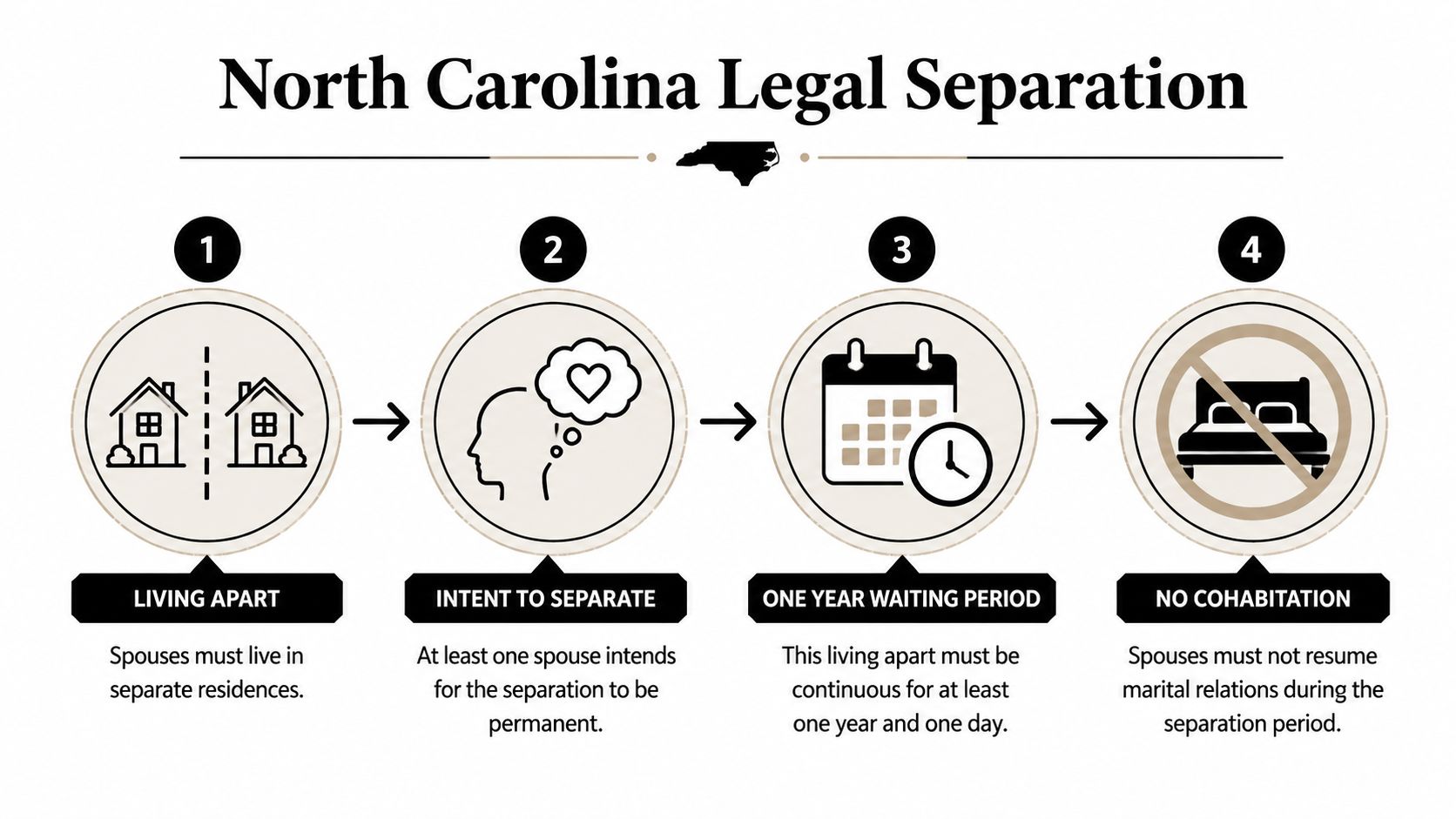
Two facts must exist at the same time
A valid separation usually turns on two core facts:
- Different homes: One spouse has moved to another residence. Staying under the same roof usually won't start the legal clock.
- Intent to separate: At least one spouse intends the separation to be permanent.
Those two facts matter more than labels. Calling yourselves separated doesn't make it so if you're still sharing the same residence.
A simple example
Suppose a husband moves into an apartment and tells his wife the marriage is over. He changes his mailing address, keeps living there, and does not move back in. In that situation, the legal separation period generally starts when he moved into the apartment with the intent to remain apart.
By contrast, if spouses sleep in separate bedrooms for months but keep living in the same home, that usually does not start the separation period required before an absolute divorce filing.
What a separation agreement does, and what it doesn't do
A separation agreement does not create the separation by itself. The living arrangement and intent do that.
What the agreement can do is set out practical rules for life after the move, such as:
- Who pays which bills
- Who stays in the home
- How parenting time will work
- Whether support will be paid
- How certain assets or debts will be handled for now
If you want a plain-language overview of the concept itself, this guide on what legal separation means in North Carolina is a useful starting point.
Separation in North Carolina is a condition, not a court filing.
That distinction matters because people often wait too long to document their move, or they sign a draft agreement before they're living apart and assume they're protected.
Impact on the Marital Home and Equitable Distribution
One of the biggest fears I hear is simple: "If I leave, do I lose the house?" Usually, no. Moving out during separation does not itself erase property rights in North Carolina. Both spouses generally retain equal rights to the marital home until a court orders otherwise, even if only one name is on the deed, according to this discussion of marital home rights after one spouse moves out.

Ownership and possession are not the same thing
Clients often get confused: Ownership rights and possession of the home are different issues.
You may still have a claim to the home's value even after you move out. But your spouse may gain practical advantage by remaining there, especially if the children continue living in that home and daily life becomes centered there.
A short comparison helps:
| Issue | What moving out usually means |
|---|---|
| Title or ownership claim | Usually not waived simply because you left |
| Right to argue over value and division | Usually preserved |
| Daily control of the property | Often shifts to the spouse who remains there |
| Leverage in temporary possession disputes | Can become weaker if you leave without a plan |
If you want more detail on how North Carolina divides marital assets, this resource on equitable distribution in North Carolina provides a helpful overview.
Where leverage is actually lost
A primary risk is often a negotiating advantage, not forfeiture. Courts can award temporary exclusive use of the home in certain circumstances, especially when children need stability, the home is unsafe, or one spouse lacks alternative housing.
That means the spouse who stays in the house may later argue:
- the children should remain where they are already settled,
- the current arrangement is working,
- changing possession would disrupt stability.
Leaving the house doesn't usually give away your property rights. It can, however, make temporary possession much harder to recover.
A practical example
Suppose a wife moves out quickly because arguments in the home have become unmanageable. She does the right thing for her peace and safety, but she leaves without taking financial records, discussing household expenses, or addressing who will live in the home long term. Months later, the husband argues that the children should stay in the same home and school routine, and that he should continue using the house exclusively. Her ownership claim may still be intact, but her day-to-day negotiating position is weaker.
That is why timing, documentation, and temporary agreements matter so much.
How Moving Out Can Affect Child Custody Arrangements
When children are involved, moving out can change the case more quickly than almost anything else. The court's focus in custody disputes is the child's best interests, and judges look closely at the child's actual routine, not just each parent's intentions.

The status quo problem
If one parent moves out and no clear parenting plan is put in place, a new normal can develop very fast. The children may start sleeping most nights with the parent who stayed in the home. That parent may begin handling school mornings, homework, meals, activities, and medical appointments.
Once that routine is established, the other side may present it as the arrangement the court should preserve.
This doesn't mean moving out ruins your custody case. It means you should not move out without thinking through how parenting time will be exercised immediately.
A common scenario
A father leaves the marital home because conflict has become constant and he doesn't want the children exposed to arguments. He believes he's doing the responsible thing. But he stays with a sibling across town and only sees the children when the other parent agrees. After several weeks, the children are functioning on a routine built almost entirely around the mother's household.
If a custody dispute starts at that point, the court may view the mother's home as the established base solely because that is what has been happening in practice.
Steps that usually help
Before or at the time of the move, try to address the following:
- Parenting schedule: Put in writing when the children will be with each parent.
- School logistics: Decide who handles pickups, homework, activities, and communication.
- Medical decisions: Keep access to doctors, records, and emergency contacts clear.
- Daily contact: If overnights won't happen immediately, preserve regular and meaningful contact.
For parents dealing with a move that may affect parenting arrangements, this page on relocation and custody issues in North Carolina can help frame the risks.
Here is a short video that can help you think about custody and family law strategy during separation:
If you leave to protect your children from conflict, make sure your actions also protect your role in their daily lives.
What not to do
Don't assume informal access will stay generous once tensions rise. Don't rely on vague promises like "we'll work it out later." And don't move far enough away that school-night parenting becomes unrealistic unless you've thought through the consequences.
Judges don't reward a parent for staying in the home. But judges do pay attention to which parent is consistently present and involved after separation begins.
Could Your Move Be Considered Marital Abandonment
Many spouses hesitate to leave because they've heard, often from friends or online forums, that moving out equals abandonment. That is not automatically true.
In North Carolina, abandonment is defined as leaving without cause or justification, without consent, and with no intent to return. It usually does not stop a no-fault divorce, but it can matter as marital misconduct in claims involving alimony and post-separation support, as discussed in this explanation of abandonment under North Carolina divorce law.
Why this issue matters
People often focus only on whether they are "allowed" to move out. The harder question is whether the move can later be framed as wrongful.
That argument can come up when one spouse says the other:
- left without agreement,
- cut off support,
- acted without justification,
- intended to end the marriage and household obligations unilaterally.
When risk goes up
The risk is usually greater when a spouse leaves suddenly, offers no explanation, provides no support where support had been expected, and leaves behind children or major responsibilities without a clear plan.
A move may be easier to defend when the facts show a legitimate reason, such as serious conflict, a mutual understanding that separation is happening, or a documented effort to reduce harm to the children.
Moving out to begin separation is not the same as desertion. The details around consent, justification, and intent are what create the dispute.
Practical ways to protect yourself
You don't need dramatic legal language. You need a clear factual record.
Consider documenting:
- Why you're leaving: Keep communications calm and factual.
- What happens next: State where you'll live and how you'll handle parenting and bills.
- Whether the move is agreed to: Save texts or emails if your spouse consents.
- Your conduct after moving: Continue appropriate involvement with children and finances where required.
A short written message often helps more than a long emotional one. For example, a spouse may write that the move is intended to reduce conflict, start a period of living separately, and allow both parties space while parenting arrangements and finances are addressed. That kind of record won't guarantee how a judge views the facts, but it is far better than silence.
A Practical Checklist Before You Relocate
Clients often call me after the lease is signed, the truck is booked, and the first argument about the children has already started. That is late. The better time to make this move is before you leave, while you still have access to records, a chance to set expectations, and room to avoid mistakes that can be used against you later.

Moving out changes your daily life immediately. It does not automatically change your legal or financial exposure. If your name is still on the mortgage, lease, utilities, or joint debt, the company owed money can still pursue you. A written agreement can help organize who pays what between spouses, but it does not rewrite the contract with the lender or utility provider. As noted earlier, North Carolina spouses often use a separation agreement to sort out these responsibilities while larger property issues are still being resolved.
Your pre-move checklist
Copy the financial record before access gets harder: Save recent bank and credit card statements, tax returns, pay stubs, retirement statements, loan balances, and records showing major assets and debts. If one spouse controls the household paperwork, getting clean copies later can become expensive and time-consuming.
Take the documents you may need on short notice: Gather passports, birth certificates, Social Security cards, insurance cards, medication information, and school or childcare records if children are involved. Keep digital copies in a secure account you alone can access.
Inventory the home before you leave: Photograph furniture, electronics, jewelry, firearms, collections, and other significant property. Also save screenshots showing account balances and recent transactions. This is often what prevents a property dispute from turning into a credibility fight.
Review every joint bill and account: Know what is on autopay, what is jointly titled, and what has your personal guarantee attached to it. Do not assume moving out ends your responsibility.
Set out a short written parenting schedule if children are involved: Include pickup times, overnights, school transportation, activities, and phone or video contact. Judges care about stability. A parent who leaves with no workable plan often starts at a disadvantage.
Be careful with any out-of-state move: Relocating across state lines can complicate service, scheduling, and custody procedure. If children are involved, get legal advice before the move, not after.
Problems people create for themselves
The first is leaving without preserving evidence. In the moment, it may feel easier to walk out with a suitcase and deal with the rest later. Later is when passwords change, items disappear, and each side remembers the finances differently.
The second is treating the move like a clean financial break. It usually is not. Stopping contributions to household expenses overnight can create pressure on support issues and make settlement harder, even when there are good reasons for the move.
The third is underestimating how the move will look in a custody dispute. If you relocate far away, accept a housing setup that does not work for the children, or leave day-to-day parenting undefined, the other side may argue that you created instability. That does not mean you should stay in a bad situation. It means the move should be planned with the custody case in mind.
Who should be involved before you go
Depending on the facts, useful help may include:
- A family law attorney to assess timing, property exposure, support issues, and any risk that your move will be framed as abandonment.
- A financial professional if the marriage involves business income, unusual assets, or questions about tracing separate and marital property.
- A counselor or parenting professional if communication has broken down and the children are caught in the middle.
- The Law Office of Bryan Fagan if you need a North Carolina family law firm to evaluate the legal consequences of moving out before you act.
A rushed move can solve one immediate problem and create three new ones. A planned move protects your position on property, parenting, and procedure.
Frequently Asked Questions About Separation and Moving Out
Can I force my spouse to move out of the house in North Carolina
Usually, one spouse cannot order the other out without legal authority. In some situations, a court may order a spouse to leave, especially in domestic violence cases through a protective order. In fault-based circumstances, a spouse may also seek relief through a divorce-from-bed-and-board claim. Whether that applies depends heavily on the facts.
Do I need a separation agreement before I move out
No. A separation agreement is not required to start living separately in North Carolina. But if you want enforceable written terms about finances, support, or other obligations, the agreement needs to be in writing and notarized. For many families, having those terms settled before or soon after the move avoids confusion.
What happens if I move out of state during separation
Moving out of state can create procedural complications. It may affect where papers must be served and whether North Carolina can decide related issues such as property division, alimony, custody, or support. It can also complicate emergency requests and parenting schedules if children are involved. This is an area where getting case-specific advice early matters.
If my spouse helps pay for my new apartment, does that stop the separation period
Financial help does not by itself undo a separation. The key issue is whether you are living in different residences and whether at least one spouse intends the split to be permanent. Support between spouses can continue during separation without automatically meaning the separation has ended.
Protect Your Future with a Strategic North Carolina Separation Plan
Moving out during separation in North Carolina is legally possible, and often necessary, but it should never be handled casually. The move can affect when you can file for divorce, how a custody pattern develops, how the marital home is treated in practice, and whether the other side tries to frame your actions as abandonment.
The right move depends on your facts. If children are involved, the timing and structure of parenting time matter immediately. If money is tight, ongoing responsibility for joint debts can follow you after you leave. If emotions are high, poor documentation can create disputes that were avoidable.
You don't need to have every answer before the separation starts. You do need a plan that protects your rights and reduces unnecessary risk.
If you're weighing whether to stay, leave, or move across town or across state lines, speak with a North Carolina family law attorney before you make the decision final.
If you're facing separation, divorce, custody concerns, or questions about moving out in North Carolina, the Law Office of Bryan Fagan can help you evaluate your options and build a practical legal strategy. Schedule a consultation to discuss your situation, protect your rights, and make your next step with clearer guidance.