One parent gets a job offer in South Carolina. The other still lives in Charlotte. Or your child went to stay with the other parent in Virginia for the school term, and now you're hearing, “I'm filing there.” If you're searching for custody if parents live in different states in NC, you're probably not looking for abstract legal theory. You want to know where the case belongs, whether North Carolina can still help, and what to do before the situation gets worse.
Interstate custody disputes feel personal because they are. A state line can suddenly affect school decisions, travel, holiday schedules, and even whether you can get in front of a judge quickly. Parents often assume the answer depends on who moved first or which state seems more convenient. In North Carolina, that's usually not the controlling issue.
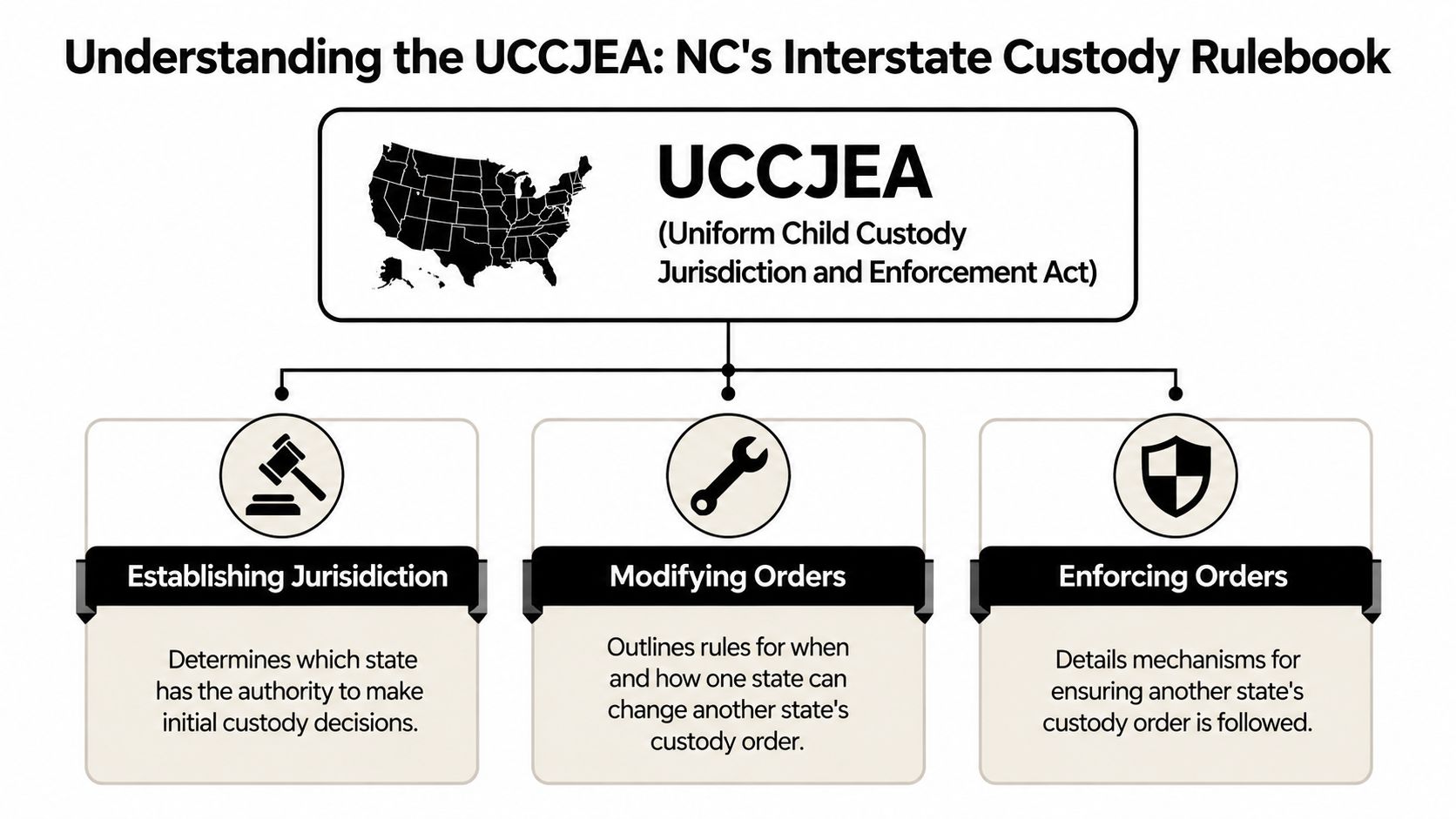
The main question is jurisdiction. In plain English, that means which court has the legal authority to make the custody decision. For interstate cases, North Carolina courts look to a law called the Uniform Child Custody Jurisdiction and Enforcement Act, usually shortened to UCCJEA.
Navigating Custody When a State Line Divides Your Family
A common version of this problem looks like this: the parents separated in North Carolina, one parent remained here, and the other moved with the child for work or family support. Another version is even more urgent. A child has been living in another state for a short time, and one parent wants to file in North Carolina before the legal ground shifts.
That timing matters more than most parents realize.
North Carolina courts don't decide interstate custody disputes by asking which parent has the stronger preference. They ask which state has authority under the jurisdiction rules. In practice, that means dates, addresses, school enrollment, medical records, and the child's living pattern can matter as much as the conflict itself.
Practical rule: In interstate custody cases, the calendar often drives the result before the judge ever reaches the parenting dispute.
The good news is that these cases aren't random. The rules were designed to stop parents from racing to different courthouses in different states and getting conflicting orders. Once you understand the timeline, many of the moving parts start to make sense.
Parents also tend to bundle several legal questions into one. They ask, “Can NC hear my case?” when they may really mean one of three different things:
- Starting a new case when there isn't a custody order yet
- Enforcing an existing order after the other parent stops following it
- Changing an older order because the move has made the old schedule unworkable
Those are not the same legal problem. They often have different answers.
If you're dealing with custody if parents live in different states in NC, the fastest way to reduce confusion is to build a simple timeline. When did the child live in North Carolina? When did the child leave? Does a parent still live here? Is there already a court order from another state? Those facts usually tell you whether North Carolina is the right place to act now, whether you need to register an order first, or whether another state still controls the case.
Understanding the UCCJEA North Carolinas Rulebook for Interstate Custody
A parent often calls after a move and asks a fair question: “My child is in another state now, so does North Carolina still have any say?” The answer usually starts with the UCCJEA, the set of jurisdiction rules North Carolina courts use in interstate custody cases.
Its job is straightforward. It tells courts which state gets to make custody decisions, when another state must defer, and when a court can step in only for a short-term emergency. That structure helps prevent dueling custody cases and conflicting orders.
North Carolina follows the same basic interstate framework used by almost every other state. That is why custody orders can usually be recognized and enforced across state lines, even though the parents now live far apart.
The home state rule
The central concept is the child's home state. Under the UCCJEA, that usually means the state where the child has lived with a parent or a person acting as a parent for at least six consecutive months before the case is filed, with temporary absences generally not breaking that period, as described in the North Carolina Bar child custody guidance. If the child is younger than six months, the analysis usually focuses on where the child has lived since birth.
For an initial custody case, that rule usually decides where filing should begin. A parent who leaves North Carolina with the child does not usually create a new filing state overnight just by crossing the border and filing first.
That said, the six-month timeline is only the starting point. In practice, parents often miss a second question that matters just as much. Is the case about the first custody order, the enforcement of an existing order, or a request to change an older order? Under the UCCJEA, those are different jurisdiction problems, and they can point to different states.
For parents reviewing North Carolina child custody laws, this is the part to keep clear early. A strong facts case on parenting time or decision-making does not help much if it is filed in a court that lacks authority to act.
Why parents get tripped up
I see the same mistake often. Parents assume that once the child has lived somewhere new for six months, the old state is automatically out of the case.
That is not always true.
For an initial determination, the child's recent residence usually controls. For a modification, the state that entered the original custody order may keep authority longer than parents expect, especially if a parent still lives there or the court has not formally given up jurisdiction. For enforcement, the question can be even more practical. North Carolina may be able to enforce an order from another state even when North Carolina does not have the power to rewrite it.
Those distinctions drive strategy and timing. Filing in the wrong state can cost months, increase legal fees, and leave a parent stuck arguing procedure instead of custody.
Emergency jurisdiction is different
North Carolina courts can also exercise temporary emergency jurisdiction in limited situations. If the child is physically present in North Carolina and needs immediate protection because of abuse, abandonment, or a comparable safety threat, a judge here may enter a temporary order.
Parents need to treat that for what it is. Emergency jurisdiction usually addresses immediate danger. It usually does not give North Carolina permanent control over the full custody case.
That difference matters in real life. A parent may properly come to North Carolina for safety, get a temporary order, and still need to address long-term custody in another state that keeps continuing jurisdiction. Understanding that split early can prevent a false sense of security and help you choose the right next filing.
Which State Has Jurisdiction A Practical Guide for NC Parents
Dates tell this story better than legal labels. When parents ask about custody if parents live in different states in NC, I usually urge them to lay out the child's living history month by month. That often answers the first question before anything is filed.
Scenario one, the recent move out of North Carolina
A child lived in Raleigh for years. Two months ago, one parent moved with the child to Tennessee. The other parent still lives in North Carolina and wants to file now.
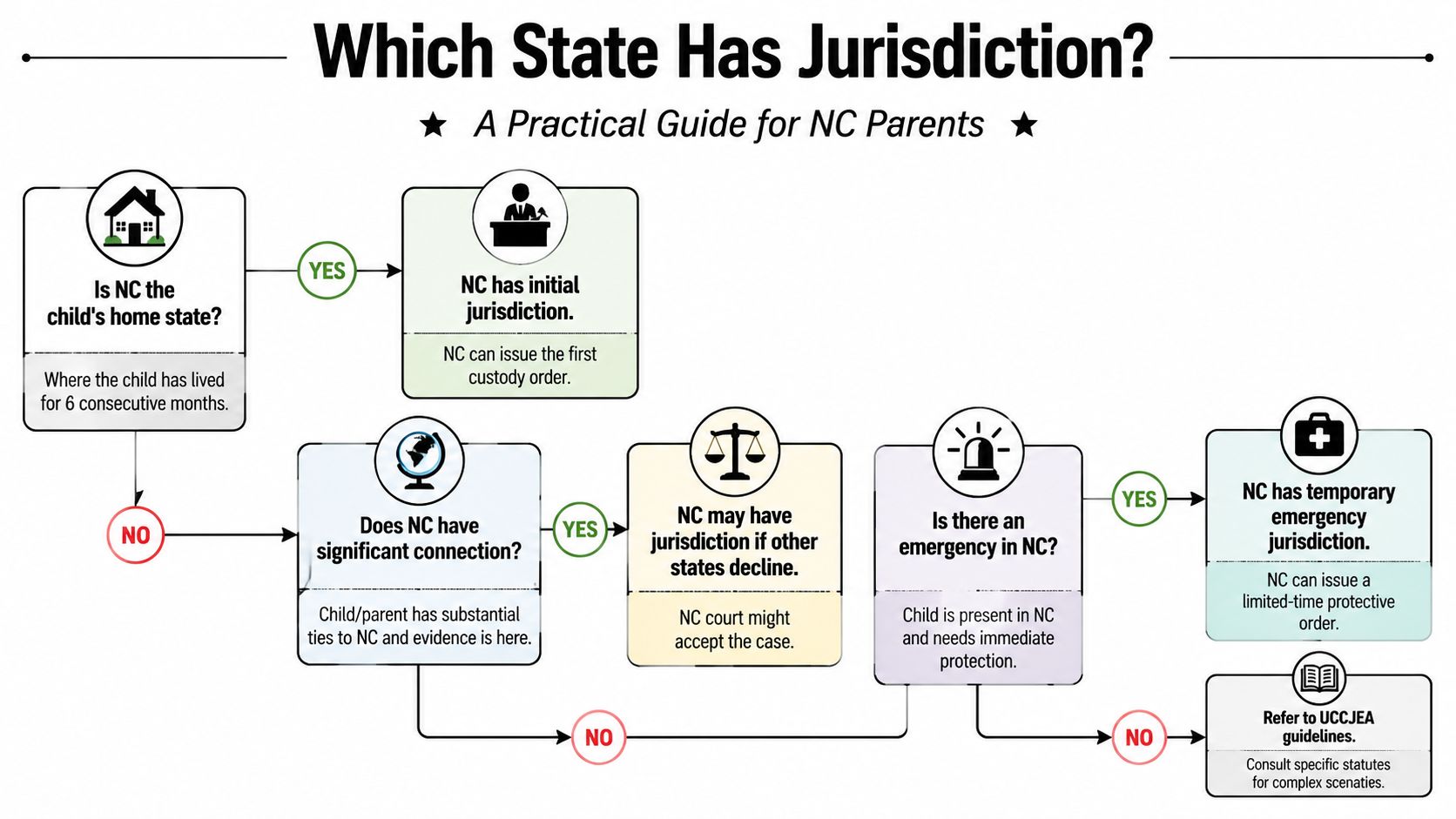
North Carolina may still be able to hear the case if NC was the child's home state within the prior six months and one parent continues to live here, as explained in this discussion of filing after recent residence in North Carolina. This is one of the most important timeline rules for recently relocated families.
That window can close. Waiting too long may shift the case to the new state.
Here's a visual way to think through the issue before filing.
Scenario two, the child moved into North Carolina recently
Now change the facts. A parent and child moved from Florida to North Carolina three months ago. There is no North Carolina order yet, and the other parent remains in Florida.
Many parents assume they can file in North Carolina immediately because they now live here. Often that's wrong. If the move is still recent, the prior state may remain the proper forum for the initial custody case. North Carolina may be on track to become the correct forum later, but “later” can matter a lot in litigation.
Impatience can result in expensive mistakes. Filing in North Carolina too early can lead to delay, dismissal, or a fight over which state should proceed.
Scenario three, military or work relocation with temporary absences
A parent in the military is stationed elsewhere for a period, or a parent takes the child out of state for a defined temporary assignment. Families often ask whether that breaks North Carolina's connection.
Not always. Temporary absences do not automatically reset the timeline. The details matter. Was the move intended to be short-term? Did the child remain tied to North Carolina doctors, school plans, or a permanent residence? Was the out-of-state stay more like travel, or more like a settled relocation?
If your child's living arrangement spans two states, labels like “visit” or “temporary” won't decide the issue by themselves. The court will look at the actual timeline and the child's real-life pattern.
A simple filing checklist
Before choosing North Carolina or another state, gather:
- Residency dates for every address where the child has lived
- School records showing enrollment and attendance
- Medical records identifying where the child regularly receives care
- Existing court papers from any prior custody case
- Travel details if the child's absence from NC was meant to be temporary
That timeline often reveals whether North Carolina has a current basis to hear the case, whether NC had it recently and still may act, or whether another state should handle the first filing.
How to File a Case or Register an Order in North Carolina
Parents often use the same words for two very different tasks. “I need to file custody in North Carolina” might mean you need to start a brand-new case. It might also mean you already have an order from another state and need North Carolina to recognize it.
Those are separate processes, and choosing the wrong one wastes time.

Filing a new custody case in North Carolina
If North Carolina is the proper state for an initial custody case, the process usually starts with filing a complaint in the appropriate North Carolina court. The exact paperwork and local procedures can vary by county, but the practical work is similar in most cases.
You'll usually need to prepare and organize:
- A clear residency timeline showing why North Carolina has jurisdiction
- Basic child information about where the child has lived and with whom
- Any related cases involving custody, domestic violence, or juvenile issues
- A proposed parenting structure if temporary arrangements are needed soon
If you're also facing an immediate care issue, you may need to ask whether temporary relief is available. Some parents also review guidance on how temporary custody issues are handled in North Carolina before deciding what to request first.
Registering an order from another state
If you already have a valid custody order from Georgia, Virginia, South Carolina, or another state, you usually do not start over in North Carolina just because you moved. Instead, the practical first step is often to register that out-of-state order here.
Registration matters because it gives North Carolina a formal basis to recognize and enforce the existing order. That can be important if the other parent is denying visitation, refusing exchanges, or acting as if the move erased the prior court order.
A typical registration package may include a certified copy of the order and supporting filings required by the clerk. Local practice matters, and even small filing errors can slow enforcement when time is already tight.
What tends to work and what doesn't
What works is matching the procedure to the problem. If there's no prior order and NC has jurisdiction, file a new custody action. If there is already an order elsewhere, look closely at registration and enforcement before talking about modification.
What usually doesn't work is walking into court and telling the judge that the old order should no longer apply because everyone's lives have changed. Courts generally want the proper procedural step first.
For parents who want case-specific direction, a North Carolina family lawyer, the clerk's office, or firms such as the Law Office of Bryan Fagan may help identify whether your next move is filing, registration, enforcement, or a request to modify in the proper state.
Modifying vs Enforcing an Interstate Custody Order in NC
Often, interstate custody cases become complicated. A parent says, “I need North Carolina to do something about this order.” The next question should be, “Do you need the court to enforce the order, or do you need the court to change it?”
Those are very different requests.
Enforcement means follow the order already in place
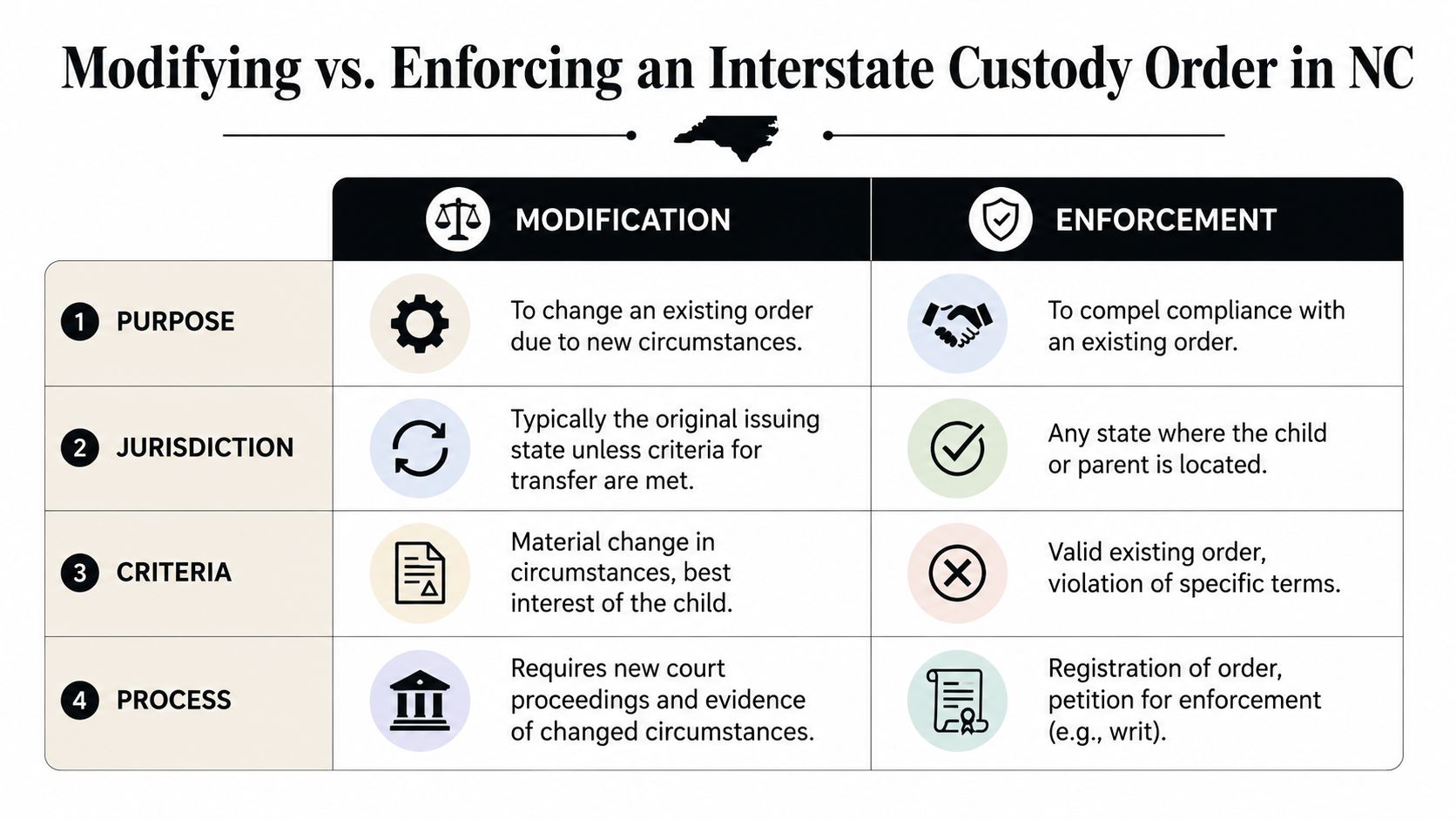
Enforcement is about compliance. The order already exists. One parent is not doing what it requires.
Examples include:
- Refusing scheduled visitation
- Keeping the child beyond the ordered return time
- Ignoring holiday or transportation terms
- Blocking communication that the order requires
North Carolina can typically register and enforce another state's valid custody order. That gives parents a practical remedy without relitigating the entire case.
Modification means change the terms
Modification is different. You are asking the court to alter the schedule or decision-making terms because the current order no longer fits the family's reality.
A long-distance move often creates this issue. A schedule built around midweek dinners, short exchanges, or frequent overnights may no longer work once the parents live states apart. At that point, parents usually need a new plan that addresses travel, school calendars, summer time, holiday rotation, and who handles transportation.
That is not enforcement. That is a request to rewrite the order.
Why North Carolina often cannot modify right away
A major point of confusion is that North Carolina may be able to enforce another state's order but still lack power to modify it. North Carolina can only modify if the original state has lost its continuing, exclusive jurisdiction, often because all parties have moved away, as explained in this discussion of out-of-state custody orders and modifications.
The old state doesn't lose control just because the order has become inconvenient.
That means a parent may have to do one of two things. Enforce the existing order in North Carolina while returning to the issuing state to request changes, or show that the issuing state no longer has the legal connection needed to keep modification authority.
For parents considering whether the old order can be revised, it helps to understand how custody modification works before deciding where to file.
A side-by-side view
| Issue | Enforcement | Modification |
|---|---|---|
| Main purpose | Make a parent obey the current order | Change the current order |
| Typical problem | Missed visitation, denied exchanges, noncompliance | Relocation, school changes, unworkable schedule |
| North Carolina's role | Often can act after registration | May be limited if another state still controls modification |
| Evidence focus | What the order says and how it was violated | Why the existing arrangement no longer works |
In real life, both issues often appear together. A parent may be violating the order and the order may also be outdated. The legal path still matters. Courts usually want you to identify which problem you're asking them to solve.
Common Pitfalls to Avoid in an Interstate Custody Case
A common timeline goes like this. One parent moves first because of work, family help, or housing. The child starts spending more time in the new state. A few months pass, conflict grows, and then someone files in the state that feels most convenient. By that point, the filing state may be wrong, the old order may still control, and the parent who moved may be defending avoidable allegations instead of focusing on the child.
The biggest mistake is treating jurisdiction as something to sort out after the move. In interstate cases, timing shapes almost everything. A parent who relocates with a child without consent, without a court order, or without checking which state still has authority can turn a manageable dispute into an emergency enforcement fight.
Another costly error is confusing relocation, enforcement, and modification. They are related, but they are not the same problem. A parent may believe, "We live here now, so this state can change the order." Often, North Carolina can enforce an existing order after proper registration while a different state still keeps the power to modify it.
Mistakes that hurt parents most often
- Moving without a filing strategy. A reasonable reason for relocating does not fix a jurisdiction problem.
- Filing where life is easier instead of where the law allows. Convenience is not the test.
- Assuming the old order faded out after the move. It usually remains in effect until a court changes it.
- Waiting through a recent move without getting advice. A few months can change which court has the strongest claim to hear the case.
- Mixing enforcement facts with modification facts. Missed exchanges prove one problem. A schedule that no longer fits the child's life proves another.
- Keeping weak records. In an interstate case, dates matter. Proof matters more.
What helps is a disciplined timeline. Start with move dates, school enrollment, medical visits, exchanges, missed returns, and every court filing in either state. Add texts, emails, travel records, lease documents, and report cards. In practice, judges and lawyers often answer interstate custody questions by lining up dates before debating motives.
Courts decide interstate custody issues by looking at where the child has lived and what order is in place, not by rewarding the parent who sounds more frustrated.
Parents also get into trouble by waiting for the other state to "let go" on its own. Sometimes that happens. Sometimes it does not. If one parent still lives in the issuing state, or the child still has significant ties there, that state may keep control over modification longer than either parent expects.
Early action usually creates better options. Late action usually leaves parents arguing over damage control.
North Carolina Interstate Custody FAQ
Can I file in North Carolina if my child just left the state?
Sometimes, yes. A recent departure doesn't always end North Carolina's role. The answer usually depends on how long ago the child left, whether North Carolina was the home state shortly before filing, and whether a parent still lives here.
What if the other parent won't return my child after an out-of-state visit?
Treat that as an enforcement problem first. Gather the existing order, document the missed return, preserve messages, and speak with counsel promptly about enforcement steps in the proper court. If there is an immediate safety concern, emergency options may also need review.
Can North Carolina change an order from another state?
Not automatically. North Carolina may be able to enforce the order here while lacking authority to rewrite it. Whether NC can modify it depends on whether the issuing state still has continuing authority over the case.
Does it matter which parent moved?
Sometimes factually, yes. But jurisdiction usually turns more on the child's living pattern and the existing order than on whose reason for moving sounds more persuasive. The timeline is usually more important than the storyline.
Can child support be handled differently from custody?
Yes. Support and custody are related in family life, but they follow different interstate rules. A relocation that changes parenting time can affect support, yet the support order and the custody order may involve different procedures and even different jurisdiction questions.
If you're dealing with an interstate parenting dispute, quick assumptions can cause lasting damage. The safer approach is to get a case-specific review of the child's residency timeline, any existing orders, and whether your issue is really a new filing, enforcement action, or modification request. The Law Office of Bryan Fagan works with North Carolina families on custody and post-separation disputes, including cases involving relocation and out-of-state parents. Schedule a consultation to discuss your options under North Carolina law and build a strategy that fits your facts.