Yes, you can negotiate a divorce settlement in North Carolina, and in practice you usually should. About 95% of divorce cases are resolved through settlement or mediation rather than a contested trial, and North Carolina's rules are built to push many cases toward structured negotiation instead of immediate courtroom litigation.
If you're at the point where you're asking whether you have any say in how your divorce turns out, that question usually comes with a lot of pressure behind it. You may be worried about the house, your retirement, parenting time, support, or how to get through the process without making a costly mistake. The good news is that North Carolina law gives you room to negotiate nearly every major issue connected to divorce.
That matters because divorce here is not just one filing. In North Carolina, the core issues can include property division, alimony, child support, custody and visitation, and the divorce itself. Some of those issues can be resolved by consent, and some may need a judge if no agreement is reached. For many people, the smartest path is to negotiate from a position of preparation, not fear.
Yes You Can Negotiate Your NC Divorce Settlement
You have been separated for a few months. The house is still in both names, the retirement accounts are larger than the checking account, and you and your spouse both want a parenting schedule that works. In that situation, the first major decision is rarely whether a judge will take over everything. The primary question is how to use North Carolina's process to reach an agreement before a court has to decide the details for you.
In this state, negotiation is not a backup plan. It is the path the system is built around. North Carolina's rules on property division, custody, support, and mediation give spouses a structured way to work through disputes and resolve them by agreement. If you want a practical overview of how property division sets the stage for settlement, start with this explanation of equitable distribution in North Carolina.
What negotiation means in a North Carolina divorce
Negotiation means deciding, issue by issue, whether you and your spouse can reach terms you are both willing to sign and live under. That may happen through attorney settlement discussions, mediation, or a collaborative process. The format matters less than the goal. You keep more control over the outcome than you would at a hearing.
That control has limits, and clients need to understand them early. You can negotiate many terms, but an agreement still needs to be legally sound, specific enough to enforce, and realistic enough to survive the first real conflict after divorce. A weak settlement often creates more expense later.
Common negotiation formats include:
- Attorney-led settlement discussions: Lawyers exchange proposals, supporting documents, and draft terms.
- Mediation: A neutral mediator helps both sides work toward resolution.
- Collaborative process: Both spouses commit to resolving the case outside court through a formal settlement process.
Practical rule: Good negotiation is not about giving up. It is about trading uncertainty for defined terms you can enforce.
Why settlement is usually the smarter starting point
For most clients, attempting to settle is a strategic advantage.
A judge can divide property, set support, and enter custody orders. A negotiated settlement can do something more useful. It can address the practical-life details that make the result workable. For example, one spouse may keep the home for a set period so the children can remain in the same school, while the other receives a larger share of another asset or a later buyout. Courts can enter practical orders, but negotiated agreements usually leave more room for timing, tradeoffs, and problem-solving.
Timing matters too. In North Carolina, spouses generally must live separate and apart for at least 12 months before an absolute divorce is granted, and a residency requirement applies to the filing spouse under the North Carolina State Bar's overview of the divorce process in North Carolina. That separation period often gives spouses time to resolve property, support, and parenting issues in an orderly way instead of waiting for a contested hearing.
The larger point is simple. North Carolina law is designed to channel many divorce disputes into structured negotiation first. Used well, that process can protect assets, reduce conflict, and produce terms that fit your family better than a one-size-fits-all ruling.
The Legal Framework for Negotiation in North Carolina
A common client question is whether settlement talks are optional or whether the court expects them. In North Carolina, the system is built to push many divorce issues toward negotiation before a judge decides them. That is especially true for property division and, in many cases, custody.
The core property statute is equitable distribution under N.C.G.S. § 50-20. Equitable distribution does not require a perfect 50/50 split of each asset. It starts from the idea that marital property should be divided fairly, with the court able to consider whether an unequal division is justified based on the facts of the marriage. If you want a fuller explanation of the rules, see what equitable distribution means in North Carolina.
Equitable does not always mean equal
North Carolina's framework gives spouses room to make practical trades. One spouse may keep the house and refinance within a set period. The other may receive a larger share of retirement funds, cash, or another asset to balance the overall division. That kind of problem-solving fits the statute well because the law focuses on fair overall results, not identical line-by-line splits.
That point matters in real cases. A family business, restricted stock, a pension, or a house with low-interest financing may be worth more in one spouse's hands than if a court forces a blunt division. Negotiation lets the parties address tax impact, timing of sale, debt payoff, and buyout terms in a way a trial court often handles more generally. For a broader look at the topic, see Equitable Distribution of Property in North Carolina.
Mediation is built into the process
North Carolina also uses mediation to structure settlement efforts, not just to encourage them. An equitable distribution claim generally must go through court-ordered mediation before it can be set for trial. That changes the strategy from deciding whether to negotiate to preparing well enough to negotiate from a position of strength.
Custody disputes are often routed into mediation too, unless an exception applies. The practical effect is clear. North Carolina family law is designed to narrow issues, test settlement options, and reserve trial for the cases that cannot be resolved.
You may not want to negotiate. The court system still expects serious settlement efforts in many divorce cases.
The strategic takeaway
Preparation usually decides whether negotiation helps or hurts. A spouse who shows up without account statements, property values, debt balances, or a clear proposal is already giving ground. A spouse who understands which assets are marital, which are separate, how they are valued, and what a court is likely to do has far more control over the outcome.
That is why I tell clients to treat negotiation as part of the legal process itself. In North Carolina, it usually is.
Common Methods for Negotiating Your NC Divorce Settlement
Not every couple should use the same process. The right method depends on communication, complexity, and conflict level.

Direct attorney-to-attorney negotiation
This is often the cleanest option when both spouses are able to act reasonably but want legal protection around the details.
Each side works through counsel. Proposals are exchanged. Documents are reviewed. Disputes get narrowed issue by issue. This method works well when the finances are understandable and both sides are motivated to settle without a formal mediation session.
A common example is a couple with regular employment income, a home, retirement accounts, and no business interests. They may disagree about timing or division, but not about basic disclosure. In that setting, direct negotiation can move steadily.
Mediation
Mediation is useful when communication is difficult but resolution still feels possible. The mediator is neutral and does not decide the case. The mediator's job is to help both sides evaluate proposals, test assumptions, and keep discussions productive.
For many North Carolina families, mediation is not just helpful. It's part of the expected path. If you're weighing that option, this overview of divorce mediation in North Carolina explains how the process typically works.
A practical example is parents who can't discuss a custody schedule calmly on their own but both want to avoid a courtroom hearing. In mediation, they may be able to separate legal issues from personal frustration and work through a parenting plan.
Collaborative divorce
Collaborative divorce is different from ordinary negotiation because it is designed around a shared commitment to resolve the case outside court. It can also include neutral professionals. In North Carolina, collaborative processes can involve financial specialists or child specialists to improve information quality and reduce conflict, particularly in complex cases, as discussed in this explanation of mediation, arbitration, and collaborative divorce tools.
That can be especially helpful in higher-asset cases. If one spouse owns a business, or if support and parenting issues are tightly connected, neutral experts can keep the conversation anchored to shared data instead of accusation.
| Method | Usually works best when | Main challenge |
|---|---|---|
| Direct attorney negotiation | Communication is workable and finances are not heavily disputed | Progress can stall if one side delays disclosure |
| Mediation | The couple needs structure and a neutral setting | A mediator can't force agreement |
| Collaborative divorce | The case is complex and both sides want a team-based process | It requires buy-in from both spouses |
If your spouse turns every conversation into a fight, don't confuse direct contact with productive negotiation. In that situation, structure matters more than optimism.
Key Issues on the Negotiation Table in North Carolina
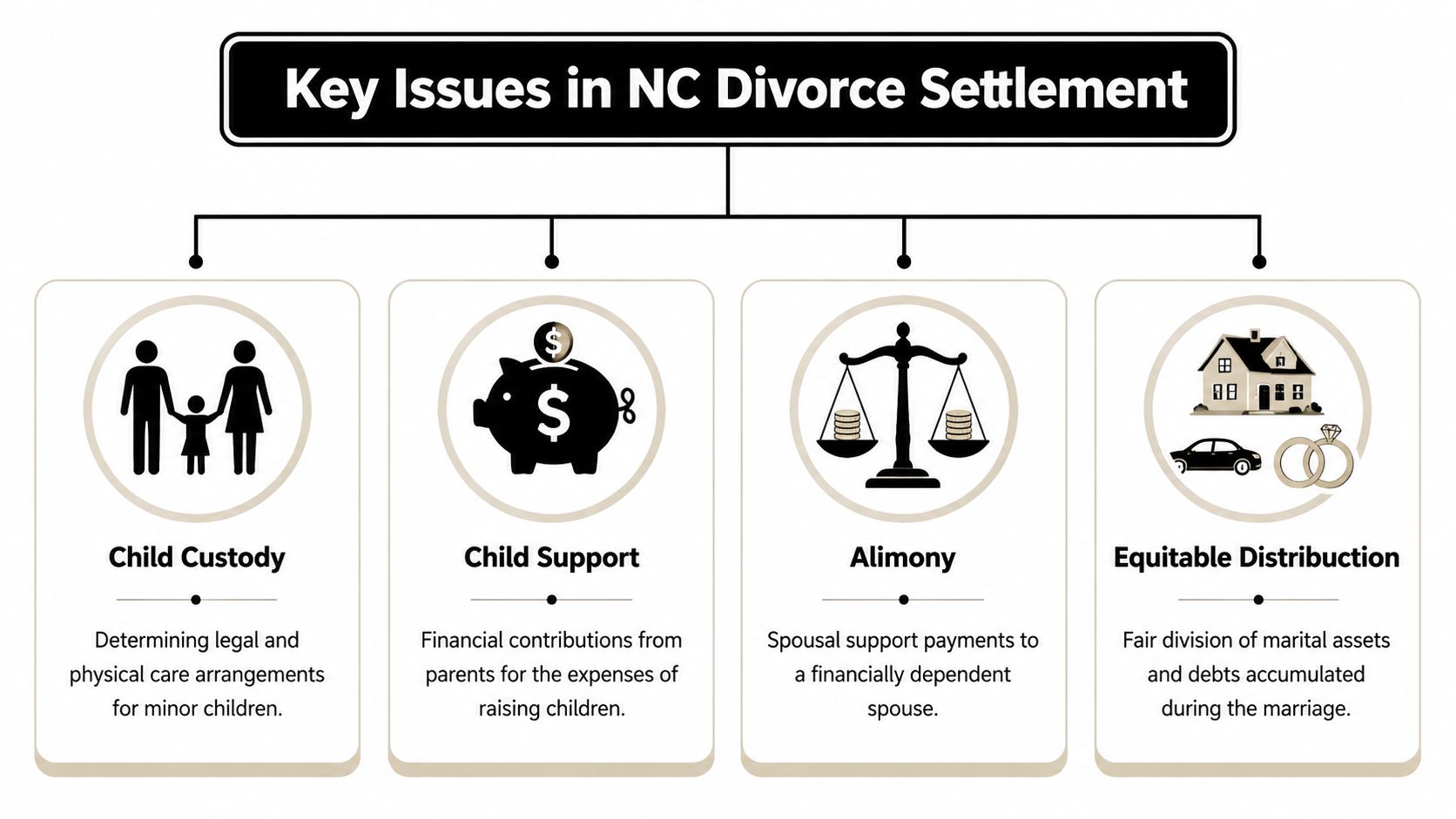
A North Carolina divorce settlement usually turns on a small group of major issues. If you know what belongs on the table, negotiations become less overwhelming.
Equitable distribution
This is the division of marital assets and debts. The first question is usually classification. What is marital, what is separate, and what value should each item carry?
A practical negotiation might sound like this: one spouse wants to keep the marital home, while the other prefers retirement assets and freedom from the mortgage. That can be a workable deal if the values are properly understood.
Alimony and post-separation support
This is financial support from one spouse to the other. The legal and strategic questions often focus on need, ability to pay, and what arrangement is realistic after separation.
In real terms, a negotiation might involve whether support is paid monthly for a period of time, whether another property trade changes the support discussion, or whether a larger asset allocation reduces the need for ongoing payments.
Child custody and visitation
Custody includes both decision-making and parenting time. Some parents only focus on overnights, but strong agreements also address school decisions, holidays, transportation, communication, and what happens when conflict arises.
For example, parents might agree that one parent has primary weekday responsibility during the school year while the other has extended summer time and defined holiday periods.
Child support
Child support addresses the financial needs of the children. Even where support guidelines apply, the surrounding details still matter. Parents often need to resolve health insurance, uncovered medical expenses, school-related costs, and activity expenses.
A common sticking point is assuming child support answers every money question involving the children. It usually doesn't. Clear drafting matters.
Divorce itself
North Carolina treats the actual divorce judgment separately from the related financial and parenting claims. That distinction catches people off guard.
A spouse may be ready to end the marriage legally, while property, support, or custody issues are still being negotiated. If those claims are not handled correctly, rights can be affected. Timing matters.
A good settlement isn't just about what each person gets. It's about whether the written terms actually solve the problems that will come up next month and next year.
Your Step-By-Step Guide to Preparing for Negotiation
Preparation changes outcomes. In North Carolina divorce negotiations, the spouse with the better information usually has the stronger position.
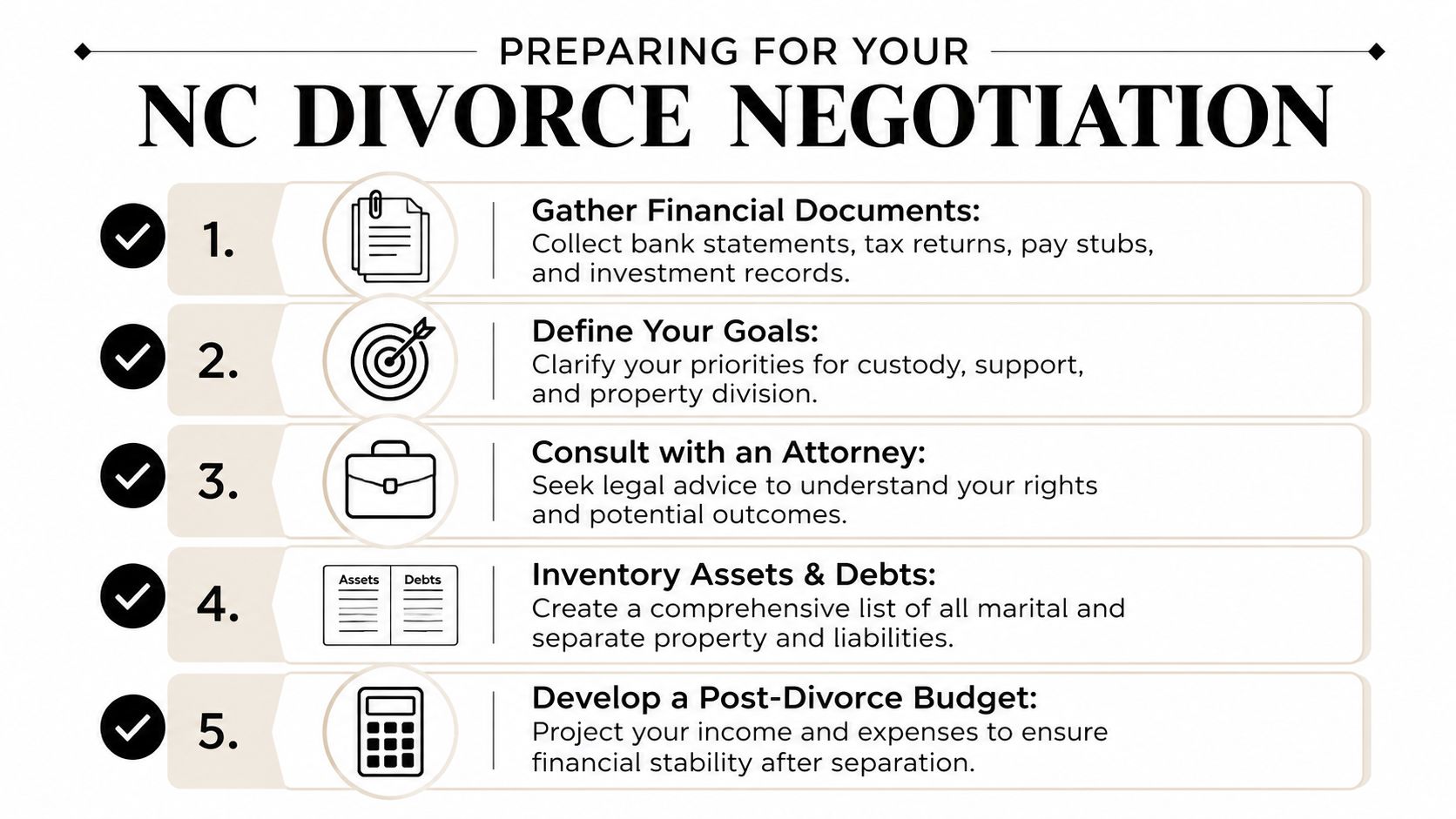
Start with the one step that is not optional: a complete financial inventory. Effective divorce negotiation in North Carolina begins with a full inventory of marital and separate property, debts, and valuations. Negotiation power is driven by valuation quality, and incomplete numbers allow the other side to anchor proposals around bad information, as explained in this discussion of divorce negotiations and financial inventory.
Build the file before you build the argument
Don't start by debating fairness. Start by gathering proof.
- Collect account records: Bank statements, retirement statements, loan balances, and credit card records help establish what exists.
- Identify major property: Real estate, vehicles, business interests, and investment accounts need current information, not guesses.
- Separate marital from separate claims: Some property may not be divisible in the same way, and that can change the whole negotiation.
If you're getting ready to meet counsel, this guide on how to prepare for a divorce consultation in NC is a practical starting point.
Know what you want and why
Some clients say they want everything to be "fair" but can't define their priorities. That makes negotiation harder.
Write down what matters most. Maybe it's staying in the same county as your children. Maybe it's protecting retirement funds. Maybe it's avoiding a support structure you can't realistically maintain. Your priorities won't eliminate compromise, but they will help you recognize smart compromise.
A short example helps. If keeping the house is your top goal, ask whether you can refinance, maintain it, and carry the taxes and upkeep on your post-separation income. A house can feel like security and still become a burden.
Here's a practical resource to review as you think through expectations:
Pressure-test your position
Before you reject an offer or make a demand, ask three questions:
- Can I prove the facts behind my position?
- Would a judge necessarily see this the way I do?
- Does this proposal help me live well after the divorce, or just feel better today?
Reality check: Strong negotiation is not stubbornness. It's knowing which points are worth pressing and which points only increase cost and delay.
Choose the process that fits the case
An organized spouse with a cooperative co-parent may do well in direct negotiation. A high-conflict custody case may need structured mediation. A business owner or high-asset spouse may need a collaborative approach with financial input.
The right process won't fix dishonesty or coercion, but it can reduce the chance that chaos controls the case.
Finalizing and Enforcing Your North Carolina Settlement Agreement
A handshake is not enough. A text exchange is not enough. An informal "we agreed" conversation is not enough.
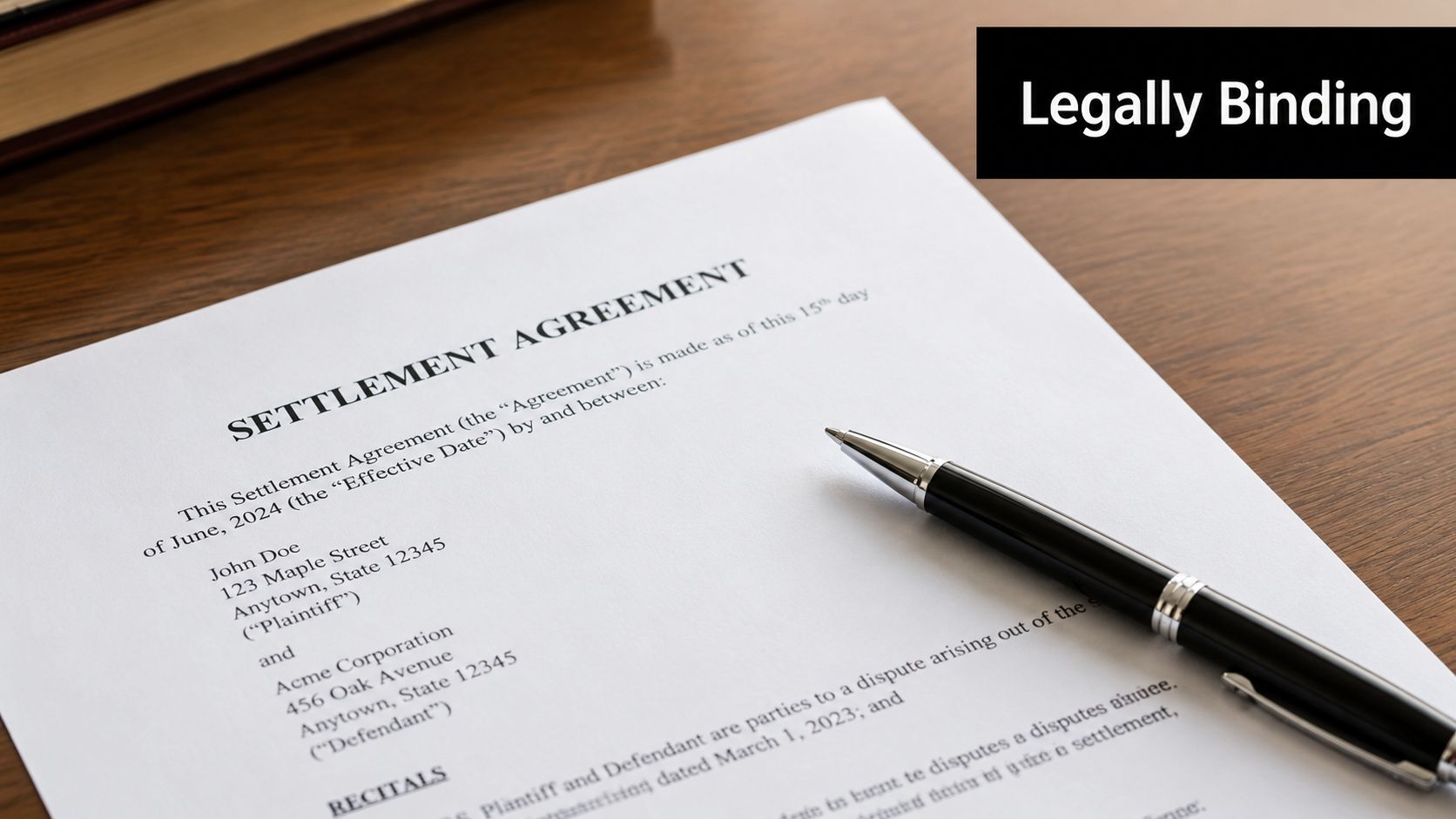
In North Carolina, a negotiated divorce settlement is not legally binding until it is put into a signed written document, and for many terms to be enforceable through the court's contempt powers, the agreement must be incorporated into a formal court order, as explained in this overview of divorce resolution and enforceable agreements.
From discussion to signed agreement
Usually, the terms need to be reduced to a written settlement document. In many cases, that takes the form of a Separation Agreement and Property Settlement. The document should spell out each obligation clearly enough that both parties know exactly what is required.
Vague language causes future disputes. If one spouse is supposed to refinance the home, the document should address timing, cooperation, and what happens if refinancing does not occur. If custody terms are agreed, the schedule should be specific.
When a court order matters
Some terms may also need to be turned into a consent order or another enforceable court order. That step is important because there is a real difference between a private agreement and an order a judge can enforce.
For a client, the practical point is simple. Winning the negotiation is only half the job. Finalizing it correctly is what gives the settlement legal force.
- Get it in writing: No side deals.
- Review every clause carefully: The small details often become the big fight later.
- Confirm enforceability: Ask whether a term should remain contractual, be incorporated into an order, or both.
A well-drafted agreement protects you long after the emotions of the negotiation have passed.
NC Divorce Negotiation FAQs and Your Next Steps
What happens if we can't agree on everything
You do not have to settle every issue at once. Some couples resolve property but not custody. Others settle custody and support but continue litigating financial claims. Partial agreements can still narrow the dispute and reduce cost.
If settlement fails on a major issue, the unresolved matter may be heard by the court. Even then, negotiation often continues in the background.
Can I negotiate my divorce settlement without a lawyer
You can, but that doesn't mean you should. The biggest risk is not noticing what has been left out, valued incorrectly, or drafted too vaguely to protect you later.
This is especially true where retirement accounts, real estate, support, or children are involved. Many mistakes happen because someone thinks they are agreeing to a simple term when they are giving up a larger right.
How long does divorce negotiation take in North Carolina
There is no single timeline that fits every case. Some cases move quickly because both spouses exchange information promptly and focus on practical solutions. Others slow down because property values are unclear, emotions are high, or one side refuses to engage productively.
North Carolina's separation requirement also affects timing. Many spouses negotiate key terms during that separation period rather than waiting for a final court decision.
Can we settle before the divorce is final
Yes. In many cases, spouses negotiate and sign agreements during separation, then finalize the divorce itself later when the legal timing requirements are met.
That approach can create stability earlier, especially around finances and parenting. It also gives both sides a clearer path forward.
The most useful answer to "can you negotiate divorce settlement NC" is yes, and the North Carolina system is largely built around that reality. The critical issue isn't whether negotiation is available. It's whether you enter that process informed, prepared, and protected.
If you're considering divorce or legal separation in North Carolina, the Law Office of Bryan Fagan handles family law matters involving divorce, equitable distribution, child custody, child support, and spousal support. A consultation can help you assess what is negotiable, what needs immediate protection, and how to build a strategy for settlement or litigation based on your specific facts.