When seeking answers about divorce with children under 18 in North Carolina, you're probably not looking for abstract legal theory. You're trying to figure out what happens to your kids, where they'll live, how bills will get paid, and whether you have to wait a full year before anything can be done.
That confusion is common. Many parents assume nothing can happen until the divorce is final. In North Carolina, that's not how it works. The final divorce has its own timing rules, but custody, parenting schedules, and child support often need attention much earlier.
For most families, the hardest part isn't only the legal paperwork. It's making steady decisions while emotions are high and the children still need routine, stability, and reassurance. A workable plan during separation often matters just as much as the final judgment.
Navigating Your North Carolina Divorce with Children
Parents usually come into this process carrying two separate worries at once. One is the marriage ending. The other is the day-to-day reality of raising children while the legal case unfolds.
Those worries deserve different answers. The end of the marriage follows one legal track. The children's schedule, support, and decision-making follow another. Keeping those tracks separate helps reduce panic and leads to better planning.
A practical roadmap usually starts with these questions:
- Where are we in the separation process: North Carolina requires a waiting period before an absolute divorce can be filed, so the timing of your household transition matters.
- Do we need immediate rules for the children: If parents are disagreeing about exchanges, school decisions, or overnights, waiting for the final divorce usually isn't the right move.
- What records should we start gathering: Income documents, childcare costs, health insurance information, and a proposed parenting schedule become important quickly.
- Can we resolve anything by agreement: Some families can settle parenting and support issues early. Others need court involvement sooner.
Practical rule: Parents who treat the separation year as planning time, not dead time, usually put themselves in a stronger position.
In a North Carolina case involving minor children, the legal system is trying to answer a straightforward question: what arrangement serves the child's best interests while protecting each parent's rights. That sounds simple, but it becomes more manageable when you break it into parts. Custody determines authority and parenting time. Child support addresses financial responsibility. The divorce itself ends the marriage.
That distinction matters because one missed assumption can create avoidable problems. A parent may think, "We'll handle the child issues in the divorce." Sometimes that works. Sometimes it doesn't, especially when nothing has been properly requested before the final hearing. Careful timing is what keeps that from happening.
North Carolinas Foundational Divorce Requirements
A common early mistake is assuming nothing meaningful can happen until the year of separation ends. That is not how North Carolina family cases work. The marriage cannot be formally dissolved until the legal waiting period runs, but parents often need custody, parenting schedules, support, and day-to-day ground rules well before then.
North Carolina allows an absolute divorce after spouses have lived separate and apart for a full year, and one spouse must have lived in North Carolina for at least six months before filing. If you want a closer explanation of how the clock is counted, this guide on the North Carolina one-year separation rule for divorce covers the timing in more detail.

What separate and apart usually means
In most cases, spouses need to live in different homes with at least one spouse intending the separation to be permanent. Separate bedrooms in the same house usually do not satisfy the rule.
That detail matters more than many parents expect. I often see families try to reduce expenses by staying under one roof while telling each other they are "separated." The money issue is real, but the legal risk is real too. If the separation date is unclear, the filing date can become unclear, and that can delay the divorce.
Many lawyers and clerks use a cautious filing practice of waiting until one year and one day from the date of separation. That approach is less about technical wording and more about avoiding an argument over whether the full year has passed.
Why parents should use the separation year carefully
For parents of children under 18, the waiting year should be used, not ignored. The divorce itself must wait. Child-related problems usually do not.
A family may need a workable exchange schedule within days of separating. School pickup, medical decisions, extracurricular costs, holiday plans, and health insurance issues rarely sit still for a year. If those issues are left informal for too long, the pattern that develops can become the source of the next dispute.
Here is the trade-off parents need to understand:
| Situation | Practical result |
|---|---|
| Parents separate and rely on verbal understandings | Misunderstandings build around exchanges, expenses, and decision-making |
| Parents create a clear temporary routine early | Children get predictability and each parent has clearer expectations |
| Parents postpone support discussions until later | Disputes often grow over who paid which expenses and whether reimbursement is owed |
The point is simple. The one-year separation rule controls when the divorce can be finalized. It does not require parents to spend that year without structure.
Agreements can help, but they need to be specific
A negotiated agreement can resolve many of these issues before the divorce is final. Separation Agreements in North Carolina may address property, support, and in some cases custody-related terms if both spouses are able to reach workable terms.
The quality of the drafting matters. "Reasonable visitation" sounds cooperative, but it often creates more conflict than it prevents. Specific pickup times, holiday rotations, rules for school communication, and clear expense terms usually serve children and parents better.
For many families, this is the most practical way to think about the first year. The court requires time before the marriage can end. Parents should use that time to put stable rules in place, protect their positions, and reduce the chance that child-related disputes become harder than they need to be.
Understanding North Carolina Child Custody
A common problem during the separation year is assuming custody can wait until the divorce filing. It cannot. Children still need a weekly schedule, parents still need decision-making rules, and disagreements about school, doctors, and exchanges often start long before anyone is eligible to finalize the divorce.
North Carolina courts decide custody based on the best interests of the child. The law does not give either parent an automatic advantage based on gender. Judges look at the facts of the family, the needs of the child, and each parent's ability to provide a stable arrangement.
Legal custody and physical custody
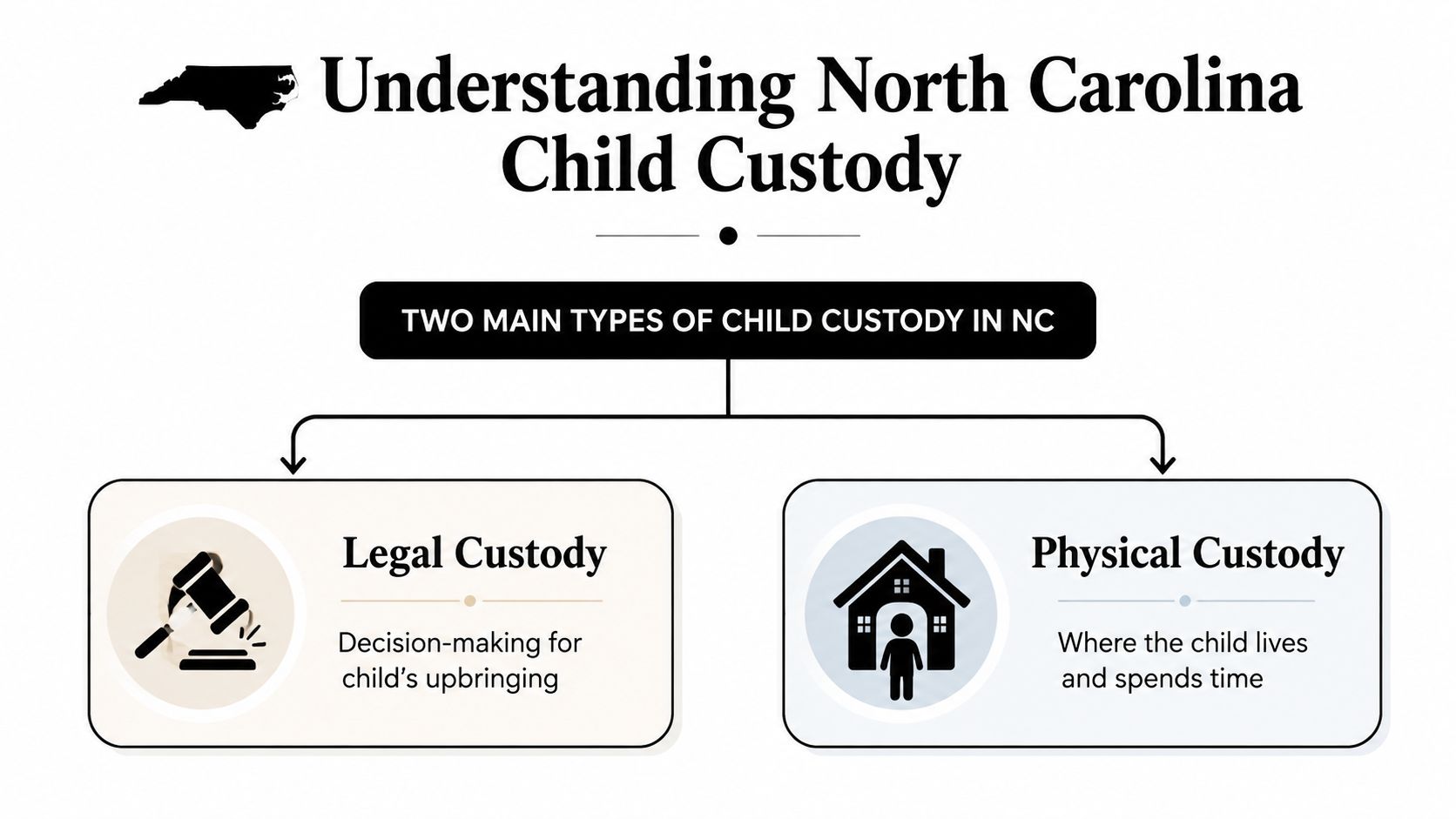
Parents often use the word "custody" as if it means one thing. In court, it usually means two separate issues.
- Legal custody covers major decisions about the child's life, including education, non-emergency medical care, mental health treatment, and religious upbringing.
- Physical custody covers where the child lives and the parenting schedule.
Those terms matter because parents can share one form of custody without sharing the other equally. Joint legal custody is common, but it does not answer practical questions by itself. Someone still needs authority to make day-to-day decisions, handle school forms, approve activities, and respond when the parents disagree. A fuller explanation of these terms appears in this guide to child custody laws in North Carolina.
In practice, the strength of a custody order comes from detail. A workable order usually addresses regular weekdays, weekends, holidays, summer schedules, transportation, communication with the child, and how parents will share information from schools and medical providers.
What judges pay attention to
Judges usually care less about who makes the strongest accusation and more about who has shown steady, child-focused judgment over time.
That means the evidence often centers on daily parenting. Who gets the child to school on time. Who keeps up with counseling or medical treatment. Who can manage transitions between homes without putting the child in the middle. Who communicates with the other parent in a way that helps the child rather than escalating conflict.
I tell parents this often. Custody cases are usually decided by patterns, not speeches.
A simple example shows the difference. One parent may have handled most weekday logistics during the marriage because that parent had a predictable schedule. The other parent may be loving, appropriate, and fully capable, but works overnight shifts or travels often. The court is not scoring the marriage. The court is deciding what arrangement will serve the child now, with the least disruption and the most stability.
A helpful overview appears here:
The separation year is often when custody evidence is created
This is the point many parents miss. The one-year separation rule delays the final divorce judgment, but it does not freeze the family in place. What happens during that year often becomes the evidence a judge later reviews if custody is contested.
If one parent consistently follows the schedule, attends appointments, communicates about school issues, and keeps the child out of adult conflict, that conduct matters. If a parent skips exchanges, withholds information, or makes major decisions without notice, that matters too. By the time a custody hearing happens, the court often has months of real-world history to examine.
That is why temporary arrangements should be treated seriously, even if they began informally. They tend to shape expectations, settlement discussions, and sometimes the final result.
Can a teenager choose where to live
This is one of the most misunderstood parts of North Carolina family law.
North Carolina law does not give a minor the power to choose a residence, but courts may consider a mature child's wishes, especially as the child gets older. The judge decides how much weight to give that preference based on maturity, reasoning, and the child's overall circumstances, as explained in this discussion of how a child's preference is treated in North Carolina custody disputes.
A teenager's opinion can matter. It is not the final answer.
Parents usually hurt their case when they ask a child to take sides or report on the other household. A better approach is to present facts the court can use: school performance, mental health needs, the child's adjustment to each home, the parents' work schedules, and whether the proposed arrangement is realistic over time.
How Child Support Is Calculated in North Carolina
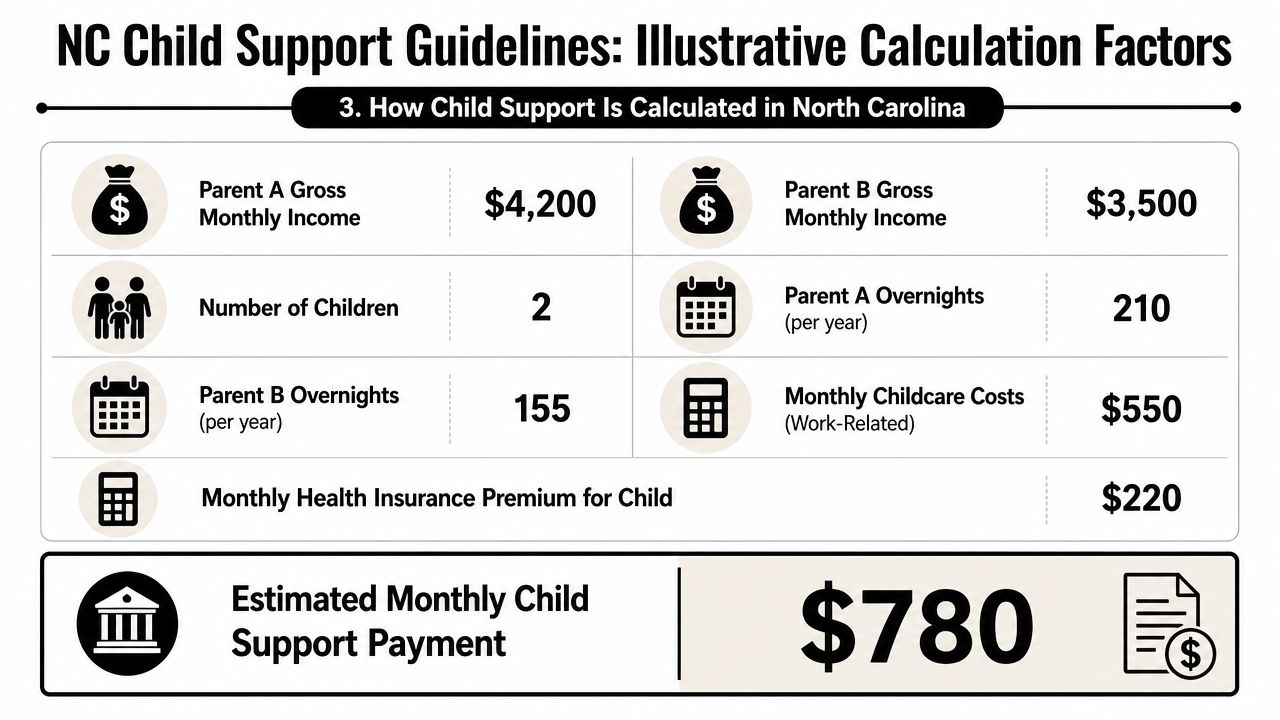
Child support in North Carolina is formula-driven, but families often experience it as anything but simple. The numbers come from a structured system, yet the final amount depends on accurate inputs. If the information going into the calculation is incomplete, the result may not reflect the actual costs of raising the child.
North Carolina uses the North Carolina Child Support Guidelines, which rely on a formula that considers both parents' incomes, childcare expenses, health-insurance costs, and custody arrangements. Either parent may ask for a deviation if the guideline amount would be unjust or inappropriate, according to North Carolina Legal Services' explanation of divorce and children in North Carolina.
The inputs that matter most
In practice, support calculations often turn on a few recurring categories:
- Income information such as pay records and other proof of earnings for each parent
- Childcare costs tied to work or similar recurring needs
- Health coverage costs for the child
- Custody arrangements including the parenting schedule and overnights
- Extraordinary expenses when they apply
This is why documentation matters. A parent who says, "I pay for daycare" still needs records. A parent who says, "The child stays with me more often" needs a schedule that can be shown clearly.
A practical example without guessing numbers
Suppose both parents are employed, one parent pays the child's health insurance premium, and the other pays a regular daycare bill so they can work. If the child spends more overnights with one parent than originally expected, that can affect the presumed support amount. If a recurring expense wasn't documented, it may be left out of the calculation.
The formula isn't designed to reward one parent and punish the other. It's designed to produce a presumptive support amount based on the information provided. That is why records gathered during separation often become central later.
Important: Child support and parenting time are connected in the guidelines, but one parent can't lawfully rewrite the schedule on their own just to improve a support position.
For a more detailed look at the mechanics, this article on how child support is calculated in North Carolina can help you prepare the right documents before court or negotiation.
When deviation becomes part of the discussion
A guideline amount is the starting point, not always the end point. A deviation request asks the court to set an amount different from the presumptive figure because the standard number would be unjust or inappropriate in that family's specific situation.
That doesn't mean every parent who dislikes the result gets a different amount. It means the court may consider whether unusual facts justify departing from the formula. Those arguments have to be supported, not assumed.
The Legal Process From Filing to Final Judgment
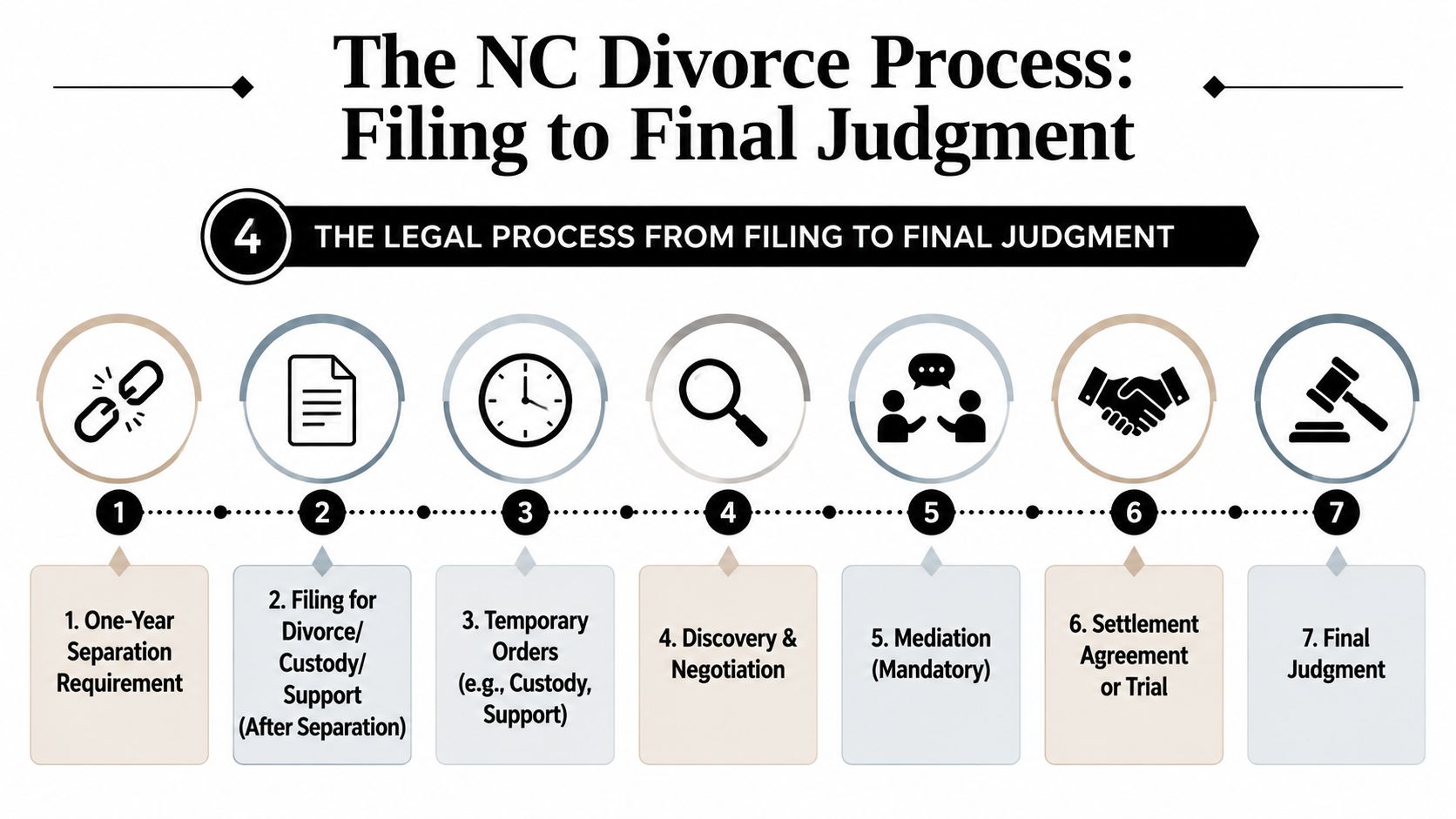
Families are often surprised by how many legal decisions happen before the final divorce hearing. In a North Carolina case with children, the timeline usually involves parenting issues, financial information, negotiation, and sometimes mediation long before the marriage is formally dissolved.
The process parents actually experience
A typical path looks like this:
- Separation begins and the household divides into two homes.
- Custody or support claims may be filed if agreements aren't holding or the family needs enforceable rules.
- Temporary arrangements or temporary orders may shape the child's schedule while the case is pending.
- Information is exchanged so each side can evaluate income, expenses, and parenting issues.
- Mediation often occurs before a judge hears custody disputes in many counties.
- Settlement or trial resolves the unresolved issues.
- Absolute divorce is finalized when the legal requirements have been met and the filing is properly made.
This process is easier to manage when the parenting plan is detailed. General promises usually produce specific arguments later.
Divorce doesn't automatically decide child issues
This point is critical. In North Carolina, custody and support are legally separable from the absolute divorce itself. They are not automatically included in the divorce judgment unless they were properly requested and addressed by the court, under North Carolina General Statutes Chapter 50, Article 1.
That means a parent who rushes to complete the divorce without securing the needed child-related orders can create avoidable problems. The court can include provisions for care, custody, tuition, and maintenance of minor children when there is jurisdiction and proper pleading. Those orders can later be modified on notice and a showing of a substantial change in condition, as reflected in the same statute.
A useful real-world way to think about it is this:
| Issue | Does the final divorce automatically handle it |
|---|---|
| Ending the marriage | Yes, if the divorce is properly filed and granted |
| Custody terms | Not unless properly requested and addressed |
| Child support terms | Not unless properly requested and addressed |
Parents should also remember that child-support obligations generally terminate at age 18, unless the child is otherwise emancipated, under the same statutory authority.
Life After Divorce Modifying Orders and Relocation
A final order doesn't end parenting issues. It creates a legal framework, but families keep changing. Jobs shift, children grow, schools change, and one parent may need to move.
That is why the quality of the original order matters so much. A vague custody order may seem peaceful at first, but it often creates future conflict because nobody can tell what was explicitly required.
Modifying custody or support
North Carolina allows later changes to custody or support orders when the legal standard is met. Under the statute discussed earlier, modifications require notice and a showing of a substantial change in condition for the child-related provisions addressed by the court.
In practical terms, the court is looking for a real change, not ordinary frustration. Common examples can include a meaningful change in a parent's income, a child's evolving educational or medical needs, repeated breakdowns in the schedule, or circumstances that affect the child's welfare in one home.
What usually doesn't work is filing because the arrangement feels unfair in hindsight. Courts tend to focus on changed facts, not buyer's remorse.
Relocation disputes are rarely simple
Relocation is one of the most volatile post-divorce issues. If a parent wants to move a significant distance and the move would interfere with the existing custody arrangement, that parent shouldn't assume the move is theirs to make unilaterally.
The safer approach is to review the current order, determine whether the other parent's consent is needed, and evaluate whether court approval should be requested before any move takes effect. A relocation dispute often becomes a custody dispute because distance changes school logistics, transportation burdens, weekday contact, and holiday structure.
A move that makes sense for a parent may still require a new legal plan for the child.
Good orders anticipate this by addressing notice requirements, travel responsibilities, communication rules, and how schedule adjustments will be handled if one parent relocates. Careful drafting at the beginning often reduces expensive litigation later.
Frequently Asked Questions About Divorce with Children in NC
Parents often reach this section after the same frustrating moment. They learn they must live separate and apart for one year before filing for absolute divorce, then assume nothing can be done about custody, support, or day-to-day parenting disputes until that year ends. That is incorrect. Many of the problems that affect children need attention during the separation year, not after it.
Can I stop the other parent from seeing the children if they aren't paying support
No. In North Carolina, child support and parenting time are treated as separate issues. If the other parent is behind on support, the proper response is to pursue enforcement, not to block visitation or refuse exchanges.
That approach usually creates a second legal problem instead of solving the first.
Can my child decide to live with me instead of the other parent
A child does not get to make that decision alone. The court may consider a mature child's wishes, but the judge decides custody based on the child's best interests.
Parents should be careful here. I often see people place too much weight on what a child says in a tense moment, especially during the separation year when routines are still unsettled. A stated preference can matter, but it is only one part of the custody analysis.
What if the other parent refuses to follow the custody order
Start documenting each violation in a clear, organized way. Keep track of missed exchanges, denied phone or video contact, late returns, school-related interference, and written communications about the problem.
Then have the order reviewed. Some violations justify a motion for contempt. Others show that the order is too vague and needs to be tightened so both parents know exactly what is required. The right strategy depends on whether the issue is isolated, repeated, or affecting the child in a serious way.
Does adultery determine child custody in North Carolina
Adultery is not an automatic factor in custody decisions. The court focuses on the child's best interests.
A parent's affair may become relevant if it affected the child's safety, exposed the child to inappropriate circumstances, showed poor judgment, or disrupted the home in a way that bears on parenting. Standing alone, adultery does not decide custody. Courts look for facts tied to the child's welfare, not moral arguments between spouses.
Do I need a lawyer if we mostly agree
In many cases, yes. Agreement on the big picture is helpful, but it does not mean the details are settled well.
The problems usually show up later. Parents agree that they will "share custody," then realize they never addressed holiday rotation, summer schedules, school decision-making, transportation, extracurricular costs, makeup time, or what happens if one parent wants to move. During the one-year separation period, those unanswered questions can turn a workable arrangement into a recurring dispute.
As noted earlier, some North Carolina parents seek guidance from the Law Office of Bryan Fagan on divorce, custody, child support, and related family-law issues. Even a limited legal review can help you turn a general agreement into terms that can be followed and enforced.
Schedule a Consultation with a North Carolina Family Law Attorney
A divorce involving children asks you to make legal decisions while your family is under strain. You may be dealing with a separation date, parenting schedules, support questions, mediation, and a final divorce filing that doesn't automatically solve every child-related issue.
That is a lot for any parent to manage alone.
Careful legal advice can help you separate urgent issues from long-term ones, avoid preventable mistakes during the separation year, and build court orders that are effective in daily life. The right strategy often isn't the most aggressive one. It's the one that protects your relationship with your children, puts reliable facts in front of the court, and creates a structure your family can live with.
If you're a North Carolina parent facing divorce with children under 18, scheduling a consultation is often the best next step. A case-specific review can clarify timing, identify immediate risks, and help you decide whether negotiation, mediation, or court action makes the most sense.
If you need guidance on divorce, custody, or child support in North Carolina, schedule a consultation with the Law Office of Bryan Fagan. The firm works with North Carolina families to evaluate separation timelines, address child-related issues before the final divorce, and develop practical legal strategies based on the facts of each case.