A contested divorce in North Carolina often takes 18 months to 3 years from the date of separation to final judgment, and every case starts with the same legal floor: spouses must live separate and apart for at least one year before an absolute divorce can even be filed. If you're already dealing with disagreement over custody, support, or property, that one-year wait is usually only the beginning of the timeline.
For many people, the hardest part isn't just the conflict. It's the uncertainty. You're trying to decide whether to keep the house, how to budget, where the children will be living, and when life will feel settled again. A contested divorce can leave you feeling like your future is on hold.
The good news is that the process is not random. It has recognizable stages, common delay points, and practical ways to keep the case moving. If you're asking how long does a contested divorce take in NC, the honest answer is that the timeline depends heavily on what you're fighting about and how those issues move through the court system. But that doesn't mean you're stuck with a vague "it depends" and nothing more.
The Uncertainty of a Contested Divorce Timeline
You separate, expect the divorce paperwork to be the easy part, and then the dispute shows up somewhere else. One spouse wants a parenting schedule the other cannot accept. Someone claims postseparation support. The house has equity, the retirement accounts need valuation, and nobody agrees on who should carry which debt. At that point, the timeline stops feeling like a date on a calendar and starts feeling like a moving target.
That uncertainty affects ordinary life in expensive ways. People hold off on selling a home, changing jobs, refinancing, or making long-term plans because they do not yet know what a court order or settlement will require. Parents feel it even more sharply. School decisions, holiday schedules, exchange logistics, and child support can remain unsettled for months while the case works through the system.
Why contested cases feel so unpredictable
Contested divorce cases in North Carolina rarely move in a straight line. Different issues often move at different speeds, and some are handled on separate tracks. A spouse may be eligible to finalize the absolute divorce while equitable distribution, custody, child support, or alimony claims are still being negotiated, scheduled for hearing, or prepared for trial.
That split surprises many people.
It also changes how I advise clients. The better question is usually not "When will everything be over?" but "Which part of the case is likely to resolve first, and which issue is likely to keep this open?" A custody dispute with allegations requiring evaluations or extensive testimony can outlast a property case. A business valuation fight can slow down a case even when parenting issues are relatively manageable. A case with temporary agreements in place may feel more stable even if final resolution takes time.
A practical explanation of what legal separation means in North Carolina also helps people understand why the divorce timeline and the dispute timeline are related, but not always identical.
What clients usually want to know first
Clients are usually not asking for a perfect prediction. They want a planning range they can use. Should they budget for a short fight, a year of litigation activity, or a case that may stretch much longer because of custody evaluations, discovery disputes, or a crowded court calendar?
That is the value of using sample timelines by case complexity instead of giving a vague "it depends" answer. A simple contested case may resolve on a very different schedule than a moderate or complex one, even though all three are called contested divorces. Broad estimates still matter because they help you make better decisions about housing, cash flow, parenting arrangements, and settlement posture before the case starts driving those decisions for you.
The timeline is uncertain, but it is not random. Patterns show up. Delay points are usually identifiable. And once you know where your case likely falls on the spectrum, the process becomes much easier to evaluate realistically.
The Non-Negotiable Starting Point NC Divorce Law
People often call my office after months of arguing over custody, support, or property and assume the divorce itself can be filed right away. In North Carolina, that is not always true. Before the court can grant an absolute divorce, state law requires two threshold conditions: the spouses must live separate and apart for at least one year, and at least one spouse must have lived in North Carolina for six months before filing.

The one-year separation rule under North Carolina law
Under N.C. Gen. Stat. § 50-6, most spouses must complete one full year of separation before filing for absolute divorce. That usually means living in separate residences and ending the marital relationship in a real, practical sense. North Carolina does not require a judge to sign a separation order before that clock starts.
For a practical explanation of what does and does not count as separation, this overview of legal separation in NC is a useful starting point.
This rule matters because clients often blend two different timelines together. The separation year is one timeline. The contested case timeline is another. A spouse may spend part of that year negotiating, gathering records, or preparing for litigation, but the court still cannot grant the divorce until the statutory year has passed.
The residency requirement and why it matters
North Carolina courts also need authority over the case. At least one spouse must have lived in the state for six months before the divorce is filed. That point becomes important when a family recently relocated, one spouse moved out of state, or there is a question about which state should handle the divorce.
Timing mistakes here create preventable delays. Some people assume the case starts on the date of separation. Legally, separation starts the waiting period. The court case begins when a complaint is filed after the legal requirements are met.
A practical point many people miss
Absolute divorce is only one part of the larger picture. A North Carolina Divorce Lawyer can advise you on the divorce itself and on related claims such as property division, custody, or support, each of which can follow a different schedule.
That distinction is why broad timeline answers are often frustrating. A simple case may meet the one-year separation rule and move to a relatively prompt divorce filing. A more complex case may meet that same rule, then spend many additional months in litigation over money, children, or both.
The practical takeaway is straightforward. Start your timeline calculation with the one-year separation period and the six-month residency requirement. Then evaluate the contested issues separately. That is the only reliable way to place your case into a simple, moderate, or complex timeline range.
Mapping the Contested Divorce Process Step by Step
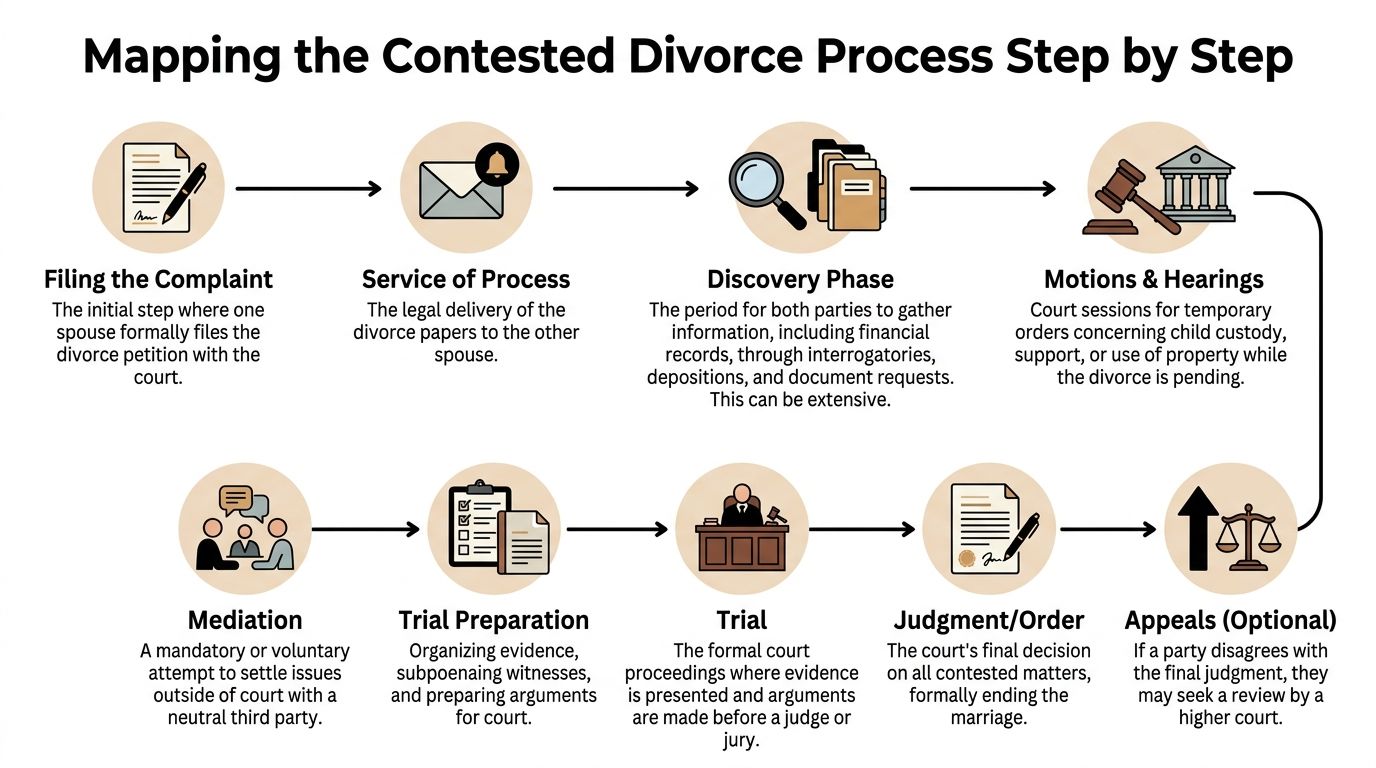
A contested divorce often feels slow because several different tracks can be moving at once. One issue may be close to resolution while another is just starting to develop. That is why two North Carolina cases filed in the same month can end on very different schedules.
The practical way to understand timing is to look at the case in stages. Each stage creates its own delay points, pressure points, and opportunities to resolve part of the dispute.
Filing and service
The court process starts when one spouse files a complaint and the other spouse is formally served. Filing opens the case. Service gives the other side legal notice and starts the deadline to respond.
In practice, this stage can be quick or frustrating. If both spouses are easy to locate and represented early, the case usually gets on track faster. If service is difficult, a spouse avoids papers, or pleadings need to be amended, the timeline slips before the actual dispute is even addressed.
If your case is moving into active litigation, this contested divorce NC resource gives a useful overview of what that shift means.
This is also the point where the scope of the fight becomes clearer. Some cases involve one disputed claim, such as alimony or equitable distribution. Others open with disputes about custody, support, property, possession of the home, and payment of ongoing bills.
Discovery and information gathering
Discovery is the part clients usually underestimate.
This is the formal process for exchanging information, requesting documents, asking written questions, and developing evidence for settlement talks or trial. In a simple case, discovery may mean collecting tax returns, pay stubs, bank records, and retirement statements. In a more complex case, it may involve business records, appraisals, compensation history, hidden account concerns, or disputes about whether someone gave full answers.
Common discovery tools include:
- Interrogatories: Written questions answered under oath.
- Requests for production: Demands for records such as bank statements, tax returns, retirement account documents, and business records.
- Depositions: Sworn testimony taken before trial, with questions asked by counsel and recorded by a court reporter.
The trade-off is straightforward. Thorough discovery takes time, but inadequate discovery can lead to bad settlements or trial surprises. In many cases, the longest part of the timeline is not a court hearing. It is the time spent getting reliable financial and factual information from the other side.
Temporary motions and hearings
Families often need rules in place long before the final hearing. Children still need a schedule. Mortgage payments still come due. One spouse may need temporary support. A business may need protection from unilateral decisions.
Temporary motions ask the court to address those immediate problems while the larger case continues. A temporary order does not end the dispute, but it can shape daily life for months and sometimes affects settlement posture because both sides now see how a judge views the early facts.
I often tell clients to treat temporary hearings seriously. A rushed presentation at this stage can create practical problems that are hard to live with while the rest of the case moves forward.
A lot of readers prefer hearing the process explained out loud before they examine strategy. This video can help orient you to the bigger picture.
Mediation, trial preparation, and final hearing
Many contested cases settle in full or in part before trial, but usually not by accident. Settlement tends to happen after enough information has been exchanged for each side to assess risk realistically. Mediation often becomes the point where that happens.
If mediation resolves all major issues, the case can shorten considerably. If it resolves only a few, that still matters. Narrowing the dispute from five issues to two can reduce preparation time, hearing time, and cost.
If settlement does not happen, trial preparation becomes its own phase. Lawyers prepare exhibits, subpoena records, organize witness testimony, address evidentiary problems, and make sure the judge has a clear path through the disputed facts and legal claims. Then comes the final hearing, followed by the written order. Even after court, there is often a short wait for the order to be drafted, reviewed, and entered.
That step-by-step view is more useful than saying a contested divorce "depends." It shows why a simple contested matter may move through these stages with limited conflict, while a moderate or complex case can stall at multiple points along the way.
Key Factors That Lengthen or Shorten Your Timeline
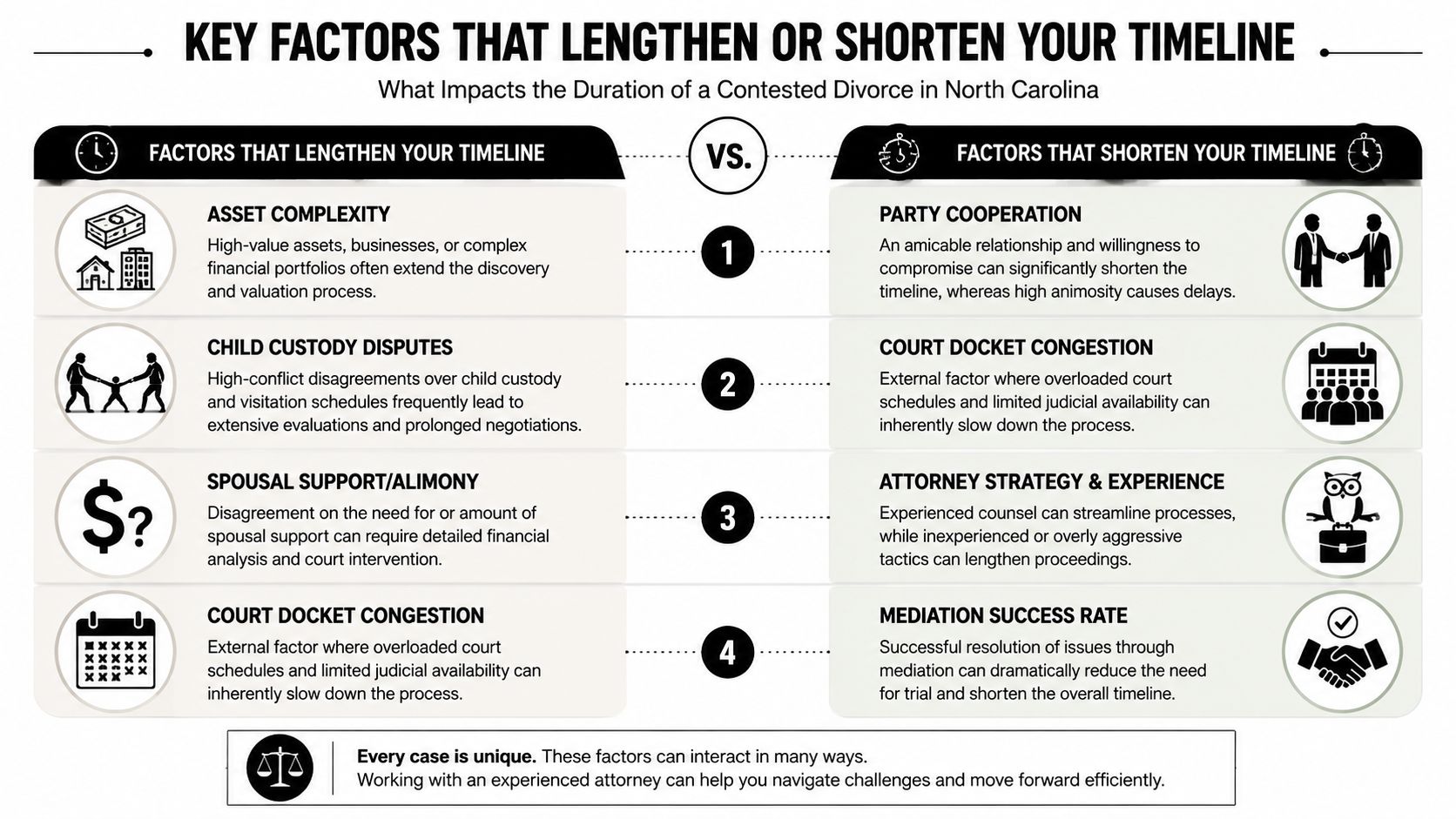
Two cases can be filed in the same week in North Carolina and finish months apart. The reason is usually not chance. It is the number of issues in dispute, how hard those issues are to prove, and how much court involvement the case needs.
North Carolina procedure also affects timing in a practical way. Absolute divorce may move on a different track than custody, child support, alimony, or equitable distribution. As noted earlier, discovery often takes a meaningful stretch of time on its own, especially when one side is slow to produce records or the finances are complicated.
Child custody disputes can add months
In practice, custody issues often change the pace of the entire case.
A disagreement about support numbers is usually narrower than a disagreement about where a child should live, how major decisions will be made, whether a parent has exercised poor judgment, or whether a schedule is workable during school weeks and holidays. Once those questions are in play, the case usually requires more documents, more witnesses, and more judicial attention.
The contrast is usually clear:
| Situation | Likely impact on timing |
|---|---|
| Parents agree on primary living arrangements but dispute child support | More focused issue set. Easier to negotiate or present |
| Parents dispute primary custody, school choice, holidays, decision-making, or raise concerns about parenting conduct | More evidence, more preparation, and a longer path to resolution |
Custody cases also tend to generate emergency requests, temporary hearings, and strong emotional reactions. All of that can slow progress even when both parents care deeply about reaching a good result.
Property division may be straightforward or document-heavy
Equitable distribution ranges from simple to highly technical. Dividing ordinary household assets is one type of case. Tracing separate property claims, addressing retirement accounts, or valuing a business is another.
These property issues commonly extend the timeline:
- Business interests: A family-owned company or professional practice may require valuation work and deeper document review.
- Missing or incomplete records: Bank statements, tax returns, loan records, and account histories often determine how quickly the case can move.
- Separate versus marital property disputes: Inherited assets, premarital property, and commingled funds often require careful tracing.
- Hidden income or assets concerns: Once that issue is raised, discovery usually becomes more expensive and more time-consuming.
This is one of the hardest parts for clients to judge early. A case that looks simple at intake can become much slower once the paper trail starts to matter.
Client decisions and court conditions affect speed
Some delays come from the system. Some come from the parties.
Cases tend to move faster when each side exchanges records promptly, narrows the actual disputes, and approaches negotiation with realistic expectations. Cases tend to drag when someone misses deadlines, files motions that do not advance the case, refuses to provide documents, or treats every issue as a fight that must be won.
Three choices often make a real difference:
- Bring organized records to your lawyer early. That reduces avoidable back-and-forth and helps your attorney assess the case sooner.
- Decide what matters most. A clear set of priorities makes settlement discussions more productive.
- Use mediation strategically. Even partial agreements can shorten preparation time and reduce what has to be tried. For many families, North Carolina divorce mediation becomes the point where the case starts to narrow.
I often tell clients the court controls the calendar, but the parties still influence how much work the case creates for that calendar.
County scheduling matters too. Some districts can hear motions or set trial dates faster than others. No lawyer can promise to speed up a crowded docket, but good strategy accounts for that reality early instead of treating delay as a surprise.
Sample Contested Divorce Timelines in North Carolina
People asking how long a contested divorce takes in North Carolina usually want a usable timeline, not another vague answer. The better way to frame it is by case type. A custody fight with one temporary hearing follows a very different schedule than a case involving business valuation, tracing separate property, and repeated motions over missing records.
These examples are estimates, not promises. Court calendars, the number of disputed issues, and how quickly each side produces information still matter. But sample timelines give you a more concrete way to plan than a generic "it depends."
Estimated timelines for NC contested divorces post-filing
| Case Complexity | Common Issues | Estimated Timeline (from Filing) |
|---|---|---|
| Simple contested case | One main disputed issue, such as alimony or a narrow property disagreement, with relatively straightforward finances and prompt document exchange | Often several months to about a year |
| Moderately complex case | Custody schedule disputes, child support or alimony disagreements, retirement division, possession of the marital home, and one or more temporary hearings | Often about a year or longer |
| Highly complex case | High-conflict custody litigation, business valuation, disputed classification of property, extensive discovery, multiple motions, and trial preparation across several claims | Often well beyond a year, and sometimes much longer |
How to use these examples
A simple contested case can still be stressful. It is narrower in scope. For example, spouses may agree on custody and most property issues but remain far apart on spousal support. If financial records are complete and mediation narrows the dispute, that case may resolve on the shorter end of the range.
A moderate case usually involves overlapping parenting and financial issues. One common pattern is a dispute over the weekly custody schedule, decision-making for the children, retirement accounts, and debt allocation. Those cases often need more than one court event, and each setting adds preparation time.
Complex cases are different in kind, not just degree. A business owner may need a valuation. One spouse may claim an asset is separate property while the other says it was mixed with marital funds. There may also be emergency custody filings or repeated discovery disputes. In practice, those cases require clients to plan for a longer process, higher legal expense, and periods where progress feels slow even though substantial work is happening behind the scenes.
The point of these sample timelines is not to predict your exact finish date. It is to help you identify which track your case is more likely to follow so you can make better decisions early about records, budgeting, settlement strategy, and trial preparation.
Frequently Asked Questions About NC Divorce Timelines
Can my spouse and I waive the one-year separation period
No. For most absolute divorces in North Carolina, the one-year separation period is a statutory requirement under N.C. Gen. Stat. § 50-6. Agreement between spouses does not eliminate that waiting period.
Does mediation make a contested divorce faster
It can. Mediation often shortens the case if it resolves some or all disputed issues because the parties avoid part of the trial process. But mediation does not guarantee a quick finish. If the parties remain far apart, the case still proceeds through litigation.
Is the divorce itself separate from custody, support, or property division
Often, yes. In North Carolina, the absolute divorce and related claims can move on separate tracks. That is one reason clients sometimes feel confused about timing. The marriage may be dissolved while other disputes continue, or those related claims may drive the overall timeline.
What usually causes the biggest delays after filing
In practice, delays usually come from disputed facts and incomplete information. Common examples include custody disagreements, missing financial records, contested business or property valuation, repeated motion practice, and crowded court calendars. The more the judge has to resolve, the longer the case usually lasts.
Can I do anything to keep my case moving
Yes. You can't force the other side to cooperate or open court dates faster, but you can do several things that help:
- Gather records early: Tax returns, pay stubs, bank statements, retirement records, and property documents should be organized as soon as possible.
- Follow temporary orders carefully: Violations create new disputes and often lead to more hearings.
- Stay focused on priorities: Every disagreement is not equally important. Cases move better when clients know which issues matter.
- Prepare for settlement seriously: A realistic settlement effort often works best when both sides are also ready to present the case in court if needed.
Clients usually shorten the process not by rushing, but by being prepared.
Take Control of Your Divorce Strategy in North Carolina
You can't control every part of a contested divorce. You can't control the court's schedule, your spouse's attitude, or how many issues may need to be decided. You can control how prepared you are, how early you get advice, and whether your case is approached with a clear strategy.
That matters. A well-prepared case is easier to evaluate, easier to negotiate, and easier to present when court intervention becomes necessary. It also helps reduce the panic that comes from not knowing what happens next.
If you're facing disputes over custody, support, or property, the timeline should shape your planning from the start. The right approach isn't to hope the case will somehow move quickly. It's to build a strategy that protects your position at each stage and keeps avoidable delay to a minimum.
If you live in North Carolina and need guidance on the likely timeline of your divorce, the Law Office of Bryan Fagan can help you assess your situation, identify the issues most likely to affect timing, and develop a practical legal strategy for your case. Schedule a consultation to discuss where your case stands, what may lengthen or shorten the process, and what steps make sense next under North Carolina law.