A new job in another state. A chance to live closer to grandparents. A safer neighborhood. Better schools. Those opportunities can feel urgent, especially when you're trying to build a stable life after separation.
Then the harder question hits. Can you move with your child if the other parent says no?
In North Carolina, that answer is rarely simple. There isn't a single relocation form or mileage rule that settles the issue. Courts look at how the move affects the child, the existing custody arrangement, and whether the change is significant enough to justify court involvement. That makes relocation custody north carolina cases highly fact-specific and emotionally loaded.
Parents often assume out-of-state moves are the only problem. They aren't. A move to another county, another school district, or even another part of the same metro area can trigger a dispute if it disrupts exchanges, school attendance, or regular parenting time. Another common mistake is thinking no court order means no restrictions. That's also dangerous.
An Introduction to Navigating Relocation and Custody in NC
North Carolina handles relocation cases through general custody law, not through a relocation-specific statute. The two concepts that drive almost every case are substantial change in circumstances and the best interests of the child. If a proposed move materially affects the child's welfare or the current custody schedule, the court may be asked to modify custody.

That means relocation cases aren't about whether one parent has a good reason to move in the abstract. Instead, they focus on the practical implications of the move for the child. Judges tend to focus on daily life. Who gets the child to school? What happens to midweek visits? Can the child still have consistent contact with both parents? Will the move help or destabilize the child's routine?
If you're considering a move, or you're worried the other parent is, you need more than general internet advice. You need a strategy built around your current order, your actual parenting pattern, and the evidence a North Carolina judge will expect to see. The details matter early. They matter even more if someone has already packed boxes, signed a lease, or made promises to a child that may not hold up in court.
Practical rule: In relocation cases, timing and preparation often matter as much as the reason for the move.
The Legal Foundation of NC Relocation Cases
North Carolina doesn't have a stand-alone statute that tells parents how far they can move, how much notice they must give, or when court approval is automatically required. Instead, relocation is usually analyzed as a custody modification issue under N.C. Gen. Stat. § 50-13.7. That statute allows modification of an existing custody order only when there has been a substantial change in circumstances affecting the child's welfare.
Why relocation cases can feel unpredictable
This structure gives judges flexibility, but it also creates uncertainty for parents. One move may seem reasonable on paper and still draw strong opposition because of how it changes the child's routine. Another move may be approved because the parent presents a careful plan that protects the child's relationship with the other parent.
North Carolina courts have been using this framework for decades. A key appellate decision is Ramirez-Barker v. Barker, decided in 1992, which established a multi-factor approach centered on the child's best interests, as discussed in this North Carolina relocation analysis. That case still shapes how attorneys prepare relocation disputes and how judges analyze them.
The second major statute is N.C. Gen. Stat. § 50-13.2, which directs courts to decide custody issues based on the best interests of the child. In a relocation dispute, those words have practical meaning. The court isn't deciding which parent is more ambitious, more sympathetic, or more frustrated. The court is deciding what arrangement best protects the child.
For a broader overview of how custody law works in this state, review this guide to North Carolina child custody laws.
What the court is actually looking for
In practice, judges usually want answers to a short list of hard questions:
- Does the move materially change the current arrangement: If it doesn't affect school, exchanges, or parenting time in a meaningful way, the case may look very different.
- Does the move improve the child's life: Better support, stability, safety, or opportunity can matter, but only if the evidence is concrete.
- Can the child maintain a strong bond with the non-moving parent: A vague promise of "we'll work it out" usually isn't enough.
- Are both parents acting in good faith: Motive matters. Courts notice when a move appears designed to interfere with the other parent's relationship.
The common misconception that causes trouble
Many parents say, "I'm the primary parent, so I can decide where we live." Sometimes the existing order gives one parent more physical time, but that does not end the analysis. If the move disrupts the other parent's court-ordered access or affects the child's welfare, the issue can land in court quickly.
Another misconception is that only out-of-state moves count. They don't. North Carolina's approach is functional, not mathematical. The legal question isn't miles. It's impact.
A relocation case is usually won or lost in the details of the parenting plan, not in the headline reason for the move.
What Qualifies as a Significant Relocation in North Carolina
A "significant" move in North Carolina isn't defined by a mileage chart. There is no mileage or distance benchmark. A move is usually significant if it disrupts school attendance, visitation exchanges, or parenting schedules, as explained in this discussion of North Carolina child relocation and intra-state moves.
That gray area is where many parents get into trouble.
Distance isn't the test. Disruption is.
A parent may move only a short distance and still trigger litigation. If the new home places the child in a different school district, makes weeknight dinners impossible, or adds enough travel time to break down the current exchange schedule, the move may be treated as a substantial issue.
By contrast, a longer move may create less conflict if the parents already use a schedule built around weekends, holidays, or school breaks and the relocation plan addresses transportation in a realistic way.
Consider these common scenarios:
- Across town but new school assignment: The drive may be manageable, but changing schools can affect the child's routine, services, friendships, and extracurricular activities.
- To a neighboring county: That may sound modest, but it can eliminate midweek visits or make morning drop-offs unrealistic.
- Within the same county: Even this can become contested if one parent relies on frequent short visits, school pickups, or involvement in activities near the current home.
How the Ramirez-Barker factors help define significance
When there's no agreement, courts often turn to the Ramirez-Barker framework. That helps answer whether a move is significant in legal terms.
Here is how that looks in everyday language:
| Factor | What It Means | Example |
|---|---|---|
| Advantages of the relocation | Whether the move improves the child's life, not just the parent's plans | A move tied to a stable job, stronger family support, or safer housing |
| Motives of the moving parent | Whether the reason is genuine or aimed at limiting the other parent | A parent moving for employment versus moving right after a custody conflict |
| Likelihood of compliance after relocation | Whether the parent will realistically follow the visitation plan after moving outside North Carolina | A detailed schedule with transportation arrangements is stronger than vague assurances |
| Integrity of the opposing parent | Whether the objection is about the child or about controlling the other parent | A parent with regular involvement may have a stronger objection than one with sporadic participation |
What works and what doesn't
What works is specificity. Parents who can explain exactly how school, transportation, holidays, and regular contact will function tend to present a stronger case.
What doesn't work is minimizing the impact. If a parent says, "It's only one county over," but the move wipes out a long-standing midweek schedule, the court will notice the mismatch between the words and the reality.
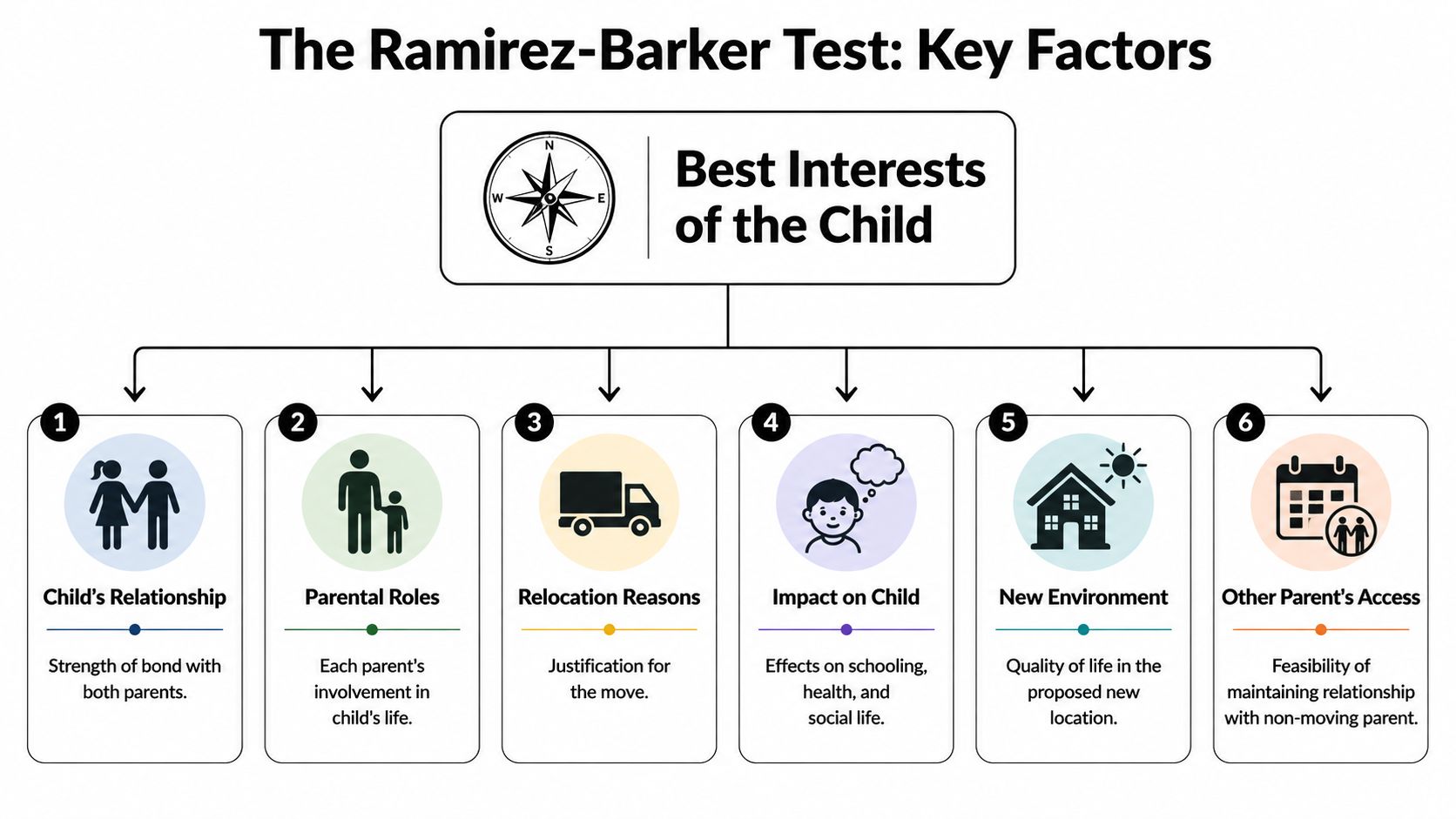
Key Factors NC Courts Consider The Ramirez-Barker Test
The best interests standard can sound vague until you put it into hearing-room terms. In relocation custody north carolina litigation, Ramirez-Barker v. Barker gives judges a practical framework for evaluating whether the move should happen and whether custody should change.
Start with the filing and the evidence
A relocation dispute usually begins when one parent files to modify custody or when the non-moving parent asks the court to prevent or respond to a move. At that point, the case turns quickly from emotion to proof.
Useful evidence often includes:
- Employment proof: Offer letters, transfer paperwork, work schedules, or documents showing why the move matters.
- School information: Enrollment options, academic support, special services, commute details, and continuity concerns.
- Parenting records: Calendars, messages about exchanges, school involvement, and extracurricular participation.
- Proposed schedules: A detailed plan for holidays, summers, breaks, transportation, and virtual contact.
The Ramirez-Barker factors in practical terms
The court in Ramirez-Barker identified core considerations that still guide these cases. Although lawyers may group related facts in different ways, these factors remain central.
| Factor | What It Means | Example |
|---|---|---|
| Advantages of the relocation | Whether the move offers real benefits for the child | A location with family support that helps with childcare and stability |
| Motives of the relocating parent | Whether the request is made in good faith | A move based on employment or safety concerns rather than conflict |
| Likelihood of complying with visitation after the move | Whether the parent can and will support continued contact | A parent who proposes transportation details and consistent communication plans |
| Integrity of the parent opposing the move | Whether the objection is child-focused | A parent who has been consistently involved and can explain the practical loss of contact |
How judges tend to apply those factors
The first factor isn't just about money. A higher salary can matter, but courts usually want to know how that change reaches the child. Will the child have more stability, better supervision, improved access to support, or safer living conditions?
The second and fourth factors are about credibility. If either parent appears more focused on winning than parenting, that can hurt. A parent who exaggerates, hides plans, or refuses practical solutions may damage an otherwise decent case.
The third factor often becomes the battleground. Long-distance parenting can work, but only if someone has thought through the logistics. Judges often want to see more than hopeful statements. They want schedules that match the school calendar, realistic travel arrangements, and proof that the moving parent understands the burden distance creates.
Parents strengthen relocation cases when they show the court how the child will keep a meaningful relationship with both households, not just why the move benefits one household.
Why detailed findings matter
North Carolina appellate courts scrutinize relocation rulings carefully. In Tuel v. Tuel, 270 N.C. App. 629 (2020), the Court of Appeals reversed a trial court's approval of a mother's relocation to Indiana because the trial court had not made sufficient findings on the child's best interests. That decision is discussed in this summary of North Carolina relocation considerations.
The practical lesson is straightforward. A judge needs a record. That means your evidence must be organized, specific, and tied to the child.
A hearing example
Suppose a mother wants to move because she has secured stable employment near extended family who can help with after-school care. That may weigh in favor of relocation. But if the father currently has frequent weekday parenting time, coaches the child's team, and handles school pickups twice a week, the move may still face strong resistance unless the proposed plan preserves that relationship in a meaningful way.
On the other side, if a father opposes the move but has a thin history of exercising time or participating in school and medical decisions, the court may weigh his objection differently. The point isn't labels like "custodial" or "noncustodial." The point is the child's lived experience.
The Process for Requesting or Opposing a Move
Relocation disputes are won through preparation, not speed. If you're asking the court to allow a move, or trying to stop one, the process should be deliberate from the start.
Under N.C. Gen. Stat. § 50-13.7, the substantial change standard creates a high evidentiary threshold. Courts distinguish between minor geographic moves and relocations that materially disrupt the existing custody arrangement. The moving parent often needs to show the benefits of the new arrangement and how it preserves frequent and meaningful contact with the other parent, as explained in this article on modifying custody when a parent relocates.
For North Carolina parents dealing with post-order changes, this overview of custody modification in NC is a useful starting point.
If you're requesting the move
A strong relocation request usually includes more than a motion and a short explanation. It should tell the court what life will look like after the move.
Build your case around documents and logistics:
Show the reason is real
Include the job offer, transfer notice, family support details, or safety concerns that make the move necessary or beneficial.Map out the child's routine
Explain school plans, childcare, medical care, transportation, and how the child will transition.Propose a workable parenting plan
Spell out holidays, summer periods, long weekends, phone or video contact, and who handles travel.Address the weak points directly
If the move reduces frequent contact, don't gloss over it. Offer realistic alternatives.
If you're opposing the move
The best response isn't just "I don't want them to go." Courts respond to evidence, not outrage.
Useful points may include:
- Current involvement: School pickups, homework help, doctor visits, activities, and regular overnight time.
- Child stability concerns: School continuity, counseling, community ties, and support systems here in North Carolina.
- Practical flaws in the proposal: Travel burden, unrealistic exchange terms, missing school, or vague communication promises.
A court often pays close attention to the parent who can explain daily parenting in concrete terms.
Don't move first and hope to fix it later
Many parents are tempted to sign the lease, start the job, and sort out custody afterward. That strategy creates serious risk.
Under the UCCJEA, North Carolina as the child's home state can remain the forum for the dispute, and the non-relocating parent may ask the court to order the child's return. Even when the move isn't treated as kidnapping, unilateral action often puts the moving parent at a disadvantage in the custody fight.
This short video gives a practical look at why early legal planning matters in family law disputes:
What experienced counsel actually does
Lawyers handling these cases often coordinate several moving parts at once: emergency issues, motion practice, negotiation, mediation, and preparation for a detailed evidentiary hearing. Some families can resolve the issue through a revised parenting plan. Others need a judge to decide.
The Law Office of Bryan Fagan is one North Carolina firm that handles custody modification and relocation disputes as part of its family law practice. Whatever counsel you choose, make sure the attorney understands both the custody standard and the practical realities of interstate and intra-state moves.
High-Risk Scenarios and Common Mistakes to Avoid
Some relocation mistakes can be repaired. Others change the case before the hearing even starts.

Relocating without a court order isn't technically illegal, but courts disfavor unilateral moves. Under the UCCJEA, the other parent can petition for the child's return to North Carolina as the home state. One source reports a 25% increase in UCCJEA emergency petitions for unapproved moves and notes that courts deny about 60% of such relocations when the child's benefits don't clearly outweigh the disruption, according to this discussion of how North Carolina custody laws affect relocation.
Can I move if there is no formal custody order yet
This is one of the most dangerous gray areas.
Parents sometimes assume that if no signed order exists, either parent can move freely. However, the situation is more complex. If North Carolina is the child's home state, a unilateral move can still trigger emergency litigation and put the moving parent on the defensive. The judge may view the move as evidence that the parent acted without regard for the other parent's relationship with the child.
If you're separated but don't yet have a custody order, get legal advice before changing states with the child.
What about a temporary move
Parents often describe a move as temporary when the legal and practical impact is not temporary at all. A short-term job trial, military-related shift, or move to stay with family may still alter school, exchanges, and daily parenting.
Temporary in conversation doesn't always look temporary in court. Judges tend to look at disruption first and labels second.
If the move is short-term, that needs documentation, a proposed schedule, and a plan for what happens if the arrangement changes.
Can bad timing or bad communication hurt a good case
Yes. Strong reasons for moving can be undermined by poor execution.
Common examples include:
- Signing a lease before speaking with counsel: That can make it look like the decision was final before the other parent or the court had any role.
- Telling the child too early: If the move falls through, the child gets caught in the middle.
- Sending emotional messages instead of a plan: Angry texts become exhibits.
- Treating the other parent as optional: Judges often care a great deal about whether each parent supports the child's relationship with the other.
Does relocation affect child support too
Often, yes. Travel costs and changed parenting time can create child support issues along with custody issues. Parents who ignore the financial side of relocation may arrive at court with only half a plan.
The mistake that shows up again and again
The most damaging pattern is acting first and asking permission later. Even where the move has understandable reasons, unilateral relocation can shift attention away from the benefits and onto the parent's judgment.
If you're the non-moving parent, don't wait to "see what happens." Delay can make a bad situation harder to unwind. If you're the moving parent, don't assume good intentions will save a poorly planned move.
Frequently Asked Questions About NC Relocation Custody
Does moving always require a custody modification in North Carolina
Not always. The question is whether the move materially changes the existing arrangement or affects the child's welfare. If the relocation interferes with parenting time, school attendance, exchanges, or stability, modification litigation is much more likely.
How does relocation affect child support
Relocation can trigger child support modification at the same time as custody litigation. Courts may examine increased travel costs and changes in parenting time under the same changed-circumstances framework, as discussed in this overview of child custody and relocation in North Carolina. If you're preparing for a relocation hearing, address the support issue early rather than treating it as an afterthought.
Can a parent move out of North Carolina before a judge rules
Some parents do, but that doesn't mean it's wise. A unilateral move can create immediate procedural and strategic problems. If North Carolina remains the child's home state, the other parent may ask the court for relief here, and the parent who moved may start the case at a disadvantage.
What if the other parent is moving within North Carolina
In-state moves can be just as serious as out-of-state moves if they disrupt the schedule. A shift to another county or school district can affect weekday parenting, transportation, and the child's routine enough to bring the issue before the court.
Should I try to handle relocation without a lawyer
That usually isn't a good risk. These cases involve statutes, appellate case law, local practice, evidence, and often overlapping issues involving custody and support. A parent who approaches relocation as an informal agreement problem may miss jurisdiction issues, hearing deadlines, or the need for detailed written findings.
The legal standard may sound broad, but relocation cases often turn on very specific facts. That's why early legal advice matters.
Secure Your Family's Future with Strategic Legal Guidance
Relocation cases ask parents to make major life decisions while a court evaluates some of the most personal parts of family life. There is no automatic answer in North Carolina. No mileage chart. No simple permission slip. What matters is how the proposed move affects the child, the other parent's relationship, and the evidence supporting your position.
If you're considering a move, responding to one, or trying to address a relocation issue before a formal custody order exists, legal strategy matters from the beginning. The right approach may involve negotiation, mediation, a motion to modify custody, emergency action, or a combined request addressing both custody and child support.
North Carolina parents dealing with these issues can benefit from speaking with a lawyer who handles child custody matters in NC. The goal isn't to promise an outcome. It's to help you protect your rights, present credible evidence, and avoid mistakes that can damage your case before the judge hears it.
If your family is at this crossroads, don't rely on assumptions or verbal understandings. Get clear advice based on your order, your timeline, and your child's actual needs.
If you're facing a relocation dispute or considering a move with a child, the Law Office of Bryan Fagan can help you evaluate your options under North Carolina law, prepare a strategy, and take the next step with clarity. Schedule a consultation to discuss your custody order, your proposed move, or your response to the other parent's relocation plans.